
HERE
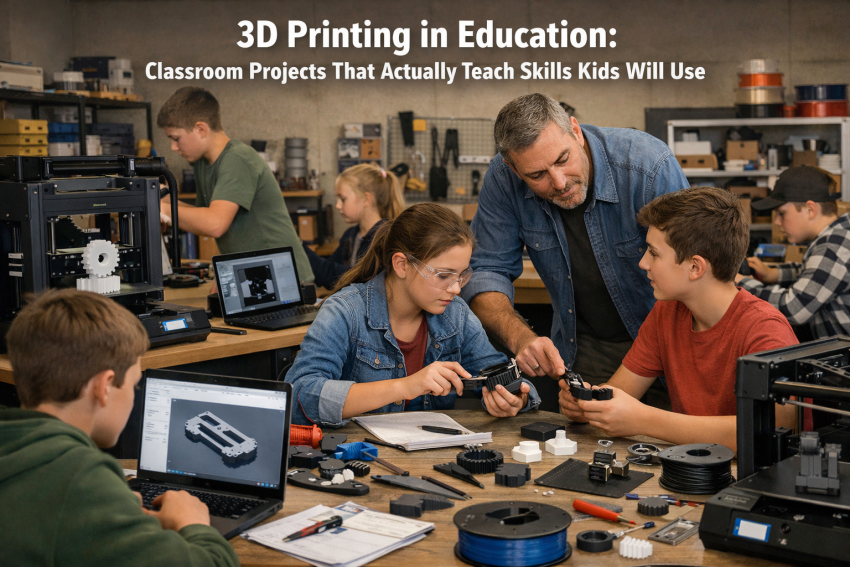
3D printing in education earns its place in the classroom for one reason: it teaches real, transferable skills that kids and teens will actually use beyond school. Not theoretical concepts. Not disposable crafts. Practical abilities rooted in design, problem-solving, and mechanical thinking. When students design, print, test, and revise physical objects, they’re learning the same skill set used in engineering shops, fabrication labs, and product development teams.
This matters because modern education often leans heavy on screens and light on consequences. 3D printing changes that equation. A bad design doesn’t just get a red mark; it fails in your hands. Parts don’t fit. Structures collapse. Tolerances matter. That friction is where usable skills are built, and it’s why additive manufacturing has become a serious educational tool rather than a novelty.
Design Thinking and Structured Problem Solving
One of the most valuable skills 3D printing teaches is structured problem solving. Students start with a need, design a solution, test it, identify failure points, and iterate. This mirrors real-world engineering workflows rather than textbook exercises with predetermined answers.
Classroom projects like designing a phone stand or a small storage container force students to define requirements up front. The object has to support weight, fit dimensions, and survive repeated use. When it doesn’t, students must diagnose the failure and redesign. That cycle builds analytical thinking and teaches kids how to approach complex problems methodically instead of guessing.
Spatial Reasoning and Mechanical Literacy
3D printing dramatically improves spatial reasoning, which is a foundational skill in engineering, trades, and technical professions. Students learn to visualize how digital shapes translate into physical objects, how parts interact, and how orientation affects strength.
Projects involving gears, hinges, or snap-fit components teach mechanical literacy. Students see firsthand how tolerances work and why two parts that look aligned on-screen might bind or fail when printed. This kind of learning sticks because it’s tactile. It’s the difference between reading about torque and feeling a bolt shear because it was undersized.
Precision, Measurement, and Attention to Detail
Precision is not optional in 3D printing. Students quickly learn that sloppy measurements lead to unusable parts. Projects that require components to fit together, such as modular organizers or enclosures, reinforce the importance of accuracy and planning.
This skill translates directly to real-world applications. Whether a student ends up in manufacturing, construction, or IT, understanding how small measurement errors cascade into big problems is invaluable. It’s like grabbing a wrench that’s almost the right size and rounding off the bolt head. You only make that mistake once before precision starts to matter.
Iteration, Failure Analysis, and Resilience
Failure is built into 3D printing, and that’s a feature, not a flaw. Warping, layer separation, weak walls, and poor adhesion all force students to analyze what went wrong and adjust their design or settings.
Middle and high school projects benefit most from this process. When a bridge collapses under load or a hinge snaps, students learn to evaluate material thickness, geometry, and stress points. This builds resilience and teaches that failure is data, not defeat. In the real world, this mindset separates capable problem-solvers from people who freeze when things don’t work the first time.
Digital Design and CAD Proficiency
3D printing introduces students to computer-aided design, a skill directly tied to modern engineering, manufacturing, and product development. Even beginner tools like Tinkercad teach core concepts such as scaling, alignment, and Boolean operations.
As students advance, they begin using professional-grade software and workflows. High school projects that involve assemblies or functional tools expose students to constraints used in real industries. These skills are immediately marketable and form a strong foundation for careers in engineering, industrial design, and skilled trades.
Project Planning and Workflow Management
Successful 3D printing projects require planning. Students must consider print time, material usage, and design revisions. Long prints introduce patience and accountability. A failed eight-hour print is a powerful lesson in preparation and testing.
Classroom environments that treat printers as shared resources also teach workflow management and collaboration. Students learn to schedule prints, optimize designs, and respect constraints. These habits translate well into professional environments where time and resources matter.
Communication and Technical Explanation
3D printing projects often require students to explain their designs, defend decisions, and document changes. This builds technical communication skills. Students learn to describe why they chose a certain geometry or material thickness and how they solved specific problems.
Being able to explain how something works is just as important as making it work. Whether presenting a prototype or collaborating with teammates, this skill is essential in technical fields and often overlooked in traditional education.
Why These Skills Matter Beyond School
The skills taught through classroom 3D printing extend far beyond the printer itself. Design thinking, precision, iteration, and mechanical understanding apply to engineering, trades, IT, and everyday problem solving. These are skills kids will use whether they become engineers, technicians, or hands-on problem solvers in any field.
For men who value competence and practical knowledge, this approach makes sense. It’s how skills have always been passed down: by building, breaking, and fixing real things.
Building Capable Problem Solvers for the Future
3D printing in education isn’t about training kids to run machines. It’s about teaching them how to think, adapt, and create under real constraints. Classroom projects that emphasize function over decoration produce students who understand cause and effect, take responsibility for outcomes, and learn from failure.
If you care about passing on real skills, subscribe to our newsletter for more insights into 3D printing, education, and hands-on learning. Join the conversation by leaving a comment below or contact us directly if you’re involved in building or supporting a program. The printer is just the tool. The skills are the point.
Call to Action
If this post sparked your creativity, don’t just scroll past. Join the community of makers and tinkerers—people turning ideas into reality with 3D printing. Subscribe for more 3D printing guides and projects, drop a comment sharing what you’re printing, or reach out and tell me about your latest project. Let’s build together.

Sources
Disclaimer:
The views and opinions expressed in this post are solely those of the author. The information provided is based on personal research, experience, and understanding of the subject matter at the time of writing. Readers should consult relevant experts or authorities for specific guidance related to their unique situations.
… liked this!