
2,164 words, 11 minutes read time.
I am Miriam of Sychar, though for much of my life, my name carried more whispers than respect. My story is not one I tell lightly, because it exposes the shame I tried to bury under layers of cleverness, charm, and defiance. I was a woman known by the men of our village, the women who whispered behind closed doors, and even by my own heart, for the mistakes I could not hide. My life had been a string of poor choices, a tangled mess of marriages that failed, and a current living arrangement that would have made the most judgmental Pharisee gasp. Yet, this is the story of a day that changed everything—the day I met Jesus at Jacob’s well.
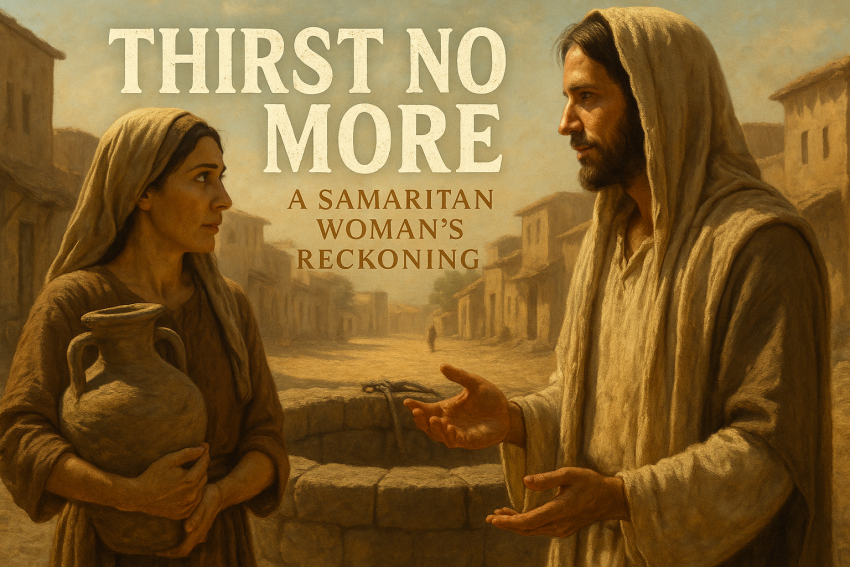
It was the hottest hour of the day, the sun beating down with a harsh intensity that made the air shimmer above the dusty roads. Most women drew water in the cool of the morning, but I preferred this hour. People rarely ventured out at noon. There was a solitude in the empty streets that suited me, a respite from the prying eyes, the judgmental glances, the whispering voices that seemed to follow me like shadows. I had learned long ago that the less people saw me, the less they could judge me. I moved swiftly, my water jar balanced on my hip, my eyes averted from the well, and yet, I could not avoid noticing him.
He was sitting there, alone, at the well. A man. A Jew. And a man who dared to look directly at me. His clothing was simple, his face unassuming, yet there was a quiet authority about him, a calmness that drew attention even without a word spoken. He seemed weary, as though he had traveled far, and yet, he was not consumed by fatigue in the way other men appeared at the well. There was a presence about him, a stillness that demanded notice. I wanted to turn away, to keep to my routine, to pretend he was not there, but something stopped me. Maybe it was curiosity. Maybe it was the rare sense of being truly seen, not as a scandal, not as a sinner, but as a person.
He asked me for a drink.
The question struck me like a thunderclap. Jews did not speak to Samaritans, certainly not women, certainly not women with reputations like mine. And yet, here he was, asking for water as if I were anything other than a Samaritan, as if my past did not matter. I studied him carefully, trying to detect mockery or trickery, some hidden insult, but there was none. Only eyes that held patience and something more—recognition. Perhaps even compassion. I responded cautiously, letting my curiosity show only a fraction. “You are a Jew,” I said. “How is it that you ask a drink from me, a woman of Samaria?”
He smiled, or at least the corner of his mouth lifted slightly. There was no judgment in his voice. “If you knew the gift of God, and who it is that asks you for a drink, you would have asked him, and he would have given you living water.”
I blinked, confused. Living water? What madness was this? All the water I had drawn in my life quenched thirst only for a moment before it returned, and yet he spoke of a water that could end thirst forever. I tried to hide the skepticism, though my eyes betrayed me. “Sir,” I said, “you have nothing to draw with and the well is deep. Where then do you get this living water? Are you greater than our father Jacob, who gave us this well?”
His gaze was steady, unwavering, and I found myself uncomfortably aware that he was reading not just my words, but something deeper. “Everyone who drinks this water will be thirsty again,” he said softly, “but whoever drinks the water I give them will never thirst. Indeed, the water I give will become in them a spring of water welling up to eternal life.”
His words struck me like an arrow. For years, I had been chasing water—approval, affection, love, respect—anything to fill the hollow ache inside me. I had pursued men like a hunter, seeking in their arms the affirmation I could not give myself. I had allowed myself to be used, to betray my own heart in search of acceptance. And yet here was this man, speaking of a water that could fill the void I had been running from my entire life. I wanted it. I needed it. But my pride, that stubborn armor I wore like a shield, whispered that I could not simply ask for it. Not from a Jew, not from a stranger, not from anyone.
“Sir,” I said, my voice trembling slightly, “give me this water, so that I will not get thirsty and have to keep coming here.”
Then he said something that stopped me cold, something that made me feel exposed in a way that I had avoided my whole life. “Go, call your husband and come back.”
I froze. My chest tightened. My mind raced. How could he know? I had five husbands, each one a chapter of failure, and now I lived with a man who was not my husband. My past, all the mistakes I had tried to hide, the shame I had buried beneath sarcasm, charm, and self-sufficiency, was laid bare. I wanted to run, to defend myself, to invent some excuse that would make me seem respectable, but the words caught in my throat. I admitted, “I have no husband.”
“You are right,” he said, “when you say you have no husband. The fact is, you have had five husbands, and the man you now have is not your husband. What you have said is true.”
There was no accusation in his tone. No condemnation. Only understanding. Only recognition. It was more terrifying than any judgment I had ever faced because it was real. He saw me. Not the carefully constructed image I projected to the world, not the lies I told myself to feel worthy, but me. The raw, unvarnished truth. And yet, instead of shaming me, he offered something far more dangerous: hope.
I wanted to turn away. I wanted to hide again. But something compelled me to stay. “Sir,” I said, “I see that you are a prophet. Our ancestors worshiped on this mountain, but you Jews say that the place where we must worship is in Jerusalem.”
He nodded, but his eyes softened. “Believe me, a time is coming when you will worship the Father neither on this mountain nor in Jerusalem. You Samaritans worship what you do not know; we worship what we do know, for salvation is from the Jews. Yet the time is coming—and has now come—when true worshipers will worship the Father in spirit and truth, for they are the kind of worshipers the Father seeks.”
True worship in spirit and truth. Not location, not ritual, not tradition. I realized I had spent my life worshiping things that could not satisfy: men, status, approval, even my own cleverness. And in that moment, I understood that what I thirsted for was not drink, not affection, not admiration—it was truth. It was being fully known. It was grace.
I said what I had never dared say aloud, even to myself: “I know that Messiah—called Christ—will come. When he comes, he will explain everything to us.”
Then he said words that I would never forget, words that would echo in my mind for the rest of my life: “I, the one speaking to you—I am he.”
Time seemed to stop. The sun, the dust, the oppressive heat of the day—they all disappeared. I was standing at the well, but I was also standing at the edge of something infinite. My past, all the failures, all the shame, all the choices I had made that led me here—they mattered, but they no longer defined me. I had been seen. I had been known. And I had been loved.
I left my water jar behind. I could not bear to carry it, not when I had been offered living water, a spring that would never run dry. I ran back to the town, my feet pounding against the stones, my heart racing with a mixture of fear and joy. I had to tell them. I had to shout it from the rooftops. “Come, see a man who told me everything I ever did! Could this be the Messiah?”
They followed, hesitant at first, then with growing urgency. And many of them believed because of what I said. Because of what I had risked in admitting the truth of my life, others were drawn to him, and they too found grace. And yet, some did not believe. Some judged. Some whispered about my past even as they marveled at his words. But that was not my concern anymore. I had been freed.
I want to speak directly to the men hearing this story, those who wrestle with pride, who bury vulnerability under work, power, or control. I know your struggles. I know the way you try to prove your worth with accomplishments, money, or strength, only to find the hollow ache deep in your chest never goes away. I chased approval in men, in status, in what people thought of me. You chase validation in work, reputation, in being the man everyone admires or fears. But all of it leaves you thirsty. The living water—the only water that can truly quench—is not found in what you accomplish or in how you appear. It is found in being fully known and fully accepted by the One who created you.
I had spent decades crafting a life that would protect me from shame. I hid my weakness, my mistakes, my desires. I manipulated situations to make myself appear stronger, more desirable, more in control. And in my striving, I built walls around my heart that left me more isolated than any punishment could. Pride is a cunning master. It whispers that vulnerability is weakness, that admitting need is failure. Yet in my encounter with Jesus, I realized that vulnerability is the doorway to life, to freedom, to water that will never run dry.
When I think back to that day, I remember the sun scorching my shoulders, the dust clinging to my feet, the heat of the day pressing down on the stones of Sychar. I remember the fear that gripped me when he spoke of my past, and I remember the relief, the uncontainable joy, when I realized that knowing the truth did not destroy me. It set me free. It offered me purpose. It invited me into life beyond the judgment of men and even beyond the confines of my own self-loathing.
I do not claim to be a saint. My life is messy, my choices have been reckless, and I am still learning what it means to live fully before God. But the lesson I want to leave with you is this: the water of this world will never satisfy your soul. Your strength, your accomplishments, your reputation—they are not enough. True life, true freedom, comes when you stop hiding, when you let God see the real you, and when you allow yourself to drink of the living water he offers. It will not always be comfortable. It may require you to confront parts of yourself you have long ignored. It may require courage to admit failures and ask for help. But it is worth it, beyond measure.
So I speak to you now, not as a perfect woman, not as someone who has all the answers, but as one who has been found and restored. Be real. Let go of your pride. Confront your weaknesses, your anger, your lust, your fear. Allow yourself to be fully known. The water is here. It is flowing freely, and it waits for those who are thirsty. Drink deeply, and you will never thirst again.

Sources
- John 4:1-42 – Jesus and the Samaritan Woman
- Matthew Henry Commentary on John 4
- Got Questions: Who Was the Samaritan Woman?
- Christianity.com: Lessons from the Samaritan Woman
- Jeremiah 2:13 – Living Water Reference
- Adam Clarke Commentary on John 4
- Desiring God: The Samaritan Woman at the Well
- Psalm 42:1-2 – Thirst for God
- Crossway: John 4 – Woman at the Well
- Blue Letter Bible: John 4 Commentary
- Bible.org: Lesson 10 – Samaritan Woman
- Ligonier: Living Water Devotional
- BibleRef: Living Water Explanation
- BibleHub Commentaries on John 4
- Monergism: The Samaritan Woman
Disclaimer:
The views and opinions expressed in this post are solely those of the author. The information provided is based on personal research, experience, and understanding of the subject matter at the time of writing. Readers should consult relevant experts or authorities for specific guidance related to their unique situations.
I love this!