
3,975 words, 21 minutes read time.
Source: theaipixelprophet
The Third Seal – The Black Horse of Famine and Economic Collapse
Our exploration into the profound and often unsettling prophecies of the Book of Revelation continues, as we methodically unseal the visions granted to John. In our initial post, we set the stage for this apocalyptic journey, emphasizing the divine authority behind these revelations and the ultimate sovereignty of God’s plan for judgment and redemption, a plan revealed through the worthiness of the Lamb, Jesus Christ, to open the sealed scroll. We established the high stakes of this cosmic drama and the weight of understanding these prophetic unveilings for believers today.
Our first deep dive into the seals brought us face-to-face with the enigmatic First Seal and the rider on the white horse. We grappled with the dual interpretations of this initial figure, contemplating whether he represented the initial advance of the Gospel or the subtle, deceptive rise of antichrist forces cloaked in an aura of purity and victory. The ambiguity of the white horse served as a crucial reminder of the need for discernment as we navigate the complexities of the end times.
Then, the narrative took a dramatic and violent turn with the breaking of the Second Seal and the emergence of the fiery red horse. Here, the symbolism was stark and unambiguous: widespread war, bloodshed, and the brutal taking of peace from the earth. We explored the historical echoes of this seal, from the persecution of early Christians under Roman rule to the recurring cycles of conflict that have plagued humanity throughout history. The Second Seal served as a sobering reminder of the destructive consequences of sin and the fragility of human peace apart from God, while also affirming His ultimate sovereignty even amidst such turmoil.
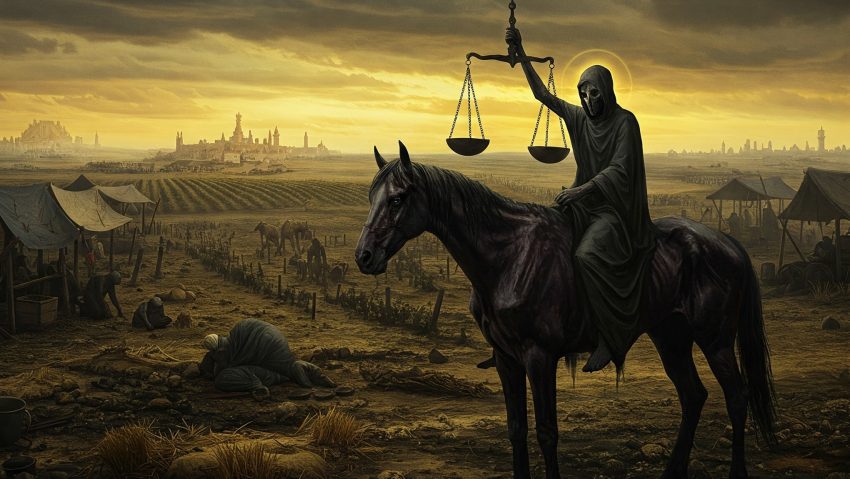
Now, as the Lamb breaks the third seal, the landscape of judgment shifts once again. We move from the overt violence of warfare to a more insidious and equally devastating threat: the arrival of the Black Horse of Famine and Economic Collapse. This seal speaks not of armies clashing, but of empty stomachs, barren fields, and a crushing scarcity that grips the very foundations of human survival. The rider on this dark steed carries scales, a symbol of measurement and economic imbalance, hinting at a future where basic necessities become tragically out of reach for the masses while luxuries remain untouched for the privileged few. In this blog post, we will delve into the chilling details of this vision, exploring its symbolic interpretations, its historical parallels, and its stark warnings for our modern world. Join us as we confront the grim realities unveiled by the Third Seal and the ominous Black Horse of famine and economic despair.
Biblical Description of the Third Seal
Let’s turn our gaze intently upon Revelation 6:5-6: “When He opened the third seal, I heard the third living creature saying, ‘Come and see.’ So I looked, and behold, a black horse, and he who sat on it had a pair of scales in his hand. And I heard a voice in the midst of the four living creatures saying, ‘A quart of wheat for a denarius, and three quarts of barley for a denarius; and do not harm the oil and the wine.’” This brief but potent passage unveils a terrifying escalation in God’s prophetic judgments, moving from the overt violence of war to the insidious grip of widespread scarcity. Let’s meticulously dissect this grim vision, drawing upon the insights of theological giants and historical context to illuminate its profound significance.
First, our eyes are drawn to the Black Horse. Following the stark white and the fiery red, the arrival of black introduces a palpable sense of dread and despair. As the influential Puritan commentator Matthew Henry observed, “Black is the colour of mourning and famine; it denotes a time of great scarcity and want.” This isn’t merely a neutral hue; it’s a symbolic shroud enveloping the land, signifying the pallor of starvation and the darkness of economic hardship descending upon humanity. This horse embodies the crushing weight of scarcity, where the very sustenance needed for life becomes desperately rare, casting a long shadow of potential death across the populace.
Next, we see the Rider, and his defining attribute: a pair of scales in his hand. This seemingly simple object carries profound implications. Scales, or balances, are traditionally associated with measurement, justice, and in the realm of commerce, with the precise weighing of goods. However, in this apocalyptic context, their presence takes on a more sinister meaning. As the insightful theologian Dr. Charles Ryrie noted, “The scales speak of scarcity and the careful weighing out of food, indicating famine.” The meticulous act of weighing suggests a time when food is so scarce that it must be carefully rationed, every ounce accounted for to prolong survival. It can also symbolize a severe economic imbalance, where the scales of commerce are tipped against the common person, making even basic necessities prohibitively expensive. The rider, therefore, embodies the harsh realities of a time when the fundamental balance of life – the ability to afford sustenance – is tragically disrupted.
Finally, we hear a voice in the midst of the four living creatures announcing specific and shocking prices: “A quart of wheat for a denarius, and three quarts of barley for a denarius; and do not harm the oil and the wine.” To understand the gravity of this pronouncement, we need to recall the description of the four living creatures from Revelation 4:6-8. These majestic, angelic beings surround God’s throne, each with a distinct appearance – like a lion, an ox, with the face of a man, and like a flying eagle – and they ceaselessly proclaim God’s holiness. The fact that the voice emanates from their midst underscores the divine origin and authority of this judgment. It is not a random catastrophe but a decree from God’s throne room itself, mediated through these powerful heavenly beings who are intimately connected to His holiness and power. As some commentators suggest, the four living creatures may represent aspects of God’s character or His created order. Their involvement here emphasizes that this judgment, while severe, is ultimately just and aligned with God’s sovereign purposes.
The voice itself announces staggering prices. A denarius, as the respected historian Josephus and numerous biblical scholars confirm, was the standard daily wage for a common laborer in that era. The fact that a single choenix (approximately a quart) of wheat – the basic staple grain – would consume an entire day’s earnings underscores the hyperinflation and extreme scarcity of essential food. As the meticulous commentator Dr. Robert H. Mounce explains, “This represents a price perhaps ten times the normal cost, indicating a famine of catastrophic proportions.” While barley, a cheaper grain consumed by the poor, is offered at a slightly better rate (three quarts for a denarius), it still signifies that a significant portion of a day’s labor would yield only a meager amount of sustenance.
The seemingly perplexing instruction, “and do not harm the oil and the wine,” is particularly revealing. Numerous commentators, including the early church father Irenaeus, have interpreted this as highlighting a stark economic disparity. While basic grains become unaffordable for the masses, luxury goods like oil and wine, typically consumed by the wealthy, remain relatively untouched by the scarcity. This paints a grim picture of a society where the privileged continue to enjoy their comforts while the poor struggle for their very survival, exacerbating social inequalities and deepening the crisis of famine. This selective impact of the judgment underscores the potential for systemic injustice to persist even in times of widespread hardship.
Symbolic Interpretations
The symbolism woven into the Third Seal extends far beyond a simple depiction of food shortage; it paints a multifaceted picture of societal breakdown and spiritual vulnerability. The black horse serves as a potent symbol of famine and scarcity, a devastating consequence often trailing in the wake of the widespread warfare unleashed by the Second Seal. As the Old Testament prophet Joel vividly described the aftermath of locust plagues and drought, “The fields are ruined, the ground is dried up; the grain is destroyed, the new wine is dried up, the oil fails” (Joel 1:10). Similarly, the black horse signifies a fundamental disruption of the life-sustaining resources, where the very ability to feed oneself and one’s family becomes a desperate struggle. Wars decimate agricultural lands, cripple vital infrastructure like irrigation systems and transportation networks, and force mass displacement of populations, all contributing to severe and prolonged food shortages. The black horse, therefore, embodies the grim reality of widespread hunger, a dark shadow cast by the preceding chaos and destruction, impacting not just physical well-being but the very fabric of society.
The image of the rider holding scales further amplifies the economic dimension of this judgment. The exorbitant grain prices – a single quart of wheat demanding a full day’s wage – paint a stark and terrifying picture of economic collapse. The fundamental value of human labor is drastically diminished when an entire day’s toil barely secures enough sustenance for a single person. This scenario speaks to a complete breakdown of the normal economic order, where the ability to provide for one’s family, a basic human responsibility, becomes virtually impossible for the common person. As the insightful preacher Charles Spurgeon once commented on the broader theme of divine judgment, “When God sends famine, he empties the markets and fills the grave.” The scales here represent not just rationing, but a profound economic imbalance where the cost of survival dwarfs the value of human effort, leading to widespread poverty and desperation.
Furthermore, the seemingly paradoxical instruction, “and do not harm the oil and the wine,” unveils a chilling reality of economic inequality. This directive suggests a stark and deeply unjust division within society. While basic grains, the staples of the poor, become astronomically expensive and scarce, luxury goods enjoyed by the wealthy remain relatively untouched. This paints a grim picture of a potential future where the affluent continue to indulge in their comforts while the masses face starvation and destitution. As the prophet Amos thundered against the social injustices of his time, “You trample on the poor and deprive them of grain… You levy a tax of grain on the poor” (Amos 5:11). The Third Seal echoes this ancient warning, highlighting a scenario where economic systems are so skewed that the basic needs of the vulnerable are disregarded while the excesses of the privileged remain secure, exacerbating social tensions and deepening the humanitarian crisis.
Beyond the immediate physical and economic implications, some theological interpretations connect the black horse to spiritual darkness and moral decline that can accompany times of extreme hardship. When individuals are consumed by the desperate struggle for survival, moral compromises can become tragically commonplace. Spiritual values and ethical considerations may be sidelined in the face of overwhelming physical need, leading to a societal erosion of integrity and compassion. The darkness associated with the black horse can symbolize this spiritual apostasy, a time when the light of faith and morality dims under the weight of suffering and desperation. As the apostle Paul warned about the perilous times to come, “People will be lovers of themselves, lovers of money, boastful, proud, abusive, disobedient to their parents, ungrateful, unholy, without love, unforgiving, slanderous, without self-control, brutal, not lovers of the good, treacherous, rash, conceited, lovers of pleasure rather than lovers of God—having a form of godliness but denying its power” (2 Timothy 3:2-5). While not directly tied to famine, this passage speaks to the moral decay that can characterize periods of intense societal stress, a darkness that the black horse may also represent.
In essence, the symbolism of the Third Seal is a multi-layered warning. It speaks of the devastating physical consequences of famine, the crushing weight of economic collapse that strips away basic dignity, the stark injustice of economic inequality that leaves the vulnerable to suffer disproportionately, and the potential for spiritual darkness to descend when survival becomes the ultimate preoccupation. It’s a sobering reminder of the interconnectedness of societal systems and the profound impact of widespread scarcity on the human condition, both materially and spiritually.
Historical Context
To truly grasp the profound implications of the Third Seal’s vision, we must immerse ourselves in the historical realities that would have shaped John’s understanding and resonated with his original audience. The first-century context, particularly life within the vast Roman Empire, provides a crucial lens through which to view the plausibility and immediate impact of the prophecy of famine and economic collapse.
As numerous historical accounts and archaeological evidence attest, famine was not a distant threat in the ancient world; it was a stark and often devastating reality that communities lived under the constant shadow of. Agricultural practices, while developing, remained fundamentally reliant on the vagaries of weather patterns, particularly the timely and sufficient arrival of rainfall crucial for the staple crops of the Mediterranean region: wheat and barley. The sophisticated irrigation systems that would later emerge were not yet widespread, leaving harvests acutely vulnerable to prolonged droughts. The writings of Roman agriculturalists like Columella detail the challenges of ancient farming, including soil exhaustion, pest infestations, and the unpredictable nature of the climate. The ever-present threat of blights, rusts, and the swarming devastation of locust plagues, vividly described in both biblical and secular texts (as seen in Pliny the Elder’s accounts of locust infestations), could decimate entire harvests in a matter of days, plunging regions into immediate and widespread starvation. The precariousness of the food supply meant that even relatively localized crop failures could have significant ripple effects, leading to shortages and price inflation in nearby areas.
Moreover, the intricate and often exploitative Roman taxation policies significantly exacerbated these natural vulnerabilities, particularly for the rural populations in conquered provinces like Judea. The Roman administration, focused on extracting resources to support the imperial center and its vast military apparatus, often levied heavy taxes in the form of agricultural produce. This system, as documented in the writings of historians like Appian and through surviving tax records, could strip already struggling farmers of a significant portion of their harvest, leaving them with barely enough to sustain their own families through the lean months. The heavy hand of Roman governors, often more concerned with personal enrichment than the well-being of their subjects (as illustrated by the corruption described by Cicero in his Verrine Orations), could further compound these hardships through arbitrary levies and confiscations. The flow of grain from the provinces to Rome, while ensuring the stability of the imperial capital, often came at the expense of the local populations, creating a system where the prosperity of the few was built upon the potential starvation of the many. The stark contrast depicted in the Third Seal – the scarcity of basic grains juxtaposed with the untouched abundance of oil and wine – eerily mirrors the social and economic stratification within the Roman Empire, where a wealthy elite enjoyed luxurious commodities while the masses often teetered on the brink of subsistence.
Looking beyond the immediate context of the first century, the tragic patterns of famine and economic disparity depicted in the Third Seal have echoed with chilling regularity throughout human history, serving as a grim testament to the enduring vulnerabilities of human societies. The Middle Ages in Europe, for instance, were punctuated by devastating famines, often triggered by a combination of poor harvests due to climatic shifts (like the “Little Ice Age”) and the disruption of agricultural production caused by incessant warfare and the feudal system, which concentrated land ownership and resources in the hands of a privileged few, as detailed in historical analyses by scholars like Barbara Tuchman. The recurring famines in China throughout its long history, often exacerbated by inefficient governance, corruption, and the exploitation of the peasantry by powerful landlords (as chronicled in the dynastic histories), paint a similar picture of widespread suffering amidst pockets of affluence.
The 19th century witnessed horrific famines, perhaps most notably the Irish Potato Famine (1845-1849). This catastrophe, triggered by a blight that decimated the potato crop – the staple food for the majority of the Irish population – resulted in mass starvation, death, and emigration. However, as historians like Cecil Woodham-Smith have meticulously documented, the severity of the famine was significantly compounded by the prevailing economic and political systems, including absentee landlordism and the prioritization of grain exports even as the population starved, starkly illustrating the “oil and wine” remaining untouched while basic sustenance vanished.
The 20th century, despite unprecedented advancements in agricultural technology, was not immune to the specter of famine, often tragically intertwined with political upheaval and conflict. The engineered famines in the Soviet Union under Stalin, particularly the Holodomor in Ukraine (1932-1933), where grain was deliberately confiscated, leading to the deaths of millions, stand as a horrific example of how political ideology can weaponize scarcity. The famines in Ethiopia in the 1980s, often exacerbated by civil war and political instability, brought the devastating consequences of food shortage to global attention. Furthermore, the phenomenon of hyperinflation, experienced in various countries throughout the 20th and 21st centuries – from post-World War I Germany to more recent economic crises in nations like Zimbabwe and Venezuela – provides a chilling parallel to the denarius buying only a meager quart of wheat. In these scenarios, the fundamental value of currency collapses, rendering basic necessities astronomically expensive and pushing large segments of the population into poverty and desperation while those with access to stable assets or foreign currency often weather the storm relatively unscathed.
The persistent issue of global food insecurity and wealth inequality in our contemporary world serves as a sobering and ongoing echo of the Third Seal’s warning. While global food production has reached unprecedented levels, access to sufficient and nutritious food remains a critical challenge for hundreds of millions of people, often due to the complex interplay of poverty, conflict, environmental degradation, and unjust economic systems. The staggering disparities in wealth distribution, where a tiny fraction of the global population controls a disproportionate share of the world’s resources, starkly mirrors the imbalance suggested by the untouched oil and wine amidst widespread grain scarcity. The ongoing struggle to achieve food security for all, despite our technological capabilities, underscores the enduring relevance of the Third Seal’s somber prophecy, reminding us that the specter of famine and the injustice of economic disparity continue to cast a long shadow over humanity.
Theological Implications
The opening of the Third Seal by the Lamb, Jesus Christ, carries profound theological weight, forcing us to confront uncomfortable truths about God’s role in a world marred by suffering. This discomfort arises because it challenges simplistic or overly sentimental views of a God often perceived solely as a benevolent protector who shields humanity from all forms of adversity. However, the entirety of Scripture, and particularly the apocalyptic visions of Revelation, reveals a God who is not only loving and merciful but also just, holy, and ultimately sovereign over all creation and the unfolding of history. The fact that the Lamb, the very embodiment of God’s love and the ultimate sacrifice for sin, is the one who initiates this judgment of famine and economic collapse underscores that these events are not random acts of a detached or powerless deity. Instead, they are intricately woven into the tapestry of God’s overarching plan, a divine response to a world that has consistently rejected His righteous rule and embraced the destructive path of sin.
Lessons for Today
The stark and unsettling imagery of the Third Seal, depicting famine and economic collapse, transcends the boundaries of ancient prophecy and carries a profound and urgent resonance when we soberly reflect on the realities of global food insecurity and economic inequality in our supposedly advanced modern world. While it is true that global food production has witnessed remarkable increases due to technological advancements and agricultural innovations, the critical issue of equitable access to food remains a devastating challenge for millions upon millions across the globe. Poverty, often exacerbated by systemic injustices, ongoing conflicts that disrupt agricultural production and supply chains, and the inherent vulnerabilities of globalized economic systems, continue to leave vast swathes of humanity teetering on the brink of hunger and malnutrition. The stark reality is that in our interconnected world, abundance for some often exists alongside dire scarcity for others, a tragic echo of the black horse’s arrival. Furthermore, the vast and ever-widening disparities in wealth distribution, where an alarmingly small percentage of the world’s population controls a disproportionate and ever-increasing share of global resources and wealth, eerily mirrors the chilling image of the untouched oil and wine amidst the widespread grain scarcity of John’s prophetic vision. This stark imbalance underscores the inherent fragility and potential for catastrophic failure within human economic systems when unchecked greed and injustice prevail. As the contemporary theologian Dr. Cornel West powerfully articulates, “Never forget that justice is what love looks like in public.” The Third Seal compels us to confront the uncomfortable truth that our current global landscape bears unsettling similarities to the grim scenario it portrays.
Conclusion
The Third Seal, with its chilling vision of a black horse, a rider wielding scales, and the stark prophecy of widespread famine and economic collapse, casts a long shadow over our understanding of the end times. We’ve journeyed from the initial ambiguity of the White Horse, potentially representing both gospel advance and deceptive power, to the brutal reality of the Red Horse unleashing global conflict and bloodshed. Now, the Third Seal unveils a more insidious form of devastation, one that strikes at the very heart of human survival, highlighting the fragility of our economic systems and the devastating consequences of scarcity and inequality. We’ve explored the biblical imagery, delved into the historical realities that echo this prophecy, and wrestled with the profound theological implications, recognizing God’s ultimate sovereignty even in times of such hardship and the stark consequences of a world marred by sin.
As we reflect on the black horse and its rider, we are compelled to confront the unsettling parallels in our modern world, grappling with the persistent issues of global food insecurity and the ever-widening chasm of economic disparity. This seal serves as both a warning and a call – a warning about the potential for societal breakdown when basic needs become unattainable for many, and a call for believers to cultivate an unwavering trust in God’s provision while actively engaging in efforts to alleviate suffering and advocate for justice in a world desperately in need of both. Let us not be passive observers, but active participants in reflecting the love of Christ in tangible ways, anticipating the ultimate restoration in God’s perfect kingdom.
Next week, our journey through the unveiling of the Seven Seals continues as we confront the arrival of the final horseman – the rider on the pale horse of Death and Destruction, unleashed by the Fourth Seal. Prepare to grapple with the ultimate consequence of a world in rebellion against its Creator, as we explore the culmination of these initial judgments and the stark realities that precede the final consummation. Join us as we continue to unravel the mysteries of Revelation and seek to understand God’s unfolding plan for the ages.
What are your thoughts on the sobering realities of the Third Seal and its implications for our world today? Share your insights in the comments below. And if this exploration has deepened your understanding, please like, subscribe, and share this series with others seeking to navigate the complexities of biblical prophecy. Your engagement helps us build a community striving for truth and understanding in these pivotal times.

Sources
Disclaimer:
The views and opinions expressed in this post are solely those of the author. The information provided is based on personal research, experience, and understanding of the subject matter at the time of writing. Readers should consult relevant experts or authorities for specific guidance related to their unique situations.
… liked this!