
1,206 words, 6 minutes read time.

I’ve spent enough time around security teams, incident reports, and postmortems to recognize a pattern: the attacks that do the most damage rarely look impressive at the start. They don’t arrive wrapped in zero-days or accompanied by cinematic breach timelines. They arrive quietly, dressed as something mundane, and they work because they never trigger the instincts we’ve trained ourselves to trust.
That’s why this email about an unexpected package with a QR code matters far more than it appears to at first glance. Not because it’s clever. Not because it’s new. But because it exploits a seam in our defensive thinking that we still pretend doesn’t exist.
The seam between the physical world and the digital one.
The Illusion of “Low-Tech” Threats
There’s a quiet bias in cybersecurity that we rarely admit out loud. We respect attacks that look technical. We prepare for malware that uses obfuscation, command-and-control channels that rotate domains, and intrusions that chain vulnerabilities together like chess moves. When something shows up that looks simple, we subconsciously downgrade it.
A cheap package on a doorstep doesn’t look like an attack. A QR code doesn’t feel like an exploit. It feels like a customer service problem, or a logistics mistake, or just noise.
That assumption is exactly what makes this attack effective.
This so-called brushing scam isn’t operating below our defenses. It’s operating outside the map entirely.
From Brushing to Breach: How the Threat Evolved
Brushing scams have existed for years. Their original purpose was reputation manipulation. Attackers would ship inexpensive items to real addresses so they could generate “verified purchases” and post fraudulent reviews. It was annoying, occasionally illegal, but rarely treated as a security concern.
What changed wasn’t the delivery mechanism. What changed was the objective.
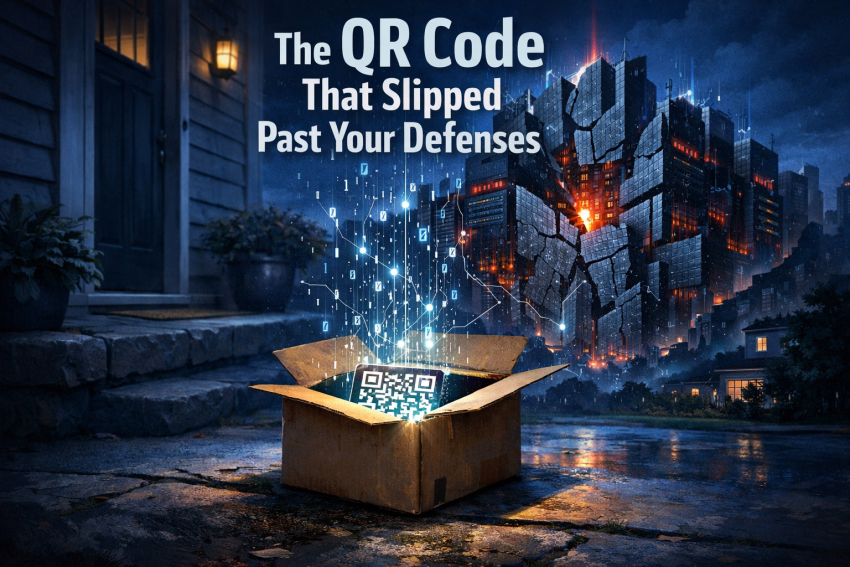
In the modern version of this scam, the package is no longer the end goal. It’s the trust anchor. The QR code inside becomes the real payload, not because it contains malware, but because it carries intent. Scan the code and you’re guided to a page that looks legitimate enough to lower your guard. Enter your information and you’ve just handed an attacker a foothold that no firewall ever had a chance to stop.
This is social engineering that doesn’t knock on your email gateway. It walks through the front door of your life.
Why Smart, Careful People Fall for This
One of the most dangerous myths in security is the idea that awareness equals immunity. It doesn’t. Experience doesn’t remove human psychology. It just changes which levers attackers pull.
This attack works because it exploits contextual trust. Physical objects carry legitimacy. We are conditioned from childhood to believe that if something arrives in our mailbox or on our porch, someone vetted it. That trust transfers unconsciously when a QR code asks us to “learn more.”
It also works because it creates ambiguity instead of urgency. Traditional phishing relies on panic. This relies on curiosity. Curiosity is harder to suppress because it doesn’t feel reckless. It feels reasonable.
Most importantly, it works because it happens out of band. The scan occurs on a personal device. The interaction takes place outside corporate controls. The failure point never generates a log entry where defenders expect to find one.
By the time anything suspicious shows up in authentication logs or account behavior, the real mistake is already days old.
Mapping the Attack to Real Frameworks
If you step back and analyze this through the lens of established frameworks like MITRE ATT&CK, the structure becomes obvious. User execution is still the entry point. Credential harvesting is still the objective. Persistence and lateral movement may still follow. The only thing that changed is where the first move happens.
It’s still an initial access technique. It’s still a compromise of confidentiality. It still threatens integrity and availability downstream. The CIA Triad doesn’t care whether the breach started with malware or curiosity.
What should concern defenders is not that this attack exists, but that it fits cleanly into our models while bypassing most of our controls.
The Visibility Gap We Don’t Like to Admit
Security programs are built around observable systems. Networks. Endpoints. Cloud platforms. Identity providers. When an action doesn’t touch those systems immediately, it lives in a blind spot.
QR code scams exploit that blind spot deliberately.
The mobile device used to scan the code may not be managed. Even if it is, browser-level telemetry is limited. The fake infrastructure hosting the phishing page often lives briefly, just long enough to harvest data before disappearing. There’s no noisy exploit to detect, no beacon to chase, no malware to reverse.
This is not a failure of tooling. It’s a failure of assumptions.
What This Means for Defenders in the Real World
The uncomfortable truth is that no amount of endpoint protection will stop a user from voluntarily giving up credentials on a convincing page. This problem cannot be solved purely with technology. It has to be addressed as a design flaw in how we think about risk.
Defense in depth still applies, but depth has to include the human layer in a meaningful way. Zero Trust still applies, but trust boundaries must extend beyond network perimeters and into everyday behavior. Incident response still matters, but prevention has to acknowledge that the first incident may happen off-network and off-device.
This is not an argument for fear-based training or blaming users. It’s an argument for realism.
What Security Leaders Need to Understand
For those making strategic decisions, this type of attack is a reminder that risk doesn’t always scale with sophistication. A low-cost package and a QR code can bypass millions of dollars in security investment if the program assumes threats only arrive through sanctioned channels.
Security awareness cannot remain static. It must evolve alongside attacker tradecraft. Policies that focus exclusively on email hygiene or password complexity are incomplete if they ignore physical-to-digital attack paths.
The question leaders should be asking isn’t whether this scam is common. It’s whether their organization is prepared to recognize and respond when the first indicator appears somewhere unexpected.
The Hard Truth About Modern Defense
The battlefield has shifted. It’s no longer confined to the network. It’s no longer bounded by corporate assets. It follows people home, onto their phones, and into their curiosity.
That doesn’t mean defenders are losing. It means the job is changing.
The QR code on the package isn’t dangerous because it’s clever. It’s dangerous because it reminds us that attackers don’t need to break our systems if they can simply step around them.
And the hardest threats to stop are the ones we don’t like to take seriously.
Call to Action
If this breakdown helped you think a little clearer about the threats out there, don’t just click away. Subscribe for more no-nonsense security insights, drop a comment with your thoughts or questions, or reach out if there’s a topic you want me to tackle next. Stay sharp out there.

Sources
MITRE ATT&CK Framework
NIST Cybersecurity Framework
CISA – Phishing Guidance
Verizon Data Breach Investigations Report
CrowdStrike Global Threat Report
Mandiant Threat Intelligence Reports
Krebs on Security
Schneier on Security
Black Hat Conference Whitepapers
DEF CON Conference Archives
Disclaimer:
The views and opinions expressed in this post are solely those of the author. The information provided is based on personal research, experience, and understanding of the subject matter at the time of writing. Readers should consult relevant experts or authorities for specific guidance related to their unique situations.