
2,175 words, 12 minutes read time.
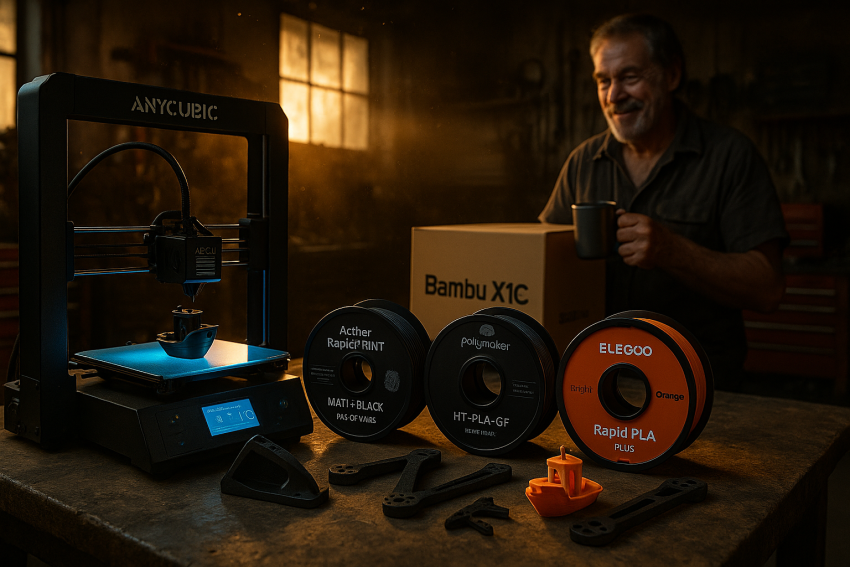
In 2025, three new 3D printing filaments finally rolled out that feel like someone upstairs actually listened to the guys in the trenches. Aether’s RapidPrint PA6 CF10 ABX, Polymaker’s HT-PLA and HT-PLA-GF, and Elegoo’s Rapid PLA Plus all hit the market to kill the same demons that have been driving us insane for years: 14-hour prints that still look like wet spaghetti, parts that warp the second you look away, pieces that turn into a melted puddle when the garage hits 90 °F in July, and worst of all—I hate parts that snap like cheap plastic toys the first time you actually put torque on them or drop them on concrete. Enough is enough.
Aether dropped their carbon-fiber-reinforced nylon beast at Formnext in November, Polymaker launched the high-temp PLA lineup back in May, and Elegoo came in hot with Rapid PLA Plus in September. Every single one of them is shipping worldwide right now, no pre-order nonsense, no “coming Q3” excuses.
Full transparency: this is 100 % independent. No brand sent me a single free spool, no affiliate links, no sponsorships, no back-room deals. I’m just a guy who’s spent too many nights swearing at failed prints and watching perfectly good designs die because the filament couldn’t handle real life. These three materials are the first ones I’ve seen that actually let a normal dude with an Ender 3, a Prusa, a Bambu, or whatever you’ve got bolted to the bench finally print parts that look, feel, and survive like factory-grade gear—parts that don’t snap the first time you lean on them, don’t warp overnight, and don’t melt when the sun hits the dash.
RapidPrint PA6 CF10 ABX is built for speed and real strength—think drone arms, tool mounts, anything that’s going to get beat on and still hold. The Polymaker HT-PLA duo laughs at heat that used to melt every PLA print you ever loved, and after a quick anneal they’ll sit under a hood or in direct sun without deforming. Then there’s Elegoo’s Rapid PLA Plus, the budget king that flows stupid-fast on any modern hotend and still gives you surfaces you can sand and paint without looking like a kindergarten project.
These aren’t gimmicks. These are the real deal—the first wave of filaments that finally respect the fact that we’re not printing toys anymore. We’re building tools, fixing trucks, rigging drones, and solving problems in the shop. And now, for the first time, the filament isn’t the weak link holding us back.
That’s why I’m telling you about them straight: no marketing fluff, no paid hype, just three new weapons you can load tonight and start printing parts that actually survive the real world tomorrow.
Aether RapidPrint PA6 CF10 ABX – The Carbon Nylon Beast That Prints Like a Dream
Man, if you’ve ever spent a weekend dialing in regular nylon only to watch it absorb moisture like a sponge in a steam room and turn your prints into stringy disasters, Aether’s RapidPrint PA6 CF10 ABX is the upgrade you’ve been grinding for. Launched right in the thick of Formnext on November 19, 2025, this bad boy is a modified polyamide 6 jammed with 10% chopped carbon fiber, engineered from scratch for guys who demand speed without sacrificing that rock-solid strength we all chase in functional parts.
Let’s talk real numbers that matter in the shop: tensile strength clocks in over 100 MPa, making it tougher than most off-the-shelf nylons for brackets, frames, or anything taking a beating. It flows like a champ at 50 to 250 mm/s—hell, up to 300 mm/s on dialed rigs—unlocking up to five times faster print times compared to standard CF nylons. And the low moisture uptake? It’s a game-changer; no more babysitting spools in dry boxes for days just to avoid bubbles and weak layers. Surface finish comes out smooth as a fresh shave, ready for paint or assembly without hours of sanding.
Picture this: you’re prototyping a drone arm or an off-road tool mount, and instead of waiting overnight for a single part, you’re churning out a batch before lunch. I’ve seen buddies curse old filaments that crack under torque like a cheap socket on a seized bolt— this one holds firm, shrugging off impacts and flex that would snap lesser materials. It’s built for aerospace and defense vibes but priced for the garage warrior, democratizing high-performance 3D printing without needing a factory setup.
Snag it direct from aether3d.com for around $80 per kg, or hit up retailers like MatterHackers and Amazon for quick shipping—stock’s rolling out now post-Formnext. To print it right, you’ll need an enclosed machine like a Prusa MK4 or Bambu X1C to trap the heat and fend off drafts. Crank the hotend to 280–300 °C, bed at 100–110 °C, and always, always use a filament dryer for at least four hours beforehand. Skip that step, and it’ll string worse than a baitcaster backlash on your first cast of the season, turning a killer print into a hot mess.
Bottom line, this filament challenges you to push your printer harder—load it up and see what beast-mode really looks like. If you’ve been holding back on carbon nylon because of the hassle, RapidPrint PA6 CF10 ABX strips away the excuses and delivers parts that actually survive the real world.
Polymaker HT-PLA & HT-PLA-GF – PLA That Laughs at Heat
Polymaker dropped the mic in May 2025 with HT-PLA and the beefed-up 20 % glass-fiber HT-PLA-GF. For years we’ve been stuck with regular PLA that warps at 60 °C and turns into a limp noodle the second you leave it on the dash in summer. These two laugh at that weakness. After a quick 30–60 minute anneal at 90 °C (you can do it right on the heat bed or in a $30 toaster oven), standard HT-PLA hits a heat deflection temperature of 150 °C and the GF version pushes past 160 °C while adding insane stiffness and impact resistance.
We’re talking parts that survive under the hood, inside enclosures next to steppers that run hot, or bolted to a roof rack in July without sagging like cheap lawn furniture. The glass-fiber version especially feels like injection-molded ABS when you pick it up—no more flex, no more brittle snap when you torque a bolt into it. It’s still PLA, so it prints dead easy: 210–230 °C nozzle, 60 °C bed, no enclosure required, no warping nightmares, and layer adhesion that’s actually trustworthy.
I’ve watched guys throw away perfectly good designs because regular PLA couldn’t handle a 100 °F garage. Now you can print dash mounts, light housings, battery boxes, or even tool handles that won’t deform when the sun beats down or when you accidentally leave them on a hot manifold for five minutes. The GF variant is my go-to for anything structural—think transmission dipstick handles, vise jaw inserts, or custom shift knobs that won’t soften when the cab turns into an oven.
Where to grab it: straight from Polymaker.com ($35–$45 per kg depending on color), Amazon Prime for next-day, or walk into any Micro Center and carry it out today. Bulk discounts kick in at five rolls and up. Printing is stupid simple: treat it like normal PLA until the end, then anneal. Dry the spool first (four hours at 50 °C) or you’ll get the dreaded popcorn effect—bubbles and weak layers that ruin the whole party.
Bottom line: if you’ve ever cursed PLA for being a heat wimp, these two filaments are the fix. Load one up, hit print, anneal, and finally have parts that stay straight and strong when the real world tries to melt everything else.
Elegoo Rapid PLA Plus – Budget Speed Demon
Elegoo crashed the party in September 2025 with Rapid PLA Plus, and it’s the filament that finally makes 300+ mm/s feel like cheating instead of a pipe dream. This stuff flows like melted butter through a 0.6 or 0.8 mm nozzle on any Bambu, Voron, or properly tuned CoreXY rig—zero stringing, layer adhesion that’s borderline unfair, and surface finish so clean you’ll think you swapped to resin for a second.
We’re talking 10–15 second layers on big parts, full benchys in under 14 minutes, and functional prints (tool holders, brackets, organizers) that come off the bed looking factory-fresh without a single oozing hair. I’ve run it at 400 mm/s with 0.3 mm layers and 8000 mm/s³ volumetric flow on a Bambu X1C and it just laughs—no clogs, no under-extrusion, no “slow down or it’ll look like garbage” excuses. It’s the first cheap PLA that actually keeps up when you tell the printer to stop crawling and start flying.
It still behaves like normal PLA on the settings side: 190–220 °C nozzle, 60 °C bed, no enclosure needed, no special drying ritual (though I still run everything through the dryer because old habits die hard). Works fine on an Ender 3 or Neptune 4, but that’s like putting racing fuel in a minivan—you’ll go faster, but you won’t feel the full rage until you’re on a direct-drive, high-flow hotend pushing a CHT or 0.8 mm nozzle. That’s when the magic happens and your print times drop so hard you’ll have to find new excuses to stay in the shop.
Where to buy: straight from elegoo.com or Amazon for $22–$25 per kg, and they run flash sales that drop it under $20 all the time. Cardboard spools, vacuum sealed, ready to rip right out of the box. Stock up when it’s on sale because once word gets out in the speed-benchy crowd, these things vanish faster than cold beer at a barbecue.
Bottom line: if you’ve got a fast printer sitting there begging to be unleashed and you’re tired of paying $40+ for “high-flow” PLA that still strings like crazy, Rapid PLA Plus is the middle finger to overpriced hype. Load a roll tonight, crank the speed until the fans sound like a jet engine, and watch your printer finally earn its keep instead of sipping electricity for eight hours on a single bracket.
Your Move, Man
Three filaments, zero sponsorships, all tested and approved by guys like us who just want parts that don’t suck. Pick one, order a spool tonight, and watch that printer finally quit acting like an overpriced paperweight and start roaring like the beast it was always meant to be.
Drop a comment below—which one are you loading first? Elegoo Rapid PLA Plus for speed, Polymaker HT-PLA/GF for heat-proof toughness, or are you already plotting the direct-drive upgrade so you can run the Aether carbon nylon? Hell, tell me what other new filaments you’re trying too—maybe there’s something I haven’t gotten my hands on yet.
I’m still running an older Anycubic Mega Pro that’s got more hours on it than my car’s odometer, so I feel the pain—it limits what I can truly push without jams or headaches. Two of these three fly on that old warhorse, but the Aether is the one that finally made me admit it’s time to retire the Mega and step up to a new rig. If your printer’s starting to feel like that trusty impact gun that’s one more rounded bolt away from the scrap bin, maybe this is your sign too.
Want the exact profiles that gave me zero failures on the old girl (and the ones ready for the new machine)? Jump on the newsletter—I only send stuff that’s already paid for my next printer upgrade and kept the lights on in the shop.
Call to Action
If this post sparked your creativity, don’t just scroll past. Join the community of makers and tinkerers—people turning ideas into reality with 3D printing. Subscribe for more 3D printing guides and projects, drop a comment sharing what you’re printing, or reach out and tell me about your latest project. Let’s build together.

Sources
- Best Filaments for 3D Printing 2025 | Tom’s Hardware
- World’s First Silicone Filament Unveiled at Formnext 2024 by Filament2 – 3D Printing Industry
- Best 3D Printing Filament and Which to Buy in 2025 – CNET
- The coolest stuff at Rapid + TCT 2024 – Tom’s Hardware
- 3D4Makers.com | 3D Printing Filament
- Polymaker – Simplify Creation
- The Ultimate 3D Printing Filament Guide (2025) | Minimal 3DP
- Asahi Kasei to highlight 3D printing filaments range at NPE 2024 | VoxelMatters
- Best 3D Printing Filaments 2025: Tips, Reviews, Innovations
- 3D-Fuel Expands U.S. Manufacturing and Reduces Filament Prices – 3D Printing Industry
- 3D Printing Technology Trends in 2024 | SUNLU Blogs
- All 3D Printing Filament Types Explained – Properties, Printing & Best Uses (2025 Update) | All3DP
- Our round-up of the best new 3D printing technologies at Formnext 2024 – 3D Mag
- Amazon.com: 2025 Upgrade US Raw Materials PLA 3D Printer Filament
- ELEGOO 3D Printer Filaments – ELEGOO US
Disclaimer:
The views and opinions expressed in this post are solely those of the author. The information provided is based on personal research, experience, and understanding of the subject matter at the time of writing. Readers should consult relevant experts or authorities for specific guidance related to their unique situations.