
2,759 words, 15 minutes read time.
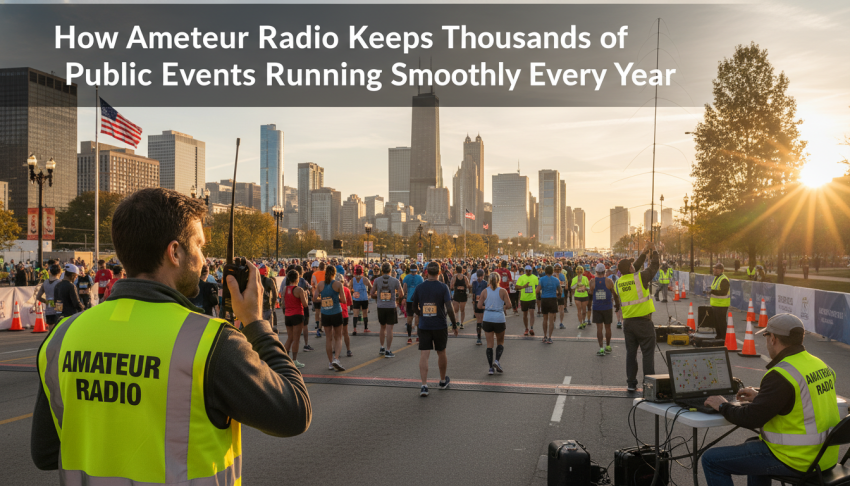
On a single weekend in October 13–14, 2024, more than 500 licensed amateur radio operators across the United States provided the sole reliable communications system for both the Bank of America Chicago Marathon (210 hams) and the Boston Marathon (280+ hams), handling everything from medical emergencies and lost children to course rerouting and supply runs while cell networks collapsed under the load. These volunteers worked 10–14 hour shifts using their own gear, received zero pay, and saved race officials countless headaches—all because amateur radio is the one communications service that is specifically designed, trained, and legally authorized to step in when commercial systems fail. This same scene repeats every weekend of the year at marathons, parades, century bike rides, festivals, air shows, and charity walks nationwide. As ARRL CEO David Minster, NA2AA, said after the 2024 Chicago Marathon, “When every other form of communication is overloaded or down, the hams are still passing traffic like clockwork.”
Real-World Event Support – Marathons, Parades, and Rides
Major marathons don’t just appreciate amateur radio anymore—they literally build their entire safety and operations plan around it. Take the 2024 Bank of America Chicago Marathon: 210 operators from Illinois, Wisconsin, Indiana, Michigan, and Iowa converged on the city before dawn. They ran six dedicated repeater channels, a separate simplex medical net, and a city-wide APRS tracking network so net control could watch every medical volunteer, supply truck, and race official move in real time on a laptop map. When a runner collapsed near mile 19 with chest pain, the nearest ham shadow team called it in within eight seconds; an ambulance was rolling before most spectators even realized something was wrong. Race director Carey Pinkowski has said publicly that the marathon’s incident rate drops noticeably on years when ham coverage is strongest, and the event’s official risk-mitigation document now lists “amateur radio communications failure” as a Tier-1 threat right alongside terrorism and extreme weather.
Boston is even more explicit. The Boston Athletic Association deploys roughly 280–300 hams every Patriots’ Day to cover the famous point-to-point course from Hopkinton to Boylston Street. Operators ride in the lead and trailing media trucks, shadow the elite runners, staff every medical tent, and maintain roving “bike mobile” teams that can reach any spot on the course within minutes. Because the route passes through eight different cities and towns—each with its own police and fire radio systems—the hams provide the only common communications platform that works seamlessly across every jurisdiction. After the 2013 bombing, the ham network stayed up when most other systems were deliberately shut down for security reasons, passing critical updates about survivor transport and family reunification for hours.
The same pattern holds at the Marine Corps Marathon in Washington, D.C. (250+ hams every October), the TCS New York City Marathon (300+ hams covering five boroughs on eleven repeaters), the Peachtree Road Race in Atlanta on the Fourth of July (the world’s largest 10K, 180 hams in 90-degree heat), and dozens of course the Honolulu Marathon, Houston Marathon, and Los Angeles Marathon. All of them have had formal, written agreements with local or regional ham clubs stretching back twenty to forty years. These aren’t casual favors; they’re line items in multi-million-dollar event budgets labeled “communications redundancy—amateur radio services: $0.00.”
Scale down to mid-size and small-town events and the dependence is just as real. The Covina, California Christmas Parade has been 100 % ham-supported since 2022—twelve operators with handhelds and a portable repeater on a nearby hill keep the police chief, fire marshal, parade marshal, and float captains all on the same page. The annual Sycamore, Illinois Pumpkin Festival parade uses the Kishwaukee Amateur Radio Club to stage more than 150 entries; one year a float caught fire and the nearest ham had fire units rolling before the driver even hit the brakes. Century bike rides like the Tour de Foothills, Elephant Rock, or the Horrible Hundred in Florida put mobile hams in every SAG wagon because riders routinely drop into cell dead zones twenty miles from the nearest tower. Regattas, air shows, hot-air balloon festivals, and even large county fairs all follow the same playbook: if more than a few thousand people are going to be in one place at one time, somebody calls the local ham club.
Race and event directors are blunt in private and in print. The executive director of one top-20 U.S. marathon told the ARRL, “If the ham group ever said they couldn’t support us, we would have to cancel the race. There is no Plan B that works.” Another major race’s safety plan, publicly filed with the city, contains the sentence: “Loss of amateur radio support would constitute a catastrophic single point of failure in the communications plan.” They aren’t being dramatic—when 50,000 phones hit the same cell sector at the starting gun, the network folds. When a medical tent’s commercial handheld battery dies at mile 22, there’s no spare on site. But there’s always a ham three feet away with a fully charged rig, a spare battery, and an antenna that can punch through concrete and crowds to a repeater five miles away.
That’s why, weekend after weekend, year after year, you’ll find groups of guys in bright yellow vests or club polo shirts standing quietly at aid stations, riding in the sag wagon, or perched on a hill with a wire in a tree—making sure the event you’re enjoying stays safe, on schedule, and fun, whether anybody in the crowd notices them or not.
Community Outreach and Recruitment – Turning Spectators into Operators
Every single year on the fourth full weekend of June, more than 2,800 amateur radio clubs drag generators, tents, antennas, and radios into public parks, beaches, fairgrounds, and even city squares for ARRL Field Day. The official goal is to practice emergency communications, but the real magic happens at the Get-On-The-Air (GOTA) station: a fully equipped rig with a coach sitting right beside it, legally allowed to let any unlicensed visitor—dad, teenage son, curious neighbor—pick up the mic and make real contacts all over the continent under the club’s callsign. In 2024 alone, GOTA stations logged over 142,000 contacts by unlicensed visitors. Thousands of those visitors went home, opened the ARRL website that night, and started studying for their Technician license before the weekend was over.
Walk up to almost any Field Day site and you’ll see the same scene: a ten-year-old boy in a baseball cap nervously saying “CQ Field Day, this is [club call] GOTA, Golf Oscar Tango Alpha” while his father stands behind him grinning ear to ear when the kid gets an answer from Oregon or Nova Scotia on nothing more than a wire tossed over a tree branch and a car battery. Ten minutes later the same dad is on the mic himself, and by the end of the day both of them are asking the coach, “So how long does it take to get a license?” That single afternoon is the most powerful recruiting event the hobby has ever invented.
The outreach never stops after June. Clubs set up portable stations at county fairs and let fairgoers talk skip into Europe on HF while eating funnel cake. They run special-event stations at Scout Jamboree-on-the-Air every October, helping thousands of boys earn their Radio merit badge in one weekend. Maker Faires, high-school STEM nights, Touch-a-Truck events, mall ham radio displays, even National Night Out with local police—any place men and boys already gather, you’ll find a folding table, a vertical antenna, and a sign that says “Talk around the world—no license needed today.” One club in Texas reports averaging thirty new license exams scheduled every year just from their two-day county fair booth. A club in Ohio traced sixty new members in a single year directly to their mall display during Christmas shopping season.
Public-service events themselves are rolling advertisements. When a guy watches a bright-vested ham at mile 20 of a marathon calmly relay “Runner down, possible heat stroke, mile marker 20.3, send ALS” and sees the ambulance arrive four minutes later, something clicks. When he’s at a downtown festival and his kid wanders off, only to be brought back fifteen minutes later because a ham on the parade route heard “lost child, red shirt, age six” and spotted the boy two blocks away, he remembers that yellow vest. When he’s stuck in traffic because of a bike race and hears the sag-wagon driver on a handheld say “Rider 412 is cramping bad at mile 67, bringing him in,” he starts wondering what kind of people do that for free—and how he can become one of them.
Club membership chairs will tell you the same story over and over: the majority of men who walk through the door today first got interested because they saw hams in action at a race, parade, or Field Day. One large Midwest club surveyed its new members in 2024—68 % said their first exposure was watching hams support a marathon or bike event, and another 24 % said it was Field Day. Only 8 % came from YouTube or online forums. Nothing recruits like real-world proof that this stuff actually works and actually matters.
That’s why clubs now treat every marathon, every parade, and every Field Day as a recruiting mission. The vests aren’t just for identification—they’re walking billboards. The GOTA coach isn’t just logging contacts—he’s closing sales. And the guy who just worked the finish-line medical tent at 5 a.m. on a Sunday morning knows that somewhere in the crowd is the next guy who’s going to buy a Baofeng, crack open the question pool, and join the ranks. Because he was once that guy himself.
Proven When It Matters Most – From Everyday Events to Major Disasters
The radios you see clipped to a yellow vest at the Chicago Marathon finish line on Sunday morning are the exact same radios that were still transmitting from western North Carolina mountain tops ten days after Hurricane Helene slammed ashore in September 2024. When every cell tower for 80 miles was either underwater, without power, or crushed by landslides—and 911 centers were literally silent—Western North Carolina hams ran continuous nets on generator and solar power, passing thousands of health-and-welfare messages, coordinating helicopter medevacs, and guiding supply convoys through roads that no longer existed on any map. One operator in Mitchell County ran his station for thirteen straight days on nothing but a pair of golf-cart batteries and a 35-watt solar panel while his own house was gone.
Rewind one year to the 2023 Maui wildfires: the town of Lahaina burned so fast that the county’s entire public-safety radio system melted. For the first 72 hours the only working communications link between the emergency operations center, the shelters, and the outside world was a handful of hams on the west side of the island using VHF repeaters that somehow stayed on the air. They passed the very first confirmed survivor counts, requested by the Governor, located dialysis patients who had fled with no medication, and told the Coast Guard where to drop water buckets because the fire crews on the ground had no other way to talk to aircraft.
Go back further and the list reads like a history’s worst hits: Hurricane Katrina (2005) – over 1,000 hams deployed, praised in Congressional testimony as “the communications system that worked.” Superstorm Sandy (2012) – hams ran the only link into Staten Island hospitals for days. California Camp Fire (2018) – operators evacuated on 30 minutes’ notice yet still managed to keep the hospital net alive from a parking lot. Texas winter storm Uri (2021) – hams kept rural counties connected when the power grid collapsed for a week. Every single time, the after-action reports from FEMA, the Department of Homeland Security, and state emergency management agencies say the same thing: “Amateur radio was one of the only auxiliary communications systems that remained fully functional throughout the event.”
That’s not marketing hype; it’s documented fact in public government reports. When the cell network dies, the hams don’t wait for permission—they flip to battery power, throw a wire in a tree, and get on the air. When commercial repeaters lose power they fire up the club’s portable repeater trailer that runs on propane for two weeks straight. When Internet is gone they switch to Winlink and send email over HF from a pickup truck in a Walmart parking lot. The discipline drilled into them every Saturday morning on the local 2-meter net—short clear transmissions, phonetics, priority traffic only—is the exact discipline that keeps a marathon medical tent calm and keeps a disaster net calm when someone is literally screaming for a medevac.
Event organizers know this history cold. The same reason the Chicago Marathon trusts 210 strangers with their $50 million race is the same reason FEMA trusts those same strangers with a billion-dollar disaster: the gear works, the training works, and the men running it have proven—over and over, for decades—that when everything else fails they will still be on frequency, calm, and ready. Race directors read those after-action reports. They see the photos of hams running nets from flooded fire stations and burned-out neighborhoods. And they sleep better on race night knowing the guys in the yellow vests have already done this when it was a thousand times worse.
For the men holding the microphones, that track record is pure rocket fuel. Nothing accelerates skill growth like knowing the voice procedures you practiced at last month’s bike ride were the same ones used to pull a family out of the floodwaters in Asheville. Nothing builds brotherhood faster than working a 14-hour marathon shift on Saturday and then turning around and running a disaster net on Tuesday. And nothing convinces a brand-new Technician licensee that his $35 Chinese handheld is worth something like seeing that same model still working on day nine of a major hurricane.
That seamless bridge from weekend parade to once-in-a-century catastrophe is why public-service volunteering has become the fastest on-ramp in the hobby. A guy can go from zero experience to handling a lost-child call at the county fair to passing critical traffic in a Red Cross shelter in under two years—because the system, the gear, and the men are the same in both places. And when he looks around that shelter at 2 a.m. and realizes every voice on frequency is someone he’s worked a marathon or Field Day with, he understands exactly why thousands of men just like him are lining up to get their license and get in the game.
Conclusion – Why this matters to you in 2025
Every single weekend somewhere in America a race director sleeps better, a parade marshal keeps the route on time, and thousands of families enjoy the day because a group of ordinary guys with radios decided to get up early, bring their own gear, and serve their community for free. That rock-solid reliability, combined with the instant real-world experience public-service events provide, is why record numbers of men are studying for their amateur radio licenses right now. If you’ve ever wanted a hobby that blends technical skill, brotherhood, and genuine impact, the marathon finish line—or the next Field Day site in your local park—is waiting for you to show up and see it for yourself.
Call to Action
If this story caught your attention, don’t just scroll past. Join the community—men sharing skills, stories, and experiences. Subscribe for more posts like this, drop a comment about your projects or lessons learned, or reach out and tell me what you’re building or experimenting with. Let’s grow together.

Sources
- ARRL Public Service Overview
- Hackaday: Ham Radio Public Service Activities
- Ham Radio FAQ: Supporting Public Events
- Arapahoe County ARES Public Affairs
- The Amateur Radio Public Service Handbook
- ARRL World Amateur Radio Day
- Amateur Radio Events Field Day
- ORCA Public Service Events
- Reddit: Amateur Radio Club Activities
- What Is Ham Radio?
- ARRL: Recognition of Amateur Radio Value
- Scouts on the Air Events
- Amateur Radio Events Main Site
- ARRL: Promoting Amateur Radio at Events
Disclaimer:
The views and opinions expressed in this post are solely those of the author. The information provided is based on personal research, experience, and understanding of the subject matter at the time of writing. Readers should consult relevant experts or authorities for specific guidance related to their unique situations.