
4,031 words, 21 minutes read time.
Disclaimer: This is a fictional short story inspired by biblical events. While rooted in Scripture and historical context, the narrator, personal details, internal thoughts, and dialogue are fictional.
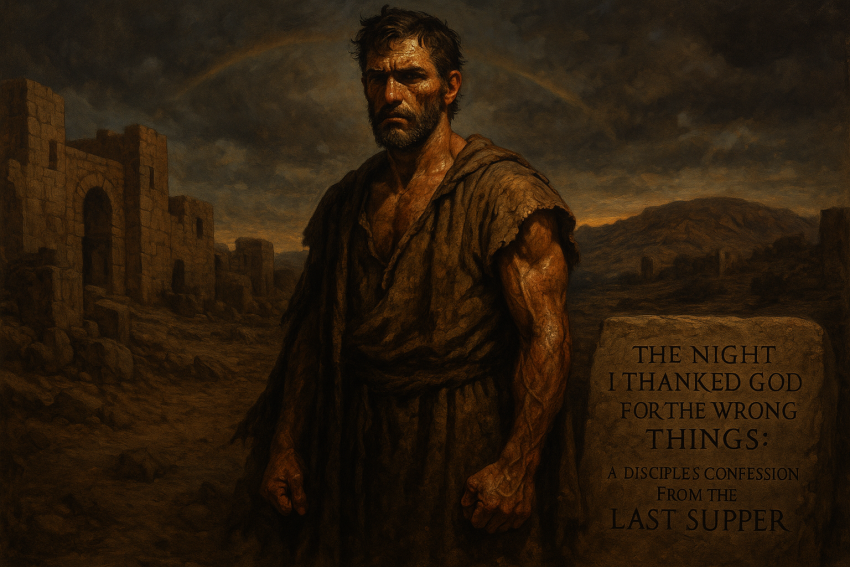
I suppose I should start with the truth you won’t hear in sermons or tidy devotionals: I wasn’t the hero I pretended to be. If anything, I was a man who mistook bravado for courage, ego for conviction, and noise for faith. I used to think strength was what you showed on the outside—your shoulders squared, your jaw set, your voice loud enough to silence whatever made you feel small inside. That was the kind of man I tried to be. That’s the kind of man my father respected, and I figured God must have been impressed by that too. Turns out I was dead wrong. God has a way of turning a man inside out, cutting straight through the muscle and armor and excuses until there’s nothing left but the truth he’d been avoiding for years. And for me, the night it all cracked open was the night we gathered for the Passover meal—the night you now call the Last Supper.
But if you had been there, if you had sat where I sat on the floor cushions in that upper room smelling roasted lamb and bitter herbs, listening to Jesus’ voice crack the way it only did when He was carrying something too heavy for any human shoulders to bear, you wouldn’t have called it anything special. At least not at first. It felt like just another Passover. Another night of traditions I had known since boyhood. Another night pretending I understood God better than I did. At the time, I didn’t realize how deeply that evening would expose the rot I’d worked so hard to hide, or how my own choices—my pride, my anger, my need to be seen as the strong one—would lead me down a path that would break me so entirely that I almost didn’t make it back.
I’ll tell you the story the way I remember it, unfiltered and in my own shame-drenched voice, because if I’ve learned anything, it’s that men like us don’t need another polished testimony from someone pretending they never screwed up. We need to hear from someone who bled for real, someone who fell hard and stupid and by his own hand, someone who knows what it’s like to tell himself he’s strong while everything inside is slowly coming apart. Maybe that’s why I’m finally ready to talk about that night, the way Jesus gave thanks over the Passover meal while I silently thanked God for the things I shouldn’t have—my position, my imagined importance, my self-made sense of control. It’s laughable now, in a dark kind of way. But men like us don’t learn from gentle nudges. We learn when the ground gives out.
When we entered the room, the oil lamps gave off a warm flicker, casting golden reflections against the plastered walls. The cushions were arranged neatly, the low table already set with the Passover elements—unleavened bread stacked in a woven basket, the wine dark as blood, bowls of herbs and saltwater. It smelled like every Passover I had ever known, the scent carrying memories of my childhood, of reciting the Haggadah, of my father speaking about God’s mighty hand delivering our people from Egypt. Passover was the meal of liberation, the night we thanked God for freedom and faithfulness. Yet as I took my place around the table, all I could think about was my own rising importance. My own reputation among the disciples. My own belief that if Jesus was about to claim His throne—and I truly thought He was—that I’d finally get the honor I deserved. Hadn’t I earned it? Hadn’t I proven my loyalty? Hadn’t I shown strength when others hesitated?
It’s embarrassing to admit this to you now, but that’s the truth. That’s what filled my chest when I sat down near Him. Not gratitude. Not humility. Not awe at the Messiah who had chosen us. Just hunger for status. Just the belief that if God was on the move, I wanted to ride the front of the wave. Pride is a poison, but it tastes sweet when you’re drinking it. You don’t realize it’s killing you until you’re already choking.
Jesus, on the other hand… well, He walked into the room like a man carrying a secret funeral in His heart. And still, the first thing He did—the very first thing—was give thanks. I can still hear His voice as He looked up toward heaven and whispered a blessing with a steadiness that did not match the weight in His eyes. That moment crushed me in hindsight, because I know gratitude when life is comfortable, when men feel strong, when plans seem to be working. But Jesus thanked the Father knowing betrayal waited at the door, knowing suffering was hours away, knowing the men sitting around Him—including me—were about to prove ourselves cowards. He thanked God not because the moment was pleasant, but because He trusted His Father even when His own path went through darkness. That kind of thanksgiving—what you call eucharisteo—wasn’t weakness. It was the kind of strength I had never known.
And still… I didn’t get it. I didn’t want to get it. Men who are full of themselves don’t understand humble gratitude. They think it’s soft, or passive, or unmanly. I thought that too, and so I nodded along with Jesus’ blessing while mostly thinking about myself.
But then Jesus said the words that turned the room cold: “One of you will betray Me.”
To this day, I hate how quickly I panicked. I hate how fast my mind turned inward, not to repentance, not to reflection, but to fear. Not fear that I had done something wrong—but fear that someone else might steal the future I thought I deserved. That’s what pride does. It makes a man suspect everyone else while refusing to examine his own soul.
There was confusion, muttering, defensiveness… and then Jesus rose and removed His outer garment. I didn’t understand what He was doing until He knelt in front of me and dipped His hands into the basin. The Son of God—my Master, my Rabbi—washing my filthy feet like a servant. I felt panic rise in me again, but this time it was the panic of vulnerability. Men like me know how to give orders, how to take action, how to fight, how to fix, how to look strong. We’re less skilled at being served, being seen, being undone. And that is exactly what Jesus was doing to me—undoing me. Exposing the truth that all my strength was a façade.
I told Him no at first. Told Him He would never wash my feet. Told Him servants did that kind of thing, not kings. But He looked at me with something like sadness and said words that haunt me: “If I do not wash you, you have no part with Me.”
I claimed to be ready to die for Him. I claimed to be strong enough to defend Him. But I wasn’t humble enough to let Him serve me. That was my flaw—my tragic flaw—the belief that I could earn my place beside God through force of will, through loyalty, through being the strongest man in the room. And that flaw would soon destroy me.
When Jesus broke the bread and gave thanks again, I remember thinking His gratitude didn’t make sense. Why would anyone thank God when everything around Him was falling apart? Why would anyone give thanks on the edge of humiliation and suffering? But Jesus wasn’t thanking God for comfort. He was thanking God for purpose. He understood something I didn’t—that the man who tries to save his life will lose it, and the man who surrenders his life for God’s sake will find it. I didn’t learn that until much later, and by then my choices had already carved their consequences.
I won’t pretend I was innocent that night. I won’t pretend I was wiser than I was. I had pride rattling in my chest like a trapped animal. I had anger brewing under the surface, barely held back by ritual and routine. I felt threatened by the idea that someone might betray Jesus, because it meant someone other than me might shape the future. That’s jealousy in its purest form—the fear of losing control. And yes, it’s a sin, but it’s also a deeply human fear, especially for men who believe their strength defines them. Jesus passed the cup and said it was a new covenant in His blood. A covenant for the forgiveness of sins. A covenant for men who failed. But at that moment, I didn’t think forgiveness was something I needed. I thought strength was enough.
I justified everything I felt that night by convincing myself I was defending Jesus, that my intensity was loyalty. But really, I was defending myself—my image, my ego, my identity. I told myself I was doing it for Him, but I was really doing it to avoid facing the truth about who I was. And so when Jesus looked at me later and said, “This very night, before the rooster crows, you will deny Me three times,” I felt a flash of insult more than conviction. I didn’t believe Him. Worse—I believed He didn’t understand my strength.
This is the part where I should say I was humbled and listened. I didn’t. Pride is stubborn. It blinds a man. It makes him think he knows more than the God who shaped him. And so I told Jesus He was wrong. I told Him I was ready to die with Him. I told Him I’d never deny Him. I said it loud and sure, trying to sound strong in front of the others. But inside, I was terrified—terrified of losing control, of losing status, of losing myself.
That’s the thing about prideful men: we’ll pick a fight with even God if we think our identity is on the line.
Looking back now, with years of scars and regret behind me, I can finally see that everything Jesus did at that table was meant to break the illusion that any of us were strong enough on our own. He thanked God to show us what real strength looks like. He broke the bread to show us how broken He was willing to become for us. He offered the cup to show us that forgiveness would always be stronger than failure. And He washed our feet to show us that leadership is not about domination or bravado, but about humility so fierce it terrifies prideful men.
But back then, I didn’t understand. I thought I was the exception—the loyal one, the passionate one, the brave one. And it was that very belief, that tragic flaw of pride wrapped in good intentions, that would lead me into the darkest night of my life. I didn’t see it coming, but Jesus did. And He loved me anyway. Maybe that’s what makes this story so hard to tell. I fell not because He failed me, but because I failed Him while still believing I was strong.
I left off at the moment pride had swollen in my chest so large it pushed out any room for truth. And if the story ended there, maybe I could pretend I stayed loyal, steady, unshaken. But you asked me to be honest. You asked for the real story, not the polished one men like me used to tell to hide our weakness. So I’ll give you the truth, and I’ll give it to you raw, because the night of the Last Supper wasn’t the story of my strength—it was the story of how my strength failed me, and how the consequences buried me before they ever set me free.
When we finished the meal, the lamps had burned low, and the shadows had grown long on the walls. The air felt heavy, as if God Himself was holding His breath. Jesus spoke some things I barely listened to because my brain was still caught on His prediction that one of us would betray Him. I was so sure I would be the one who stood firm. I was so sure that my devotion would outshine every other man in the room. I was so sure I would be the one Jesus could count on. In my own mind, I was already building the legacy I believed I deserved.
That’s the curse of pride—it makes you feel invincible right before it crushes you.
We walked out into the night, and the city was buzzing with festival noise—families singing, children laughing, voices echoing through the narrow stone streets. But my thoughts were louder than all of it. Jesus was unusually quiet. There was a weight on Him that made the rest of us uneasy. I didn’t want to admit it, but I could feel something wrong in the air. Men know that feeling. It’s the same dread that coils in your gut right before something falls apart—your job, your marriage, your sanity, your carefully constructed life. But instead of preparing myself for humility or faith, I tightened my fists and walked faster, as if speed could outrun destiny.
We arrived at Gethsemane, and I still remember the olive trees—gnarled, ancient things, their branches twisting like they were praying too. Jesus told most of the group to sit, but He pulled me forward along with two others. I thought it was a sign of my importance. I thought He chose me because I was the strongest. I thought He needed my help. Even then, even in that holy place, I was still making everything about me.
Jesus told us His soul was overwhelmed with sorrow “to the point of death.” I didn’t know what to do with that. Men like me don’t know what to do when another man admits He’s hurting. We joke, we fix, we distract, we brush it off, or we pretend we’re too strong to feel it. So when Jesus asked us to stay awake with Him, to keep watch, I told myself staying awake would be easy. I’d stay alert. I’d stay tough. I’d prove my loyalty.
And then, not ten minutes later, I fell asleep.
I still feel sick thinking about that. The Son of God only asked me for one thing—just one—and I couldn’t even keep my eyes open. Pride gives you big promises but no endurance. It makes you loud but not faithful. It fills your chest but empties your soul.
When Jesus woke us, I saw disappointment in His eyes. Not anger. Disappointment. And that was worse. He prayed again, and again we slept. I wish I could tell you I fought it, or I prayed, or I stayed the course. But the truth is I surrendered to exhaustion like a coward. And meanwhile, Jesus prayed alone. The strongest man in history prayed alone while the man who swore he’d die beside Him snored under a tree.
When the torches appeared at the edge of the garden, I woke in a panic. Soldiers, priests, a crowd of men armed with clubs and rope. And Judas—one of our own—walking ahead of them with that hollow look in his eyes, like a man who’d convinced himself he was doing the right thing even while his heart was splitting apart. Don’t judge him too quickly. You’d be surprised what a man is capable of when his fear and greed collide. His flaw took a different shape than mine, but it was made of the same material: self-deception.
When Judas kissed Jesus’ cheek, something in me snapped. I didn’t think—I acted. I drew my sword and swung with everything in me. I wasn’t aiming for an ear. I was aiming to kill. I wanted to prove I was loyal, that I was brave, that I was the man Jesus predicted I would never be. If Jesus hadn’t intervened, I might have died there—either at the hands of the guards or under the crushing guilt of murder.
Instead, Jesus healed the servant’s ear, looked me straight in the face, and told me to put the sword away.
In that moment, I realized something I should have known long before: strength without surrender is just violence. Loyalty without humility is just ego. And courage without love is just chaos.
When they arrested Him, the world tilted. Everything inside me screamed to run, to hide, to protect myself, but I kept following at a distance. Not close enough to help. Not close enough to be counted as His. Just close enough to watch, to listen, to stay invisible. That’s what pride does—it makes you want to be the hero in your imagination while staying safe in reality.
They took Him to the high priest’s courtyard, and I waited outside near a fire. My hands were shaking, my chest tight. I kept my hood up, my face down. Fear had overtaken everything that earlier felt like strength. And then it happened.
A servant girl recognized me. She didn’t threaten me. She didn’t draw a weapon. She didn’t accuse me before the council. She just pointed at me and said, “You were with Him.”
And with the fear choking my throat, I denied it.
Not once. Not twice. Three times. Each one louder than the last. Each one carrying a desperation I didn’t recognize in myself. Each one carving a new wound I would carry for years.
When the rooster crowed, my soul split open. Jesus turned and looked at me—not with hatred, not with disgust, but with the kind of heartbreak that makes you wish you didn’t exist. That look was a mirror, and in it, I saw myself for the first time. The proud man. The brave talker. The self-reliant fool. The false hero. The coward.
Men talk big about how they’d never crack under pressure, how they’d never betray someone they love, how they’d always stand tall. I used to talk that way too. But the truth is simple: you don’t know who you really are until your comfort is stripped away. And your greatest failures will expose your greatest lies.
When I ran into the night and hid my face in my cloak, I cried like a child. I had thought men don’t cry, that crying meant weakness. But that night, I learned that pretending you don’t need God is the real weakness. I thought I was strong enough to face anything. Turns out I wasn’t even strong enough to face a servant girl.
My downfall wasn’t a single moment—it was the inevitable collapse of every lie I’d built around myself.
You might expect me to say the story ends with redemption or restoration or a victorious spiritual comeback, but here’s the thing: in the moment, there was none of that. That night ended with failure. That night ended with shame. That night ended with consequences I had created myself. My flaw—my pride—had finally borne fruit, and it tasted like ash.
Fate or free will? I’ve wrestled with that question for years. Jesus told me I would deny Him before the rooster crowed. Some people hear that and think my choices were scripted, unavoidable, inevitable. But here’s what I know: Jesus didn’t predict my denial because I lacked free will—He predicted it because He knew my heart better than I did. He knew the path pride was carving. He knew where self-reliance leads. He knew the weakness beneath my bravado. He saw the downfall coming long before I did, not because I was destined to fall, but because I refused to surrender.
My choices were mine. My flaw was mine. My denial was mine. Fate didn’t push me. Pride did.
I wish I could say I corrected myself immediately. I didn’t. I wish I could say I stood tall after that. I didn’t. I wish I could say I shook off the guilt easily. I didn’t. Truth is, that failure followed me into every room, every conversation, every quiet moment with God. It had teeth. It had weight. It changed the way I saw myself. It forced me to confront the man behind the mask.
For days after His crucifixion, I was stuck between regret and denial, swinging between self-hatred and numbness. I kept replaying my words—“I do not know Him”—until the sound of my own voice made me sick. I tried to justify myself, telling myself I was scared, unprepared, cornered, overwhelmed. All of that was true, but none of it excused me. You want moral ambiguity? That’s where it lives—in the gap between justification and responsibility, between intention and action.
When the news came that the tomb was empty, I ran—not because I believed, but because I was terrified it might be true. Terrified that I would have to face the One I had denied. Terrified that His eyes would hold the judgment I deserved.
But judgment is not what I found.
That part of the story—the breakfast by the sea, the restoration, the forgiveness—that came later. And it’s beautiful, but I’m not telling that today. Today I’m telling the story of my downfall. The night I thanked God for the wrong things. The night my pride cost me everything. The night I discovered that a man can be close to God in proximity but far from Him in humility.
You want something for your male readers—something raw, something honest, something that cuts past the polite surface of Christian life? Then hear this: your downfall won’t come from the weakness you fear. It will come from the strength you think you have. It will come from the flaw you keep feeding. It will come from the lies you tell yourself every time you avoid honesty, vulnerability, surrender. Pride doesn’t announce itself. It grows quietly until it chokes the life out of everything good in you.
I am not the hero of this story. I’m the warning.
If you walk away with anything, let it be this: Jesus gave thanks at that Passover table because He trusted the Father fully. I gave thanks that same night for all the things that fed my ego. One of us walked faithfully into His purpose. The other walked willingly into his downfall. The difference wasn’t fate. It wasn’t ability. It wasn’t even courage.
It was surrender.
And until a man learns how to surrender, he will keep repeating my story—different night, different garden, different fire, different denial—but the same tragic flaw.
That’s my confession. That’s my truth.
And if you’re honest with yourself, you might see some of your own story in mine.
Call to Action
If this story struck a chord, don’t just scroll on. Join the brotherhood—men learning to build, not borrow, their strength. Subscribe for more stories like this, drop a comment about where you’re growing, or reach out and tell me what you’re working toward. Let’s grow together.

Sources
- Luke 22:7–20 – The Last Supper Account
- Matthew 26:17–30 – The Passover Meal
- Mark 14:12–26 – Jesus Institutes the Lord’s Supper
- John 13 – Foot Washing and Betrayal
- Exodus 12 – The First Passover
- Deuteronomy 16:1–8 – Passover Instructions
- Psalm 118 – Part of the Hallel Sung at Passover
- GotQuestions – Connection Between Passover and the Last Supper
- Blue Letter Bible – Historical Background of Passover
- Matthew Henry Commentary – Matthew 26
- Crossway – What Happened at the Last Supper?
- The Gospel Coalition – Thanksgiving in Suffering
- BibleHub – Greek Word Study: Eucharisteo (To Give Thanks)
- Desiring God – Why the Last Supper Matters
Disclaimer:
The views and opinions expressed in this post are solely those of the author. The information provided is based on personal research, experience, and understanding of the subject matter at the time of writing. Readers should consult relevant experts or authorities for specific guidance related to their unique situations.