
2,779 words, 15 minutes read time.
I don’t share this story because I’m proud of it. I share it because every man I’ve ever known, whether he wears a prayer shawl, a Roman helmet, or a modern button-down, carries the same disease I did. Not the paralysis. Not the fever. I’m talking about that thing inside us that gnaws and whispers we must stand alone, prove ourselves, earn respect with our fists, our sweat, our reputation, or by outworking every man around us. I fed that beast so long it finally ate me from the inside out. If you want the truth, what happened to me wasn’t just a miracle. It was the collapse of the life I built with my own two hands. And maybe you’ll understand why when I tell you exactly how it happened.
I served under a Roman centurion in the fishing town of Capernaum—humble little place with more dust than glory. My commander was a man unlike any I’d ever met. Roman officers usually wear pride like armor, but not him. He was disciplined, calculating, respected by his men, and feared by anyone dumb enough to challenge him. Yet he carried a stillness about him, like he didn’t need to prove anything. I envied him for that. Me? I was the opposite. I was the guy who couldn’t let anything go. I had something to prove to everyone—maybe especially to myself. Every task became a competition, every conversation a test, every failure a humiliation. I hated looking weak. I hated needing help. If you’ve ever been that kind of man, then you already know exactly the kind of poison that was in me.
The centurion took me into his household early in my life. I worked harder than every servant combined. I told myself it was discipline, drive, ambition. But underneath it, truthfully, it was fear—the fear that if I stopped performing, I’d be nothing. Men like me don’t rest; we only collapse. And that’s exactly what I did.
It started as a dull ache in my legs. I ignored it. Pain was familiar. Pain meant I was doing my job. Then one morning I stood up and my knees failed beneath me. I hit the ground like dead weight. My pride screamed louder than the pain. I waved off the hands reaching toward me and forced myself back up, pretending it was nothing. But nothing became everything. Over days the pain tightened like ropes around my muscles, pulling, twisting, clamping down. I lost strength. I shook uncontrollably. I couldn’t hide it anymore. The centurion saw me one morning trying to sweep the courtyard while leaning against the wall like a drunk. He walked over, placed a hand on my shoulder, and said, “You’re done for today.” I tried to protest, tried to prove I was fine. He gave me a look that cut straight through all my lies. “Marcus,” he said, “you’re not well. And you don’t have to pretend.”
You ever have someone call you out so gently that it feels like a sword in your gut? That was the moment.
I told myself I just needed a day of rest, then two, then a week. But the truth was uglier. I became bedridden. I couldn’t walk. I couldn’t sit up. The pain was so fierce I thought death would be mercy. What made it worse was the shame. I’d tied my whole identity to being strong, capable, dependable. And now, laid out like a broken tool, I felt useless. Men visited me with pity in their eyes. Some whispered behind the door—“He’s finished. He’ll never rise again.” I hated every one of those words, because they were all true.
I hear men today talk about burnout, stress, collapsing under pressure, turning to anger, lust, work, alcohol, or meaningless distractions just to quiet the noise in their heads. You think those things are modern problems? We wrapped them in different clothes back then, but they were the same demons stalking every man who feared being truly seen. I hid my pain behind performance until the mask crushed me.
Here’s the part I’ve never told anyone outside the household: I blamed God. I cursed Him in whispers. I accused Him of abandoning me when I had worked so hard to stand tall. I envied other men who were healthy. My flaw was never the illness. My flaw was the belief that I deserved to be unbreakable. And when God allowed me to break, I treated it like betrayal.
One afternoon, my centurion came into my room with a look I recognized—the look of a man who had made a decision he knew would cost him something. “Marcus,” he said, “I’ve heard of a healer. A Jewish teacher named Jesus.” I scoffed at first. Romans don’t ask help from Jewish miracle workers. It’s not the way their world functions. But my commander wasn’t like the others. I’d seen him give alms to Jewish families, fund their synagogue, even study their Scriptures out of respect. He believed their God was real. I only believed their God was unpredictable.
I told him not to bother. I told him I didn’t deserve healing. I even told him I was ready to die. But he didn’t listen to any of that nonsense. He cared for me more than I cared for myself. I think that annoyed me most. I didn’t want to be someone’s charity. I didn’t want to be dependent. Pride has a way of turning kindness into humiliation.
He left the house with urgency, and later I overheard the other servants talking about how he sent Jewish elders to plead for my healing. That humiliated me even more. A Roman officer—my officer—begging Jewish leaders on behalf of a servant? I felt small. Worthless. And strangely angry. I kept thinking, “Why would he do that for me? I’m not that important.” I wrestled with that question until it began eating at me. I wanted to believe it was loyalty, or duty, or that he simply didn’t want to train another servant. But deep down I feared it was pity, and pity is a bitter cup for a proud man.
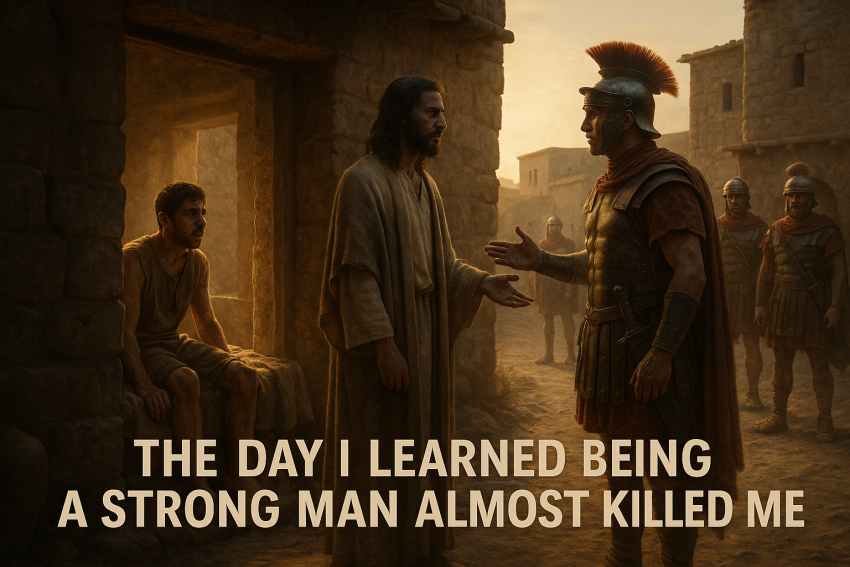
The next day, word came that Jesus Himself was approaching our home. I panicked. Not out of faith. Out of shame. I didn’t want someone like Jesus seeing me like this. I didn’t want Him to witness my weakness. I didn’t want anyone peeling back the layers I’d spent years building to protect myself from vulnerability. When one of the other servants rushed in saying the centurion had gone out to stop Jesus before He reached the gate, I collapsed inside. I knew exactly why. My commander said, “I am not worthy for You to enter under my roof.” Those words broke me in a way my illness couldn’t. A Roman warrior declaring himself unworthy? And for my sake? I didn’t understand humility then. I mistook it for self-doubt. Only later did I see it for what it truly was—strength.
I lay there, trembling, as the report came back. The centurion had said, “Just say the word, and my servant will be healed.” No rituals. No house visit. No ceremony. Just authority. He explained that he understood authority because he lived under it and carried it. If he gave a command, soldiers obeyed. If Jesus gave a command, sickness itself would obey. I didn’t know whether to laugh or cry. I had spent my whole life proving myself. And here was the centurion proving his faith with one simple declaration. I was the broken one. He was whole in ways I couldn’t even fathom.
I wish I could tell you I felt a holy sensation or some supernatural light filled the room. But what happened was stranger. It was silent. It was ordinary. It was immediate. One moment pain was devouring me, and the next it evaporated like smoke. Heat surged through my limbs. My fingers stopped shaking. My legs straightened. Strength flooded back into my body. I sat up—slowly at first, then all at once, like a drowning man breaking the surface. I stood. I stood. I didn’t deserve it. I didn’t ask for it. I didn’t even believe it would happen. And still He healed me.
I cried harder than I ever had in my life. But here’s the part no man likes to admit. I wasn’t just crying from gratitude. I was crying from shame. All my life I thought strength came from pushing, grinding, achieving, conquering. But in that moment, healed by a word spoken miles away, I realized how small I was and how big God truly is. It wrecked me.
My centurion returned later that afternoon. He saw me standing in the courtyard, leaning awkwardly against a pillar like a man unsure of his own legs. But the truth is I wasn’t unsure of my legs. I was unsure of my heart. He smiled. Not a proud smile. A relieved one. I wanted to embrace him, to say thank you, to confess how wrong I’d been, but the words stuck in my throat. I wasn’t used to vulnerability. Men like me are fluent in sarcasm, bravado, competence. But gratitude? Humility? Honesty? That was a language I had to learn from scratch. Instead, I said the first thing that came to mind: “It worked.” He laughed, clapped my shoulder, and simply said, “Of course it did.”
I wish I could tell you everything got better from that moment on. That I became a wise, godly man bursting with humility. But that would be a lie, and I promised myself I wouldn’t lie to you. Healing exposed a deeper sickness—my addiction to self-reliance. I struggled with it long after my legs strengthened. I struggled with pride, resentment, jealousy of other men’s success. I wrestled with lust, with anger, with the pressure to reclaim the identity I had lost. I tried to outrun my old self, but sometimes he outran me.
There were nights I wished Jesus had healed my heart the way He healed my body—instantly, effortlessly, completely. But soul-work doesn’t happen like that. Not for me. Not for any man I’ve ever met. It’s a battle. A wrestling match between who you were, who you pretend to be, and who God is trying to make you into.
I once read a commentary that said, “Faith is not the absence of weakness; it is the courage to bring weakness into the light.” It linked to a study on humility, and I remember thinking how much I hated that word. Humility felt like defeat. But the older I get, the more I realize humility is not surrendering your strength—it’s surrendering your illusion of control.
I’ll tell you the truth no one told me. Being healed didn’t fix my relationships. Being healed didn’t restore the friendships I neglected, the trust I shattered, the people I pushed away in my drive for perfection. Jesus’ miracle saved my life, but it didn’t erase the consequences of the man I had been. I had to face those myself. Sometimes I faced them well, sometimes I failed miserably. And maybe that’s why I’m telling you this story. Because healing is not the end of a man’s battle; sometimes it’s the beginning.
There were days after my recovery when the centurion would watch me quietly, as if checking whether pride would return. And sure enough, it did. I found myself slipping back into old patterns, trying to outwork the other servants, trying to prove that I deserved the miracle I had been given. I tried to earn it with performance because I hadn’t learned how to receive mercy. Grace is uncomfortable for men like me. It exposes us. It reminds us we aren’t the gods of our own lives. And I didn’t want that reminder.
I remember one argument I had with another servant, a younger man who tried to take over some of my duties after my recovery. I exploded in anger. I accused him of trying to replace me. In truth, I was terrified that my worth was still tied to my labor. Afterward, he avoided me for weeks. That broken relationship was one of many consequences that stayed with me. Jesus healed my body, but He didn’t erase the damage I had caused while trying to prove myself invincible. That’s the part of the story most people don’t want to hear.
If I could tell modern men anything, it’s this: don’t wait until you’re paralyzed to admit that you’re carrying too much. Don’t wait until you lose everything to confess that you’re drowning. I learned that the hard way. My downfall wasn’t my illness. My downfall was my pride. My obsession with power and control. My refusal to be weak in front of anyone. But weakness isn’t the enemy. Hidden weakness is.
Some nights, when I walk along the shore of Galilee and watch the boats coming in, I think about how close I came to dying as a slave to my own ego. I think about how Jesus healed me without even stepping into our home. I think about how the centurion believed before I did. And I think about how many men today are lying on invisible beds, paralyzed not in body but in spirit because they refuse to admit they need help.
You may think my story has a perfect ending. It doesn’t. I am still a flawed man. I still wrestle with anger. I still compare myself to others. I still have moments when I want to run back to the old version of myself—the one with muscles, status, tasks, and respect instead of vulnerability and honesty. Healing gave me a second chance, not a new personality. And I squandered more of that chance than I care to admit.
But even with all my flaws, even with all my regrets, even with all the relationships I never repaired, one truth gives me strength: Jesus didn’t heal me because I was worthy. He healed me because He is merciful. And mercy doesn’t depend on my perfection. It depends on His character.
So here is my testimony for you, man to man. You can keep pretending you’re strong. You can keep hiding your weakness behind work, anger, lust, sarcasm, or bravado. You can keep grinding yourself into dust because you’re terrified someone might see the cracks. But sooner or later, life will bring you to your knees. And when it does, hear this from someone who was broken, bitter, and healed all in the same week: you don’t have to be worthy for God to help you. You just have to stop pretending you don’t need Him.
That’s what I learned the day He said the word and my body obeyed. Healing didn’t make me perfect. It made me honest. And sometimes honesty is the hardest miracle of all.
If you want to know how I survived long after the miracle, the truth is I didn’t survive by being strong. I survived by being real. And maybe that’s what you need too, before your own downfall crushes you. You can let your pride finish the job my illness started, or you can drop the act and face the truth like a man.
I hope you choose the truth. Because the day you finally stop trying to prove yourself might be the day God finally heals you.
Call to Action
If this story struck a chord, don’t just scroll on. Join the brotherhood—men learning to build, not borrow, their strength. Subscribe for more stories like this, drop a comment about where you’re growing, or reach out and tell me what you’re working toward. Let’s grow together.

Sources
- Matthew 8:5–13 – Jesus Heals the Centurion’s Servant
- Luke 7:1–10 – The Centurion’s Great Faith
- Psalm 34:18 – The Lord is Near to the Brokenhearted
- James 4:6 – God Opposes the Proud but Gives Grace to the Humble
- 1 Peter 5:5–7 – Clothe Yourselves with Humility
- Isaiah 53:4–5 – By His Wounds We Are Healed
- GotQuestions – Why Was the Centurion’s Faith Remarkable?
- Matthew Henry Commentary – Matthew 8
- Enduring Word Commentary – Matthew 8
- Enduring Word Commentary – Luke 7
- David Guzik Commentary – Matthew 8
- David Guzik Commentary – Luke 7
- Desiring God – On Faith and Healing
- The Gospel Coalition – Jesus’ Authority and Compassion
- Bible Hub Commentaries – Matthew 8:13
Disclaimer:
The views and opinions expressed in this post are solely those of the author. The information provided is based on personal research, experience, and understanding of the subject matter at the time of writing. Readers should consult relevant experts or authorities for specific guidance related to their unique situations.