
1,162 words, 6 minutes read time.
The Scam That Pretends to Offer You a Better Life
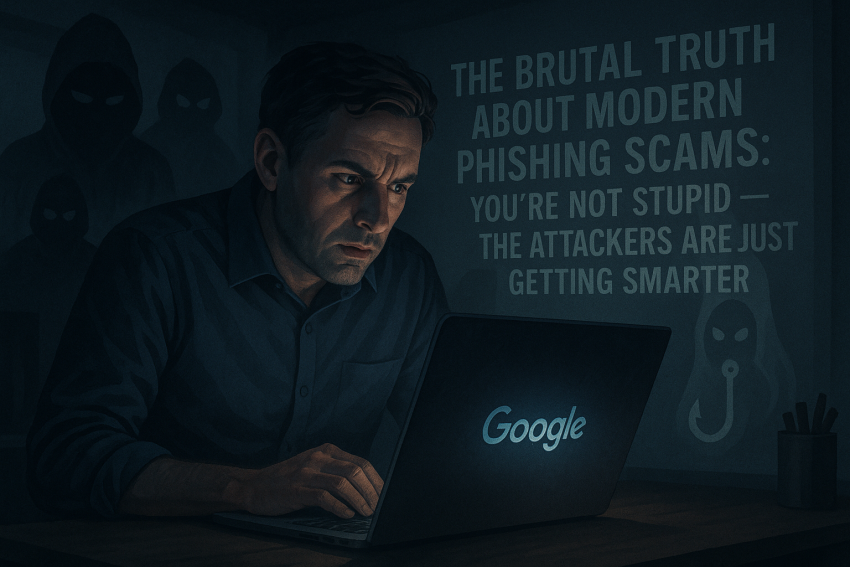
Every man I know has, at some point, looked at his job and thought, “There’s gotta be something better out there.” That’s normal. That’s human. That’s ambition doing its thing. And the attackers know it. Lately, scammers have been sending out fake Google Careers emails that look real enough to fool even people who live neck-deep in technology. The email pitches a shiny new opportunity, something that sounds like a door swinging open. And let’s be honest, a lot of guys will click something promising a better job before they think twice. You land on a fake Google scheduling page that looks polished, crisp, and professional enough to pass a recruiter’s sniff test. It asks for your name, your work email, your number. No big deal, right? Except the moment you give them that, the trap closes. You get pushed into a fake Google login page designed to capture your credentials. One moment of optimism becomes a credential compromise that hands your digital life to someone on the other side of the world. It’s not happening because you’re careless or clueless. It’s happening because social engineers study human desire the same way hunters study animal behavior. They know when you’re most likely to let your guard down.
Why This Scam Works Even on Smart Guys
I’ve been in I.T. long enough to know that “intelligent” doesn’t mean “immune.” I’ve watched seasoned engineers, battle-hardened SOC analysts, and even a CISO or two click something they shouldn’t. The mistake isn’t the point. The point is the environment. Attackers operate like professional illusionists. They copy the Google Careers layout pixel for pixel. They steal the tone of real recruiter emails. They register domains that look legit when your eyes are tired and your brain is juggling work, family, bills, and the quiet pressure to get ahead. It’s the same playbook used in breaches like SolarWinds, NotPetya, and the long list of credential-stealing campaigns mapped under MITRE ATT&CK techniques like phishing (T1566), credential harvesting (T1556), and web-based social engineering. These attackers don’t break in anymore. They knock on the door and convince you to open it. And when they do, your data, your accounts, your workplace, and sometimes your employer’s entire environment are suddenly exposed to risk. It’s not stupidity. It’s human nature being exploited by a threat actor who has spent years refining psychological manipulation into an art form.
How Modern Attackers Weaponize Your Ambition
A lot of men carry the silent weight of expectation. Provide more. Earn more. Climb higher. Prove yourself. That mindset is fuel for progress, but in the wrong hands it becomes leverage. Threat actors don’t just imitate legitimacy; they imitate opportunity. They target the part of you that’s trying to build a better life. A fake job interview isn’t just a phishing lure. It’s a promise. It’s the whisper that says, “Here’s your chance.” And when you mix ambition with urgency, you short-circuit risk analysis. You stop checking domain names. You stop verifying links. You stop noticing that the email came at a strange hour or from a sender address that doesn’t quite line up with official Google HR domains. Attackers count on it. They rely on the fact that men don’t want to miss a shot. When you understand that, the whole landscape of phishing changes. You stop seeing it as a tech problem and start seeing it as a human one. Technology didn’t fail. Awareness did. And that’s something we can fix.
Slow Down, Verify, and Stop Letting Attackers Script Your Story
The best defense isn’t a firewall or an antivirus suite or even MFA—though those matter. The best defense is the habit of slowing down. Every legitimate opportunity can survive a few seconds of scrutiny. Every scam collapses under it. You never click the link in the email. You navigate to the official site yourself. You look up the recruiter on LinkedIn. You check the sender’s domain. You notice whether the scheduling page is actually hosted on careers.google.com or some off-brand fake sitting on a compromised WordPress server in another country. This is the part where men often roll their eyes and say, “I know, I know, check the link.” But here’s the truth: you don’t check when you’re excited. You don’t check when you feel chosen. And attackers thrive on those moments. Slowing down is not hesitation. It’s discipline. And discipline is one of the most masculine cybersecurity skills you’ll ever cultivate.
You’re Not the Problem — The Threat Landscape Changed
If you’re reading this and thinking, “Man, I feel dumb for almost falling for this,” stop that right now. The entire industry has shifted. Phishing is no longer the sloppy, typo-filled nonsense you saw in the early 2000s. It’s a multi-billion-dollar criminal ecosystem backed by research, tooling, automation, and dark-web marketplaces selling pre-built scam kits with polished UIs and high conversion rates. Attackers test their pages the same way designers test landing pages. They A/B test subject lines. They run analytics. They track success metrics. They improve based on performance numbers. This is not “hackers in a basement.” This is organized, well-funded digital predation. You’re not stupid for being targeted. You’d be stupid for pretending you’re not. The smartest people I know treat every unexpected message like it’s wrapped in poison until proven otherwise. That’s the mindset that keeps you safe.
Final Thoughts: Stay Sharp, Stay Real, Stay Human
I’ve seen what happens after a successful credential harvest. I’ve watched accounts get drained, businesses get breached, identities get shredded, and careers get damaged. All because someone wanted to believe a door was opening for them. The fix isn’t shame. The fix is awareness, humility, and discipline. These scams will keep evolving because attackers only need one person to slip. So take your time. Trust your instincts. And remember that you’re not being targeted because you’re weak. You’re being targeted because you have something worth stealing. That alone should tell you the kind of world we’re living in. Stay sharp out there.
Call to Action
If this breakdown helped you think a little clearer about the threats out there, don’t just click away. Subscribe for more no-nonsense security insights, drop a comment with your thoughts or questions, or reach out if there’s a topic you want me to tackle next. Stay sharp out there.

Sources
MITRE ATT&CK – T1566.002: Credential Phishing
MITRE ATT&CK – T1539: Steal Web Session Cookie
CISA – Phishing Guidance
NIST SP 800-63: Digital Identity Guidelines
Verizon Data Breach Investigations Report
Mandiant Threat Intelligence Reports
CrowdStrike Security Blog
Krebs on Security
Schneier on Security
Microsoft Security Blog
SANS – What Is Phishing?
Cybersecurity Insiders
Disclaimer:
The views and opinions expressed in this post are solely those of the author. The information provided is based on personal research, experience, and understanding of the subject matter at the time of writing. Readers should consult relevant experts or authorities for specific guidance related to their unique situations.