
6,893 words, 36 minutes read time.
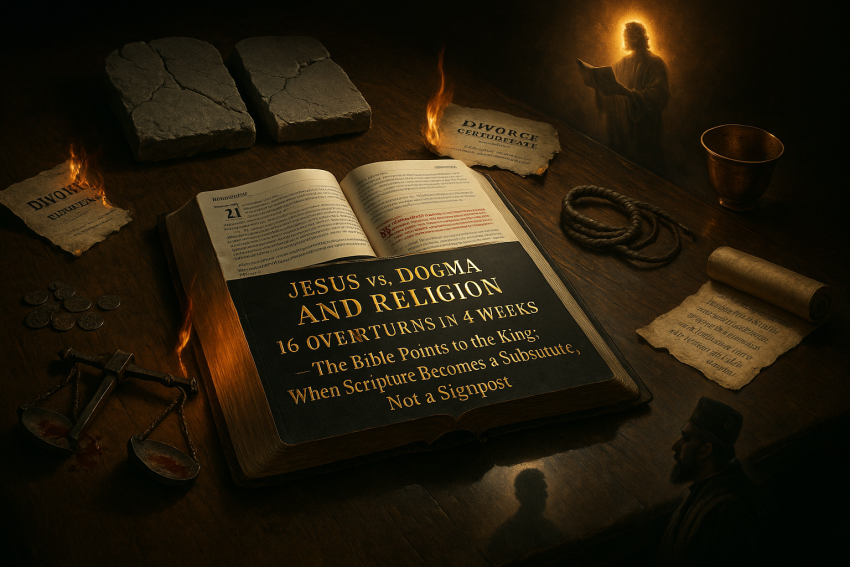
For three weeks we have watched Jesus dismantle the entire religious superstructure of His day. He tore down oral-law fences that overwrote the written Torah and crushed the very people the law was meant to protect. He exposed designer-robed hypocrisy: fasting without joy, tithing cumin while widows starved, polished cups sloshing with extortion, burdens loaded by leaders who refused to lift a finger. He overturned tables in the temple and marriage certificates in the courtroom, revealing how the holiest spaces on earth had been franchised for profit and loopholes.
Every tradition defended, every polished façade, every table turned into a cash register rested on one final, fatal error—the error that made all the others possible.
They loved the Bible more than the One the Bible was screaming about.
This final week is the kill-shot. We will watch Jesus do something no rabbi had ever dared: in the six great antitheses of Matthew 5, He places His simple “I say to you” directly against the written words of Moses and claims the authority to deepen, overrule, and fulfill the Torah itself. Anger becomes murder, lust becomes adultery, divorce beyond porneia becomes adultery, oaths are reduced to yes and no, eye-for-eye justice is transformed into kingdom generosity, and hatred of enemies is replaced by love that prays for persecutors. Six times He speaks as the Lawgiver who gave the law in the first place.
Then, in the devastating climax of John 5:39-40, He delivers the autopsy on the entire system: “You search the Scriptures because you think that in them you have eternal life; and it is they that bear witness about me, yet you refuse to come to me that you may have life.”
This week is seven hammer blows: anger that equals murder, lust that equals adultery, divorce beyond porneia, oaths beyond yes and no, eye-for-eye turned into kingdom generosity, love that embraces enemies, and finally the refusal to come to the Living Word after searching the written one.
Same unrelenting depth: verse-by-verse, Greek, Mishnah, Dead Sea parallels, first-century halakhic debates, and one question per section that will follow you into the dark and into the light.
This is the finale. There is nowhere left to hide.
Anger = Murder: When the Heart Becomes the Crime Scene
Matthew 5:21–22
Jesus opens the six antitheses with a detonation sequence with a statement designed to make every self-righteous man in the crowd feel the ground disappear beneath him: “You have heard that it was said to those of old, ‘You shall not murder; and whoever murders will be liable to the judgment.’ But I say to you that everyone who is angry with his brother without cause will be liable to the judgment; whoever says to his brother ‘Raca’ will be liable to the Sanhedrin; and whoever says ‘You fool’ will be liable to the Gehenna of fire.”
The sixth commandment was the one sin every Pharisee knew he had never committed. Exodus 20:13 and Deuteronomy 5:17 were unambiguous: do not murder. The penalty was death by stoning or sword, and it required two or three eyewitnesses plus a full trial before the local court or the Sanhedrin. Rabbis debated edge cases (accidental killing, capital punishment, self-defense), but the line was bright: if no blood was spilled, the commandment stood unbroken. A man could nurse hatred for decades, curse his enemy in prayer meetings, cut him off socially, ruin his reputation with whispers, and still pass a polygraph on “Have you ever murdered anyone?” His hands were clean, his heart a slaughterhouse.
Jesus walks into that smug certainty and burns it to the ground with six Greek words: “But I say to you…” He does not quote another rabbi, another verse, another tradition. He simply speaks as the One who originally thundered the commandment from Sinai, and He drags the crime scene from the street into the chest cavity. Unjustified, ongoing anger (orgizomenos eikē, present participle) already puts a man under the same judgment as murder. The Aramaic slur “Raca” (empty-head, spit-out, worthless) drags him before the supreme court. The word “fool (mōre, a curse on someone’s eternal destiny) lands him in the burning garbage dump outside Jerusalem that had become the image of final hell. The progression is not rhetorical flourish; it is a legal escalation that moves from local court to capital offense to eternal damnation in three breaths.
The phrase “without cause” (eikē) is missing from the best and earliest manuscripts (Sinaiticus, Vaticanus, and most others), meaning even anger that feels justified is included if it is not repented of quickly (Ephesians 4:26). The present tense of the participle makes it worse: this is not a flash of rage but a lifestyle of nursing wrath, rehearsing grievances, keeping mental kill-lists. One outburst might be sin; a heart that stores resentment like treasure is already a serial killer in slow motion.
First-century evidence shows how casually contempt was weaponized. The Dead Sea Scrolls overflow with curses against the “sons of darkness.” Pharisees prayed lengthy prayers thanking God they were not like other men—tax collectors, Gentiles, or that sinner over there. The Talmud records rabbis pronouncing anathemas on theological opponents. Jesus looks at men who would never dream of drawing a knife and says, “Your tongue has already slit a thousand throats.” Cain’s hand only finished what his heart had done days earlier when he decided Abel was worthless in the eyes of God (Genesis 4; 1 John 3:15). The Pharisees could quote the Shema while plotting to kill Lazarus for the crime of being raised from the dead. Their hands were spotless; their hearts were a mass grave.
We have not escaped the crime scene; we have only upgraded the weapons. We store wrath in group chats, silent treatment, cold shoulders, and “concerned” prayer requests that are really character assassinations. We cancel people with a tweet and call it justice. We keep spreadsheets of every offense and update them religiously. We preach grace on Sunday and rehearse grievances on Monday. We teach our children “words can never hurt me” while we ourselves bleed out from sentences spoken twenty years ago. We say “I forgive you” through clenched teeth while mentally putting the person on probation for life. We tell ourselves “righteous anger” is different, then let it metastasize into bitterness that poisons every relationship we touch. We bless God and curse men made in His likeness with the same mouth and call it spiritual maturity.
The deepest cut is that anger is always, at root, an assault on the image of God in another human being. To call a brother “Raca” is to declare that the Imago Dei in him is empty, worthless, disposable. To call him “fool” is to pronounce eternal damnation on a soul Christ died to redeem. Every time we dehumanize someone (spouse, child, parent, pastor, politician, that driver who cut you off), we reenact the original murder in Eden when the serpent convinced Eve that God’s image could be despised. Anger is not a personality trait; it is deicide in slow motion.
Jesus is not raising the bar; He is revealing what the bar always was. The sixth commandment was never about external restraint; it was about the heart’s refusal to see every human being as sacred. The man who harbors contempt is already standing on the edge of the lake of fire with blood on his hands he cannot see.
Name the person whose face now triggers a surge of rage or contempt in your chest (spouse, ex, parent, child, coworker, that Christian leader you love to hate). You have not touched a weapon, but Jesus says you are already on trial for murder, and the evidence is the footage God has been recording in your heart for years. The same mouth that sings worship songs has been pronouncing death sentences in private. The same hands raised in praise have been clenched in secret fantasies of revenge.
Will you drop the charge in your heart before the Judge drops the gavel on the last day, or will you keep killing with the cleanest weapon the devil ever invented: a tongue that never draws blood but always leaves corpses? The kingdom is coming, and in that kingdom the Lamb who was slain will wipe away every tear—including the ones you caused while convincing yourself your anger was holy. Repent while mercy is still speaking, because justice is already sharpening the blade.
Lust = Adultery: When the Glance Becomes the Act
Matthew 5:27–28
Jesus does not slow down. He moves straight from murder in the heart to adultery in the heart with a sentence that should make every man in the crowd feel suddenly naked:
“You have heard that it was said, ‘You shall not commit adultery.’ But I say to you that everyone who looks at a woman with lustful intent has already committed adultery with her in his heart.”
The seventh commandment was short, blunt, and universally understood: “You shall not commit adultery” (Exodus 20:14). In rabbinic courts adultery required physical penetration and two eyewitnesses; anything less was legally clean. A man could feast his eyes, feed his imagination, rent his thoughts to every passing body, and walk away technically innocent as long as he never crossed the final line. The heart was declared a no-man’s-land the law never entered. The body was policed; the mind was a private playground.
Jesus torches the playground and salts the earth.
The Greek is surgical in its brutality. The verb is blepōn (present participle)—ongoing, deliberate looking, not the accidental glance or the involuntary thought. This is the second look, the lingering stare, the purposeful return to the image for another hit of dopamine. The phrase pros to epithymēsai autēn means “for the purpose of lusting after her.” Intent is the crime. The moment a man (or woman) looks at another human being in order to awaken or inflame sexual desire, the act is finished. He has already committed adultery with her in his heart. The preposition en tē kardia autou is devastating: the heart is not a safe room; it is the courtroom where God keeps perfect, high-definition records. The adultery Jesus condemns is not potential, not symbolic, not “almost.” It is actual, complete, and prosecutable on the last day.
First-century culture made the sin easy and respectable. Public baths were mixed. Roman dress exposed more than it covered. Slave girls were property, legally available for their owners’ pleasure. The rabbis themselves debated how many times a man could look at a married woman before it became sin—some said twice, some three, some “as long as the heart is not moved.” Jesus says once with intent is once too many. The woman on the street, the servant in the house, the neighbor’s wife—every one of them bears God’s image and belongs, body and soul, to Christ or to the husband He may one day give her. When a man undresses her in his mind, he steals what was never his to take and violates a covenant he never signed.
We have industrialized the crime and baptized it as entertainment.
We carry infinite harems in our pockets, accessible with a thumb swipe. We call it “porn” when it is mass adultery with borrowed bodies. We justify “soft” material because “no one got hurt” and “it’s just pixels,” while the women on the screen (made in God’s image, many of them trafficked, drugged, or desperate) bear the weight of millions of stolen glances. We watch “steamy” shows and call it art. We scroll Instagram and call it inspiration. We double-tap thirst traps and call it harmless. We preach purity on Sunday and feed the beast in private browsing mode on Monday. We have created a generation of men who can quote Ephesians 5 while living in habitual adultery of the heart, and a generation of women who learn to market their bodies because male eyes trained on screens now treat flesh like wallpaper.
The deepest wound is theological. Lust is not a chemical misfire; it is treason against the Bridegroom. Every human body is either Christ’s purchased possession or destined to be presented to Him spotless at the resurrection. When we lust, we reach into the future marriage bed of Jesus Himself and steal what belongs to Him. The woman on the screen, the coworker in the cubicle, the stranger on the beach—she is someone’s future or current wife in the eyes of God, and ultimately she is part of the Bride being prepared for the Lamb. To lust after her is to commit adultery against Jesus before it is ever adultery against her earthly husband. Pornography is not a victimless click; it is sacrilege against the marriage supper that is coming.
We have tried every trick to lower the bar. We blame “male wiring,” testosterone, culture, stress, an unloving wife, a sexless marriage, youth, singleness, or “everybody does it.” Jesus offers no exemptions. He will go on in the next verses to speak of gouging out eyes and cutting off hands—not because literal mutilation saves, but because the heart that refuses to repent of lust is already amputated from the body of Christ. Better to enter life maimed than to keep both eyes and burn.
Name the last image, memory, fantasy, or deliberate second look you fed.
You did not touch her body, but Jesus says you have already slept with her, violated her covenant, and trampled the future marriage bed of the Lamb. The marriage you may have defiled could one day be your own daughter’s. The heart you trained to consume is the same heart that will stand before the Judge who sees every hidden thing.
Will you gouge out the eye that offends before the King gouges it out for you on the day when every secret glance is played on heaven’s screen in front of your wife, your children, and the Lamb you pierced again with your eyes?
The kingdom is coming, and in that kingdom there will be no more night, no more screen, no more hiding—just the pure gaze of the Bridegroom on a Bride who kept herself only for Him.
Repent while the door is still open, because the wedding is nearer than when you first clicked.
Divorce Beyond Porneia: When the Exception Becomes the Rule
Jesus refuses to give this one a full antithesis. He reduces it to a single, white-hot sentence that lands like a guillotine: “It was also said, ‘Whoever divorces his wife, let him give her a certificate of divorce.’ But I say to you that everyone who divorces his wife, except on the ground of porneia, makes her commit adultery, and whoever marries a divorced woman commits adultery.”
No preamble, no softening, no debate format. Just the blade.
Deuteronomy 24:1–4 had allowed a man to write a certificate of divorce if he found “some indecency” in his wife and send her out of his house. By Jesus’ day that “indecency” had been inflated into a catch-all escape hatch. Hillel taught that a man could divorce for anything that displeased him: a spoiled meal, a gray hair, a loud voice, or simply finding someone prettier. Hundreds of divorce certificates from the Judean desert (Babatha archive, Masada, Cave of Letters) prove it was routine. One papyrus reads, “You are free for any man,” with no cause listed. Scribes charged fees, husbands kept dowry and children, and women walked away with a scrap of paper and a ruined life. The certificate that Moses gave as a reluctant concession to hardness of heart had become a male privilege dressed in Scripture and sold for cash.
Jesus drags the whole machinery back to Eden and slams the door shut so hard the hinges break. He grants exactly one legitimate ground: porneia (sexual immorality that violates the one-flesh union). Every other divorce, no matter how many pastors, lawyers, or counselors sign off, is null and void in heaven’s court. The man who divorces for any lesser reason does not merely end a marriage; he forces his wife into adultery when she remarries to survive, and he turns every future husband of hers into an adulterer as well. The Greek is vicious: poiei autēn moicheuthēnai—he makes her be adulterated. She becomes the victim of a sin she did not choose. The husband who thought he was escaping covenant responsibility has now chained an innocent woman (and every man who will ever love her) to ongoing adultery before God.
This is not about protecting an institution; it is about protecting people, especially the vulnerable. A discarded first-century wife lost home, children, reputation, and economic survival overnight. The get was supposed to be her lifeline; instead it became the receipt for her destruction. Jesus looks at the men waving their certificates like trophies and says, “You did not free her; you branded her an adulteress while you walk away clean.” The same mouth that quoted Deuteronomy 24 now drips with the blood of the woman it just crucified.
We have only updated the stationery and the vocabulary. “No-fault” divorce is the twenty-first-century get. “Irreconcilable differences” is the new “she burned the toast.” We file papers, split assets, trade custody schedules, update dating profiles, and still take the Lord’s Supper. We tell ourselves the children will be fine, the ex will move on, and God is a God of second chances. Jesus says the marriage never ended, the new relationships are adultery in real time, and the children are growing up in a house built on sanctioned covenant-breaking. We have pastors who will marry divorced people faster than they will reconcile them, elders who sign off on “biblical” grounds that are nowhere in the Bible, and entire denominations that have rewritten Jesus’ words into footnotes.
The deepest wound is that we treat marriage as a contract that expires when feelings do, when Jesus says it is a one-flesh union welded by God Himself. The only thing that severs it is the one thing that severs the offender from the covenant community: porneia. Everything else is hardness of heart wearing the mask of legality, compassion, or “moving on.” We have made the exception the rule and the rule the exception, and we call it grace.
Name the marriage you ended (or are ending, or are planning to end) because it stopped serving you. If Genesis 2:24, not state law, were the final court, would the papers in your desk drawer (or already filed) be declared fraud by the One who joined you? Are you living in a union that heaven calls adultery while earth calls it freedom? The certificate you clutch is burning parchment in the hand of the King who still sees two as one flesh.
The question is merciless: Will you repent of treating God’s welding as a contract with fine print, or will you keep forcing the woman (or man) you once vowed to cherish into a lifetime of adultery while you start chapter two with a clean conscience and a new ring? There is still time to tear up the get and come home. The door is open, but the Judge is already standing.
Oaths Beyond Yes/No: When Truth Becomes a Loophole Factory
Matthew 5:33–37
Jesus keeps the axe swinging and now aims at the very tongue we use to bless God and curse men: “Again you have heard that it was said to those of old, ‘You shall not swear falsely, but shall perform to the Lord what you have sworn.’ But I say to you, Do not take an oath at all, either by heaven, for it is the throne of God, or by the earth, for it is his footstool, or by Jerusalem, for it is the city of the great King. And do not take an oath by your head, for you cannot make one hair white or black. Let what you say be simply ‘Yes, yes’ or ‘No, no’; anything more than this comes from the evil one.”
The Torah never commanded oath-taking; it only regulated it. Leviticus 19:12 forbade swearing falsely by God’s name. Numbers 30 laid out rules for vows made “to the Lord,” and Deuteronomy 23:21–23 warned that once a vow was uttered, it had to be paid. Over centuries, however, the scribes turned those guardrails into a high-stakes casino of evasion. They built an entire halakhic skyscraper on the difference between oaths that explicitly named God (binding) and oaths that danced around His name (non-binding). Swear by the Temple? You could break it. Swear by the gold in the Temple? You were stuck. Swear by Jerusalem? Walk away free. Swear toward Jerusalem? You owed God. The Mishnah devotes eleven full tractates to vows and annulments. Professional rabbis made a living teaching wealthy merchants how to promise the moon “by the altar” and then laugh when the promise-keepers came knocking, because the altar oath was technically void. Truth had become a game of magical syllables, and honesty was for peasants who couldn’t afford a scribe.
Jesus walks into that casino and kicks over every table.
He does not reform the system; He abolishes oath-taking entirely. No “not falsely,” no “only when necessary,” no “as long as you keep it.” He says mē omosai holōs: do not swear at all, period. Heaven is God’s throne, earth His footstool, Jerusalem His city, your head His property; every oath, no matter how small, drags the holy name of God into the swamp of human deceit. The man who needs to swear “by heaven” to be believed is already confessing that his bare word is worthless. The man who swears “on my mother’s grave” is admitting that his naked “yes” carries no weight. Every extra syllable is a neon sign flashing, “I am a liar who needs religious props to sound credible.”
Then comes the alternative that feels like a slap: let your word be yes or no, nothing more. In the kingdom, a man’s unadorned speech must carry the same authority as a blood oath in the old world. Anything beyond that (any flourish, any “I swear on the Bible,” any “to be honest with you,” any “pinky promise,” any “trust me, bro”) comes ek tou ponērou, from the evil one himself. The father of lies loves religious language that lets us sound truthful while leaving escape hatches wide open. He is the original loophole artist, and every exaggerated oath is his graffiti on our tongue.
We have not abandoned the practice; we have merely secularized and digitized it. We sign 47-page contracts with fine print designed to be broken. We say “I’ll pray about it” when we mean no. We text “I’m here for you” and ghost the next day. We promise our children “this weekend is just for us” while already mentally scheduling overtime. We tell our spouses “till death do us part” while running exit-strategy calculations in the back of our minds. We teach teenagers to say “I didn’t do it” when every adult in the room knows they did. We pepper our speech with “literally,” “no cap,” “on God,” and a thousand emojis because our plain word has the credibility of a campaign promise. We have turned truth into a performance that requires props, and the props keep getting louder because the substance keeps getting thinner.
Look closer and the rot goes marrow-deep. The man who needs to swear “I promise” to his wife is already confessing that his promises have been worthless for years. The pastor who says “I give you my word as a man of God” is admitting that his word as a man is not enough. The politician who ends every sentence with “I swear to you” is telegraphing that nothing he has said so far can be trusted. The friend who begins every commitment with “cross my heart” is hanging a sign around his own neck that reads “chronic liar.” In the kingdom, a disciple’s yes must be more binding than a pagan’s blood oath, because the Spirit who lives in us is the same Spirit who raised Jesus from the dead. Anything less is blasphemy wearing the mask of piety.
Jesus is not giving us a higher standard of oath-taking; He is exposing oath-taking as evidence of a fallen world where truth has died and needs religious CPR to look alive. In Eden no one swore, because no one lied. In the new creation no one will swear, because every word will be true. Until then, the citizen of the kingdom lives as a preview of that coming world: his bare, unadorned word carries eternal weight, and heaven itself takes notes.
Name the last promise you made (to your spouse, your child, your friend, your church, your God) where your yes was not fully yes and your no was not fully no. You did not raise your right hand on a Bible, but Jesus says the evil one was ghost-writing the script. Will you repent of every verbal loophole, every exaggerated assurance, every “I meant it at the time,” and let your next word be so true that God Himself can bank on it without a single collateral oath?
The kingdom is coming, and it is already here, and in that kingdom a man’s naked “yes” will outlast every sworn contract the world has ever written.
Eye for Eye to Courts: When Kingdom Justice Refuses the Scale
Matthew 5:38–42
Jesus now swings at the deepest instinct of fallen humanity: the demand that justice feel like payback. “You have heard that it was said, ‘An eye for an eye and a tooth for a tooth.’ But I say to you, Do not resist the one who is evil. But if anyone slaps you on the right cheek, turn to him the other also. And if anyone would sue you and take your tunic, let him have your cloak as well. And if anyone forces you to go one mile, go with him two. Give to the one who asks you, and do not refuse the one who would borrow from you.”
The phrase “eye for eye, tooth for tooth” is straight from the Torah (Exodus 21:24, Leviticus 24:20, Deuteronomy 19:21). It was never a license for personal revenge; it was God’s mercy in the form of a ceiling. One eye only, not two, not an arm, not a life. It was designed to stop blood feuds from swallowing clans whole. By Jesus’ day, Jewish courts had largely replaced physical retaliation with monetary fines, and Rome had stripped Jews of the right to execute it anyway. The principle lived on, though, in every human heart that keeps a ledger of wrongs and waits for the scales to balance.
Jesus does not reform the principle. He detonates it. He forbids resistance against the evil person (mē antistēnai tō ponērō), not in the sense of surrendering to sin, but in refusing to mirror evil with evil. Then He fires four rapid, escalating examples that move from insult to theft to oppression to need, each one more outrageous than the last.
A backhanded slap on the right cheek was the standard way a superior humiliated an inferior (Roman to Jew, master to slave, husband to wife). Turning the other cheek forces the striker either to hit you as an equal (forehand) or to stop, exposing his own shame. A lawsuit for your tunic (the inner garment) was the ancient equivalent of garnishing wages; the poor man’s last decent piece of clothing. Giving the cloak as well meant walking out naked, shaming the creditor before God and the watching crowd for stripping a man of dignity. The forced mile was Roman law: any soldier could compel a Jewish civilian to carry his 70-pound pack up to one mile. Volunteering the second mile turned coercion into freely offered service, heaping burning coals of inexplicable grace on the oppressor’s head. Finally, the beggar and the borrower receive no qualifications, no credit check, no interest, no refusal—just open hands.
This is not passive victimhood. This is weaponized mercy. Every response strips the evil person of power and forces him to stare at the image of God in the one he is trying to crush. The kingdom does not balance the scales; it shatters them and replaces them with a cross.
We still worship the scale. We keep meticulous records of every offense and calculate exactly how much payback is owed. We lawyer up at the first slight. We post screenshots and subtweets to justify our retaliation. We refuse the second mile because “healthy boundaries.” We screen our giving through tax receipts, background checks, and political litmus tests. We want justice that feels like vengeance and call it righteousness. We quote Romans 13 about the sword of the state while wielding our own digital swords in the comment section. We nurse grudges like fine wine and call it “processing our pain.”
What Jesus wants us to learn is that kingdom justice is not the balanced scale; it is the cross where the only eye-for-eye transaction God ever accepted was His own Son’s eyes for ours, His teeth for ours, His blood for ours. Every demand for personal payback after Calvary is a public declaration that the debt has not been paid in full. The One who was slapped did not slap back. The One stripped naked did not demand His clothes. The One forced to carry a cross went the second mile and the third and the fourth all the way to Golgotha. The One who could have called twelve legions of angels opened His hands to the nails instead.
Name the person or group you are still making pay (emotionally, relationally, financially, reputationally) for what they took from you. Jesus already paid their debt with His body, yet you keep sending invoices, demanding interest, and threatening foreclosure on their soul. Will you absorb the evil one more time, or will you force the nail-scarred hands to open again and bleed for the same crime twice?
Love Enemies: When the Command Becomes Impossible
Matthew 5:43–48
Jesus ends the six antitheses with the one command that makes every human instinct scream for an exemption clause:
“You have heard that it was said, ‘You shall love your neighbor and hate your enemy.’ But I say to you, Love your enemies and pray for those who persecute you, so that you may be sons of your Father who is in heaven. For he makes his sun rise on the evil and on the good, and sends rain on the just and on the unjust. For if you love those who love you, what reward do you have? Do not even the tax collectors do the same? And if you greet only your brothers, what more are you doing than others? Do not even the Gentiles do the same? You therefore must be perfect, as your heavenly Father is perfect.”
The first half of the quotation (“love your neighbor”) is straight from Leviticus 19:18. The second half (“hate your enemy”) is nowhere in Torah. It was added by men who needed moral permission to despise Romans, tax collectors, Samaritans, and anyone else they labeled outside the covenant. The Qumran community wrote it into their rule book: love the sons of light, hate the sons of darkness forever. The Zealots carried it in their hearts along with their daggers. Ordinary Jews whispered it when Roman soldiers requisitioned their donkeys or when Herod’s tax men came knocking. Hate the enemy was not a verse; it was the air they breathed.
Jesus drags that air out of their lungs and replaces it with fire.
He does not say tolerate your enemies, ignore your enemies, or outlive your enemies. He says agapate tous echthrous hymōn (love your enemies) and then doubles the voltage: proseuchesthe hyper tōn diōkontōn hymas (pray for those who persecute you). This is not sentimental affection; this is deliberate, active, self-sacrificial love, the same love that will nail Him to a cross while He begs forgiveness for the men driving the spikes. And the word for “pray” is the language of temple intercession. You are to stand in the gap for the very people trying to destroy you.
He gives two arguments that leave no wriggle room. First, God Himself loves His enemies indiscriminately: sun on the wicked, rain on the ungrateful. If you restrict your love to the lovable, you are no better than tax collectors and pagans; even the mafia kisses its own. Second, kingdom citizens must be teleioi (perfect, complete, mature, brought to their intended purpose) exactly as the Father is perfect. Anything less is spiritual infancy masquerading as prudence. This is not a suggestion for super-saints; it is the baseline definition of what it means to be a child of God.
This command is impossible for the same reason the cross is impossible: it requires a man to die while he is still breathing. It is Roman-soldier-in-your-house, tax-collector-at-your-table, ex-who-destroyed-your-life, abuser-who-still-walks-free, politician-who-mocks-your-faith kind of love. It is getting on your knees and asking the Father to give the man who molested you the same mercy He gave you while you were shaking your fist at heaven. It is blessing the coworker who knifed you in the back, giving the second mile to the soldier who just flogged your brother, breaking bread with the family member who slandered you to the entire church.
We have spent two thousand years trying to domesticate the command. We redefine “enemy” down to the guy who cuts us off in traffic. We spiritualize “pray for them” into vague positive thoughts. We quote Dietrich Bonhoeffer on cheap grace while nursing expensive grudges. We preach “love your enemies” from pulpits on Sunday and then block them on every platform by Monday morning. We teach our children to forgive in Sunday school and model vengeance the rest of the week. We create entire theologies of “righteous anger” and “just war” and “holy boundaries” because the plain command is too costly for our flesh to bear.
Yet the gospel itself is enemy-love in the flesh. While we were enemies, Christ died for us (Romans 5:10). The cross is not Plan B after enemy-love failed; the cross is enemy-love at full strength. Every refusal to love an enemy is a refusal to look like the Father who loved us when we were unlovable. Every refusal to pray blessing on a persecutor is a vote to keep the world unreconciled and the image of God fractured.
Name the person whose name in your mouth tastes like poison, whose face in your feed makes your chest tighten, whose very existence you secretly wish would end. Jesus does not give you permission to wait until they repent, until they apologize, until they are safe. He commands you (today, right now) to get on your knees and ask the Father to give them the same mercy He gave you while you were spitting in His face.
Will you obey the impossible command, or will you keep proving that you are still a child of hell instead of a son or daughter of your Father in heaven?
Scripture Search, Refuse Christ: The Final, Fatal Error
John 5:39–40
Everything we have torn open across these four weeks (every fence built to crush the bruised, every designer robe hiding extortion, every temple table franchising forgiveness, every marriage certificate weaponized, every angry heart that murdered without a knife, every lustful glance that committed adultery in secret, every oath that let us lie with a clean conscience, every eye-for-eye demand that kept the scales balanced while the cross bled out) comes to rest on this one sentence spoken in a quiet upper room after Jesus had healed a man on the Sabbath and the religious elite were already plotting murder:
“You search the Scriptures because you think that in them you have eternal life; and it is they that bear witness about me, yet you refuse to come to me that you may have life.”
These words are not a gentle correction. They are a death sentence on every form of religion that stops at the text and never walks through the door the text is screaming to open. The men Jesus addressed were the most biblically literate human beings who ever lived. They copied Torah scrolls letter by letter, counting every yod and tittle so that not one stroke would perish. They fasted when a scroll tore. They bound Deuteronomy 6 on their foreheads and wrists in leather boxes. They kissed the mezuzah on every doorpost. They could recite entire prophetic books while standing on one foot, and they did it to applause. Their identity, their politics, their purity, their hope of resurrection—everything—was built on the sacred page.
And when the Word became flesh and tabernacled among them, when the One the entire canon had been groaning toward for fifteen hundred years stood in front of them healing, teaching, weeping, raising the dead, forgiving prostitutes, and calling tax collectors to dinner, they looked Him in the eye and said, “We have Abraham. We have Moses. We have the Temple. We have the Scriptures. We don’t need You.”
The verb Jesus uses is brutal: ou thelete elthein (you are not willing to come). Present tense, active voice, ongoing refusal. This was not ignorance, not lack of evidence, not a sincere scholarly dispute. This was deliberate, willful, murderous rejection of the very One their scrolls had promised. Every Passover lamb had screamed His name. Every bronze serpent lifted in the desert had pointed to Him. Every blood-soaked altar had been a billboard flashing “The real Sacrifice is coming.” Every psalm had been His prayer breathed back to the Father. Every prophet had been a megaphone shouting, “Behold the Lamb.” And they took the megaphone, turned it into a museum exhibit, and crucified the Lamb while clutching their scrolls.
We have never left that upper room. We have only upgraded the décor. We build libraries of commentaries while our prayer closets collect dust. We master Greek conjugations and Hebrew poetry but refuse to reconcile with the brother we haven’t spoken to in seven years. We underline verses about grace while nursing bitterness like a favorite addiction. We preach expository series on the love of God and then block our enemies on every platform. We tattoo verses on our skin while our hearts stay stone. We win theological arguments on social media while our children walk away because they never saw Jesus in us—only a Bible used as a bludgeon. Bibliolatry is still the cleanest, most respectable idolatry in the church. It lets us feel spiritual while keeping a safe, scholarly distance from the dangerous Person who will not be managed by proof texts or controlled by systematic theology.
The Pharisees were not stupid. They were brilliant, disciplined, and utterly lost. They searched the Scriptures day and night, convinced that in the searching itself they possessed life. Jesus looked them in the eye and said, “You have the flashlight, but you refuse to walk into the Light.” The tragedy is not that they lacked the Book. The tragedy is that they used the Book as a substitute for the Bridegroom the Book was written to reveal. The arrow became a wall hanging. The witness became the groom. The menu became the meal.
This is the root sin that made every other sin we have examined possible. The fences around the Sabbath were built by men who loved the Torah more than the Lord of the Sabbath. The polished cups and tithing herbs were defended by men who loved the text more than the God who demanded justice and mercy. The temple bazaar thrived because men loved the system the Scriptures sanctioned more than the Savior the Scriptures promised. The divorce certificates flowed because men loved the concession Moses granted more than the creation ordinance God spoke. The anger, the lust, the oaths, the vengeance, the enemy-hatred—all of it grew from the same poisoned soil: loving the written word more than the Living Word.
Close the commentary. Close the app. Close the study Bible. The entire canon has done its job if it brings you to the feet of the risen Christ who is standing in front of you right now—scarred hands open, eyes burning with love and judgment. He is not a doctrine to be defended. He is not a proposition to be debated. He is the Person to whom every verse has been pointing since Genesis 1:1.
You have searched the Scriptures. You have underlined, highlighted, memorized, preached, and argued them. Now the only question left is the one that ends the series and begins eternity:
Will you finally come to Him and have life?
Conclusion: The Throne and the Table
Four weeks ago we began watching Jesus walk through the corridors of institutional religion like a hurricane with an address. He tore down the oral-law fences that overwrote the written Torah and crushed the very people the law was sent to protect. He ripped the designer robes off hearts that fasted without joy, tithed cumin seeds while devouring widows’ houses, polished cups that sloshed with extortion, and loaded impossible burdens while refusing to lift a finger. He overturned the tables in the temple that franchised forgiveness, scattered the coins of the high-priestly cartel, and whipped the air where the Court of the Gentiles should have been a house of prayer. He exposed marriage certificates turned into eject buttons for male convenience and declared that every divorce outside porneia forces the innocent into adultery. Then, in the final week, He did the unthinkable: He placed His naked “I say to you” over the written words of Moses and ruled on anger that murders without a knife, lust that adulterates without touch, oaths that lie while sounding holy, vengeance that keeps scales the cross already shattered, and love that refuses even the enemy who deserves it least. He saved the kill-shot for the upper room: “You search the Scriptures thinking that in them you have eternal life, yet you refuse to come to Me that you may have life.”
Every fence, every robe, every table, every certificate, every angry heart, every wandering eye, every slippery oath, every demand for payback, every refusal to pray blessing on a persecutor, grew from the same poisoned root: loving the Book, the system, the tradition, the identity, the control more than the Bridegroom the Book was written to reveal. That root produced every hypocrisy we have examined, and it still produces them in us.
This series has been a mirror, a scalpel, and a consuming fire. The mirror showed us the Pharisee staring back from our own polished stoneware. The scalpel cut past every excuse to the marrow. The fire burned away every hiding place we built out of proof texts, church covenants, marriage loopholes, and righteous indignation. Nothing sacred to man survived the week untouched.
Now the dust has settled and the overturned tables lie where Jesus left them. There are only two possible responses when the King walks in and dismantles every lesser authority we trusted. We can clutch the debris (our traditions, our reputations, our marriages, our anger, our lust, our certificates, our balanced scales, our Bibles turned into weapons) and demand they be restored. Or we can let the debris stay overturned, let the robes burn, let the certificates turn to ash, and come to Him empty-handed, broken, desperate, alive.
The throne is taken. The wedding supper is ready. The question that began in a Galilean synagogue and echoes to the end of the age is still the only one that matters: You have seen the King overturn every table you built your life on. Will you finally come to Him and live?
Call to Action
If this study encouraged you, don’t just scroll on. Subscribe for more bible studies, share a comment about what God is teaching you, or reach out and tell me what you’re reflecting on today. Let’s grow in faith together.

Sources
- R. T. France, The Gospel of Matthew (NICNT, 2007)
- David Instone-Brewer, Divorce and Remarriage in the Bible: The Social and Literary Context (Eerdmans, 2002)
- E. P. Sanders, Judaism: Practice and Belief 63 BCE–66 CE (SCM Press, 1992)
- Craig S. Keener, The Gospel of Matthew: A Socio-Rhetorical Commentary (Eerdmans, 2009)
- Josephus, Antiquities of the Jews (esp. Book 20) – full text at flaviusjosephus.com
- The Babatha Archive – Legal Documents from the Dead Sea Region (biblicalarchaeology.org)
- The Dead Sea Scrolls Digital Library (Community Rule, Damascus Document, War Scroll)
- Mishnah Gittin 9:10 (Hillel vs. Shammai divorce debate) – Sefaria.org
- Mishnah Nedarim (vows and oath hierarchy) – Sefaria.org
- Nestle-Aland 28th Edition Greek Text of Matthew 5–23 (biblehub.com)
- Biblia Hebraica Stuttgartensia (academic-bible.com)
- Hannah M. Cotton & Ada Yardeni, Aramaic, Hebrew and Greek Documentary Texts from Nahal Hever (Discoveries in the Judaean Desert XXVII)
- N. T. Wright, Jesus and the Victory of God (Fortress Press, 1996)
- Josephus, Complete Works (trans. William Whiston) – Logos edition
Disclaimer:
The views and opinions expressed in this post are solely those of the author. The information provided is based on personal research, experience, and understanding of the subject matter at the time of writing. Readers should consult relevant experts or authorities for specific guidance related to their unique situations.