
3,648 words, 19 minutes read time.
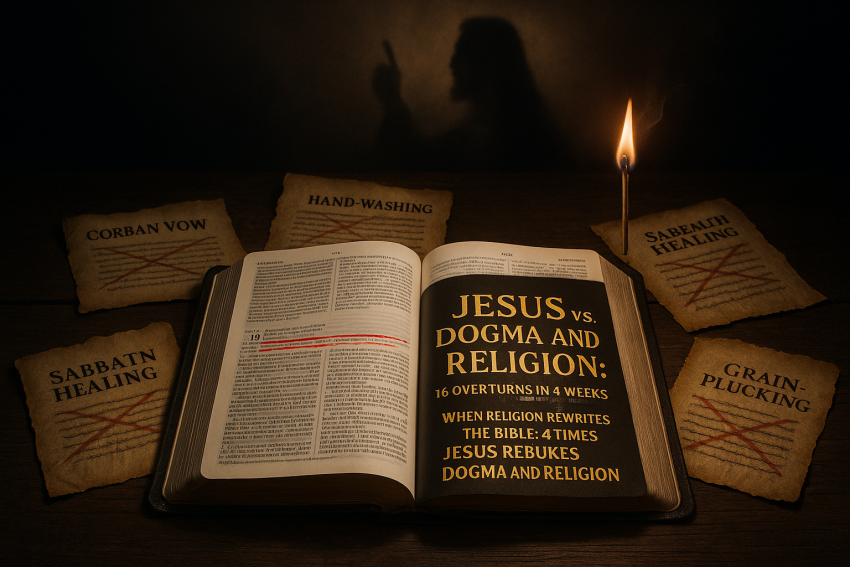
When Religion Rewrites the Bible: 4 Times Jesus Rebukes Dogma and Religion
You open the Gospel of Mark and within the first seven chapters you find Jesus already locked in combat with the religious establishment. These are not casual disagreements; they are direct assaults on systems that claim to protect God’s law while actually nullifying it. In Mark 7:13 Jesus delivers the indictment that sets the tone for everything we will study this week: “thus making void the word of God by your tradition that you have handed down” (ESV). The Greek verb here, akuroō, means to render inoperative—like a law struck down by a higher court. That is exactly what Jesus is doing: functioning as the final authority, overturning human rulings that contradict the divine text.
I have structured this first week around four specific confrontations where tradition rewrites Scripture’s plain commands. My guiding framework remains the same one introduced in the series hub: Scripture is the Constitution, religion the society that grows up around it, and dogma the amendments we treat as untouchable. Jesus keeps tearing the amendments off the wall and pointing us back to the original document. I will work primarily from the English Standard Version (ESV), with occasional reference to the Greek text via standard lexical tools such as BDAG and Strong’s. My interpretive method is historical-grammatical, Christ-centered, and aimed at men who bear weight in homes, workplaces, and local churches—believers and seekers alike who want faith that functions in real life.
The Corban Controversy: When Vows Cancel Commands
The confrontation in Mark 7:1-13 centers on one explosive example: the Corban vow. Pharisees and scribes from Jerusalem accuse Jesus’ disciples of eating with unwashed hands, but Jesus redirects the entire debate to authority. They defend their action by appealing to “the tradition of the elders” (verse 5)—a body of oral law that, by the second century, would be codified in the Mishnah but already carried binding force in first-century Pharisaic practice.
Jesus counters with the Corban practice. The term korban (Hebrew qorbān, “offering”) allowed a son to pronounce his property or income “Corban” to God, effectively dedicating it to the temple treasury. Once declared, the vow was irrevocable. Mishnah Nedarim 9:1 is explicit: “If a man said to his father or his mother, ‘Whatever you would have gained from me is Corban,’ he is forbidden to benefit them.” This created a legal loophole: the son retained use of the assets during his lifetime but was exempt from the fifth commandment’s mandate in Exodus 20:12—“Honor your father and your mother”—which rabbinic tradition universally interpreted to include material support in old age (cf. m. Kiddushin 1:7).
Jesus quotes Isaiah 29:13 (LXX) to expose the root: “This people honors me with their lips, but their heart is far from me; in vain do they worship me, teaching as doctrines the commandments of men” (verses 6-7). He then delivers the verdict in verse 13: “You nullify the word of God by your tradition that you have handed down” (Greek akuroō, “to render inoperative”—legal terminology for voiding a contract). The oral tradition had elevated a human mechanism (the irrevocable vow) above a divine imperative (honor parents).
Jesus changes the equation by reasserting the priority of God’s written command over human rulings. He does not abolish vows; He subordinates them to the weightier matter of covenant loyalty to parents. The “why” is heart-level: tradition had become a tool for self-protection, allowing piety on the lips while withholding love in action.
What Jesus wants us to learn is a principle of commandment hierarchy and heart obedience that transcends the Jewish context and binds every follower—Jew or Gentile. For the original Jewish audience, the rebuke dismantles the Pharisaic claim that oral law stands equal to Torah. By citing Isaiah, Jesus reminds them that God rejected Israel’s worship when external acts masked internal rebellion; the same danger now threatens the covenant community. The fifth commandment is not ceremonial but moral, rooted in creation order (Genesis 2:24) and covenant relationship (Deuteronomy 5:16). Corban inverted this by letting a secondary act of devotion (temple gift) override a primary relational duty.
For Gentiles—Mark’s primary readers and every non-Jewish believer today—the lesson is equally sharp. Paul echoes the principle in 1 Timothy 5:8: “But if anyone does not provide for his relatives, and especially for members of his household, he has denied the faith and is worse than an unbeliever” (ESV). The Greek pronoia here means forethought and material provision; the context is widows and family responsibility, not unlimited submission. This verse is sometimes weaponized to force adult children into abusive or manipulative dynamics with parents, but that misreads both Paul and Jesus. Honor is not the same as enabling abuse. The same Paul who wrote 1 Timothy 5 also commanded believers to separate from unrepentant abusers (1 Corinthians 5:11) and modeled boundaries with toxic religious leaders (Galatians 2:11-14).
The biblical pattern is clear: honor and provision are owed to parents who are genuinely needy and non-abusive; they are not a license for toxic control, financial exploitation, or emotional manipulation. Jesus Himself confronted His own mother when family loyalty threatened kingdom priority (Mark 3:31-35), and He protected the vulnerable from predatory religious systems. If a parent demands resources while destroying your household’s peace, health, or ability to care for your own spouse and children, the command to “leave and cleave” (Genesis 2:24) and to lead your home with wisdom (Ephesians 5:25-6:4) takes precedence. Honor can mean setting firm boundaries, seeking mediation, or even legal separation while still praying for reconciliation and providing only what is safe and sustainable. God does not require you to stay in an abusive relationship—whether parental, spousal, or otherwise—to prove obedience.
The application remains universal: audit every “Corban” in your life—every pledge, budget line, or schedule that lets you say “given to God” while the people under your roof go without the honor, time, or money Scripture demands. Do it with wisdom, not guilt, and always with the goal of protecting the household God has entrusted to you.
Hand-Washing Ritual: When External Purity Replaces Internal Reality
The confrontation escalates in Mark 7:14-23, where Jesus leaves the Pharisees mid-debate, summons the crowd (proskalesamenos ton ochlon), and issues a public manifesto: “Hear me, all of you, and understand: There is nothing outside a person that by going into him can defile him, but the things that come out of a person are what defile him” (verses 14-15, ESV). The disciples—still steeped in purity culture—ask for a private explanation in verse 17, prompting Jesus’ exasperated question: “Are you also without understanding?” (verse 18).
The Pharisees’ hand-washing ritual (niptō tais chersin pygmē, verse 3) did not originate in the Torah’s hygiene code but in priestly purity regulations. Leviticus 15 governs bodily discharges and requires priests to wash before entering the sanctuary or eating sacred portions (Leviticus 22:4-7). By the intertestamental period, the oral tradition—later crystallized in Mishnah Yadayim—extended this priestly standard to every Israelite before ordinary meals, transforming a temple-centric rule into a daily identity marker. Archaeological corroboration is abundant: over 700 mikva’ot (ritual immersion pools) have been excavated in Jerusalem alone, many adjacent to domestic courtyards, while stone vessels immune to impurity (John 2:6) dominate Herodian-era households. The infrastructure reveals a society obsessed with external boundary maintenance.
Jesus demolishes the entire construct with surgical precision. In verses 18-19 He traces the digestive process: food enters the stomach (koilia), not the heart (kardia), and exits the body—Mark’s parenthetical note, “(Thus he declared all foods clean),” is a thunderclap for Gentile readers. The Greek katharizōn panta ta brōmata uses the masculine participle to describe Jesus Himself as the agent of purification, not the ritual. Defilement, He insists, is moral, not material.
Verses 21-23 catalog thirteen vices in a cascading vice list that echoes the Ten Commandments while expanding inward:
- dialogismoi hoi kakoi – evil intents (cf. Genesis 6:5)
- porneiai – sexual immoralities (Exodus 20:14)
- klopai – thefts (Exodus 20:15)
- phonoi – murders (Exodus 20:13)
- followed by nine more: adulteries, covetousness, wickedness, deceit, sensuality, envy, slander, pride, foolishness.
The list is not random; it moves from thought (dialogismoi) to word (blasphēmia) to deed, with kardia repeated as the source. In Hellenistic anthropology, kardia is the control center of volition, intellect, and emotion—BDAG cites it as “the causative source of all that is good or bad in human life.” Jesus relocates the battlefield from hands to heart, from ritual to relationship.
What Jesus wants us to learn is a radical reorientation of holiness: purity is not a status achieved by avoidance but a condition produced by transformation. For Jews, this guts the Pharisaic system that equated covenant fidelity with separation from Gentiles and unclean foods. For Gentiles—Mark’s audience and every non-Jewish reader—the declaration that “all foods are clean” removes the final barrier to table fellowship with Jewish believers, fulfilling the Abrahamic promise that all nations would be blessed (Genesis 12:3).
This same purity obsession directly fuels the tragedy in the Parable of the Good Samaritan (Luke 10:25-37). A priest and a Levite—both bound by the expanded priestly code—pass by the bleeding man on the Jericho road. Leviticus 21:1-3 forbids priests from contacting corpses except for close kin; the oral law extended this to any risk of corpse impurity, which would disqualify them from temple service for seven days (Numbers 19:11). The half-dead victim, lying in a pool of blood, could render them ritually unclean with a single touch. The Samaritan, unencumbered by such regulations, “had compassion” (esplanchnisthē), bandaged wounds, and paid for care—fulfilling Leviticus 19:18’s “love your neighbor” in a way the purity-keepers could not.
Jesus’ question to the lawyer—“Which of these three proved to be a neighbor?”—exposes the lethal endpoint of external purity: it can justify walking past human suffering to protect religious status. The priest and Levite were not evil; they were obedient to the system Jesus is dismantling in Mark 7.
For us—Jew or Gentile, believer or seeker—the takeaway is diagnostic and urgent. Identify one outward religious habit you maintain—church attendance, giving percentage, Bible-reading streak, social-media fast—and trace its causal chain: does it actually address the heart issue it claims to fix, or does it function as a modern mikveh, giving the appearance of cleanliness while the thirteen vices still leak from within? Worse, does it ever cause you to step over a bleeding neighbor—a hurting coworker, a struggling child, a marginalized stranger—because helping would mess up your schedule, budget, or reputation? Jesus does not abolish discipline; He reorients it toward the only purification that reaches the kardia—His own blood applied by faith (Hebrews 9:14)—and demands that purity produce mercy, not excuse its absence.
Sabbath Healing: When Regulation Subordinates Mercy
We move to Mark 3:1-6, a tense synagogue scene where the stakes are life and death—both for the man with the withered hand and, prophetically, for Jesus Himself. The Greek xēran tēn cheira (verse 1) describes a hand shriveled, likely paralyzed, rendering the man economically crippled in an agrarian society. The Pharisees are not passive observers; Mark says they “watched him closely” (pareteroun auton, verse 2)—the imperfect tense implies continuous, predatory scrutiny—to see if He would heal on the Sabbath, hina katēgorēsōsin autou (“that they might accuse him”).
Their legal framework rested on Exodus 31:14—“Whoever does any work on the Sabbath day shall be put to death”—but the oral tradition had ballooned this into thirty-nine prohibited melakhot (categories of labor) codified later in Mishnah Shabbat 7:2. Healing fell under “kneading” (bandaging) or “building” (restoring function) unless the patient was in mortal peril (pikuach nefesh). Rabbinic sources like t. Shabbat 16:22 permit only life-saving intervention; a chronic condition like a withered hand did not qualify. The man was expendable to preserve systemic purity.
Jesus seizes the initiative. He commands the man to “stand in the middle” (egeire eis to meson, verse 3)—a public act that forces the Pharisees to confront the human cost of their halakhah. Then comes the rhetorical trap in verse 4: Exestin tois sabbasin agathopoiein ē kakopoiein, psychēn sōsai ē apokteinai? (“Is it lawful on the Sabbath to do good or to do harm, to save life or to kill?”). The verb agathopoiein (“to do good”) is rare in the LXX but echoes Genesis 1:31’s kalōs lian—God’s verdict on creation. Kakopoiein (“to do harm”) is its antithesis. Jesus reframes Sabbath as active benevolence, not passive abstention. Silence falls; Mark notes their hardened hearts (orgē kai syllypoumenos epi tē pylrōsei tēs kardias autōn, verse 5)—grief mixed with anger at their callousness.
He heals with a word: Exteinon tēn cheira sou (“Stretch out your hand”)—the man obeys, and apekatestathē hē cheir autou (“his hand was restored,” verse 5). The Pharisees exit and immediately conspire with the Herodians—political enemies united by a common threat—to apolesōsin auton (“destroy him,” verse 6). Irony saturates the scene: the healers of regulation plot murder on the day meant for life.
What Jesus wants us to learn is the telos of Sabbath: it is made dia ton anthrōpon (“for man,” Mark 2:27), a gift of restoration, not a cage of restriction. For Jews, this overturns the Pharisaic fortress that turned rest into rigor mortis. For Gentiles—Mark’s audience—it models kingdom ethics where human need trumps institutional sanctity. The withered hand symbolizes every marginalized life the system deems “non-urgent.”
For us, the diagnostic is ruthless: examine one church rule, policy, or tradition you enforce—attendance requirements, dress codes, ministry schedules, financial gatekeeping—and ask Jesus’ question: Does this facilitate human flourishing or merely preserve order? If helping a brother in crisis would violate your “Sabbath” (your sacred structure), you stand with the Pharisees. Mercy is not an exception to the rule; it is the rule. Jesus heals on the Sabbath to prove the day was made to make men whole—not to keep systems intact.
Grain-Plucking Incident: When Rest Becomes a Burden
Finally, Mark 2:23-28 places us on a dusty Galilean path where the disciples, walking behind Jesus, begin tillontes tous stachuas (“plucking the heads of grain,” verse 23). The Pharisees pounce: “Look, why are they doing what is not lawful on the Sabbath?” Their objection hinges on Deuteronomy 23:25, which explicitly permits a passerby to pluck grain by hand (beyadeka) but not with a sickle—intended to protect the poor and the traveler. Yet the oral tradition, later codified in Mishnah Shabbat 7:2, classified the disciples’ actions under three of the thirty-nine prohibited melakhot: reaping (plucking), threshing (rubbing in palms), and winnowing (blowing chaff). A single stalk was permissible; a handful triggered violation. The system had turned a concession for hunger into a capital offense.
Jesus responds with a double-barreled counterattack. First, the historical precedent: “Have you never read what David did… how he entered the house of God… and ate the bread of the Presence, which is not lawful for any but the priests to eat?” (verses 25-26, citing 1 Samuel 21:1-6). Abiathar is high priest in the narrative frame, though Ahimelech officiated—the point is not chronology but priestly prerogative under necessity. David, fleeing Saul, takes consecrated bread; the priest gives it because human need (pikuach nefesh) overrides ritual exclusivity. Jesus positions Himself as greater than David, His disciples as a new priestly company on kingdom mission.
Second, the theological declaration in verse 27: To sabbaton dia ton anthrōpon egeneto, ouch ho anthrōpos dia to sabbaton—“The Sabbath was made for man, not man for the Sabbath.” The preposition dia with the accusative denotes purpose and benefit; the Sabbath exists for the sake of humanity’s flourishing, not as a master humanity must serve. Verse 28 seals it: “So the Son of Man is lord even of the Sabbath” (kyrios estin tou sabbatou ho huios tou anthrōpou). Jesus is not abolishing the fourth commandment; He is reclaiming its intent from the oral law’s distortions.
What Jesus wants us to learn is the teleological priority of Sabbath: it is a gift (dia ton anthrōpon) rooted in creation (Genesis 2:2-3) and covenant (Exodus 20:8-11), designed to restore body, soul, and community. For Jews, this liberates the day from 1,500+ rabbinic fences (Shabbat 7:2–24:5) that turned rest into exhaustion. For Gentiles—Mark’s audience—it models a rhythm of grace where human need is never “unproductive.”
For us, the diagnostic is liberating: identify one “Sabbath” in your week—your sacred schedule, your ministry rhythm, your productivity cult—and schedule one intentional act of rest your current system labels “unproductive.” Sleep in. Walk without a podcast. Sit with your kids without an agenda. Cook a meal slowly. Receive it as the gift Jesus died to protect, not a cage you must escape. The Son of Man is Lord of your calendar; let Him heal what religion has withered.
Conclusion
These four confrontations—Corban, hand-washing, Sabbath healing, and grain-plucking—unfold like a slow-motion autopsy of religious drift. Tradition begins with noble intent: a modest fence around the Torah to keep Israel from stumbling into idolatry or exile. The oral law’s thirty-nine melakhot, the expansion of priestly washings to every meal, the irrevocable korban vow—all were erected as protective railings. Yet fences metastasize. What starts as a guardrail becomes a gated community, then a fortress, and finally a prison where the very people the law was meant to serve are locked outside. By the time Jesus arrives, the system no longer shields Scripture; it smothers it. The fifth commandment is voided by a temple donation, mercy is postponed until the clock strikes sundown, hunger is criminalized on the day designed for rest, and a bleeding man on the Jericho road is stepped over because touching him might delay a priest’s next sacrifice.
Jesus does not swing a wrecking ball at the law; He performs open-heart surgery. With surgical precision He slices through the scar tissue of human accretion and exposes the pulsing intent beneath: human need, when genuine and urgent, is the law’s highest priority. This is not situational relativism but kingdom teleology. The Sabbath exists dia ton anthrōpon—for the sake of man’s restoration, not his restriction. Purity regulations were given to make Israel a light to the nations, not a closed club. Vows were meant to express covenant loyalty, not to dodge it. Every time ritual collides with a withered hand, an empty stomach, aging parents, or a Gentile at the table, Jesus rules in favor of the image-bearer. The Greek agathopoiein in Mark 3:4 is not a loophole; it is the DNA of the day. Mercy is not the exception that proves the rule; mercy is the rule.
The same ancient trap has been reset with new paint. We don’t hate the LGBTQ community, the divorced, the addicted, or the doubter; we just believe doctrinal purity requires exclusion. We build membership covenants, political litmus tests, and sexuality clauses, then call them “biblical fidelity.” We baptize a convert and six months later he’s policing pronouns, ghosting old friends, or picketing funerals—all in the name of “standing for truth.” Jesus’ indictment in Matthew 23:13 still rings: “You shut the kingdom of heaven in people’s faces. For you neither enter yourselves nor allow those who would enter to go in.” The Corban spirit lives when a church plants a $10M campus but won’t fund a recovery home because “we don’t platform sin.” The Sabbath cage endures when a father misses his daughter’s game because “volunteer sign-up is non-negotiable.” The purity myth thrives when we demand celibacy from gay teens but offer no path to belonging, no family to belong to, no table to sit at.
Paul saw it coming in Galatians 3:28: “There is neither Jew nor Greek, slave nor free, male nor female, for you are all one in Christ Jesus.” Not after you clean up. Not once you sign the statement of faith. In Christ—the moment someone breathes that name, the gate swings open. The Samaritan doesn’t get a theology exam before the innkeeper gets paid. The prodigal doesn’t recite a creed before the ring hits his finger. We’ve been convinced that love looks like a locked door. Jesus called it shutting the kingdom in people’s faces.
For Jews, Jesus’ surgery liberated the Torah from its captors. For Gentiles—and every believer today—it issues the same summons: tear down every fence that keeps a neighbor from the feast. Audit the rules you enforce, the budgets you defend, the schedules you sanctify. Ask the diagnostic question: Does this open the gate or slam it shut? If your gospel leaves anyone bleeding on the roadside—addict, immigrant, skeptic, prodigal—you have become the priest and Levite. The Son of Man is still Lord of the Sabbath, the temple, and every man-made gate. Let Him fling them wide.
Call to Action
If this study encouraged you, don’t just scroll on. Subscribe for more bible studies, share a comment about what God is teaching you, or reach out and tell me what you’re reflecting on today. Let’s grow in faith together.

Sources
- English Standard Version Bible
- Crossway (ESV permissions)
- BibleHub (Greek interlinear)
- Blue Letter Bible (Strong’s & lexicon)
- France, R. T., *The Gospel of Mark* (NICNT)
- Bailey, Kenneth E., *Jesus Through Middle Eastern Eyes*
- Neusner, Jacob, *The Mishnah: A New Translation*
- Sanders, E. P., *Jewish Law from Jesus to the Mishnah*
- Brueggemann, Walter, *Sabbath as Resistance*
- BibleProject | Mark Overview
- Logos Bible Software (Mishnah module)
- Flavius Josephus (Antiquities on Sabbath)
- The Gospel Coalition – “What Jesus Did on the Sabbath”
Disclaimer:
The views and opinions expressed in this post are solely those of the author. The information provided is based on personal research, experience, and understanding of the subject matter at the time of writing. Readers should consult relevant experts or authorities for specific guidance related to their unique situations.
1 thought on “Jesus vs. Dogma and Religion: 16 Overturns in 4 Weeks”