
1,125 words, 6 minutes read time.
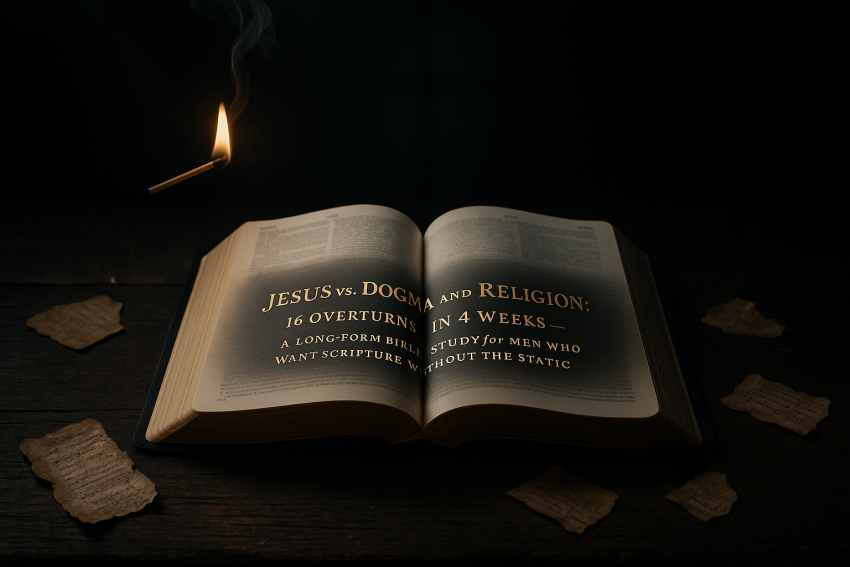
A Man’s Guide to Cutting Through the Noise and Finding the Heart of God
The Pharisees were not villains in their own story. They were devout, Scripture-saturated men who built elaborate fences around the Torah to protect it from violation. Yet in Mark 7:13 Jesus declares, “thus making void the word of God by your tradition that you have handed down” (ESV). Their protective system had become the very thing that nullified God’s command. This pattern repeats across the Gospels, and it forms the backbone of the study you are about to begin.
I am structuring the next four weeks around sixteen specific confrontations where Jesus identifies a religious or dogmatic error, names its root, and recovers the original intent of Scripture. My guiding framework is straightforward and can be captured in this simple table for easy reference:
| Scripture | The Constitution – the founding, authoritative text (the Bible as God’s written Word). |
| Religion | The society – the living system, institutions, and practices that grow up around Scripture. |
| Dogma | The amendments – human interpretations and rules elevated to equal authority with Scripture. |
Jesus consistently strips away the amendments and returns us to the founding text. I will work primarily from the English Standard Version (ESV), with occasional reference to the Greek New Testament via standard lexical tools such as Strong’s and BDAG. My interpretive approach is historical-grammatical, Christ-centered, and practically oriented toward men who carry leadership in families, workplaces, and local congregations.
Week 1 – When Religion Rewrites the Bible
This opening week focuses on four passages where human tradition directly overwrites divine command, showing how good intentions can lead to direct disobedience. We start with the Corban controversy in Mark 7:1-13, where a man-made financial vow allows sons to evade the fifth commandment’s mandate to honor parents—Jesus quotes Isaiah 29:13 to expose hearts far from God despite lips that honor Him. Next, the hand-washing ritual in Mark 7:1-23 shifts the debate to defilement, with Jesus teaching that evil comes from within the heart, not from unwashed hands, drawing on Leviticus purity laws but redirecting to moral reality. Then, the synagogue healing on the Sabbath in Mark 3:1-6, where Pharisees watch to accuse, and Jesus asks if it is lawful to do good or harm on the Sabbath, healing the man’s withered hand in defiance of their interpretation of Exodus 31:14. Finally, the grain-plucking incident in Mark 2:23-28, where disciples eat heads of grain, prompting Jesus to recall David eating showbread and declare, “The Sabbath was made for man, not man for the Sabbath.” Each study includes Mishnaic parallels for oral law, verse-by-verse breakdown, and one immediate application to audit your own traditions against Scripture.
- The Corban controversy (Mark 7:1-13): Financial vow nullifies honoring parents; Isaiah 29:13 quoted.
- Hand-washing ritual (Mark 7:14-23): Defilement from heart, not hands; Leviticus redirected.
- Synagogue healing on Sabbath (Mark 3:1-6): Mercy over regulation; Exodus 31:14 defied.
- Grain-plucking incident (Mark 2:23-28): Sabbath for man; David’s showbread recalled.
Week 2 – Society in Designer Robes
Here we examine four texts that peel back polished exteriors to reveal internal emptiness, targeting hypocrisy in leaders and followers alike. The fasting debate in Mark 2:18-22 contrasts John’s disciples and Pharisees fasting while Jesus’ feast, with the bridegroom parable explaining joy in His presence and new wine requiring new wineskins. The tithing-of-herbs indictment in Matthew 23:23-24 accuses scribes of giving a tenth of mint, dill, and cumin while neglecting justice, mercy, and faithfulness—Jesus calls them blind guides straining gnats but swallowing camels. The clean-cup metaphor in Matthew 23:25-26 describes washing the outside while inside full of greed and self-indulgence, urging first clean the inside. The heavy-burden rebuke in Matthew 23:2-4 notes leaders binding burdens without lifting a finger, sitting in Moses’ seat but failing to practice what they preach. Word studies on dikaiosynē (justice), eleos (mercy), and pistis (faithfulness) from the Septuagint, plus boundary-marker archaeology, will anchor the exegesis, ending with steps to align outward practice with inward reality.
- Fasting debate (Mark 2:18-22): Bridegroom parable; new wine, new wineskins.
- Tithing-of-herbs indictment (Matthew 23:23-24): Justice, mercy, faithfulness neglected; gnat/camel.
- Clean-cup metaphor (Matthew 23:25-26): Outside clean, inside greedy; clean inside first.
- Heavy-burden rebuke (Matthew 23:2-4): Burdens bound, no help; Moses’ seat hypocrisy.
Week 3 – Lobbyists in God’s House
Three passages expose how worship becomes commerce and relationships disposable. The divorce-certificate loophole in Matthew 19:3-9 tests Jesus on any-cause divorce from Deuteronomy 24:1, but He returns to Genesis 2:24’s one-flesh ideal, allowing exception only for porneia due to hard hearts. The temple cleansing in John 2:13-16 (with parallels in Matthew 21:12-13, Mark 11:15-17, Luke 19:45-46) drives out sellers, overturns tables, quoting Isaiah 56:7 and Jeremiah 7:11 against a den of robbers. Background includes Tyrian shekels required for temple tax, animal sales for sacrifices, and Annas family profiteering from the bazaar in the Court of Gentiles. Each segment details economic exploitation, Jesus’ zeal for His Father’s house as prayer for all nations, and application to modern monetized ministry.
- Divorce-certificate loophole (Matthew 19:3-9): Genesis 2:24 ideal; porneia exception.
- Temple cleansing (John 2:13-16 & parallels): Isaiah 56:7, Jeremiah 7:11 quoted; tables overturned.
- Economic background: Tyrian shekels, animal sales, Annas profiteering.
Week 4 – The Bible Points to the King
The series climaxes with seven antitheses from the Sermon on the Mount in Matthew 5:21-48, plus John 5:39-40. Jesus says “You have heard… but I say” on anger equaling murder (Exodus 20:13), lust equaling adultery (Exodus 20:14), divorce beyond porneia, oaths beyond yes/no (Numbers 30:2), eye-for-eye limited to courts (Exodus 21:24), and loving neighbors extended to enemies (Leviticus 19:18). He fulfills the Law and Prophets. In John 5:39-40, Jews search Scriptures for eternal life but refuse to come to Him. Rabbinic interpretation methods, fulfillment motifs, and the ultimate error of bibliolatry over Christology close the study, with applications to Kingdom ethics in daily decisions.
- Anger = murder (Matthew 5:21-22; Exodus 20:13).
- Lust = adultery (Matthew 5:27-28; Exodus 20:14).
- Divorce beyond porneia (Matthew 5:31-32).
- Oaths beyond yes/no (Matthew 5:33-37; Numbers 30:2).
- Eye-for-eye to courts (Matthew 5:38-42; Exodus 21:24).
- Love enemies (Matthew 5:43-48; Leviticus 19:18).
- Scripture search, refuse Christ (John 5:39-40).
Every week follows the same rhythm—context, exegesis, exposure, recovery, application. The goal is not shame but freedom: the kind that lets you lead without the scaffolding.
Call to Action
If this study encouraged you, don’t just scroll on. Subscribe for more devotionals, share a comment about what God is teaching you, or reach out and tell me what you’re reflecting on today. Let’s grow in faith together.

Sources
Disclaimer:
The views and opinions expressed in this post are solely those of the author. The information provided is based on personal research, experience, and understanding of the subject matter at the time of writing. Readers should consult relevant experts or authorities for specific guidance related to their unique situations.