
2,607 words, 14 minutes read time.
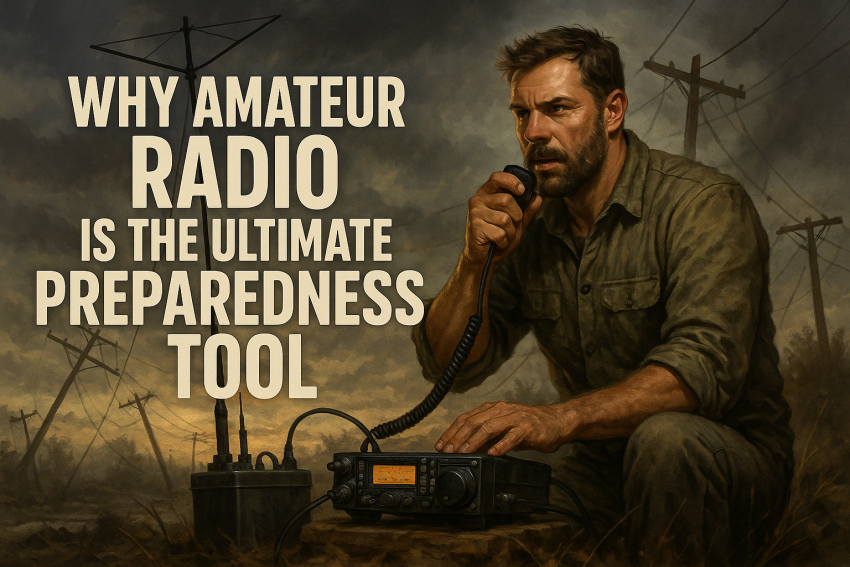
When you strip away the luxury of flawless infrastructure and ease of instant connectivity, you find yourself facing a simple truth: in a crisis, communications falter fast. Power grids go down. Cell towers fail. Internet & landlines sputter and vanish. If you’re serious about being prepared — truly ready — you need the ability to talk when others can’t. That’s where amateur radio comes in. For the man who wants capability — not just gear — ham radio offers a unique, resilient path to readiness. I’ve been around emergency‑communications and communications‑systems long enough to know: a well‑equipped and practiced amateur radio operator is one of the last lines of reliable communication when all else fails.
Let’s dig into why that matters, what it really gives you, how you can start building toward it (even before you take the exam), and how you fit into the bigger picture of preparedness and service.
The Preparedness Mindset Shift
Preparedness isn’t just about buying gear, stacking food, or having an emergency kit under the bed. It’s about mindset — being ready to act, ready to engage, ready to be the link. Too often, communications is an afterthought in disaster planning: we have a generator, we have water, we have food — but who’s going to speak when the tower collapses? Real preparedness sees communications as foundational.
When the cell network is down and the internet’s off‑line, the first casualty is connection. Thus, the man who anticipates real disruption doesn’t just ask “How do I keep my lights on?” — he asks “How will I talk?” If your aim is to serve your family, your neighbors, or your community when normal systems quit, then you need a system that doesn’t rely on the grid or a single service provider. Enter amateur radio.
What sets HAM radio apart from most prepping gear is not just redundancy, but autonomy. It allows you to build your own network, set your own power source, and reach out independent of commercial infrastructure. Where many preppers buy the generator and portable solar panel and consider themselves ready — a ham‑operator is asking “Can I still send a message even if the grid, internet, and towers are all down?” That shift from “backup” to “capability” is what elevates ham radio to the ultimate tool.
What Makes Amateur Radio the Ultimate Tool
Let’s break down the key advantages of amateur radio for preparedness, and why these matter in real world scenarios:
Infrastructure‑independence. One of the strongest claims of amateur radio is that it can operate entirely outside normal infrastructure. According to the American Radio Relay League (ARRL), licensed amateur radio operators “set up and operate organized communication networks locally for governmental and emergency officials … when power outages and destruction of telephone, cellular and other infrastructure‑dependent systems” occur. arrl.org Imagine being able to deploy a station off‑grid, run on battery or solar, and still talk. That kind of autonomy changes your preparedness posture.
Reach and flexibility. Communication isn’t just local. Amateur radio spans from local VHF/UHF nets to long‑haul HF transmissions and digital modes. As one article puts it, ham radio “fills communication gaps that often occur during emergencies when conventional systems fail or become overwhelmed.” Domestic Preparedness+1 What that means: you’re not locked into a single channel—you can adjust to the scenario: local for short haul, HF for longer reach.
Training and experience. Preparing to get your licence isn’t just about passing a test—it’s about gaining understanding of antennas, propagation, power, situational awareness, nets, protocols. One guide explains that obtaining the licence and joining emergency communications organizations builds knowledge of electronics, antennas and radio‑wave characteristics that “make you a more effective communicator.” Ham Radio Prep That translates into real, tactical skills rather than simply owning gear.
Service and community. Being an amateur radio operator often means tying into volunteer networks that activate during emergencies. From the ARRL’s Amateur Radio Emergency Service (ARES) to local club nets, you become part of a team. That team‑aspect isn’t just altruism—it’s resilience. When you know who’s listening, who’s ready, what band they’re on, your gear and skill become part of something larger.
Value for money & capability. Compared to many preparedness tools, your licence + gear + practice unlocks far more capability than simply buying “survival radios” off the shelf. A handheld rig, an antenna, basic power source transforms into a capability that works when typical systems don’t. It’s not the flashiest gear, but for readiness it ranks high.
Real‑World Stories & Case Studies
It’s one thing to talk theory—another to see how amateur radio actually performs when the screws come loose.
When Hurricane Maria devastated Puerto Rico in 2017, nearly all communications were down. According to Ham Radio Prep, amateur radio operators “helped restore lifelines … using HF radios, WinLink digital systems, and simple dipole antennas, relaying health and welfare messages to the mainland.” Ham Radio Prep In effect, ham radio became the bridge when all other bridges were gone.
In another example, a preparedness article noted that during major emergencies, amateur radio operators “quickly set up communication stations in various locations… from urban centers to remote areas,” providing redundancy when standard channels failed. Ohio Military Reserve On the flip side, there are voices in ham‑forums who caution that ham radio is not magic: one user wrote bluntly:
“Ham radio is not a functional communications solution, ESPECIALLY in an emergency… The radio is ONLY useful if there is someone at the far end.” RadioReference.com Forums
This isn’t a deal‑breaker—it’s a reality check: you need to practise, network, prepare, and know what you’re doing. The truth is: the potential is huge, but the work is real.
For you as the reader gearing toward that licence one day, these stories signal two things: (1) this tool works in extreme situations, and (2) you must start building the habit now — because when you’re called upon, you’ll need more than a licence: you’ll need readiness.
What You Should Be Doing Now (Even Before the Licence)
Even though you’re not focused on the test right now, there are concrete steps you should start taking so your ham‑radio‑preparedness journey is real and forward‑moving.
First, adopt the operator mindset. That means you aren’t merely a listener; you’re someone who will use radio, who understands the mission, who networks with other operators. Monitor a local VHF repeater, listen to nets, figure out the language, the cadence, the operational practices. Get used to calling “listening, listening, CQ” and watching how messages flow.
Second, join your local amateur radio club. Even before licence, you can visit as a listener, attend a net or meeting. Build relationships. Find the guys in your area who deploy in emergency communications, ask what their gear looks like, how they train, what standards they use.
Third, gear up with purpose, not just hobby. Yes – you’ll eventually have more equipment. But begin with something simple: a reliable handheld VHF/UHF transceiver, charged by battery, capable of being used off‑grid. Think about power backup: a car battery, solar panel, deep‑cycle battery. Consider antennas you can deploy on‑site: mobile whip, portable dipole, an antenna that doesn’t require a tower. The goal: you can deploy quickly, you can operate off‑grid, you can talk when others cannot.
Fourth, begin training. Participate in drills or nets (your club likely holds them). Practice message relays, understand basic procedures, get comfortable with “net control” vs “check‑in station”. Learn basic radio etiquette: plain language, short transmissions, clarity. The Federal Communications Commission’s EMCOMM guide emphasises: “Use plain language… Speak slowly and clearly… Pause every 30 seconds during lengthy transmissions.” transition.fcc.gov Training transforms gear into capability.
Fifth, build your network. Know who’s on your net, who’s your backup, what frequencies are used locally, what agencies coordinate with amateur radio in your region. Being isolated isn’t as powerful as being connected intelligently. When you get your licence, you’ll be ready to plug into this network.
The Licence Path (Briefly as a Means to the End)
We aren’t focusing in depth on getting your licence today — but it’s essential to understand that the licence enables the preparation. When you become a licensed operator, you unlock the full capability of amateur radio. You gain access to more frequencies, more modes, more responsibility.
The entry‑level licence (Technician in the U.S.) lets you use VHF/UHF frequencies largely suitable for local and regional operations. But many emergency communications roles – especially HF (longer range) – require the General or even Amateur Extra licence. A ham‑preparedness guide notes: the Technician licence is a start, yet the ultimate goal could be Amateur Extra because “the extra frequency privileges may come in handy in some emergency situations … and the real benefit is the knowledge of electronics, antennas, and radio wave characteristics that you’ll gain by studying.” Ham Radio Prep
In short: the licence is the key that opens the door. But the door leads to capability and service — not just the test.
Practical Preparedness Considerations Specific to Amateur Radio
Let’s talk technical and tactical details. As someone with a preparedness mindset, you always think “mission first”, then gear, then training. Here are the key domains:
Power options. In a grid‑down scenario, your radio does you little good if you have no power. Consider battery banks, deep‑cycle batteries, solar panels, car alternator systems, portable generator backup. The goal: if your home loses power—or you deploy to a remote site—you can still transmit. Some amateur radio operators pack a power kit just like their bug‑out bag.
Antenna strategy for resilience. Many ham hobbyists will mount huge fixed towers. That may be fine for the hobby—but for preparedness you need agility. Portable dipoles, easily deployable masts, stealth wire antennas, verticals that can be used from vehicles or remote sites. Your antenna needs to be practical for a real scenario. Also think about the antenna tuner, feed line quality, grounding and lightning protection.
Communications modes: voice, digital, nets, interoperability. Voice (SSB, FM) will be your primary mode. But digital modes (WinLink email over radio, PSK31, FT8) have gotten more and more relevant for emergency comms. For example, the ham‑radio guide notes: operators in Puerto Rico used WinLink and HF digital to relay health‑and‑welfare messages when conventional systems failed. Ham Radio Prep Also: integration with nets and emergency management organizations matters. Being effective means knowing the nets, how messages are passed, how you plug your station into a wider system.
Integration with your overall preparedness system. Your amateur radio capability isn’t a silo—it plugs into your broader readiness: your go‑bag, your mobility plan, your communications plan for family/neighborhood. For example: when you’re packing your field kit, ask “What radio gear, power source, antenna setup can I bring with a backpack or vehicle in under ten minutes?” When you’re planning your home resilience, ask “Where will my radio station be if the house loses power? Can I get out and set up portable?” This mindset ensures your ham radio setup supports your preparedness posture — rather than being an unused hobby.
Maintenance, training, iteration. Just as you maintain your vehicle or your generator, you maintain your radio station. Practice transmissions, check batteries, verify antennas, monitor battery health, update software if applicable. All the gear in the world does nothing if it sits and gathers dust. Get on nets weekly, listen, transmit occasionally, practice emergencies (simulate grid‑down, AC off, battery only). The mantra: readiness isn’t a purchase—it’s a discipline.
The Bigger Picture – Why This Matters for You and Your Community
Let’s zoom out for a minute. Why does the man who’s prepping today care about amateur radio — beyond just his own gear? Because this is about leadership, capability, community—and legacy. When you can communicate while others cannot, you become the hub of resilience. You become the link for your family, your neighborhood, maybe your town.
Your amateur radio capability bridges personal readiness and community service. Because the same skills and gear you build for your own emergencies can support others. Some of the most impactful ham radio operations activate not because someone wanted fame—they activated because they answered the call.
You might see yourself as the guy who can step in and bridge information gaps when infrastructure collapses. You can mentor others: younger men, neighbors, friends. You can build a network around you—not just people you know online, but people you physically train with, you call weekly, you coordinate drills with. That adds exponential value to your preparedness posture.
Let me share the intangible: confidence. When you know you can get on the air, you know you have a mode of communication that doesn’t rely on corporate towers. That knowledge changes how you behave in readiness. It changes how you view “what if.” You’re not just hoping for things to go right—you’re prepared for things to go wrong and still function. That’s a mindset men gravitate to.
So: think bigger than your own kit. Let your ham radio preparation reflect the mission of service. Let your license one day be the badge that means you’re ready, not just for your family—but for whoever needs you. And maybe, down the road, you’ll be the guy others reach out to when the network is dead and silence hangs in the air.
Conclusion
In a world where communications are assumed to be seamless—and yet fail more often than we admit—the man who builds capability in advance wins an edge. Amateur radio isn’t merely a hobby. It’s a readiness discipline, a service commitment, a piece of architecture for communication when everything else has failed.
You don’t need to wait for the licence exam to start. You don’t need to buy the most expensive gear off the bat. What you need is the mindset, the training, the network, and the practise. By the time you’re ready to take the test, you’ll already be operating like an amateur radio operator in the field of emergency preparedness.
Picture yourself licensed, radio active, portable station powered by batteries or solar, antenna deployed, you’re receiving and sending transmissions, coordinating, bridging. That day isn’t the finish line—it’s the beginning of your capability.
If you’re serious about being prepared, serious about being useful when others are unable, then amateur radio is the tool you should build into your plan now. Start listening, start training, start networking. The licence will come—but the readiness begins today.
If this blog resonates with you, I invite you to join the conversation. Subscribe to our newsletter and let’s build this community of capable men who refuse to rely on someone else’s infrastructure. Leave a comment below sharing your current communications plan. Contact me through this form tell me your goals, ask your questions, and let’s move forward together. You don’t have to wait to be capable. Start now.

Sources
- Amateur Radio Emergency Communication – ARRL
- Unleashing the Power of Amateur Radio in Times of Emergency – Domestic Preparedness
- Ham Radio Emergency Communications Guide – Ham Radio Prep
- Amateur Radio Emergency Service (ARES) – ARRL
- The Vital Role of Ham Radio in Disaster Preparedness – Radio Design Group
- Tips for Ham Radio Operators: Natural Disaster Communications – IBTS on Hand
- Ham Radio and Emergency Preparedness – United Spinal Association
- The Importance of Amateur Radio in Emergency Management – Ohio Military Reserve
- Novel Amateur Radio Drill Aids in Emergency Communications – U.S. Department of Energy
- S. 459 – Amateur Radio Emergency Preparedness Act (legislation)
- HAM radio for emergencies – RadioReference.com Forums (critical commentary)
- Amateur Radio Emergency Communications – Wikipedia
- Ham Radio – Emergency Communications – OffGrid Survival
- Utilizing Machine Learning for Signal Classification and Noise Reduction in Amateur Radio – arXiv (academic angle)
Disclaimer:
The views and opinions expressed in this post are solely those of the author. The information provided is based on personal research, experience, and understanding of the subject matter at the time of writing. Readers should consult relevant experts or authorities for specific guidance related to their unique situations.