
1,375 words, 7 minutes read time.
I thought strength was everything. That a man was measured by the weight he could lift, the scars he could carry, the enemies he could crush. Then I watched Samson fall. The strongest man alive, undone not by sword or spear, but by the sin he refused to see. And standing there that night, sword in my hand, I realized a truth I had spent years running from: strength isn’t enough when sin blinds you.
I was a younger man then, still eager to prove myself among the Philistine soldiers. My beard was patchy, my sword hand unsure, but I swaggered as if I were already a seasoned warrior. Every man in our ranks knew the name of Samson. He was the enemy we cursed and feared, the Nazirite whose strength no army could break. From the time of his birth, his people said, their God had set him apart. Whether you believed that or not, you couldn’t deny his strength. We all knew the stories: the lion torn apart with bare hands, the jawbone of a donkey turned into a weapon that piled corpses high, the city gates ripped from their hinges and carried up a hill like bundles of sticks.
We mocked those stories in public, but in private we believed them. Men like Samson cast a long shadow. He was untouchable, and we hated him for it. But what I didn’t see then, what I only see now, is that Samson wasn’t untouchable at all. He was a man just like the rest of us, carrying the same weaknesses we all hide, only his were larger, more obvious, and more dangerous.
The first time I heard Delilah’s name, we were gathered by a fire outside Gaza, sharpening blades we all knew were useless against him. One of the captains leaned in, lowering his voice, and said, “The lords have found a woman. Her name is Delilah.”
The men erupted in laughter. Of course it would come to this. If iron chains and spears couldn’t bring Samson down, maybe lust could. Everyone knew his weakness. He had a taste for women who weren’t his—Philistine women, prostitutes, foreign wives. He was reckless with his heart, and it made him reckless with his calling. I remember sneering, calling him a fool, saying no man so strong should be so easily undone by desire. I even bet another soldier how long it would take Delilah to worm his secret out of him. I thought I was clever, mocking him. What I didn’t realize was that I was mocking myself. Because I too was a man who sought escape in the wrong beds, who chased the thrill of desire while ignoring the rot it carved in my soul.
At first, Delilah’s attempts made us laugh harder. She begged him for his secret, and he toyed with her. Fresh bowstrings, new ropes, weaving his hair in a loom—each time, she cried out, “The Philistines are upon you!” and each time, he snapped the bonds and laughed like it was a game. He thought he was in control. That’s what pride does to a man. It makes him think he can dance with sin and still call the tune. But every time he played along, he stepped closer to the edge.
The night it happened, I was there. The lords had summoned us to wait in the shadows of Delilah’s chamber. I remember gripping my sword so tightly my knuckles burned. Inside, Samson lay with his head in her lap. We couldn’t see them, but we heard the sound that still chills me—the slow, deliberate slice of shears. His hair, the mark of his vow, the symbol of his strength, was being cut away strand by strand.
When Delilah called out, “Samson, the Philistines are upon you!” we rushed in. He leapt to his feet as always, but this time there was nothing behind his eyes. No fire, no fight, just confusion. We fell on him, and he was helpless. The man who once slaughtered a thousand with a jawbone couldn’t push a single soldier back. We bound him, we beat him, and when the lords commanded, we gouged out his eyes.
I should have felt joy. This was the victory we had long prayed for. But as I watched him stumble in darkness, chains on his wrists, I felt only sickness. Because I realized something that struck deep: Samson had been blind long before we touched his eyes. He was blind to his sin, blind to the danger of pride, blind to the power lust had over him. And in his blindness, I saw myself.
We chained him in the prison, forced him to grind grain like an ox. At first, I spat at him, mocked him, laughed at the sight of a once-mighty man broken down to nothing. But over time, something changed. His hair began to grow. His lips moved in prayer. He carried himself differently—not with arrogance, but with a strange humility. It unsettled me, because I had spent my whole life believing strength meant hiding weakness. Yet here was Samson, blind and chained, somehow stronger in his brokenness than I ever was in my pride.
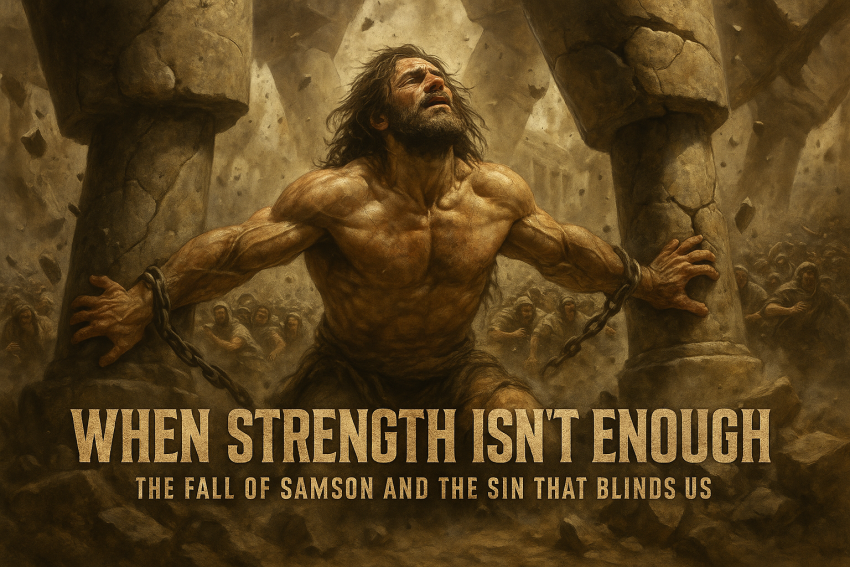
The day of the feast to Dagon will never leave me. Thousands filled the temple, lords and nobles celebrating Samson’s downfall. They dragged him out as a trophy, a crippled dog for us to laugh at. I stood among the crowd as he was placed by the pillars, his hands resting against the stone. His head tilted back, and though his voice was faint, I heard him pray. Not to Dagon, not to us, but to his God. “O Lord God, please remember me. Strengthen me just this once.”
Then the ground trembled. The pillars cracked. The roof groaned. In an instant, the laughter turned to screams as the temple collapsed. Stone and timber crashed down. Dust filled my lungs. Thousands died—including the lords who paid Delilah. And Samson died with them, destroying more in his death than he ever had in his life.
I survived, but I wasn’t the same. I walked away with scars, not just on my body but on my soul. I used to mock him, call him a fool, but now I see I was no different. He was blinded by lust and pride; I was blinded by my own. He lost his strength, his sight, his freedom, but in the end, he finally saw clearly. He cried out to God, and God answered.
That’s why I tell you this, men. Because Samson’s story is not just his story—it’s ours. We chase strength, pride, success, desire. We think we’re in control, until one day we’re not. Sin blinds us, binds us, and grinds us down. And the only way out is to open our eyes before it’s too late. Don’t wait until you’ve lost everything. Don’t wait until you’re chained and broken.
Samson’s fall is a warning. His prayer is a lifeline. And his God—the God who gave him strength in his final breath—is the same God who can redeem you. Even in ruins. Even in weakness. Even in blindness.
I mocked him once. I thought strength was everything. But I’ve learned what Samson learned the hard way: when strength isn’t enough, only God is.

Sources
- Judges 13–16 (The Story of Samson)
- Hebrews 11:32–34 (Samson in the Hall of Faith)
- Matthew Henry’s Commentary on Judges 16
- GotQuestions: What can we learn from the life of Samson?
- Bible Hub Commentary on Judges 16
- David Guzik’s Commentary on Judges 16
- Zondervan Academic: Lessons from Samson
- Desiring God: The Life of Samson
- Christianity.com: Who Was Delilah in the Bible?
- The Gospel Coalition: Samson—Judge of Israel
- Bible Project: Overview of Judges
- BibleRef Commentary on Judges 16
- Hebraic Thought: What Should We Think About Samson?
- My Jewish Learning: Samson the Nazirite
- Enduring Word Commentary on Judges 16
Disclaimer:
The views and opinions expressed in this post are solely those of the author. The information provided is based on personal research, experience, and understanding of the subject matter at the time of writing. Readers should consult relevant experts or authorities for specific guidance related to their unique situations.