
1,450 words, 8 minutes read time.
Gentlemen, if you’ve ever felt the sting of a game that feels more like a grind than an adventure, you know the frustration. It’s like your favorite wrench suddenly refusing to fit a bolt—you’re stuck, your momentum is halted, and the flow is gone. But the future of gaming is about to flip that script. Imagine worlds that respond to you, characters that evolve with you, and gameplay that adapts to your skill and style. That’s the power AI is bringing to the table. For those of us who thrive on tinkering with machines, pushing boundaries, and creating in 3D spaces, AI in gaming isn’t just a tool—it’s a co-pilot for exploration, challenge, and innovation.
Smarter NPCs: The Heartbeat of Dynamic Gameplay
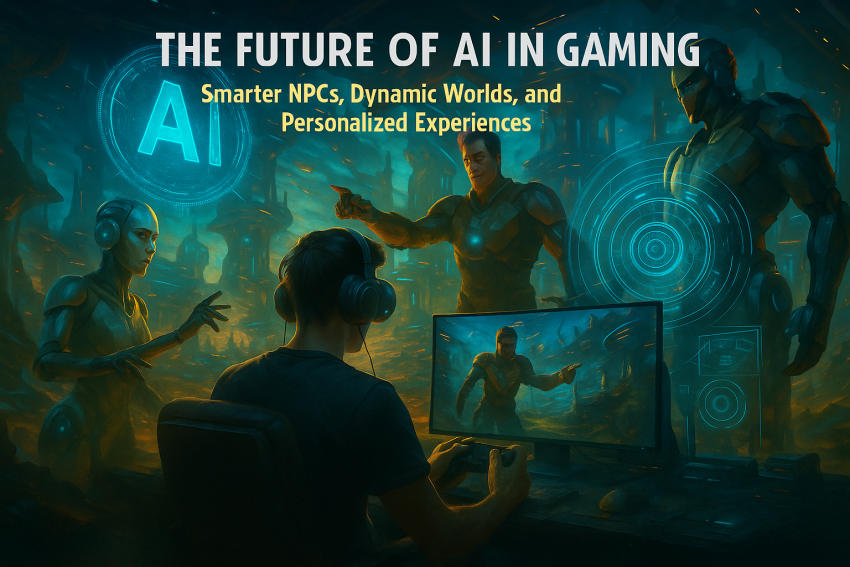
NPCs—or non-player characters—used to be little more than glorified cardboard cutouts. They repeated the same lines, marched in pre-set paths, and offered rewards that felt detached from the player. Today, AI is turning those NPCs into living, breathing entities. Smarter NPCs can remember your past actions, react dynamically to your decisions, and engage in conversations that feel unscripted. Imagine walking into a tavern where the barkeep recognizes you from your last raid and even references your past choices—this is the kind of immersion we’re talking about.
What’s exciting for us, especially those who love the technical side of 3D printing and machinery, is that these NPCs are essentially “assembled” from AI algorithms in ways that mimic human cognition. Developers now treat NPC behavior like they would a complex mechanical assembly: every part interlocks with another to produce smooth, reliable, yet surprisingly unpredictable outcomes. It’s like watching your custom 3D printer handle a challenging print with precision—the satisfaction comes from the harmony between design and execution.
This evolution isn’t just about realism—it’s about challenge and engagement. Smarter NPCs force players to think strategically, react on the fly, and invest emotionally. They’re partners in your story, not just background props. For men who thrive on mastery and skill, this change transforms gaming from a passive escape to an active mental workout.
Dynamic Worlds: Procedural Generation Meets AI
Static game environments feel predictable, like printing the same model over and over. But AI-driven dynamic worlds are procedural, living, and evolving. These aren’t just randomly generated landscapes—they adapt to your presence, your choices, and even your playstyle. Walk through a forest once, and it reacts differently than your last visit. Conquer a fortress, and the next one you approach might reinforce itself, armed with new defenses. It’s like tuning your slicer for different filaments and seeing the outcome in real time: you’re engaged, challenged, and continuously learning.
Dynamic worlds also allow developers to create infinitely replayable content without manually designing every nook and cranny. Think of it as having a warehouse full of modular 3D parts—you assemble them differently every time, producing a unique, functional outcome with each iteration. This procedural creativity keeps players invested and constantly exploring. You never know what’s around the corner, and every session offers something novel, whether it’s a hidden quest, a unique terrain formation, or a strategic opportunity.
For 3D printing enthusiasts, the appeal is obvious: the same satisfaction we get from iterating a complex print is mirrored in these AI worlds. Every interaction feels crafted, every environment reacts logically, and every challenge feels earned.
Personalized Experiences: AI Tailored to You
Nothing kills immersion faster than a game that’s “one size fits all.” Too easy? Boring. Too hard? Frustrating. AI personalization changes all that by analyzing how you play and tailoring the experience accordingly. It’s like calibrating a 3D printer for your favorite filament—your setup, your style, your quirks. AI-driven systems can adjust enemy behaviors, suggest missions, or modify storylines to match your skills and interests.
For example, if you’re a risk-taker who thrives on high-stakes missions, AI might push tougher enemies or more complex challenges your way. If you prefer meticulous planning and exploration, the game could offer hidden puzzles or strategic quests that reward patience. The result is a game that doesn’t just react to your choices—it understands you. And for men who love optimizing and mastering systems, this is pure gold. Every session feels tailored, every achievement earned, and every victory satisfying.
The long-term impact is more than fun; it’s engagement. Games can now hook players more effectively by making every session feel meaningful. Your decisions shape the narrative, your style influences the challenge, and the AI constantly adapts, ensuring that your experience is never static or repetitive.
The Role of Large Language Models in Gaming
One of the most exciting advancements is how AI is redefining communication within games. Large Language Models (LLMs) allow NPCs to converse naturally, respond to nuanced questions, and even remember previous interactions. Imagine interrogating a villain, and their dialogue evolves based on your prior encounters, or seeking advice from a mentor NPC that adapts its responses to your choices and strategy. It’s like having an assistant in your 3D print lab who not only knows your printer settings but can anticipate the tweaks you’re about to make before you touch the controls.
This integration makes storytelling deeper and more immersive. Conversations no longer feel like rigid scripts—they’re fluid, context-aware interactions that enrich your connection to the game world. For enthusiasts who enjoy strategy, exploration, and tactical thinking, this creates a layer of depth that traditional games simply can’t match.
The Future: AI-Powered Co-Playable Characters and Immersive Worlds
Looking ahead, AI isn’t just creating smarter NPCs—it’s producing co-playable characters that can evolve alongside you. Imagine teammates that learn your playstyle, anticipate your moves, and coordinate with you in real time. AI companions will no longer be predictable sidekicks; they’ll be dynamic partners who enhance your experience, challenge your strategies, and even teach you new ways to approach the game.
From an engineering standpoint, this is thrilling. It’s like watching a 3D printer with adaptive controls: the machine doesn’t just follow instructions—it understands material behavior, compensates for anomalies, and optimizes output in real time. In gaming, AI companions bring the same level of adaptive intelligence to strategy, combat, and exploration, creating worlds that feel alive and responsive.
Challenges and Ethical Considerations
Of course, with all this power comes responsibility. The integration of AI in gaming raises ethical questions. Player data is critical to personalization, but privacy must be respected. NPC behavior and AI decision-making must remain predictable enough to avoid manipulation or exploitation. The challenge lies in leveraging AI’s capabilities while ensuring the player remains in control and the game stays fair.
For gamers and enthusiasts, this is akin to experimenting with new 3D printing techniques: you want to push the limits, but you need to understand the risks and constraints. Responsible development ensures that AI enhances the experience rather than undermining it, preserving both immersion and integrity.
Conclusion: Embrace the Future
Gentlemen, the future of gaming isn’t about bigger graphics or endless loot—it’s about smarter, adaptive, and deeply personal experiences. AI is transforming gaming into an active, evolving adventure where your decisions matter, your style shapes the outcome, and every quest feels like your own personal journey.
The question is simple: are you ready to play in a world that reacts to you, adapts with you, and challenges you at every turn? AI is the engine driving that revolution.
Join the Conversation
Stay ahead of the curve—subscribe to our newsletter at https://wordpress.com/reader/site/subscription/61236952 for insights on AI, gaming, and innovation. Or, drop a comment below to share your thoughts, experiences, or challenges, or reach out directly through our contact form at https://bdking71.wordpress.com/contact/. Let’s shape the future of gaming together.

Sources
- Tribe AI: Revolutionizing Interactive Worlds and Player Experiences
- Inworld AI: AI NPCs and the Future of Gaming
- Medium: How AI Fuels Gaming Innovation
- NYU Engineering: The Future of AI in Gaming
- Appinventiv: How AI is Propelling the Gaming Industry
- Medium: The Future of Gaming with AI-Driven NPCs
- Oyelabs: How AI is Changing the Gaming Industry
- Novus ASI: The Future of AI in Gaming
- AI Infra Link: Creating Smarter NPCs and Dynamic Worlds
- Medium: The Future of AI in Game Development
- Remocapp: How AI is Transforming Gaming
- Intel Capital: Inworld AI’s AI-Driven NPCs
- VGLeaks: AI-Powered NPCs and Adaptive Game Worlds
- KeenGamer: The Evolution of AI in Video Games
Disclaimer:
The views and opinions expressed in this post are solely those of the author. The information provided is based on personal research, experience, and understanding of the subject matter at the time of writing. Readers should consult relevant experts or authorities for specific guidance related to their unique situations.