
853 words, 5 minutes read time.
Introduction
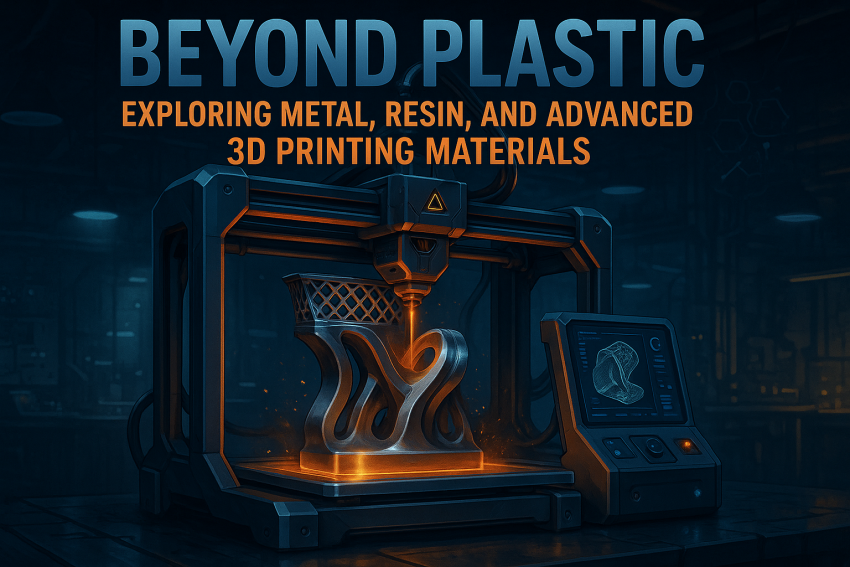
Alright, listen up, fellas. If you’re still printing in PLA and calling it a day, it’s time to level up. The world of 3D printing has evolved, and so should your toolkit. We’re talking about metal, resin, and high-performance polymers—materials that can take your prints from “meh” to “mission-critical.” Whether you’re in aerospace, automotive, or just tinkering in your garage, this guide is your blueprint to the next frontier.
Metal 3D Printing Materials
Metal 3D printing isn’t just for aerospace engineers and NASA anymore. It’s for anyone who needs parts that can take a beating. We’re talking about alloys like titanium, Inconel, and cobalt chrome—materials that laugh in the face of heat and stress. Processes like Selective Laser Melting (SLM) and Direct Metal Laser Sintering (DMLS) are the go-to methods for fusing these metals into solid parts. These techniques are used in industries ranging from aerospace to medical, where precision and durability are non-negotiable. Protolabs Network
But here’s the kicker: metal 3D printing used to be expensive and out of reach for most. Enter IIT Indore’s Micro-Plasma Metal Additive Manufacturing (MP-MAM) technology. This game-changer slashes costs and energy consumption, making metal printing more accessible than ever. It’s already making waves in sectors like healthcare and aerospace. The Times of India
Resin-Based 3D Printing Materials
If you’re after detail, resin’s your best friend. Resins cure under UV light to form solid parts with incredible precision. They’re ideal for creating intricate designs, dental models, and jewelry prototypes. The most common types include standard, tough, durable, heat-resistant, rubber-like, dental, and castable resins. Each has unique properties tailored to specific applications. 3Dnatives
But it’s not just about looks. Resin printing offers high resolution and smooth surface finishes, making it a go-to for functional parts that need to fit and perform. Plus, advancements in resin formulations are pushing the boundaries of what’s possible, opening doors to new applications and industries.
Advanced 3D Printing Materials
Now, let’s talk about the heavy hitters: high-performance polymers and composites. Materials like PEEK, PEKK, and PEI (ULTEM) are engineered to withstand extreme temperatures and mechanical stress. They’re used in industries where failure isn’t an option—think aerospace, automotive, and medical. These materials enable engineers to reduce costs and eliminate lengthy lead times, allowing for rapid prototyping and production of end-use parts. GoEngineer
Composite materials, such as carbon fiber and glass fiber reinforced polymers, offer enhanced strength-to-weight ratios, making them ideal for applications requiring lightweight yet durable components. These composites are revolutionizing industries by enabling the production of parts that are both strong and lightweight, without compromising on performance.
Integration with Artificial Intelligence
Artificial Intelligence isn’t just for self-driving cars and smart assistants. It’s making its mark in 3D printing, too. AI is being used to optimize designs, predict material behavior, and even monitor print quality in real-time. Platforms like 3YOURMIND analyze machine performance data to predict maintenance needs, reducing downtime and extending equipment life. Phrozen Technology
Furthermore, AI-driven tools are streamlining the design process by automating tasks such as part orientation and support generation, leading to more efficient and cost-effective printing. These advancements are not only improving the speed and accuracy of 3D printing but also expanding its capabilities to new and innovative applications.
Conclusion
Gentlemen, the days of basic prints are behind us. The materials and technologies available today are pushing the boundaries of what’s possible in 3D printing. Whether you’re crafting a custom tool, prototyping a new product, or just experimenting in your workshop, embracing these advanced materials and integrating AI into your workflow can set you apart from the crowd.
Don’t let your prints be basic. Step into the future of 3D printing with metal, resin, and high-performance polymers. And if you’re hungry for more insights, tips, and updates, subscribe to our newsletter, drop a comment below, or reach out directly through our contact form. Let’s keep pushing the limits together.
Call to Action:
Ready to take your 3D printing game to the next level? Subscribe to our newsletter for the latest tips, tricks, and industry news. Got questions or want to share your experiences? Leave a comment below or contact us directly. Let’s keep the conversation going.

Sources
- Markforged: Metal 3D Printing Materials
- 3Dnatives: Different Types of Resins for 3D Printing
- Formlabs: Guide to 3D Printing Materials
- HP: Types of 3D Printing Metals & Metal Filaments
- Protolabs: Metal 3D Printing Materials Guide
- Simplify3D: Ultimate 3D Printing Materials Guide
- All3DP: High-Performance 3D Printing Materials Guide
- 3DS: The Best Resins for 3D Printing
- Sculpteo: 3D Printing Resin Guide
- MSE Supplies: Metal Powders for 3D Printing
- Tom’s Hardware: Recyclable 3D-Printed PCB with Liquid Metal
- Times of India: IIT Indore’s Low-Cost Metal 3D Printing Technology
- The Verge: Anker’s UV Printer E1 for Textured Printing
- Axios: 3D Printing’s Next Act: Big Metal Objects
Disclaimer:
The views and opinions expressed in this post are solely those of the author. The information provided is based on personal research, experience, and understanding of the subject matter at the time of writing. Readers should consult relevant experts or authorities for specific guidance related to their unique situations.