
1,190 words, 6 minutes read time.
Introduction: When Machines Start Thinking Like Artists
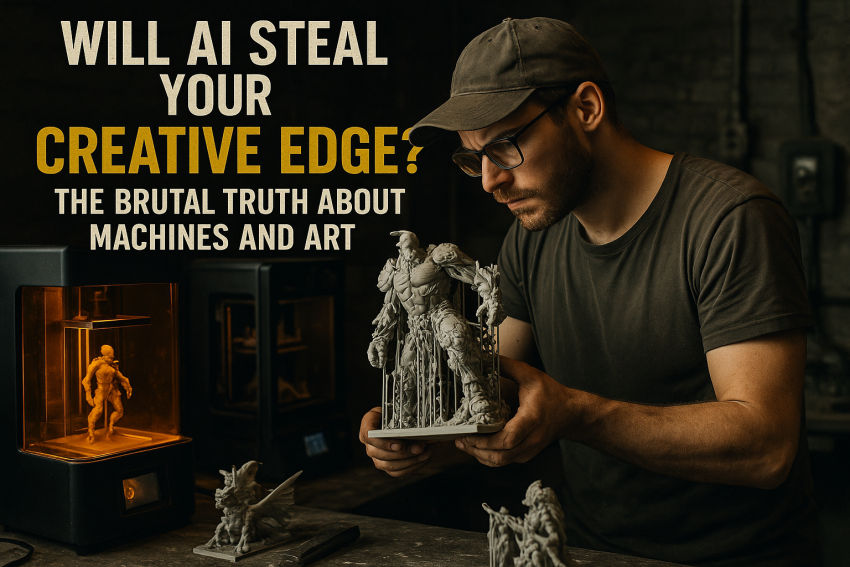
Picture this: you’re in your workshop, hands smeared with resin, watching your latest 3D print come alive layer by layer. You’ve spent hours tweaking supports, adjusting settings, chasing perfection. Now imagine a machine doing that for you—without sweat, without frustration, without that gut-level sense of pride when a piece finally hits just right. That’s the reality creeping into our world. Artificial Intelligence is creeping into creativity, and it’s tempting to ask: could AI eventually replace the human spark behind our work?
For guys who thrive on building, tinkering, and pushing limits in 3D printing, this isn’t just tech talk. This is a wake-up call. Machines are learning fast, generating ideas, art, even designs that look like they came from a master’s hand. But does that make them creative, or is it like using a power drill to carve wood—you get something functional, but the soul isn’t there.
The Anatomy of Creativity: Why Humans Still Hold the Cards
Let’s strip it down: creativity isn’t just producing output. It’s rooted in experience, mistakes, risk, and emotion. Every failed print, jammed extruder, or warped layer teaches lessons no AI can feel. Human creativity has an intuitive pulse. You know when a design is off before it prints. You sense balance, proportion, and aesthetics in ways a machine only approximates.
AI, on the other hand, runs off patterns, statistics, and datasets. It doesn’t know satisfaction, frustration, or joy. It can mimic, but it cannot feel. And feelings are what separate a mediocre 3D print from something that makes your chest swell when you hold it.
Think of AI as that ultra-efficient, annoyingly precise assistant you wish existed. It can render a file in minutes, suggest color palettes, or generate hundreds of iterations in a heartbeat. But the vision behind the project—the stubborn, human stubbornness that drives innovation—remains yours.
AI in the Workshop: Tools, Not Replacements
Here’s where things get practical. AI can massively speed up ideation. Say you’re designing a complex gear assembly. AI can test tolerances, simulate stress points, and suggest alternatives you might not have considered. In the world of 3D printing, this is a godsend. You can cut hours off design cycles and still push your prints to new levels of precision.
But here’s the catch: if you rely too heavily on AI for the “creative” part, you risk producing work that feels sterile. The designs might be optimized, but they won’t have that signature flair that makes people stop and say, “Wow, someone really crafted that.” The human eye for nuance, the gut instinct for aesthetics, and the willingness to experiment recklessly still reign supreme.
Imagine a top-shelf 3D printer that refuses to play by your rules. That’s AI without your guiding hand—it can’t improvise when things go wrong, it can’t adapt to the weird, gritty realities of hands-on creation. That’s your edge, your creativity, and it’s something no algorithm can replace.
The Hybrid Approach: Collaborating with Machines
The sweet spot isn’t humans versus AI—it’s humans with AI. In the workshop, AI should act like a co-pilot, not the pilot. You throw the vision into the cockpit, and it helps you plot multiple courses, calculate tolerances, and refine your prints faster than ever. Think of it like having a friend who never gets tired and always has a second opinion—but never can quite tell you why something feels right.
This collaboration opens doors. You can tackle projects that would have been impossible solo, like intricate lattice structures, ultra-complex mechanical assemblies, or high-resolution resin prints with hundreds of micro-details. AI handles the grunt work and lets you experiment without fear of wasting time on trial-and-error. You still make the final calls. You still own the spark.
Ethics and Ownership in the Age of AI
There’s another layer to consider: ownership. When AI generates a design inspired by millions of human-created models, who owns it? If a machine churns out a piece that resembles your style, how do you claim credit? These questions aren’t theoretical—they’re happening now.
As creators, you need to stay vigilant. Use AI responsibly, protect your IP, and make sure your designs remain authentically yours. Think of it like guarding your workbench: tools can make you faster, but someone else picking up your resin mix shouldn’t take your innovation.
The Future of Creativity: Amplified, Not Replaced
Here’s the reality: AI is going to get better. Way better. But human creativity isn’t going anywhere. Your experience, instincts, and willingness to risk failure are irreplaceable. AI amplifies your abilities—it’s the turbo boost, not the engine.
The ideal scenario? You push the limits of your imagination while AI handles repetitive calculations, optimization, and iteration. That’s how you dominate in the 3D printing space, constantly evolving designs that are bold, intricate, and unmistakably yours.
Machines can assist, inspire, and optimize, but they cannot dream. That’s still a strictly human domain. And anyone who’s spent a night troubleshooting a jammed resin printer knows that half the battle—and the joy—comes from wrestling with reality and winning.
Conclusion: Own Your Creative Edge
So, will AI steal your creative edge? Not if you play it smart. AI is a partner, a precision tool, a way to scale your imagination. It isn’t a replacement for the grit, instinct, and stubborn human intuition that makes your work stand out. Your creativity—the one that survives countless failures, messy prints, and late-night caffeine binges—remains untouchable.
Here’s your move: embrace AI as a collaborator, experiment boldly, and continue pushing the boundaries of what’s possible in 3D printing and design. But don’t hand over your spark. The future of creativity belongs to those who wield technology, not those who let it lead.
If you’re ready to take your creative game to the next level, subscribe to our newsletter at https://wordpress.com/reader/site/subscription/61236952 for insider tips, tutorials, and discussions. Or join the conversation below—share your experiences, your frustrations, and your victories in the workshop. You can also contact me directly through my contact form. Let’s shape the future of human creativity together, one print at a time.

Sources
- Forbes: Will AI Replace Human Creativity?
- Oxford University: Artists Cannot Be Replaced by Machines
- Crayon: Can AI Replace Humans in Artistic Jobs?
- Reddit Discussion: AI Won’t Destroy Human Creativity
- World Economic Forum: Why AI is Replacing Some Jobs Faster Than Others
- PayBump: 25 Jobs AI Can’t Replace Yet
- Nexford: How Will Artificial Intelligence Affect Jobs 2025-2030
- Chief Wine Officer: AI Will Boost Human Creativity, Not Replace It
- UNC Media Hub: Can AI Art Replace Human Artists?
- Cognitive Research Journal: Humans vs. AI in Art Appreciation
- Debut Infotech: AI Art vs Human Creativity
- Solulab: How Generative AI Can Augment Human Creativity
- MarkTechPost: Best AI-Based Art Generators in 2023
- Bernard Marr: Can Machines Really Be Creative?
Disclaimer:
The views and opinions expressed in this post are solely those of the author. The information provided is based on personal research, experience, and understanding of the subject matter at the time of writing. Readers should consult relevant experts or authorities for specific guidance related to their unique situations.