
3,027 words, 16 minutes read time.
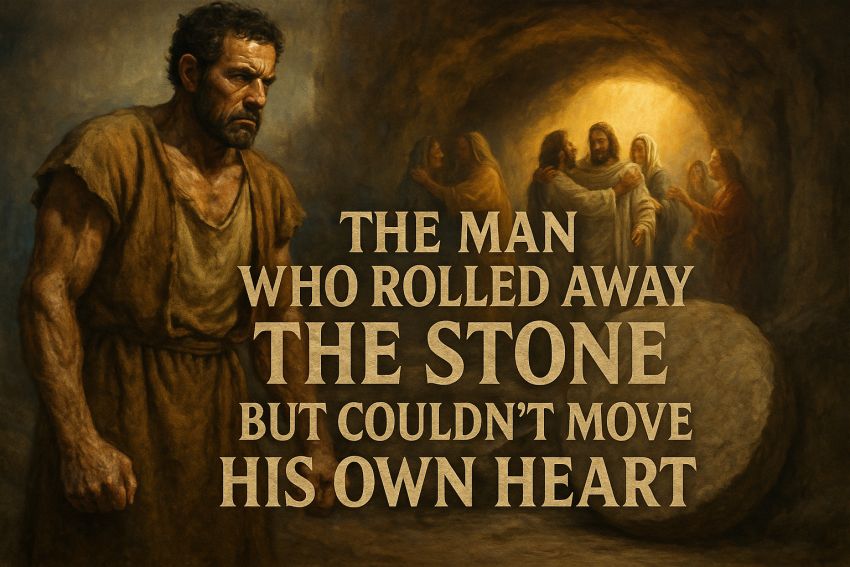
My name is Shimon ben Masa. In your tongue, Simon, son of burden. A fitting name for a man who spent his life moving stones and died carrying one he could never set down. I was there when the Rabbi from Nazareth called Lazarus from his tomb. I was the fool who rolled away the stone with my hands while my heart remained sealed tighter than any grave.
You want to know about being real? Let me tell you about the day I moved a stone that weighed less than the one I carried in my chest for the rest of my days. I’m talking to you men tonight because I see myself in your faces. That same look I perfected for decades – jaw set, eyes hard, pretending you’ve got it all figured out while something rots inside you like Lazarus in that tomb. You come to church with your wives, check your phones during the sermon, and tell yourself you’re doing your duty. I know because I was the religious one, the strong one, the one everyone looked to when things got tough. And it destroyed me.
See, I wasn’t just some random observer that day in Bethany. I was one of the prominent men from Jerusalem, someone with enough influence that when Mary and Martha needed help, they knew my name. I’d made my fortune in the stone trade – ironic, isn’t it? I spent my life moving rocks, building monuments to other men’s glory, never realizing I was constructing my own tomb. The Pharisees respected me, the common people feared me, and I told myself that respect and fear were the same as love.
When word came that Jesus was finally coming to Bethany, I was already there. I’d been helping with the funeral arrangements, you understand. That’s what important men do – we take charge when others fall apart. Martha and Mary were destroyed, absolutely shattered. Their brother had been dead four days. In our culture, that meant something. Three days, the soul might linger. Four days? Even God couldn’t argue with that kind of death.
I remember standing with the other men from Jerusalem, the ones who’d come to comfort the sisters. We spoke in low voices about practical things – the estate, the future, anything but the raw grief that filled that house like smoke from a sacrifice. When someone mentioned Jesus was approaching, I felt my jaw tighten. The nerve of him, showing up now. If he’d come when they first sent word, Lazarus would still be alive. We all knew about his supposed miracles, his healing touch. But he’d waited. Deliberately waited. And now he wanted to play the comforting rabbi?
Martha ran out to meet him, and I followed with a group of others. Not because I cared, but because someone needed to make sure this didn’t turn into some spectacle. The family had suffered enough. I stayed back, close enough to hear but far enough to maintain my dignity. That’s what we do, isn’t it? Stay close enough to seem involved but far enough to avoid getting messy.
“Lord, if you had been here, my brother would not have died,” Martha said, and there was steel in her voice that reminded me why I respected these women. She wasn’t pulling punches, wasn’t pretending everything was fine. She was being real in a way that made my chest tight with something I couldn’t name.
Jesus looked at her with those eyes – I’ll never forget those eyes – and said, “Your brother will rise again.”
Martha gave the proper religious response about the resurrection at the last day, the kind of thing we all said at funerals. Empty words to fill empty spaces. But then Jesus said something that should have shattered my stone heart right there: “I am the resurrection and the life. Whoever believes in me, though he die, yet shall he live.”
The arrogance of it should have infuriated me. Instead, it terrified me. Because for just a moment, standing there in the dusty road with the sun beating down on us, I almost believed him. And that kind of belief would have cost me everything – my position, my reputation, my carefully constructed life.
When we got to the tomb, I saw something that haunts me still. Jesus wept. Not the controlled, dignified tears of a rabbi at a funeral. Real, ugly, shoulder-shaking sobs. The Son of God – if that’s what he was – breaking down like a child. The other men shifted uncomfortably, looked away, cleared their throats. I stood there frozen, watching this supposed Messiah fall apart, and felt something crack inside me like a fault line before an earthquake.
Then he did it. He looked right at me – not the others, but me, as if he knew exactly who I was and what I was hiding – and said, “Take away the stone.”
The request was insane. Martha immediately protested, “Lord, by this time there will be an odor, for he has been dead four days.” Finally, someone speaking sense. You didn’t open tombs after four days. The body would be decomposing, the smell overwhelming. It was disgusting, undignified, and unnecessary. What was he planning to do, traumatize these poor women further by showing them their brother’s rotting corpse?
But Jesus kept looking at me. Not asking. Commanding. And everyone else was looking at me too, because I was the stone expert, the strong one, the one who got things done. My whole identity was wrapped up in being the man who could handle what others couldn’t. So what choice did I have?
I walked to that tomb like a man walking to his own execution. My hands were shaking – me, whose hands had been steady through business disasters and family tragedies. I could feel the weight of everyone’s expectations, could hear the whispers starting. Some people were already backing away, covering their noses preemptively. Smart people. People who knew when to keep their distance from death.
The stone was a typical rolling stone, probably three feet in diameter, set in a groove. I’d moved a thousand like it. But this one felt different. This one felt like it was sealing away more than just a corpse. As I gripped it, I caught a whiff of what was inside – that sweet, sick smell of death that gets in your clothes and stays for days. My stomach turned, but I couldn’t show weakness. Not now. Not ever.
I looked back at Jesus one more time, hoping he’d changed his mind. He hadn’t. If anything, his expression had intensified, like he was looking through the stone, through me, into something I couldn’t see. “Did I not tell you that if you believed you would see the glory of God?” he said to Martha, but I knew he was talking to me too.
Believed. Such a simple word for such an impossible thing. I didn’t believe. I was just following orders, doing what needed to be done because that’s what I did. I was the responsible one, the reliable one, the one who handled the hard things so others didn’t have to. That wasn’t faith; it was function. And I was about to be functionally humiliated when nothing happened and we all stood there staring at a decomposing corpse.
I rolled the stone away.
The smell hit us like a physical force. People gagged, stepped back, covered their faces. But Jesus stepped forward. He looked up – why up? – and started praying. Thanking his Father for hearing him, saying it was for the benefit of the people standing around. Performance prayer, I thought. Classic rabbi move when you’ve painted yourself into a corner.
Then he shouted. Not spoke, not called – shouted with a voice that seemed to come from somewhere deeper than lungs and throat: “Lazarus, come out!”
The silence that followed was the loudest thing I’ve ever heard. We all stood there, frozen, waiting for nothing to happen, for this to be the moment when the miracle worker was exposed as a fraud. I was already formulating how I’d comfort the sisters, how I’d handle the crowd, how I’d explain this to the authorities who were surely going to hear about this disaster.
Then we heard it. A shuffling sound from inside the tomb. Not possible. The dead don’t shuffle. But there it was again, closer now. And then, like something out of a nightmare or a dream – I still can’t decide which – Lazarus appeared in the entrance of the tomb.
He was still wrapped in his grave clothes, strips of linen wound around him like a mummy, a cloth over his face. He shouldn’t have been able to walk, but he was walking. He shouldn’t have been breathing, but I could see his chest moving. He shouldn’t have been alive, but he was standing there, blinking in the sunlight, very much alive.
“Unbind him, and let him go,” Jesus said, and his voice was casual, like he’d just asked us to pass the bread at dinner.
People rushed forward. Some were crying, some were laughing, some were on their knees. Martha and Mary were holding their brother, pulling at his grave clothes, touching his face like they couldn’t believe he was real. And in the middle of it all, I stood there with my hands still dusty from the stone, watching my entire worldview crumble like a wall with its foundation removed.
I should have fallen to my knees. I should have proclaimed him Lord right there. I should have done a lot of things. Instead, I did what I’d always done – I managed the situation. I helped organize the crowd, made sure people gave the family space, acted like this was just another task to be handled efficiently. Because if I stopped moving, stopped managing, stopped being the strong one for even a moment, I would have had to face what had just happened. And facing it would have meant admitting that everything I’d built my life on was worthless compared to what I’d just witnessed.
Some of the other Jews who were there with me went to the Pharisees and told them what had happened. They wanted guidance, wanted to know what to make of this impossible thing. I went with them, telling myself I was being responsible, keeping the authorities informed. Really, I was running. Running from the truth that was chasing me like a man running from his own shadow.
The meeting with the Pharisees was exactly what I needed – controlled, rational, focused on practical concerns. Caiaphas, the high priest that year, said something that lodged in my brain like a splinter: “It is better for you that one man should die for the people, not that the whole nation should perish.” There it was – the logic I could hide behind. This wasn’t about truth or faith or miracles. This was about politics, about stability, about protecting what we’d built.
I threw myself into the planning. When they decided Jesus had to die, I was the one who knew the movements of the crowds, the one who could predict where he’d be and when. I told myself I was serving a greater good, protecting our people from Roman intervention, maintaining order. But really, I was protecting myself from the terrifying possibility that I might have to change, might have to admit that my strength was actually weakness, that my control was actually chaos.
The night they arrested him, I stayed away. When they crucified him, I watched from a distance, telling myself I was being prudent. When they said he’d risen from the dead three days later, I laughed. I’d seen him raise Lazarus, yes, but surely someone else would have to raise him. That’s not how power works. You can’t save yourself.
But the stories kept coming. Five hundred people had seen him. His disciples were transforming from cowards to lions. The movement was growing, spreading like fire through dry grass. And Lazarus – Lazarus was walking around Bethany, living proof that death wasn’t final, that everything we thought we knew about reality was wrong.
I saw Lazarus once more, about a year after his resurrection. I was in Bethany on business, and there he was in the market, buying fish like any other man. Our eyes met across the crowd, and he smiled at me – not a small, polite smile, but a full, joy-filled grin like we shared some wonderful secret. He started walking toward me, probably to thank me for rolling away the stone, to share what it had been like on the other side.
I ran. Literally turned and walked quickly away, pretending I hadn’t seen him. Because talking to him would have meant admitting it was all real. And if it was real, then I had chosen darkness when I’d been offered light. I had chosen death when I’d been standing right next to Life himself.
You want to know the worst part? It’s not that I rejected Jesus. It’s that I never even gave him the chance to accept or reject me. I was so busy being strong, being in control, being the man everyone could count on, that I never let myself be weak enough to need saving. I touched the stone that covered death, I watched life walk out of that tomb, and I still chose to stay buried in my own grave of pride and self-sufficiency.
Some of you are smirking right now, thinking this is just another cautionary tale, another old man’s regret dressed up as wisdom. You’re sitting there with your arms crossed, that little defensive smile that says you’re humoring this but not really listening. I know that smile. I invented that smile. It’s the smile of a man who thinks vulnerability is weakness, who believes he can muscle through anything life throws at him.
But some of you – I can see it in your eyes – some of you are standing at your own stones right now. Maybe it’s a marriage that’s been dead so long you can smell the decay. Maybe it’s an addiction you’ve buried so deep you think no one knows, but it’s rotting you from the inside. Maybe it’s a dream, a calling, a purpose that you killed with your own hands because following it would have meant admitting you couldn’t do it alone.
Jesus is standing next to you right now, just like he stood next to me at that tomb. He’s not asking you to be strong enough to move the stone. He’s asking you to be weak enough to let him work. He’s asking you to be real about what’s died in your life, to stop pretending the smell isn’t there, to stop managing and maintaining and controlling long enough to let resurrection happen.
But here’s what I learned too late: resurrection requires admission of death. You can’t raise what you won’t admit is dead. You can’t heal what you pretend isn’t broken. You can’t save what you insist doesn’t need saving.
I rolled away the stone that day, but I couldn’t roll away my pride. I witnessed a miracle but chose to stay in my own tomb. I saw Jesus weep real tears and still couldn’t cry my own. I watched him command death and it obeyed, but when he commanded me to believe, I chose the safety of my stone-cold heart.
Don’t be me. Don’t be the man who was handed resurrection and chose to stay dead. Don’t be so invested in being the strong one that you miss the chance to be the saved one. That stone you’re refusing to roll away? It’s not protecting you; it’s entombing you. That smell you’re pretending isn’t there? Everyone can smell it. That image you’re maintaining? It’s killing you as surely as the disease that killed Lazarus.
The Rabbi from Nazareth is still in the business of calling dead things to life. But you have to be willing to admit you’re dead first. You have to be willing to let him see you wrapped in your grave clothes, stumbling and blind and helpless. You have to be willing to be unbound, to let others see what you’ve been hiding, to walk out of your tomb in broad daylight where everyone can see what you really are – a dead man walking, saved only by grace you didn’t earn and couldn’t deserve.
I’m Shimon ben Masa, and I carry my father’s name like a prophecy. Son of burden. I moved stones for the living and sealed tombs for the dead, but I could never move the stone that mattered most. I was strong enough to serve death but too weak to accept life.
The stone is waiting. The command has been given. The only question is: will you roll it away, or will you spend eternity carrying it?
I know which one I chose. I pray you choose differently.
Be real enough to be resurrected. Be weak enough to be made strong. Be dead enough to be brought to life.
Because I promise you this – the weight of that stone you’re refusing to move is nothing compared to the weight of carrying it forever.
—
Author’s Note
Brothers — this story of Shimon ben Masa, the stone mason who rolled away Lazarus’s tomb but couldn’t move his own heart, didn’t come from thin air. It came from staring at two tombs.
The first: Lazarus’s — where Jesus commanded trembling hands to roll away the stone before He called life out of death. A miracle that required human obedience. A resurrection that still ended in a second death.
The second: Jesus’ own — where no man dared touch the stone, because Roman guards stood watch… and an angel moved it. Not to let Jesus out — He needed no help — but to show the world He was already alive. A resurrection with no expiration date. A victory no army could contain.
That contrast haunts me. Because so many of us men live like we’re trying to earn what’s already been given. We muscle through our spiritual lives like hired laborers rolling stones, thinking if we just work harder, perform better, control tighter — we’ll finally be worthy of the miracle.
But the truth?
You don’t roll away the stone of your salvation.
You receive it — already moved.
Already conquered.
Already finished.
Shimon’s tragedy wasn’t that he failed to believe in miracles.
It was that he believed in himself more than the Miracle-Maker.
Don’t be Shimon.
Roll the stones God asks you to roll — the hard conversations, the surrendered pride, the exposed shame, the buried dreams.
But fall on your knees at the stone only God could move — the one that declared once and for all: Death is dead. Grace has won. You are free.
This story? It’s fiction. But the tombs? Real.
The stones? Real.
The choice? Still yours.

Sources
- John 11:1-44 (ESV) – The Death and Resurrection of Lazarus
- John 20:24-29 – Thomas’s Doubt and Faith
- 2 Corinthians 12:9-10 – Power Made Perfect in Weakness
- Desiring God – “Jesus Wept” by John Piper
- The Gospel Coalition – “Why Jesus Wept at Lazarus’s Tomb”
- Biblical Archaeology Society – Ancient Jewish Burial Practices
- Christianity Today – “Why Men Struggle with Church”
- Psalm 30:5 – Weeping and Joy
- Romans 6:4 – Buried and Raised to New Life
- Bible Hub Commentaries – John 11:39 (The Stone and Martha’s Protest)
- Crossway – “The Significance of Jesus Raising Lazarus from the Dead”
- Authentic Manhood – “The Struggle is Real: Male Vulnerability”
- Ezekiel 37:1-14 – The Valley of Dry Bones
- Ligonier Ministries – “Jesus at Lazarus’ Tomb”
- 9Marks – “A Biblical Theology of Resurrection”
Disclaimer:
The views and opinions expressed in this post are solely those of the author. The information provided is based on personal research, experience, and understanding of the subject matter at the time of writing. Readers should consult relevant experts or authorities for specific guidance related to their unique situations.