
3,457 words, 18 minutes read time.
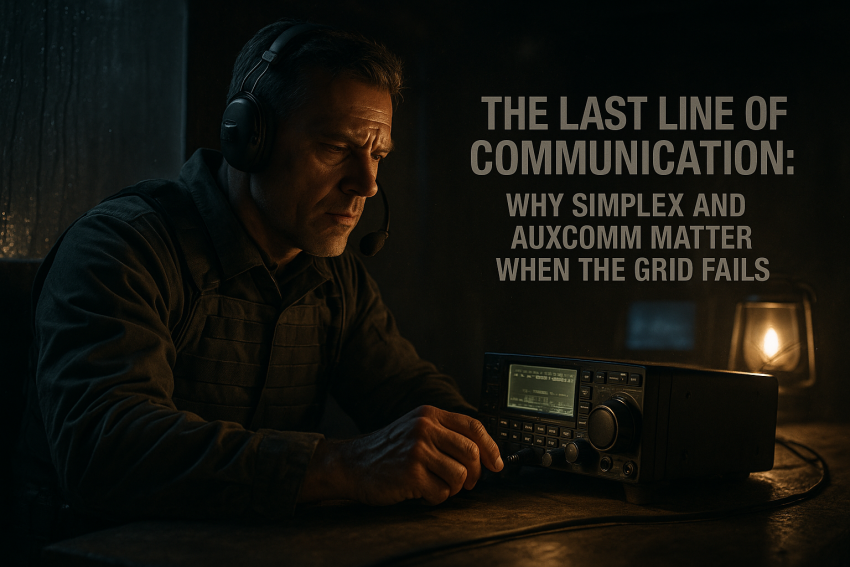
The morning after Hurricane Michael made landfall in October 2018, Panama City, Florida resembled a war zone. Cell towers lay twisted like pretzels across highways, power lines draped uselessly over crushed vehicles, and the internet had vanished as completely as if it had never existed. For seventy-two critical hours, the only voices cutting through that deadly silence belonged to amateur radio operators, their handheld radios and mobile units becoming the lifeline between trapped families and rescue teams. This wasn’t a hobby anymore. This was survival communication at its most essential.
Most men today carry smartphones that can access the sum of human knowledge, navigate to any location on Earth, and connect instantly with anyone, anywhere. Yet all that capability depends on an invisible infrastructure that proves remarkably fragile when nature flexes its muscles or when man-made disasters strike. The uncomfortable truth is that our hyper-connected society rests on a foundation that can disappear in seconds, leaving us more isolated than our grandfathers ever were with their rotary phones and party lines.
This is where the world of auxiliary communications, or AUXCOMM, becomes not just relevant but critical. Far from the stereotype of lonely ham radio operators chatting about the weather from their basements, modern emergency communicators represent a highly trained, disciplined force that government agencies and disaster response organizations depend upon when everything else fails. These men don’t just own radios; they understand the science of propagation, the art of message handling, and most importantly, they possess the legal authority and technical skill to establish communications when civilization’s normal channels go dark.
Understanding the Mission: What is AUXCOMM?
The term AUXCOMM emerged from the Department of Homeland Security’s recognition that amateur radio operators needed standardized training to integrate effectively with professional emergency responders. As the Cybersecurity and Infrastructure Security Agency defines it, AUXCOMM represents “the mechanism for establishing auxiliary communications resources to support state and local government entities.” This isn’t about replacing professional first responders; it’s about augmenting their capabilities with skilled volunteers who bring their own equipment, expertise, and most crucially, their ability to operate independently of compromised infrastructure.
Think of AUXCOMM as the professional standard for emergency communications volunteers. While any licensed amateur radio operator can offer assistance during disasters, AUXCOMM-trained operators have completed rigorous coursework covering the Incident Command System, proper radio protocols, interoperability standards, and the specific needs of served agencies. They understand how to integrate seamlessly into an emergency operations center, how to format messages for maximum clarity and legal documentation, and how to maintain operational security when handling sensitive information.
Within this framework operate two primary service organizations that many have heard of but few truly understand. The Amateur Radio Emergency Service, known as ARES, represents the broader volunteer force that serves communities, non-governmental organizations like the Red Cross, and hospitals during times of crisis. ARES volunteers train regularly, participating in simulated emergency tests and public service events that hone their skills while providing valuable community support. These operators might relay health and welfare messages from disaster zones, coordinate logistics for emergency shelters, or provide communications for search and rescue operations in terrain where cell phones become expensive paperweights.
The Radio Amateur Civil Emergency Service, or RACES, operates under more specific constraints but with explicit government authority. RACES volunteers are authorized by federal regulations to provide communications specifically for civil defense purposes, activated only by government officials during declared emergencies. When RACES is activated, these operators work directly for emergency management agencies, often from government facilities, handling official traffic that might include damage assessments, resource requests, and coordination between different levels of government response.
The beauty of the AUXCOMM concept lies in how it unifies these traditionally separate groups under common training standards and operational procedures. As one emergency coordinator from California explained during the 2020 wildfire season, “When you have AUXCOMM-trained operators, it doesn’t matter if they normally work with ARES or RACES. They all speak the same language, follow the same protocols, and can slot into any position we need them.” This interoperability becomes crucial when disasters don’t respect jurisdictional boundaries and when response efforts require coordination across multiple agencies and regions.
The Federal Emergency Management Agency has invested heavily in AUXCOMM training because they’ve learned through painful experience that amateur radio operators can provide capabilities that no amount of government funding can replicate. During Hurricane Katrina, when the New Orleans police department’s multi-million dollar radio system failed completely, it was amateur radio operators who maintained the only functioning communications network for days. The lesson was clear: redundancy through diversity of systems and operators provides resilience that no single solution can match.
The Magic of Simplex: Direct Contact and Self-Reliance
To understand why simplex communication represents such a critical capability, you first need to understand how most amateur radio traffic typically flows. The majority of daily amateur radio communications rely on repeater systems, sophisticated installations usually positioned on mountaintops, tall buildings, or towers that receive weak signals from handheld or mobile radios and retransmit them with significantly more power across a much wider area. These repeaters extend the range of a five-watt handheld radio from perhaps a mile or two to potentially fifty miles or more, depending on terrain and repeater elevation.
Repeaters are remarkable force multipliers for communication, but they represent single points of failure that become painfully obvious during disasters. When commercial power fails, repeaters depend on backup batteries that might last anywhere from a few hours to several days, assuming they haven’t been physically damaged by the same event that knocked out the power. During the 2017 Thomas Fire in California, multiple repeater sites burned completely, while others lost power when their battery banks were exhausted and solar panels were obscured by smoke so thick it turned noon into twilight.
This is where simplex communication reveals its fundamental importance. Simplex means direct radio-to-radio contact without any intermediate infrastructure. Your radio transmits, and another radio within range receives that transmission directly. No towers, no repeaters, no internet links, no phone lines, nothing except the electromagnetic waves traveling through space from one antenna to another. It’s communication stripped down to its most basic, most reliable form.
The tactical advantages of simplex become immediately apparent in real-world emergency situations. Search and rescue teams working a collapsed building don’t need to reach a repeater twenty miles away; they need to coordinate with the team on the other side of the debris pile. Damage assessment teams surveying neighborhoods after a tornado need to communicate with their unit leader a few blocks away, not tie up a repeater that might be handling regional emergency traffic. Simplex provides immediate, local communication that doesn’t depend on anything except the radios in the operators’ hands and their skill in using them.
Yet simplex communication demands significantly more knowledge and skill than simply programming repeater frequencies into a radio. Effective simplex operation requires understanding how radio waves propagate at different frequencies, how terrain affects signal paths, and how antenna selection and positioning can mean the difference between clear communication and frustrating silence. The operator who can establish reliable simplex communications in challenging conditions demonstrates mastery of the fundamental physics and practical techniques that separate trained communicators from mere equipment owners.
Consider the experience of a Virginia AUXCOMM team during a 2019 ice storm that knocked out power across multiple counties. As team leader Robert Hendricks later recounted, “The repeaters went down one by one as batteries died. We shifted to simplex operations, setting up relay points on hilltops using mobile units with mag-mount antennas. Operators had to understand propagation, had to know how to position themselves for maximum coverage, had to maintain discipline to avoid stepping on each other’s transmissions. It was amateur radio at its most fundamental and most effective.”
The ability to operate simplex also provides operational security advantages that become important when handling sensitive information. Repeater communications can be monitored by anyone within the repeater’s coverage area, potentially dozens of miles away. Simplex communications, especially when using directional antennas and appropriate power levels, can be much more difficult to intercept from distant locations. While amateur radio is never truly secure, and operators must always assume their transmissions are being monitored, simplex at least limits the geographic area from which casual monitoring is possible.
Training for effective simplex operation involves more than theoretical knowledge. Regular simplex nets, where operators practice communicating without repeaters, reveal the real-world challenges and solutions. Operators learn to identify locations in their area that provide advantageous elevation for extended simplex range. They discover how different antenna configurations affect their signal patterns. They develop the discipline to speak clearly and concisely, knowing that simplex signals are often weaker and more prone to interference than repeater-assisted communications.
The Gear and the Mindset
The concept of the “go-kit” has become central to serious emergency communications preparation, but it represents far more than just accumulating equipment. A properly conceived go-kit embodies a philosophy of readiness, self-sufficiency, and operational capability that distinguishes the prepared operator from someone who simply owns radio equipment. The contents matter less than the thinking behind them: What will you need to establish and maintain communications for extended periods without outside support?
Experienced AUXCOMM operators approach their go-kit with the same mentality that special forces soldiers apply to their loadout. Every item serves a specific purpose, has been tested under realistic conditions, and can be deployed quickly under stress. This might include multiple radios for different frequency bands, various antennas optimized for different situations, battery banks with solar charging capability, detailed frequency guides and contact lists protected in waterproof sleeves, and the often-overlooked supplies like logs, message forms, and writing implements that become critical for formal emergency traffic handling.
But the most sophisticated equipment becomes useless without the proper mindset to employ it effectively. Emergency communications demand a particular psychological approach that combines technical competence with emotional stability and disciplined operational procedures. When everyone else is panicking, when rumors are flying faster than facts, when officials are demanding immediate answers to impossible questions, the emergency communicator must remain calm, methodical, and focused on accurate information transfer.
This mindset doesn’t develop automatically; it requires conscious cultivation through training and experience. Regular participation in emergency exercises teaches operators to manage the stress of high-volume traffic, conflicting priorities, and ambiguous situations. Public service events like marathons or bike races provide opportunities to practice formal traffic handling under time pressure while the stakes remain relatively low. Each experience builds the mental calluses that allow effective performance when real emergencies strike.
The role of the emergency communicator extends beyond simply relaying messages. These operators must understand their position within the larger emergency response structure, recognizing when to take initiative and when to strictly follow established protocols. They must resist the temptation to interpret or embellish information, instead serving as transparent conduits for accurate data flow. They must maintain operational security, understanding that even well-intentioned speculation or premature information release can compromise response efforts or cause public panic.
Professional emergency managers consistently emphasize that the most valuable AUXCOMM operators are those who understand their supporting role. As one Florida emergency management director explained, “I don’t need radio operators who want to be heroes or who think they know better than the incident commander. I need operators who will accurately relay exactly what they’re told to relay, who will maintain their position until properly relieved, and who understand that sometimes the most important thing they can do is simply keep a frequency clear for priority traffic.”
This professional approach to emergency communications requires developing skills that extend well beyond technical radio knowledge. Effective operators must master the art of brevity, conveying maximum information in minimum transmission time. They must learn the standardized phonetic alphabets and number pronunciations that ensure accuracy even through static and interference. They must understand formal message formats that create legal documentation of emergency communications. They must develop the patience to handle repetitive relay duties and the flexibility to adapt quickly when situations change.
The Brotherhood of the Blue Comm Plan
The culture of emergency communications attracts a particular type of man, one who finds purpose in preparation and satisfaction in service. The regular training nets that might seem tedious to outsiders become proving grounds where operators hone their skills and build the relationships that prove invaluable during actual emergencies. These aren’t mere practice sessions; they’re performances that maintain readiness and reveal areas needing improvement.
Weekly ARES nets across the country follow similar patterns, but each develops its own character based on local needs and challenges. Operators check in with their tactical callsigns, report their readiness status, and participate in training scenarios that might involve message relay exercises, simplex communication drills, or discussions of recent emergency responses. The repetition builds muscle memory that persists under stress, while the regular interaction creates the interpersonal bonds that transform a collection of individuals into a cohesive team.
The commitment to training extends beyond local nets to regional and national exercises. The annual Simulated Emergency Test challenges operators to respond to realistic disaster scenarios, often with induced failures that force creative problem-solving. Field Day, while partly a public demonstration and social event, provides invaluable experience operating under austere conditions with temporary antennas and emergency power. These exercises reveal equipment limitations, procedural gaps, and training needs that can be addressed before lives depend on the communication network.
The relationships formed through emergency communications training create a unique brotherhood bound by shared purpose and mutual respect. Unlike social clubs or hobby groups, emergency communication teams unite around a mission that transcends individual interests. The retired military officer, the software engineer, the electrician, and the teacher find common ground in their commitment to serving their community when disaster strikes. These diverse backgrounds bring different strengths to the team, creating a collective capability greater than any individual contribution.
Veterans often find particular resonance in emergency communications, recognizing familiar elements of military service: the emphasis on preparedness, the chain of command, the importance of clear communications, and the satisfaction of mission accomplishment. Many AUXCOMM groups benefit from the leadership and organizational skills that veterans bring, while providing these men with continued opportunities for meaningful service after their military careers.
The culture also attracts those with technical inclinations who enjoy the challenge of establishing communications under difficult conditions. The problem-solving aspects of emergency communications, from optimizing antenna systems to coordinating frequency usage across multiple agencies, provide intellectual stimulation that goes far beyond simple radio operation. Each deployment presents unique challenges that require creative solutions, keeping the work engaging even for operators with decades of experience.
Your Move
The capability to communicate when normal systems fail isn’t just a useful skill; it’s a fundamental aspect of resilience in an increasingly fragile world. Every year brings new reminders of how quickly our technological conveniences can disappear, whether through natural disasters that seem to grow more severe with each passing season, infrastructure failures that cascade through interconnected systems, or human-caused events that disrupt the careful balance of modern life. The ability to establish and maintain communications during these events transforms you from a victim of circumstances into a valuable asset for your family and community.
The path to becoming an effective emergency communicator requires more than purchasing equipment or memorizing frequency lists. It demands developing a combination of technical knowledge, practical skills, and mental preparation that only comes through dedicated study and regular practice. The amateur radio license represents just the beginning of this journey, providing the legal authority to transmit but not the expertise to do so effectively when it matters most. The real education begins after the license arrives, through participation in nets, training exercises, and actual emergency responses.
Consider what you could contribute if you possessed these capabilities. When the next hurricane makes landfall, you could relay critical information between emergency shelters and response coordinators. When wildfires threaten your community, you could provide real-time intelligence to firefighters about wind conditions and fire spread. When winter storms isolate neighborhoods, you could coordinate welfare checks and resource distribution. When search and rescue teams deploy, you could maintain the communications link that guides them to those in need.
The investment required to develop these capabilities pales in comparison to their potential value. While quality radio equipment requires financial investment, the knowledge and skills that make that equipment effective cost only time and dedication to acquire. Local clubs often provide mentorship and training at no cost, emergency exercises offer hands-on experience, and online resources provide unlimited educational opportunities. The barrier to entry isn’t resources but rather the decision to begin.
The amateur radio community stands ready to welcome and train those who step forward. Despite stereotypes, this isn’t an exclusive club of technical elites but rather a diverse group united by common purpose and mutual support. Experienced operators remember their own beginnings and eagerly share knowledge with newcomers who demonstrate genuine interest and commitment. The culture values competence over credentials, effort over perfection, and service over self-promotion.
Every man reading this has the potential to become a critical communications asset for his community. The technical knowledge can be learned, the operational skills can be developed, and the necessary discipline already exists within those who recognize the importance of preparation. The question isn’t whether you’re capable of joining this essential infrastructure but whether you’re willing to invest the effort required to do so.
The time to prepare isn’t after disaster strikes but right now, while systems still function and training opportunities abound. The skills you develop, the relationships you build, and the capabilities you acquire through emergency communications preparation will serve you whether or not you ever face a major disaster. The confidence that comes from knowing you can establish communications when others cannot, the satisfaction of providing critical service during emergencies, and the brotherhood of like-minded men committed to community resilience provide rewards that extend far beyond any single event.
Take the first step today. Research local amateur radio clubs and ARES groups in your area. Attend a meeting or training net as an observer. Talk to active emergency communicators about their experiences and motivations. Begin studying for your amateur radio license, not as an end goal but as the key that unlocks a world of capability and service. The infrastructure of emergency communications needs more trained operators, and your community needs men willing to stand ready when conventional systems fail.
Your next move could be the one that transforms you from someone who hopes for help during disasters to someone who provides it. The choice, and the opportunity, is yours.
**Ready to join this critical conversation about emergency preparedness and communications? Subscribe to our newsletter at https://wordpress.com/reader/site/subscription/61236952 for regular updates on building resilience and self-reliance. Share your thoughts and experiences in the comments below, or reach out directly through our contact form at https://bdking71.wordpress.com/contact/. Your perspective and questions help shape future content and build our community of prepared individuals.**

Sources
- CISA (Cybersecurity & Infrastructure Security Agency) – AUXCOMM Program: The official government definition and standards for Auxiliary Emergency Communications. https://www.cisa.gov/resources-tools/programs/auxiliary-communications-auxcomm
- ARRL – What is ARES?: The definitive explanation of the Amateur Radio Emergency Service from the national association for Amateur Radio. http://www.arrl.org/ares
- FEMA – RACES (Radio Amateur Civil Emergency Service): FEMA’s description of RACES and its specific role during civil emergencies. https://www.fema.gov/glossary/radio-amateur-civil-emergency-service
- ARRL – The Difference Between ARES and RACES: A clear breakdown of the operational distinctions between the two main service groups. http://www.arrl.org/ares-el?issue=2014-09-10#toc04
- Off Grid Ham – The Importance of Simplex Communications: A practical look at why relying on repeaters can be dangerous in a grid-down scenario. https://offgridham.com/2017/01/simplex-communications/
- CISA – Auxiliary Communications Field Operations Guide (AUXFOG): The technical “playbook” used by AUXCOMM operators, showing the seriousness of the role. https://www.cisa.gov/resources-tools/resources/auxiliary-communications-field-operations-guide-auxfog
- Radio Magazine – When Repeaters Fail: An analysis of infrastructure vulnerabilities during disasters like Hurricane Katrina and the importance of direct tactical comms. https://www.radioworld.com/tech-and-gear/when-repeaters-fail-simplex-to-the-rescue
- Ready.gov – Emergency Communications Preparedness: Context on why backup communication plans are essential for personal and community resilience. https://www.ready.gov/plan
- The Prepared – Why Ham Radio is the Ultimate SHTF Communication: An article aimed at the preparedness community detailing the unique advantages of amateur radio. https://theprepared.com/homestead/guides/ham-radio-shtf-survival/
- ARRL – Public Service Communications Manual: The foundational doctrine for how amateur radio operators interface with served agencies. http://www.arrl.org/public-service-field-services-manual
- Crisis Response Journal – The Role of Amateur Radio in Modern Disaster Management: A professional look at how “hams” integrate into complex emergency response structures. https://crisisresponsejournal.com/article/the-role-of-amateur-radio-in-modern-disaster-management
- Practical Amateur Radio Podcast – Episode on Tactical Simplex: Audio resources discussing the practical application of direct radio contact in the field. https://practicalamateurradio.com/
Disclaimer:
The views and opinions expressed in this post are solely those of the author. The information provided is based on personal research, experience, and understanding of the subject matter at the time of writing. Readers should consult relevant experts or authorities for specific guidance related to their unique situations.