
3,286 words, 17 minutes read time.
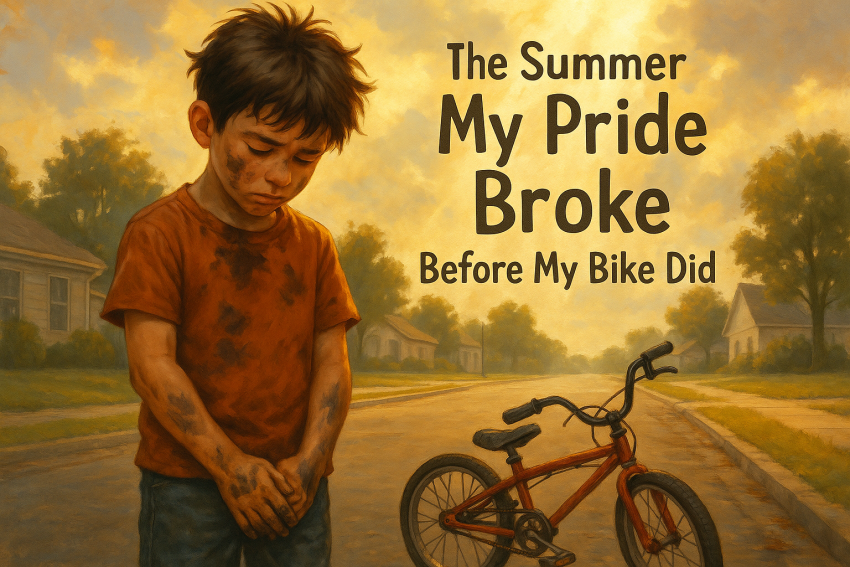
I used to believe strength meant never asking for help. Maybe you’ve thought the same thing—that if you just push hard enough, keep your head down, and grind through the pain, you’ll prove to the world that you’re strong. That’s what I believed. I wore that belief like armor, thick enough to block out anyone who dared to get too close. But I’ve learned the hard way that armor can be a prison too. I didn’t learn it in some dramatic battle or after years of wisdom. I learned it one summer, when the chain of my old red bike snapped, and with it, so did the lie I’d been telling myself.
It was July, and the air was thick with the kind of heat that makes the blacktop shimmer like silver waves. I was nine years old, and Oakwood Street might as well have been a kingdom. At least, that’s how I saw it. Every kid has a territory where they prove themselves. Some do it on the baseball field, some on the basketball court. For me, it was the street. We raced our bikes up and down that cracked stretch of pavement until our legs burned. And I was the fastest. Or at least, I needed to be.
That Saturday, we had planned what we called “The Great Race.” It was nothing official—no trophies, no banners, no crowds—but for me, it was more important than the Olympics. My friends lined up with me: Marcus with his shiny blue BMX, Luis with his dented mountain bike, and Sam with a secondhand cruiser he swore was faster than it looked. I glanced at them and felt that familiar knot in my stomach, the one that whispered, If you don’t win, they’ll know you’re not really the strongest. They’ll laugh. You’ll be nothing.
When the whistle blew—Sam always insisted on a whistle we’d found in his dad’s toolbox—we launched forward like rockets. The wheels hummed against the asphalt, and the wind slapped my face. I could feel victory already, the way it always came, filling me with the rush of being untouchable. But then it happened.
A sharp metallic clink, followed by a jolt. My pedals spun wildly under my feet, useless. My chain had snapped, dangling like a broken snake against the frame. My handlebars wobbled, and I nearly tipped over. By the time I steadied myself, the others were specks ahead of me, their laughter and shouts echoing in the hot air.
I could have called out. I could have waved them down and admitted what happened. But pride is louder than reason. Pride told me it would be better to vanish than to be seen broken. So I pushed my bike to the side of the road, my face burning hotter than the sun, and dragged it behind my house. I leaned it against the shed, chain dangling, shame heavy in my chest.
That should have been the end of it—a quick fix with a little help. But instead, it was the beginning of a long summer of hiding.
The next day, my friends knocked on my door. “Coming out?” Marcus asked, helmet already strapped on. I told them I was busy. When they pressed, I shrugged and said I didn’t feel like it. Their faces flickered with confusion, but they left, tires buzzing down the road without me. I told myself it was fine. I didn’t need them. I didn’t need anyone.
Inside, I stared at the broken chain. I fiddled with it, smearing grease across my fingers, but I had no idea what I was doing. Every attempt ended in frustration. Still, the thought of asking my dad, or even worse, my friends, felt impossible. I could almost hear them laughing, see the pity in their eyes. So I shoved the bike deeper behind the shed and shoved my feelings even deeper inside me.
The days dragged. I told my mom I was tired, that I wanted to read, that I was working on “important things.” She raised an eyebrow but didn’t push. The truth is, I spent hours staring out the window, watching my friends ride past, hearing their laughter like a mocking echo. My anger grew. At them, at myself, at the world. But mostly, it was pride. Pride whispered that it was better to sit alone than to admit I needed help. Pride convinced me that isolation was dignity.
Looking back now, I see the irony. I thought I was protecting my image, but really, I was losing everything that mattered. I was giving up friendship, joy, and freedom for the illusion of strength. But at nine years old, all I knew was the sting of being left behind.
One afternoon, I sat on the back steps, chin in my hands, staring at the cracked driveway. That’s when Mr. James noticed me. He lived next door, an older man with kind eyes and hands that looked like they’d built half the neighborhood. He leaned over the fence and called, “Why so gloomy, champ?”
I shrugged, muttered something about being tired. He didn’t buy it. His eyes flicked toward the shed. “That bike of yours giving you trouble?”
I froze. Part of me wanted to deny it, to spin another excuse. But his voice wasn’t mocking. It was steady, gentle, like he already knew the truth.
“I used to be just like you,” he said. “Thought asking for help made me weak. Tried to carry everything myself. But let me tell you a secret: even Jesus needed help. When He carried the cross, a man named Simon helped Him. If the Son of God could accept help in His weakest moment, don’t you think maybe it’s okay if we do too?”
I remember blinking at him, my pride trying desperately to find a comeback. But the words stuck in my throat. I knew the story. I’d heard it in Sunday school. But I had never thought about it like that. Jesus, the strongest man who ever lived, accepted help. And here I was, a boy with a broken bike, too proud to let anyone touch it.
Mr. James didn’t push after that. He just leaned on the fence, looking out at the street like he had all the time in the world. I couldn’t stand the silence, so I muttered, “It’s just a chain. I can fix it.”
He raised an eyebrow. “Have you fixed it yet?”
I felt heat rise in my cheeks. I wanted to say yes, but lying to Mr. James felt different than lying to my friends. His eyes were too sharp, too steady. He’d know. So I stayed quiet.
“That’s what I thought,” he said, but not in a mean way. More like a doctor telling you he’s seen this sickness before. He let the words hang there, and I squirmed under their weight.
Finally, I snapped, “I don’t need help. I just haven’t gotten around to it.”
He chuckled softly. “Son, not asking for help doesn’t make you strong. It makes you stubborn. And stubborn isn’t the same thing as strong. Stubborn breaks you down. Strength lifts you up.”
I hated how much that sounded true. But I also hated admitting it. Pride flared up like a shield. “If I ask for help, they’ll think I’m weak. They’ll laugh.”
He shook his head slowly. “Maybe. Or maybe they’ll respect you more for being honest. You’d be surprised how many people are waiting for someone else to be real first. Pride locks us in cages we build ourselves. Humility sets us free.”
He was saying things I didn’t want to hear, but couldn’t ignore either. That night, lying in bed, I replayed his words over and over. I stared at the ceiling and thought about Simon helping Jesus. I thought about how Jesus didn’t flinch, didn’t push Simon away, didn’t hide His need. And I thought about how I had been hiding behind a shed for weeks.
The next morning, I tried again to fix the chain. My fingers slipped, the grease smeared, and the frustration boiled over until I slammed the wrench down and shouted into the empty yard. That’s when Marcus rode past, slowing his bike when he saw me.
“Hey,” he called, “you coming out today?”
The words caught in my throat. I wanted to say yes. I wanted to be out there with them, laughing in the sun, flying down the road. But pride yanked me back. “Nah. I’m busy.”
Marcus frowned. “Busy with what?”
I panicked. “Homework.”
He laughed. “It’s summer, dude.”
I felt stupid. Exposed. And in that moment, something cracked inside me. I was tired of lying. Tired of missing out. Tired of being a prisoner in my own pride. I took a deep breath and said the words I had been choking on for weeks. “My bike’s broken. The chain snapped. I… I can’t fix it.”
Marcus blinked at me. For a second, I braced myself for laughter. But instead, he grinned. “Why didn’t you just say so? My brother showed me how to fix mine last month. I can help.”
It was that simple. The wall I had built around myself collapsed with one honest confession.
By that afternoon, Marcus and Luis were in my driveway, tools spread out, grease on their hands. Mr. James leaned over the fence again, offering a tip or two. I swallowed my pride and let them help. It wasn’t easy. Every time someone tightened a bolt or adjusted the chain, my pride whispered that I should be doing it myself. But louder than that was the laughter. The jokes. The way my friends teased me but in the way friends do, not to tear me down but to pull me back in.
When we finally snapped the chain back into place, I felt something lift inside me. I hopped on, pedaled down the street, and the wind slapped my face again—but this time, it wasn’t victory I felt. It was freedom. Not the freedom of being untouchable, but the freedom of not having to pretend anymore.
That evening, sitting on the steps with my friends, I realized something I had missed all along. They didn’t care that I wasn’t perfect. They cared that I was there. They cared that I showed up. My pride had stolen weeks from me, and for what? To protect an image no one else was even thinking about.
Still, I wish I could say the lesson stuck forever. That from that day on, I always asked for help, that I never hid behind pride again. But the truth is, pride is sticky. It clings to you. Even now, years later, I still feel it pulling at me. I still hear the voice that says, “Don’t admit weakness. Don’t let them see.” Sometimes I still listen.
But that summer planted a seed. Now, when pride whispers, I remember the bike. I remember Mr. James telling me that even Jesus accepted help. I remember how my friends respected me more when I admitted the truth. And sometimes, that memory is enough to break pride’s grip.
I think about Proverbs 16:18, the verse I learned later: “Pride goes before destruction, a haughty spirit before a fall.” My fall wasn’t dramatic, just a broken chain. But it was enough to show me how fragile pride really is. I also think about Ecclesiastes 4:9–10: “Two are better than one… If either of them falls down, one can help the other up.” That summer, I fell hard into pride, and my friends helped me up.
When I look back now, I realize the real tragedy wasn’t the broken bike. It was the weeks I lost because I was too proud to admit I couldn’t do it alone. That was my downfall. That was the cage I built.
And though I’ve stumbled into that same cage many times since, I can never quite forget the summer my pride broke before my bike did.
Looking back, I sometimes wonder if that broken chain was God’s way of giving me a warning shot. A small collapse before the bigger ones came. Because the truth is, life has a way of snapping your chain over and over again.
When I was a boy, pride kept me off my bike for a summer. As a man, pride has kept me from much more. I carried that same flaw into friendships, into relationships, into work. I thought admitting I was tired, or scared, or tempted, would make people see me as less. So I put on the same armor I wore back then. I smiled when I was angry. I clenched my fists when I should have opened my hands. I said “I’m fine” when the truth was I was crumbling.
Sometimes the hiding worked—for a while. I fooled coworkers into thinking I was invincible. I fooled friends into thinking I had no struggles. I even fooled myself into thinking I could handle everything. But like that bike chain, the strain kept building until it snapped. My anger would explode in sharp words that cut deeper than I intended. My fear of being seen as weak kept me from apologizing, from saying “I need you,” from confessing that sometimes I didn’t even know who I was supposed to be.
And lust—yes, even that—I thought I could wrestle it alone. I told myself no one needed to know. I buried it in the dark, believing secrecy made me stronger. But secrecy is just another shed to hide behind. Every time I stumbled, the shame doubled, and instead of reaching for help, I hid again. Just like I did when I was nine.
I see now how dangerous that cycle is. Pride isolates you, then whispers that you deserve to be alone. Anger lashes out, then convinces you no one would forgive you. Lust promises comfort, then leaves you emptier than before. All of it ties back to the same flaw: the refusal to admit weakness, the refusal to say, “I can’t fix this on my own.”
I sometimes think of Mr. James’s words: “Even Jesus needed help.” That line has haunted me more times than I can count. I used to wrestle with it, thinking, How could the Son of God need anything? But that’s just it—He didn’t need, but He allowed. He chose vulnerability. He chose to let Simon step in. He modeled what I’ve resisted my whole life.
I can justify myself if I want. I can say I grew up in a world that told boys to be tough, to never cry, to fight their own battles. I can say I was only doing what I thought was expected. I can even tell you that pride gave me success in some ways—it made me push harder, achieve more, refuse to quit. But if I’m being honest, pride didn’t make me strong. It made me brittle. And brittle things break.
When I think about fate and free will, I wonder if I was destined to learn this lesson the hard way. Or maybe God gave me plenty of outs—plenty of times like that summer, where the chain snapped, and I could have chosen humility instead of hiding. Maybe it wasn’t fate that trapped me. Maybe it was just me, stubbornly gripping the handlebars of my life while the wheels spun useless beneath me.
There’s a verse that gnaws at me: James 4:6, “God opposes the proud but gives grace to the humble.” I used to think that verse was too harsh. Why would God oppose me? I wasn’t hurting anyone. I was just trying to stand on my own two feet. But pride blinds you to the quiet ways it hurts the people around you. My friends lost a companion that summer. My mom lost honest conversations with her son. Later in life, coworkers lost a teammate they could trust, girlfriends lost a man who could be honest about his flaws, and God lost the prayers I was too stubborn to pray.
Do I regret it? Yes. But I also resist regret, because part of me still whispers that justifying it makes it easier to bear. That’s the thing about flaws—they don’t leave quietly. They fight for their place. Even as I write this, I can feel pride tugging at me, saying, Don’t be too vulnerable. Don’t let them see too much.
But I’ve seen the cost of listening to that voice. And I’ve seen the grace that comes when I ignore it. Like when I finally confessed to a friend that I was struggling, and instead of mocking me, he put a hand on my shoulder and said, “You’re not alone.” Or when I admitted to God that I couldn’t fight temptation by myself, and instead of condemning me, He reminded me of 2 Corinthians 12:9: “My grace is sufficient for you, for my power is made perfect in weakness.”
Weakness. That word used to terrify me. Now I see it differently. Weakness isn’t failure—it’s an invitation. An invitation to let someone else in. An invitation to let God show His strength. An invitation to stop hiding behind sheds and broken bikes.
Still, the tragic truth is that I haven’t fully conquered pride. I don’t know if I ever will. Sometimes I still lie, still isolate, still pretend. Sometimes I still end up alone in a room, staring at the mess I made, grease on my hands, shame in my chest. The lesson is there, but so is the flaw.
Maybe that’s why I tell this story. Because even if I can’t erase my own mistakes, maybe I can keep someone else from repeating them. Maybe some boy out there, gripping his handlebars, trying to prove he’s the king of his block, will hear this and realize that strength isn’t about hiding. It’s about admitting when the chain snaps.
So if you take anything from my story, let it be this: don’t wait until pride steals your whole summer. Don’t wait until it steals your friendships, your peace, your joy. Don’t wait until it hardens you into someone who can’t even remember what freedom feels like. Admit it now. Say the words I was too proud to say: “I need help.”
Because the summer my pride broke before my bike did was the summer I learned that real strength doesn’t come from standing alone. It comes from kneeling low, from reaching out, from letting someone else step in. And though my pride still fights me, though my flaws still drag me down, that truth won’t leave me. It haunts me, it humbles me, and maybe—just maybe—it will save me.

Sources
- Proverbs 16:18 – Pride goes before destruction
- Ecclesiastes 4:9–10 – Two are better than one
- 2 Corinthians 12:9 – Power made perfect in weakness
- Philippians 2:3–4 – Humility and valuing others
- James 4:6 – God opposes the proud but gives grace to the humble
- Galatians 6:2 – Carry each other’s burdens
- Psalm 34:18 – The Lord is close to the brokenhearted
- 1 Corinthians 10:13 – God provides a way out of temptation
- John 15:5 – Apart from Me you can do nothing
- Matthew 11:28–30 – Come to me, all who are weary
- Hebrews 12:1–2 – Run with perseverance
- Focus on the Family – Parenting Resources
- Desiring God – Articles on Pride
- Crosswalk – Christian Parenting Resources
- Lifeway – Parenting & Discipleship
Disclaimer:
The views and opinions expressed in this post are solely those of the author. The information provided is based on personal research, experience, and understanding of the subject matter at the time of writing. Readers should consult relevant experts or authorities for specific guidance related to their unique situations.