
2,848 words, 15 minutes read time.
My name is Balthazar, and I’m not the man I once was. These days, I carry the marks of a life well-lived and hard-learned—my skin weathered by the Ethiopian sun, deep lines etched around my eyes from years of squinting at scrolls and staring into the distance, searching for answers. My hair has turned silver, cropped short in the practical style of a man who’s traded courtly pomp for simpler days, and my frame, though still tall and straight from a lifetime of command, bears the subtle stoop of reflection and humility. I dress plainly now, in a simple linen tunic belted at the waist, sandals worn from walking roads both literal and spiritual, a far cry from the opulent robes that once defined me. But back then, oh, I was a sight—draped in finery that screamed success, hiding a soul starved for something real. I used to think I had it all figured out—wealth, power, respect, the kind of life that makes other men jealous. I was the chief treasurer for Queen Candace of Ethiopia, a position that put me at the heart of an empire’s fortunes. My chariot gleamed under the desert sun, my robes were woven with threads of gold, and my name carried weight in every market from Aksum to Meroë. But beneath the polished surface, I was a mess of pride, shame, and a deep, gnawing fear that I’d never be enough. This is my story, raw and unfiltered, of how my own choices nearly dragged me under and how a dusty road and a stranger’s words pulled me back. It’s for every man out there—believer or not—who’s ever hidden his struggles behind a mask of strength, who’s wondered if he’s worth more than his job or his reputation.
I was born in Ethiopia, a land where the sun scorches the earth and the Nile’s waters carve life through the dust. Our markets buzzed with the clatter of merchants, the scent of myrrh and frankincense thick in the air, and the chatter of a dozen tongues trading goods from across the world. As a boy, I ran through those markets, my feet bare against the warm earth, my laughter mingling with the calls of vendors. I was the youngest of five, born to a family of weavers who wove intricate patterns for the nobles of Aksum. Life was simple then, full of small joys—a shared meal of injera and lentils, my mother’s stories of our ancestors, my father’s calloused hands teaching me to thread a loom. But that life ended when I was nine. Men from the royal court came, their faces stern, their words final. I was chosen—plucked from my family for my quick mind and sharp eyes—to serve the queen. The price of that honor was a brutal one. They made me a eunuch, a procedure that left me screaming through the pain, my body forever altered to ensure I’d never have a family of my own, never threaten the royal line with heirs. It was a mark of trust, they said, a role reserved for those who could be relied upon to serve without distraction. But to me, it was a wound that never healed, a scar that marked me as less than whole.
In Ethiopian culture, family was everything—lineage, legacy, the continuation of a name through sons and daughters. As a eunuch, I was cut off from that, a man without a future, a name without a legacy. The shame clung to me like dust, impossible to shake. I learned to hide it early, to swallow the taunts from boys who’d once been my friends, to ignore the pitying glances from elders. But the real blow came later, when I began to study the scrolls of the Jewish faith, drawn to the God of Israel whose power stretched beyond our rivers and mountains. I found Deuteronomy 23:1, a verse that hit me like a fist: “No one who has been emasculated by crushing or cutting may enter the assembly of the Lord.” It was as if God Himself had drawn a line in the sand, declaring me unfit, unworthy. That verse became my shadow, a constant reminder that no matter how much I achieved, I’d always be an outsider in the eyes of the God I longed to know. It festered in me, a wound I buried beneath layers of ambition and grit. I told myself I didn’t need His acceptance. I’d carve my own place in the world.
And carve it I did. I threw myself into my work, honing my mind until I could calculate sums faster than any scribe, negotiate deals that left merchants speechless, and manage the queen’s treasury with a precision that earned me her trust. By the time I was thirty, I was her right hand, overseeing caravans laden with gold, ivory, and spices, commanding respect from men who’d once looked down on me. My title was my armor, my status my shield. In those days, I dressed to impress, my robes flowing in rich crimson and purple dyes imported from Phoenicia, embroidered with golden threads that caught the light like fire. Around my neck hung a heavy chain of office, studded with jewels from the queen’s mines, and on my fingers, rings that signified my authority—each one a symbol of deals struck and fortunes secured. My skin, dark and smooth from oils scented with sandalwood, bore no scars visible to the eye, and my posture was always erect, a man who commanded rooms without a word. But pride—that old serpent—slithered into my heart, whispering that I didn’t need anyone. Not my family, long lost to me. Not the God who’d rejected me. Not even the men who served under me, whom I kept at arm’s length, afraid they’d see the shame I carried. I told myself I was enough, that my achievements were my worth. But at night, alone in my chambers, the silence was deafening. No amount of gold could fill the void, no title could drown out the question that haunted me: Was I enough?
My journey to Jerusalem was born of that question, though I’d never admit it then. I’d heard of the God of Israel, the One who parted seas and toppled giants, whose temple drew pilgrims from every corner of the world. I wanted to know Him, to see if His power could touch even a man like me. So I set out, my chariot loaded with provisions, my heart heavy with a hunger I couldn’t name. For the trip, I chose my finest attire—a tunic of fine linen beneath a robe of deep blue silk, fringed with tassels of gold, and a headdress adorned with feathers from exotic birds, marking me as a man of high status from a distant land. My sandals were crafted from the softest leather, strapped up my calves, and I carried a staff topped with an ivory carving of a lion, symbolizing the strength I projected to the world. The road was long, winding through deserts where the sand stung my face and over mountains where the air grew thin. I carried a scroll of Isaiah, its words a mystery I couldn’t unravel but couldn’t put down. I read of a suffering servant, a man “despised and rejected, a man of sorrows, acquainted with grief” (Isaiah 53:3). The words hit too close, stirring something in me I didn’t want to face. I was a man of status, not sorrow. I was respected, not rejected. But the more I read, the more I wondered: Was this servant like me? Did he know what it was to be cut off, to carry a wound no one could see?
Jerusalem was a city of splendor, its temple a marvel of stone and gold, its courts alive with the hum of worship. But for me, it was a place of exile. As a eunuch, I was barred from the inner courts, forced to linger at the edges where the Gentiles and the “unclean” stood. I watched men offer their sacrifices, their prayers rising like incense, while I clutched my scroll and my dignity, my heart burning with a mix of longing and anger. My elaborate dress, which turned heads in the streets, only amplified my sense of being an outsider— a foreigner in fine clothes, yet still unworthy. I told myself it didn’t matter. I’d come for answers, not acceptance. I’d prove I was worthy, not by worship but by understanding. But the truth was uglier. I was angry—at the law that shut me out, at the God who seemed to favor the whole over the broken, at myself for caring so much. I justified my bitterness, telling myself I’d built a life without divine favor. I didn’t need God’s approval; I had the queen’s. But it was a lie, and deep down, I knew it. Pride was my master, and it was leading me nowhere.
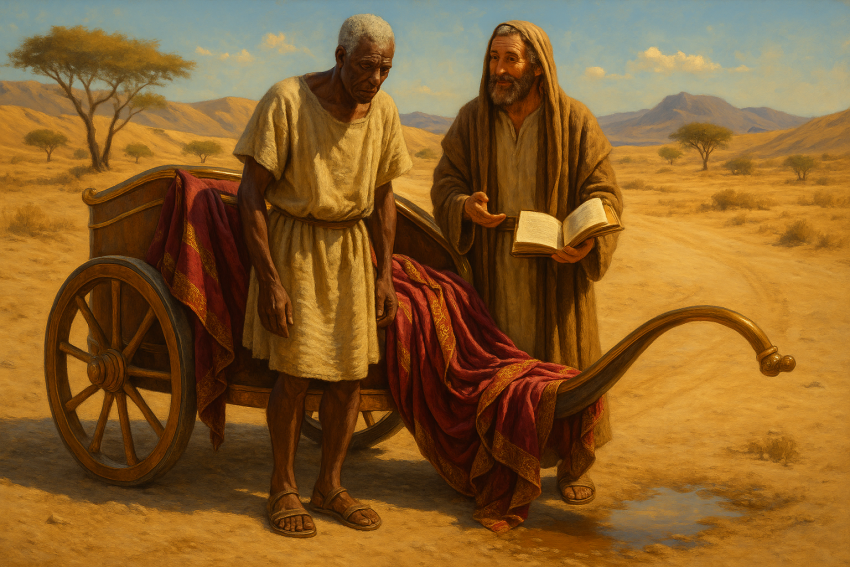
The return journey was when my world began to crack. I was in my chariot, the scroll of Isaiah open on my lap, reading aloud to drown out the noise in my head. “He was led like a sheep to the slaughter, and as a lamb before its shearer is silent, so he did not open his mouth” (Isaiah 53:7). The words felt like a mirror, reflecting a suffering I couldn’t articulate. Who was this man? Why did his pain matter? I was so lost in thought that I barely noticed the stranger keeping pace with my chariot until he called out, “Do you understand what you’re reading?” His voice was warm, unassuming, but it startled me. I looked down to see a man with weathered skin and bright eyes, dressed in simple robes but carrying himself with a quiet strength. His name, I’d learn, was Philip, a follower of a man called Jesus.
My first instinct was to snap at him—how dare a stranger question my intellect? I was Balthazar, scholar of scrolls, master of the queen’s treasury. But something in his eyes stopped me, a kindness that felt like a challenge. “How can I,” I said, my voice tighter than I meant, “unless someone explains it to me?” It was the first time I’d admitted I didn’t have all the answers, a crack in the armor I’d spent years forging. I invited him into the chariot, half-expecting to regret it. Philip settled beside me, his presence calm but piercing, like he could see the man beneath the title. I handed him the scroll, pointing to Isaiah 53, and asked, “Who is this? The prophet himself, or someone else?”
Philip’s answer was like a blade, cutting through my defenses. He spoke of Jesus, a man who’d walked these same roads, who’d been crucified and risen again. “This is the suffering servant,” Philip said, his voice steady but alive with fire. “Jesus took on our sins, our shame, our rejection. He died for the outcast, the broken, the ones who feel they don’t belong.” I listened, my heart pounding. Philip didn’t know my story, but his words were my story. I was the outcast, the man marked by shame, the one who’d built a life on pride to hide my wounds. Yet here was this Jesus, offering a love that didn’t demand perfection or status, a love that saw me as I was.
I tried to push back, to justify my skepticism. “How could this be for me?” I asked, my voice sharp. “I’m a eunuch. Your God’s law says I’m unfit.” I expected Philip to hesitate, to offer some platitude, but he didn’t. He leaned closer, his eyes unwavering. “God’s promise isn’t bound by the law’s limits,” he said. “Isaiah himself says it—‘To the eunuchs who keep my Sabbaths, who choose what pleases me, I will give a name better than sons and daughters’” (Isaiah 56:4–5). The words hit me like a wave, washing away years of rejection. I’d spent my life believing I was unworthy, that my shame defined me. But Philip’s words, rooted in Scripture, told a different story—a story of a God who saw me, who offered me a name, a place, a purpose.
We passed a pool of water, a muddy patch shimmering under the desert sun. Something broke in me, a reckless, desperate hope. “Look, here’s water,” I said, my voice shaking. “What’s stopping me from being baptized?” It was a challenge, a defiance of the shame that had held me captive. Philip didn’t flinch. “If you believe with all your heart,” he said, “nothing stops you.” I wanted to argue, to list all the reasons I didn’t deserve this—my pride, my anger, my years of self-reliance. But I was tired of running, tired of hiding. “I believe,” I said, the words raw and real. “I believe Jesus is the Son of God.”
We stopped the chariot, and Philip led me to the water. It was no sacred river, just a roadside puddle, but it felt like holy ground. As I stepped in, the mud squelching beneath my feet, I felt the weight of my pride, my shame, my isolation slip away. My fine robes, now soaked and muddied, clung to me like a shedding skin, symbols of the status I was leaving behind. Philip baptized me, and when I emerged, dripping and trembling, I was changed. I wasn’t just Balthazar the treasurer, the eunuch, the outcast. I was Balthazar, a child of God, loved not for what I’d achieved but for who I was. Philip disappeared soon after—some say by a miracle—but his words stayed with me, a light in the darkness I’d carried too long.
Looking back, I see how my pride nearly destroyed me. It was my tragic flaw, the sin that drove me to build a life on my own terms, to hide my pain behind titles and wealth. I justified it, told myself I was strong, that I didn’t need anyone. But that road led to a lonely throne, a life where no amount of success could silence the ache. I think about fate and free will now—how God sent Philip to that road, but it was my choice to listen, to be real, to step into the water. I could have dismissed him, clung to my pride, and driven on. But I didn’t. And that choice saved me.
To every man reading this, believer or skeptic, I know what it’s like to hide your struggles. Maybe it’s pride, like mine, or anger that flares too fast, or lust that pulls you into places you don’t want to go. Maybe you’ve tied your worth to your job, your strength, your status, and the thought of letting that mask slip terrifies you. I get it. Being real feels like standing naked in a storm. But here’s what I learned in that muddy pool: you don’t have to be enough. God’s grace is enough. Jesus didn’t die for the perfect; He died for the broken, the proud, the ashamed. Stop justifying the walls you’ve built. Tear them down. Be real with God, with yourself, with the men around you. It’s not weakness—it’s the kind of courage that changes everything.
I don’t know what my life held after that day. Maybe I returned to Ethiopia and told others about Jesus, carrying His name to the courts of Aksum. Maybe I lived quietly, my heart full of a joy I’d never known. But I know this: my pride nearly cost me everything, but God’s love gave me everything. I regret the years I spent hiding, but I don’t deny them. They led me to that road, to that water, to a God who saw me and loved me anyway. So, brothers, take it from a man who learned the hard way: don’t let your flaws define you. Let them lead you to the One who can make you whole. Let’s pray for the guts to be real, to trust that God’s grace is bigger than our failures. Amen.

Sources
- Acts 8:26–39 (NIV) – The Ethiopian Eunuch’s Baptism
- Isaiah 53 (NIV) – The Suffering Servant
- Deuteronomy 23:1 (NIV) – Exclusion of Eunuchs from Assembly
- Isaiah 56:3–5 (NIV) – God’s Promise to Eunuchs
- Blue Letter Bible: David Guzik Commentary on Acts 8
- Working Preacher: Commentary on Acts 8:26–40
- Matthew Henry Commentary on Acts 8
- Christianity Today: Eunuchs and God’s Inclusive Love
- The Gospel Coalition: Why the Eunuch’s Story Matters
- ESV Global Study Bible: Notes on Acts 8:26–40
- Expositor’s Bible Commentary: Acts 8
- LDS Church: The Ethiopian Eunuch – A Story of Inclusion
- Biblical Archaeology: The Ethiopian Eunuch and Christianity in Africa
- Crossway: 5 Lessons from the Ethiopian Eunuch
- Precept Austin: Commentary on Acts 8
Disclaimer:
The views and opinions expressed in this post are solely those of the author. The information provided is based on personal research, experience, and understanding of the subject matter at the time of writing. Readers should consult relevant experts or authorities for specific guidance related to their unique situations.