
1,417 words, 7 minutes read time.
Every programmer knows the grind: late nights, blinking cursors, endless scrolling through log files, chasing that one bug that refuses to die. You’ve built a page, an API, a dashboard—and suddenly, it’s behaving like a rebellious machine that won’t listen. Sometimes the culprit isn’t complex logic or missing dependencies—it’s messy, redundant data silently wreaking havoc. This is the battlefield where reusable, smart code comes in, turning chaos into order. Welcome to the world of building utility functions like uniqueEntries, tools designed to fix recurring problems before they become catastrophic headaches.
Programming isn’t just about getting things to work—it’s about building systems that anticipate problems and solve them elegantly. Reusable functions are the weapons in a developer’s toolbox, the kind of tools you reach for instinctively, like your favorite wrench that fits every stubborn bolt without complaint. In this article, we’re going to explore the philosophy behind reusable code, dissect the power of uniqueEntries for filtering duplicates in TypeScript, and extend these principles to craft functions that save you hours, prevent frustration, and make you look like a coding craftsman in the eyes of your team.
The Problem: Duplicates and Their Hidden Costs
Duplicate data is more than just a minor nuisance; it’s a silent performance killer, a subtle saboteur of user experience and data integrity. Imagine a situation where a dashboard is feeding off an API, showing sales figures, user activity, or system logs. One overlooked duplication, and suddenly charts are inflated, totals are wrong, and the team is scrambling to explain anomalies. In web applications, even a single repeated object in a state array can cause unnecessary re-renders in React, slowing down the UI and frustrating users. In backend systems, duplicates in cached responses or database queries can lead to bloated storage and unpredictable behavior.
It’s not uncommon to stumble upon duplicates hidden deep in your data. Perhaps a user exists multiple times because of inconsistencies in your signup flow, or two records share an ID but differ in categories. These issues aren’t just minor bugs—they represent lost hours of debugging, team frustration, and, ultimately, a loss of trust in the codebase. As a man in charge of delivering quality, you know that half-measures don’t cut it; we need robust, reusable solutions that tackle the root of the problem, not just patch the symptoms.
Why Filtering by One Key Isn’t Enough
Many developers reach for the quick fix: filter duplicates by a single key. On the surface, it works. A simple array filter based on an ID or name seems to eliminate redundancy. But real-world data rarely respects our assumptions. Consider a scenario where a product ID appears in multiple categories, or a username is duplicated across different environments. Filtering by a single key might remove one record but leave others lurking, causing subtle inconsistencies. The result is the same nightmare: misaligned UI, corrupted datasets, and late-night debugging sessions fueled by coffee and regret.
The lesson here is brutal but clear: partial solutions are liabilities. Like using a wrench that’s slightly too small for the bolt, it might turn it a few degrees, but the problem isn’t solved and can even worsen. Developers need functions that address the full complexity of their data structures, supporting multiple keys, nested objects, and flexibility for future expansion.
Enter uniqueEntries: The Reusable Fix
Enter uniqueEntries, a TypeScript function designed to filter duplicates based on any combination of keys. Unlike ad hoc one-key filters, it’s generic, flexible, and built to be reused across projects. With a single import, you can ensure arrays are clean, predictable, and free of repeated objects. Let’s look at a core implementation:
export const uniqueEntries = <T>(array: T[], keys: (keyof T)[]): T[] => {
  const seen = new Set<string>();

  return array.filter(item => {
    const key = keys.map(k => String(item[k])).join('|');
    if (seen.has(key)) return false;
    seen.add(key);
    return true;
  });
};
This function works with any interface, accepts multiple keys, and keeps the first occurrence of each unique combination. It’s simple, yet it addresses a problem that often eats up hours in debugging. Notice the use of Set to track seen combinations—a performance-conscious choice that avoids repeated findIndex scans through the array. This is crucial when dealing with large datasets, ensuring your solutions are not just correct but efficient.
Breaking Down the Code Like a Pro
Understanding uniqueEntries isn’t just about memorizing syntax—it’s about grasping the philosophy behind it. Generics (<T>) allow the function to work with any object type. keyof T ensures TypeScript enforces that only valid keys are passed, preventing runtime surprises. Joining keys with a delimiter creates a composite string that represents each object’s identity across multiple fields. The Set then guarantees uniqueness without iterating unnecessarily, preserving order and efficiency.
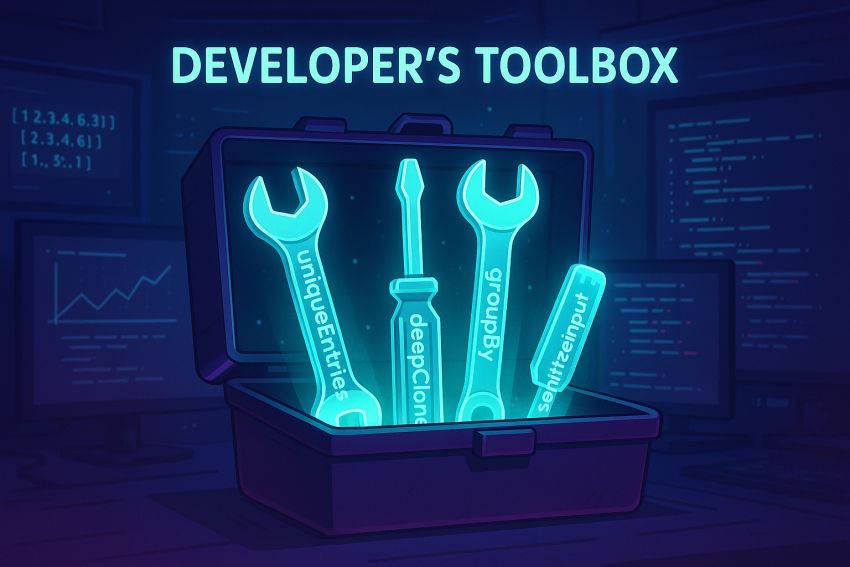
Think of it like building a toolbox. Each tool has a purpose, a design that anticipates stress and repeated use. uniqueEntries is your multi-purpose wrench: versatile, reliable, and ready for any stubborn bolt of duplicate data. Once in your toolkit, it frees you to focus on higher-level problems, confident that this piece of machinery will not fail when you need it most.
Practical Applications in Real Projects
The power of uniqueEntries extends far beyond simple arrays. In frontend development, it ensures that React state is predictable, prevents redundant re-renders, and cleans API responses before they hit your UI. Charts, tables, and dashboards suddenly become trustworthy tools rather than sources of frustration. On the backend, it pre-processes query results, guarantees cache consistency, and enforces data integrity in high-traffic systems.
Moreover, in CI/CD pipelines, uniqueEntries can automate data cleanup tasks, reducing human error and improving deployment reliability. Imagine a nightly script that consolidates duplicate logs, cleans user data, or pre-validates records before pushing to production. This isn’t just convenience—it’s professional rigor, a mindset that separates average programmers from true developers who take pride in their craft.
Other potential utilities in your developer toolbox might include functions like deepClone for immutable copies, groupBy for data categorization, or sanitizeInput for security and validation. Together, they represent a philosophy: write once, reuse often, solve problems efficiently, and never let recurring issues become bottlenecks in your workflow.
Developer Mindset: Building Reusable Tools
Building reusable functions is not just technical—it’s a statement of professionalism and foresight. It’s the difference between writing code that “works for now” and code that “works for life.” Each function you create is a tool in your arsenal, a testament to understanding the problem domain and thinking ahead. Reusability is about ownership: owning your code, your craft, and your responsibility to teammates and users alike.
As a male programmer navigating complex projects, deadlines, and expectations, there’s a certain pride in crafting tools that solve recurring headaches. Writing reusable functions is like building a personal machine shop in code: every function sharp, every solution deliberate, every line a mark of expertise. Functions like uniqueEntries are small, but they embody a mindset of efficiency, precision, and professionalism that translates across all aspects of development.
Conclusion & Call to Action
Reusable functions are more than convenient snippets—they are essential tools for surviving and thriving in the daily grind of programming. uniqueEntries exemplifies the power of thoughtful, generic utility functions: elegant, efficient, and versatile. By integrating such functions into your workflow, you reclaim time, reduce frustration, and elevate the reliability of your codebase. These aren’t just coding best practices—they’re professional statements.
Now it’s your turn. Build your toolbox. Experiment with uniqueEntries and other reusable utilities. Share your own solutions and battle-tested tricks with the community. Subscribe to our newsletter for more in-depth guides, join the conversation in the comments, or reach out directly with your questions. Remember: every smart tool you create today saves hours of frustration tomorrow. Make your code count, and let your toolbox grow—because a well-armed developer is an unstoppable force.

Sources
- TypeScript Official Documentation
- MDN Web Docs – JavaScript Set
- MDN Web Docs – Arrow Functions
- TypeScript Handbook – Generics
- Lodash uniqBy Documentation
- Dev.to – Developer Insights and Tutorials
- LogRocket Blog – Web Development Best Practices
- Refactoring Guru – Clean Code & Design Patterns
- Kent C. Dodds – JavaScript & TypeScript Best Practices
- Smashing Magazine – Advanced Development Articles
- FreeCodeCamp – Developer Tutorials & Guides
- Medium – Programming and Software Engineering
- CSS-Tricks – Frontend Development Tips
- Stack Overflow – Developer Q&A Community
Disclaimer:
The views and opinions expressed in this post are solely those of the author. The information provided is based on personal research, experience, and understanding of the subject matter at the time of writing. Readers should consult relevant experts or authorities for specific guidance related to their unique situations.