
1,526 words, 8 minutes read time.
— A Modern Day Testimony of Fear, Pride, and the One Who Came After Me
I’m not a pastor. I’m not a counselor. I don’t have seminary credentials or a podcast with catchy quotes. I’m a builder. I pour concrete. I run a crew. I fix things with my hands. And for most of my life, I thought that made me strong.
My name’s Jack Morrison. I’m 42. I live just outside Nashville, and I’ve been in church nearly every Sunday of my life. I could recite Psalm 23 before I could ride a bike. I know how to keep eye contact when I pray in public. I tithe. I’ve led small groups. My wife used to brag about me to her Bible study friends. My son wore a shirt once that said “My Dad Can Fix Anything,” and I believed it.
But none of that mattered when I broke inside.
And let me tell you, I didn’t even know I was breaking. That’s the part that still haunts me. Because when men like us—hardworking, high-capacity, respected men—start to fall, we don’t crash all at once. We crack slowly. Quietly. Secretly. And the deeper the crack goes, the harder we work to cover it up.
This story starts a couple of years ago, when I still thought vulnerability was for guys who cried in movies and overshared on Facebook. I had no category for real weakness—especially not my own.
I remember sitting in church one Sunday and hearing the parable of the lost sheep. You know the one—Jesus tells this story about a shepherd who leaves ninety-nine sheep just to chase down one stupid, wandering one. I rolled my eyes. I’m a doer. I’ve led crews. No way I’d leave ninety-nine head of livestock for one stray. Doesn’t make sense. It’s not smart leadership. But Jesus said that’s exactly what the good shepherd does.
And the part that burned? He said, “There’s more rejoicing in heaven over one sinner who repents than over ninety-nine righteous people who don’t need to.”
I didn’t know it at the time, but I was the lost one. And I had built a life pretending to be found.
See, I was addicted. Not just to porn—though that was part of it. I was addicted to control. To being seen as strong. I had rules for myself. Show up. Work hard. Pay the bills. Provide. Protect. And never, ever let them see you sweat.
I remember one night, standing in my kitchen with the fridge door open, staring into nothing. My wife had gone to bed hours earlier. My son was asleep. I was just standing there, trying to breathe. The silence was loud. And I thought, How did I get here? Not physically—I was in my own house. But emotionally, spiritually? I was somewhere cold and far from home.
The cracks had started to show months before. Business deal gone wrong. Lawsuit. Stress. Long hours. But instead of opening up, I doubled down. Worked longer. Pushed harder. When my wife asked if I was okay, I grunted and told her I was “handling it.” Truth was, I hadn’t prayed in weeks. My Bible sat in the truck under receipts and drywall dust. But I still smiled at church. Still showed up at men’s group. Still talked about “God’s faithfulness” like I was living it.
You want to know what hell feels like? It’s sitting in a room full of men, all pretending they’re fine—while you’re drowning and too proud to raise your hand.
I convinced myself it wasn’t the time to get real. Maybe when things settled down. Maybe when I wasn’t so tired, or when business picked up. Maybe when I figured it out on my own. You ever tell yourself that? That you just need time and space? That you’re almost okay?
It’s a lie.
The moment of collapse came when I got a message from someone I shouldn’t have been messaging. A woman I met at a supplier event. We’d been texting for weeks. Nothing physical—yet. But emotional? Absolutely. I told myself it was harmless. I needed a release. A connection. Something that made me feel like more than a paycheck and a hammer.
She called me “funny” and “strong.” Things I hadn’t heard from my wife in years—not because she stopped saying them, but because I’d stopped listening. I’d stopped being present.
One night, my wife found the messages.
She didn’t scream. She didn’t throw things. She just looked at me like someone watching a house they built catch fire. And in that moment, I realized how far I’d wandered. How lost I really was.
And the worst part? I still tried to justify it.
I told myself I wasn’t that guy. I didn’t sleep with her. I’m not a cheater. I’m not like them. I’m not the sheep who strays. I’m the one who stays close to the Shepherd. I’ve got standards. A reputation.
But all that crumbled when my wife said, “Jack, when are you going to stop pretending?”
I slept on the couch that night. Actually, I didn’t sleep. I stared at the ceiling for hours. And somewhere around 3 a.m., I whispered, “God, I don’t even know who I am anymore.”
And I swear to you—something in the darkness whispered back, Finally.
That was the night I stopped being one of the ninety-nine.
I started therapy. I sat with a pastor and confessed everything. Not just the woman. But the fear. The porn. The pride. The anger I didn’t know I was carrying. The shame I buried deep. The ache of never feeling like I was enough—not for my dad, not for the world, not even for God.
It was humiliating. And holy.
You want to know what real strength looks like? It’s not fixing your life with a spreadsheet or a gym membership. It’s not grinding harder. It’s not white-knuckling your way through temptation.
It’s weeping on your knees in your truck before church and saying, “Jesus, I’ve made a mess I can’t clean up. I’m tired of hiding. Come find me.”
He did.
I don’t know where you are right now. Maybe you’re coasting. Maybe you’ve got a good job, a decent marriage, a Bible app that sends you daily verses. But maybe—just maybe—you’re scared to death of being seen. Of being real. Of admitting you don’t have it all together.
I get it. I lived there for decades.
But I’m telling you, the Shepherd doesn’t just tolerate lost sheep. He pursues them. He’s not mad at you for wandering. He’s not disgusted by your mess. He’s not waiting for you to clean up. He leaves the ninety-nine for you.
And He did it for me.
That parable in Luke 15? It’s not just a story. It’s a mirror. It’s not about sheep. It’s about men like you and me who are dying on the inside but too afraid to admit it.
Jesus said, “Suppose one of you has a hundred sheep and loses one of them. Doesn’t he leave the ninety-nine in the open country and go after the lost sheep until he finds it?” (Luke 15:4, NIV).
He didn’t say, “Wait until the sheep comes back.” He didn’t say, “Hope it figures it out.” He goes after it. And when He finds it, He doesn’t scold it. He doesn’t guilt-trip it. He rejoices.
I used to think being a man meant never being weak.
Now I know it means being found.
I still struggle. My marriage isn’t magically perfect. I still fight shame, still have to choose honesty daily. But now I have freedom. I have peace. And I have the presence of a Savior who didn’t wait for me to be found—He came after me when I didn’t even know I was lost.
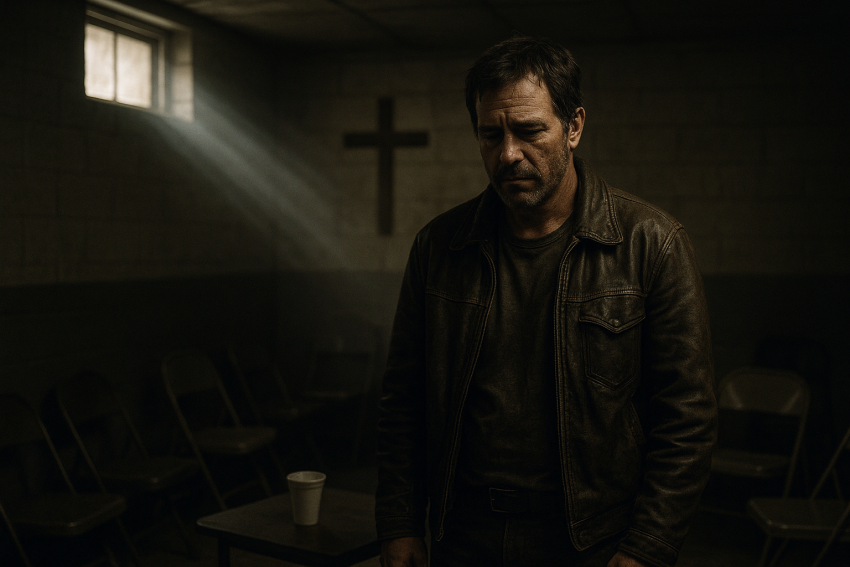
So if you’re sitting in that chair, holding your coffee, pretending you’re okay—man to man, drop the act. You can’t heal what you’re hiding. And you don’t have to keep pretending.
He’s not just the Shepherd of the ninety-nine.
He’s coming for you too.
Author’s Note
This story came from a place of wrestling—with God, with pride, and with the brutal fear of being truly seen. If you’re anything like Jack, then maybe you’ve been holding your breath, trying to keep it together, afraid of what might happen if you let go. I’ve been there. Most men I know have been there. And I want you to know something: Jesus doesn’t wait for perfect. He runs after real. I wrote this story to show that even in the darkest corners, especially there, grace can still find you.
If Jack’s story hit something in you—if you felt that lump in your throat or recognized your reflection in his fear—don’t leave it there. Do something about it. Drop the act. Talk to someone. Pray. Or just start by being honest—with God and with yourself. You’re not alone. You’re not beyond reach. And you’re not too far gone.
“There will be more joy in heaven over one sinner who repents than over ninety-nine righteous persons who do not need to repent.”
—Luke 15:7
We’d love to keep this conversation going. If this story stirred something in you, subscribe to our newsletter to get more stories, devotions, and real-life testimonies like this one. Leave a comment below, or if you’d rather talk one-on-one, feel free to reach out directly. I’m here, and I read every message.
Let’s be real—because that’s where redemption begins.

Sources
- Luke 15:1–7 – The Parable of the Lost Sheep
- Matthew 18:12–14 – The Lost Sheep in a Discipleship Context
- GotQuestions: What are the parables of Jesus?
- GotQuestions: What is the meaning of the Parable of the Lost Sheep?
- Bible Hub Commentary: Luke 15:4
- Enduring Word Commentary: Luke 15
- Desiring God: Jesus, Friend of Sinners
- Crossway: What Does It Mean to Be Lost?
- The Gospel Coalition: The Parables of Jesus
- Ligonier Ministries: The Lost Sheep
- Focus on the Family: Breaking the Power of Secret Sin
- Spiritual Direction for Men – Vulnerability and Discipleship
- Navigators: Discipleship for Men in Modern Times
- Covenant Eyes: Why Men Struggle to Ask for Help
- Real Men Hiding – A Devotion on Masking Weakness
Disclaimer:
The views and opinions expressed in this post are solely those of the author. The information provided is based on personal research, experience, and understanding of the subject matter at the time of writing. Readers should consult relevant experts or authorities for specific guidance related to their unique situations.