
1,807 words, 10 minutes read time.
Amateur radio has always been a fascinating blend of technology, communication, and community. Among its many facets, digital modes stand out as some of the most exciting and rapidly evolving ways for hams to connect. Whether you’re just starting your journey toward earning your amateur radio license or you’re a seasoned operator curious about the latest trends, understanding digital modes like FT8, PSK31, and others opens up a world of possibilities. These modes offer unique ways to communicate across continents, operate under challenging conditions, and experiment with cutting-edge technology, all while deepening your technical knowledge.
In this comprehensive guide, we’ll explore the history, technical fundamentals, and practical applications of the most popular digital modes. We’ll examine what makes them effective, how to get started, and why mastering these modes can make you a more skilled, versatile, and confident ham operator.
The Rise of Digital Modes in Amateur Radio
Digital modes in amateur radio represent the intersection of radio communication and computer technology. Unlike traditional voice (phone) or Morse code (CW) transmissions, digital modes use computer algorithms to encode and decode text or data signals sent over radio frequencies. This enables communication that is often more reliable, efficient, and capable of penetrating difficult propagation conditions.
Historically, amateur radio started with voice and Morse code. Over time, as technology advanced, digital modes began to appear in the late 20th century. Early modes like RTTY (Radio Teletype) laid the foundation, but they were often cumbersome and required specialized hardware. The explosion of personal computing power in recent decades has transformed digital modes from a niche curiosity to mainstream use.
Today, digital modes are vital tools for many hams. The rise of modes like FT8, developed by Nobel Prize-winning astrophysicist Joe Taylor, K1JT, has revolutionized how hams communicate. FT8 allows operators to make contacts under extremely weak signal conditions that would be impossible with voice or CW, broadening accessibility and expanding the amateur radio experience.
Understanding Popular Digital Modes: FT8, PSK31, and Beyond
Let’s start by breaking down the most commonly used digital modes that any aspiring operator should know about.
FT8 is currently the most popular digital mode worldwide. Designed for making fast, reliable contacts with very low power and weak signals, FT8 sends short, structured messages in synchronized 15-second transmission intervals. It excels in crowded bands and poor propagation environments, making it ideal for operators who want to “work the world” without high power or complex setups. According to Joe Taylor, FT8’s creator, its “ability to decode signals 24 dB below the noise level” is what makes it so remarkable.
PSK31 (Phase Shift Keying, 31 baud) is one of the oldest and still most beloved digital modes. It offers real-time, conversational text communication at a relatively slow speed, making it a favorite for casual ragchewing. PSK31 uses a narrow bandwidth (about 31 Hz), which means it is efficient and easy to filter on crowded HF bands. Its human-readable speed and low latency make it ideal for beginners learning digital modes.
Beyond FT8 and PSK31, there are other notable modes worth mentioning. RTTY remains popular for contesting and vintage-style operation. JT65 and FT4, also designed by Joe Taylor and team, serve specific niches—JT65 for extremely weak-signal contacts and FT4 for rapid contest-style exchanges. WSPR (Weak Signal Propagation Reporter) is another fascinating mode used to map propagation paths worldwide automatically, often without human intervention.
Each mode has its strengths, technical nuances, and ideal use cases. For a beginner, FT8 and PSK31 are the most accessible starting points due to their large active communities, readily available software, and straightforward operating procedures.
How Digital Modes Work: The Technical Backbone
At its core, digital mode operation involves converting text messages into audio tones that are transmitted over the radio waves. These tones are then decoded back into text by the receiving station’s software.
Unlike voice, which modulates radio waves using varying amplitude or frequency, digital modes encode information through precise changes in frequency, phase, or timing. For example, PSK31 uses phase shift keying, where the phase of a carrier wave shifts to represent data bits. FT8 and similar modes use more complex, computer-generated waveforms and error-correcting codes to ensure data integrity even with weak signals.
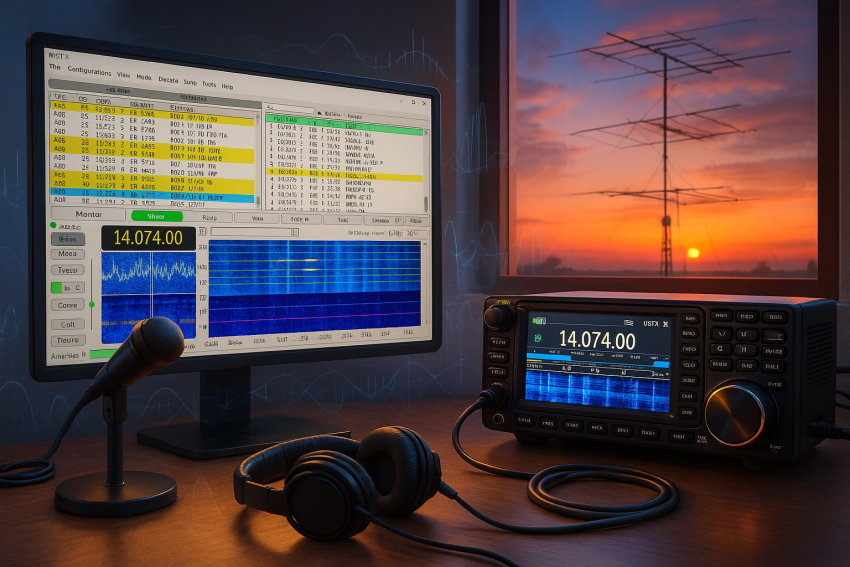
Software plays a crucial role. Programs like WSJT-X, FLdigi, and Ham Radio Deluxe handle modulation and demodulation, interface with radios, and decode incoming signals. The typical setup includes a transceiver connected to a computer through an interface box or sound card, allowing the digital tones to pass between radio and software.
Understanding how these technologies interact deepens your appreciation of radio science and prepares you for more advanced experimentation down the road.
Setting Up Your Station for Digital Mode Operation
One of the most encouraging aspects of digital modes is how accessible they have become. With a modest investment, you can start making digital contacts from your home or even portable setups.
Your radio equipment doesn’t need to be fancy. Many modern transceivers come with built-in digital interfaces or USB audio capabilities that simplify connecting to a computer. If you’re just beginning, a simple HF or VHF/UHF transceiver paired with a laptop or even a Raspberry Pi is enough.
Software like WSJT-X (for FT8, FT4, JT65) or FLdigi (for PSK31 and others) is free and widely supported. Installing and configuring these programs requires some patience, but numerous tutorials and forums can guide you step-by-step.
A quiet antenna environment and a stable power supply help improve results, but even a simple wire antenna can yield successful digital contacts. Portable digital operations are also popular, with operators running low-power “QRP” stations from parks or remote locations, enjoying the challenge of efficient communication.
Tips for Effective Digital Mode Operation
Success with digital modes isn’t just about having the right equipment; it’s also about timing, technique, and patience.
FT8 relies on precise timing, synchronized to Coordinated Universal Time (UTC), because transmissions occur in strict 15-second intervals. Being off by a few seconds can cause missed decodes. Using internet-based time synchronization tools is essential for consistent operation.
Understanding propagation is vital. Digital modes can thrive under weak conditions, but they still depend on solar cycles, ionospheric layers, and other natural phenomena. Monitoring band activity and joining networks or spotting services can keep you aware of optimal times for contacts.
When operating PSK31 or other conversational modes, maintaining proper radio discipline—such as respecting band plans, avoiding interference, and making clear calls—is important to foster a welcoming on-air environment.
Experimentation is encouraged. Adjusting power levels, antenna orientation, or software settings can yield surprising improvements. Many hams share their experiences in online communities, providing a rich resource for newcomers.
Digital Modes and Their Role in Emergency Communications
One of the most compelling reasons to learn digital modes is their utility in emergency situations. When conventional communication networks fail, amateur radio often becomes a lifeline.
Digital modes are particularly useful because they can transmit important messages reliably over weak or noisy channels. Modes like Winlink, which use digital protocols over radio, allow for email-like messaging without the internet. This capability has proven invaluable in disaster zones where cellular and internet infrastructure are compromised.
Organizations like the Amateur Radio Emergency Service (ARES) incorporate digital mode training into their preparedness plans. Learning digital operation not only equips you for everyday enjoyment but also prepares you to serve your community when it matters most.
How Mastering Digital Modes Helps You Prepare for Licensing
While this document doesn’t focus on licensing itself, exploring digital modes offers a practical and motivating way to build the technical foundation needed for your amateur radio license exam.
By working with digital modes, you gain hands-on experience with radio fundamentals: frequency usage, signal propagation, antenna basics, and station setup. You’ll naturally become familiar with concepts like modulation, bandwidth, and operating procedures that form the backbone of licensing exams.
Furthermore, engaging with the digital community exposes you to operational etiquette, logging practices, and technical troubleshooting, all of which will serve you well as a licensed ham.
Finding Community and Resources for Digital Mode Operators
The digital ham radio community is vibrant, diverse, and welcoming. From specialized forums to local clubs, you’ll find ample opportunities to learn, share, and grow.
Online resources like the ARRL website, the WSJT-X user groups, and platforms like Reddit’s r/amateurradio provide tutorials, troubleshooting advice, and lively discussions. Many clubs host workshops or net sessions dedicated to digital modes.
Learning from others’ experiences accelerates your journey and keeps you motivated. Don’t hesitate to reach out, ask questions, and even participate in contests or special events to test your skills.
The Future of Digital Modes: Innovation on the Horizon
Digital modes continue to evolve, with new protocols and technologies emerging regularly. Developments in software-defined radio (SDR), machine learning-assisted decoding, and mesh networking hint at exciting possibilities.
Modes designed for even greater efficiency and speed are under development, promising to make amateur radio communication faster, more reliable, and more accessible than ever.
As 5G and satellite internet expand worldwide, the interplay between traditional ham radio and digital internet-based communication will grow, offering hybrid operation modes that blend the best of both worlds.
Embracing Digital Modes: Your Next Step as an Aspiring Ham
Digital modes offer a thrilling way to dive into amateur radio’s technical and communicative depths. They are accessible, rewarding, and directly relevant to the future of the hobby. Whether you want to make contacts on weak signals halfway across the globe or prepare yourself for emergency communication service, learning digital modes like FT8 and PSK31 puts powerful tools in your hands.
Remember, every expert operator was once a beginner who took that first step. Explore, experiment, and engage with the community, and you’ll find that digital modes not only enhance your radio skills but also deepen your appreciation for the art and science of amateur radio.
Ready to start your journey? Download WSJT-X or FLdigi today, set up your station, and make your first digital contact. And when you do, join the conversation below or subscribe to our newsletter to keep learning and connecting with fellow hams.

Sources
- ARRL Digital Modes Overview
- FT8 Mode Description by Joe Taylor, K1JT
- PSK31.com – A Comprehensive PSK31 Resource
- Understanding FT8 and Other Digital Modes – DXEngineering
- Introduction to Digital Modes – Ham Radio Secrets
- Popular Digital Modes – Ham Stack Exchange
- An Introduction to Digital Modes – VE3MCF
- A Look at Digital Modes – eHam.net
- FT8 Mode Explained – QRZ.com
- PSK31 Technical Overview – Signal Identification Wiki
- Digital Modes Explained – RTL-SDR.com
- Digital Modes Overview – K3VSA
- Introduction to Digital Modes – AMSAT-UK
- FT8 Operating Tips and Info – DXAtlas
- Digital Modes Resources – AD7FO
Disclaimer:
The views and opinions expressed in this post are solely those of the author. The information provided is based on personal research, experience, and understanding of the subject matter at the time of writing. Readers should consult relevant experts or authorities for specific guidance related to their unique situations.