
2,937 words, 16 minutes read time.
My name is Nabu, a servant in the vast and glorious Babylonian empire, tasked with tending the great furnace—a roaring, insatiable beast that was the fiery mouth of King Nebuchadnezzar’s power. If you asked any man in those days about Babylon, he would tell you it was the pinnacle of human achievement, a fortress of unshakable strength, a city that gleamed like the sun itself. Its golden walls stretched toward the heavens, its ziggurats pierced the sky, and its markets buzzed with the wealth of nations. To be Babylonian was to be part of the world’s heartbeat, to stand at least in the shadow of immortality. And I, Nabu, was proud to serve it.
But that pride, I now know, was a lie.
I wore it like armor, a shield against the uncertainties of a world where men could rise or fall on a king’s whim. To be Babylonian gave me worth, or so I believed. My identity was bound to the empire’s machinery—my hands stoking the furnace, my sweat fueling its glory. I was a man who measured himself by his work, his status, and his loyalty to the king. To serve Nebuchadnezzar was to serve order, strength, and the gods themselves. Or so I told myself.
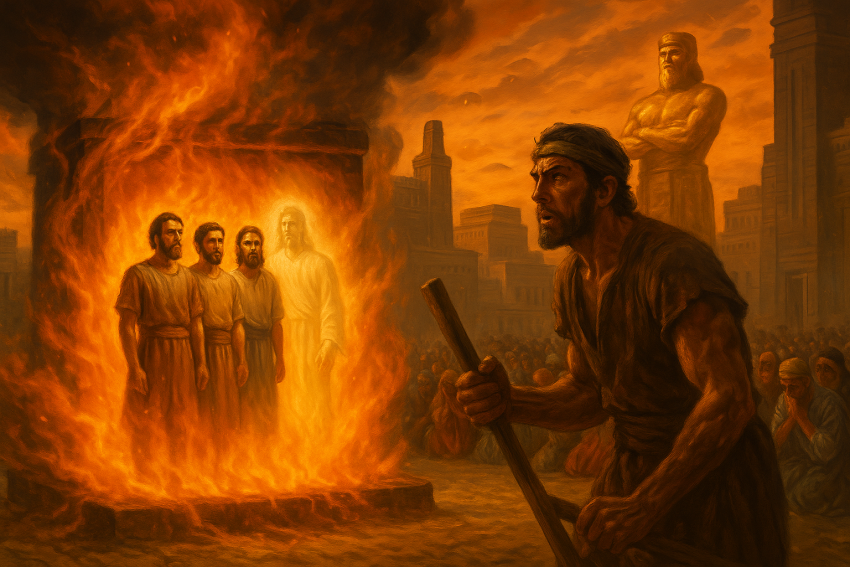
That day—the furnace day—changed everything. It was a day of heat and terror, of pride and revelation, a day that burned away the illusions I had built around my heart. It began like any other, with the sun blazing over the plain of Dura, where the king had erected his golden image. The statue towered ninety cubits high, a gleaming monument to his power, his divinity, his unbreakable will. It was a command to the world: Bow, or perish.
The air was thick with the scent of dust and sweat as the people gathered—nobles, governors, merchants, and slaves, a sea of faces from every corner of the empire. I stood among the furnace keepers, my tunic damp with perspiration, my hands calloused from years of feeding the flames. The herald’s voice rang out, sharp as a blade, commanding all to bow when the music played—flutes, lyres, horns, and drums, a cacophony of worship. To refuse was to invite death, a fiery death in the furnace I tended. I had seen men die in those flames before—thieves, rebels, those who dared defy the king. The furnace was no respecter of persons. It consumed all.
I bowed. Not just with my knees, but with my soul, weighed down by fear. To refuse was madness, a rebellion against the order of Babylon itself. I told myself it was wisdom, that survival was the highest good. Better to live in shame than to die in pride, I whispered to myself as my forehead touched the earth. The music played, the crowd knelt, and the golden image loomed above us, a god of metal and fear.
But then I saw them.
Shadrach, Meshach, and Abednego—captives from Judah, men I had seen in the king’s court, advisors who had risen far above their station. They were like me in some ways, exiles in a foreign land, yet unlike any man I had ever met. While the rest of us bowed, they stood tall, their eyes fixed on the golden statue with unflinching resolve. No fear. No hesitation. No bowing.
I remember the anger that surged in my chest, tinged with disbelief. Who do they think they are? I thought. They were throwing away everything—life, security, reputation—for what? A God I did not believe could save them? Their faith seemed reckless, a foolish gamble against the might of Babylon. I had heard whispers of their God, the one they called Yahweh, but to me, He was just another deity among many, no match for the king’s power or the furnace’s hunger. Their defiance was pride, I told myself, a dangerous, suicidal pride.
The crowd noticed them too. Murmurs rippled through the masses, and soon the king’s officials were alerted. Nebuchadnezzar’s face darkened with fury when he heard of their rebellion. He summoned them before him, his throne elevated on a dais, his eyes burning with the same intensity as the furnace I tended. The air was heavy with tension, the kind that precedes bloodshed. I stood nearby, close enough to hear, close enough to feel the weight of the moment.
“Is it true,” the king thundered, his voice echoing across the plain, “that you do not serve my gods or worship the golden image I have set up?” His words were a challenge, a dare to defy him further. I expected them to falter, to beg for mercy, to offer some excuse. But they did not.
Shadrach, the tallest of the three, stepped forward, his voice steady as stone. “O Nebuchadnezzar, we have no need to answer you in this matter. Our God, whom we serve, is able to deliver us from the burning fiery furnace, and He will deliver us out of your hand, O king. But even if He does not, know this: we will not serve your gods or worship the golden image you have set up.”
The crowd gasped. My heart pounded. Their words were madness, a direct affront to the king’s divinity, to the very order of Babylon. I glanced at the furnace, its mouth glowing red, its heat already searing the air even from a distance. I had stoked those flames myself, fed them with oil and wood until they roared like a lion. No man could survive that fire. No god could save them.
Nebuchadnezzar’s rage was a storm unleashed. “Heat the furnace seven times hotter!” he bellowed, his face contorted with wrath. I hesitated for a moment, my hands trembling as I obeyed the order. My fellow furnace keepers and I worked feverishly, piling fuel into the fire, the heat so intense it scorched our skin even from yards away. The flames danced and roared, a beast awakened, hungry for its prey. I felt no joy in my task, only dread. My heart trembled, not for the three men, but for myself—for what their defiance revealed about my own cowardice.
The soldiers bound Shadrach, Meshach, and Abednego with ropes, their hands and feet secured tightly. The king’s guard, men I knew to be strong and fearless, hesitated as they approached the furnace. The heat was unbearable, the air shimmering with its ferocity. I watched as they pushed the three men toward the mouth of the furnace, their faces grim with the knowledge that this task might cost them their lives. And it did. The flames leapt out, greedy and merciless, consuming the soldiers in an instant. Their screams were brief, swallowed by the roar of the fire.
I expected the same fate for the three Judeans.
I braced myself for the sight of their bodies crumbling to ash, their defiance reduced to nothing. But then the impossible happened.Not three men, but four, stood in the fire.
I blinked, my eyes stinging from the heat and disbelief. There, in the heart of the furnace, where no man should have survived, Shadrach, Meshach, and Abednego walked unharmed. Their ropes had burned away, but their bodies were untouched, their tunics unscorched. And beside them was a fourth figure—a presence so radiant, so serene amid the flames, that it crushed my pride and fear in a single glance. The king would later say it looked like a son of the gods, but I knew this was different. This was divine, beyond the gods of Babylon, beyond the power of Nebuchadnezzar. This was the God of Shadrach, Meshach, and Abednego, walking with them in the fire.
The crowd was silent, the air thick with awe and terror. Even Nebuchadnezzar rose from his throne, his face pale, his voice trembling. “Did we not cast three men bound into the fire?” he asked his counselors. They nodded, their eyes wide with fear. “But I see four men unbound, walking in the midst of the fire, and they are not hurt. And the appearance of the fourth is like a son of the gods.”
I stood frozen, my hands still gripping the tools of my trade, the furnace no longer a symbol of Babylon’s power but a stage for a miracle. The flames, which I had tended with such pride, were now a testimony to a power greater than any I had known. The three men emerged from the furnace, their faces calm, their eyes filled with a peace I could not comprehend. Not a hair on their heads was singed, not a thread of their clothing burned. The smell of smoke did not cling to them. They were untouched, as if the fire had been nothing יותר than a breeze.
For a man like me—proud of Babylon, proud of my role in its glory—this was a moment of reckoning. I saw my weakness laid bare. I had bowed to the golden image out of fear, out of a desperate need to survive, to preserve my place in the empire. But Shadrach, Meshach, and Abednego had stood real—real enough to die for their God, real enough to trust Him even when death seemed certain. Their faith was not pride, as I had thought, but a strength I had never known. It was a strength that came not from control or status, but from vulnerability, from surrender to a God who walked with them in the fire.
The king was shaken. He called the three men forward and praised their God, declaring that no one in his empire should speak against Him. He promoted Shadrach, Meshach, and Abednego, giving them greater authority in his court. But I barely heard his words. My mind was elsewhere, wrestling with what I had seen, with what it meant for me.
After that day, I was changed. Not outwardly—Babylon still thrived, its furnaces still burned, its golden walls still gleamed. But inside, my pride was broken. I returned to my work, but the fire no longer held the same power over me. It was no longer a symbol of my worth, my loyalty, my identity. Instead, it was a reminder of my fear, my weakness, and the God who had walked in the flames.
In the days that followed, I sought out Shadrach, Meshach, and Abednego. I did not dare approach them openly—my status as a furnace keeper was too low, and my shame too great. But I watched them from a distance, listening to the whispers of their conversations in the court. They spoke of their God with a quiet confidence, not as a distant deity but as a friend, a father, a protector. They spoke of His promises, His faithfulness, His love. I began to wonder if such a God could know a man like me, a man who had bowed to a false god, who had hidden behind his work and his pride.
One evening, as the sun set over the Euphrates, I found myself alone near the riverbank, the weight of my thoughts too heavy to bear. I knelt in the dust, not out of fear this time, but out of desperation. “God of Shadrach, Meshach, and Abednego,” I whispered, my voice trembling, “if You are real, if You see me, show me what it means to stand, to be real, to be free.”
I did not hear a voice, nor did a radiant figure appear before me. But in that moment, I felt a stirring in my heart, a quiet assurance that I was not alone. It was as if the God who walked in the fire was near, listening, waiting for me to take a step toward Him.
The furnace day became my turning point. I began to see my life through new eyes. I had defined myself by my work, my loyalty to Babylon, my ability to survive. But survival was not enough. To live—to truly live—was to stand for something greater than myself, to trust in a God who could deliver me, not just from fire, but from the chains of fear and pride.
Shadrach, Meshach, and Abednego taught me that being real—being honest about your faith, your fears, your weaknesses—is true strength. It is a strength that does not come from bowing to the gods of this world, whether they be golden statues or the expectations of men. It is a strength that comes from standing in the furnace, trusting in the One who walks with you through the flames.
I stand here now, not as a proud Babylonian, but as a man humbled by fire, faith, and truth. My hands still bear the scars of the furnace, but my heart bears the mark of a God who sees me. I am no longer defined by my work or my status, but by my willingness to stand, to be vulnerable, to trust.
To you who hear my story, especially you men who define yourselves by pride, by control, by hiding your weaknesses: What furnace are you facing? What false gods do you bow to—success, power, fear of failure? The fire is coming for us all, whether in the form of loss, betrayal, or the weight of our own choices. Will you stand real, trusting in the God who walks in the flames? Or will you bow in fear, clinging to a lie that can never save you?
I have seen the fire. I have seen the fourth man. And I know this: the God of Shadrach, Meshach, and Abednego is real. He is enough. And He is calling you to stand.
Author’s Note
Writing Nabu’s story hit me hard. It’s not just a tale of fire and faith—it’s a gut-check for any man who’s ever wrestled with what it means to stand tall in a world that demands you kneel. Nabu, a servant in the Babylonian machine, thought his pride in the empire—its power, its glory—gave him strength. He tied his worth to his work, his loyalty to a king, and the might of a nation. Sound familiar? How many of us have staked our identity on the pride of our “state”—whether it’s a career, a reputation, or the systems we’ve built our lives around—only to find it’s a hollow foundation when the fire comes?
This story, rooted in Daniel 3, is a call to every man to shift that pride from the kingdoms of this world to the unshakable Kingdom of God. Nabu’s journey mirrors the moment in Daniel 3:16-18 when Shadrach, Meshach, and Abednego faced Nebuchadnezzar’s fury and said, “Our God whom we serve is able to deliver us from the burning fiery furnace… But if not, be it known to you, O king, that we will not serve your gods or worship the golden image that you have set up.” That’s not just defiance—it’s a declaration of where their loyalty lies. They didn’t trust in Babylon’s strength, but in the God who walks through fire with His people.
As men, we’re taught to stand strong, to control, to conquer. But Nabu’s reckoning shows us that real strength isn’t in clinging to the pride of state—whether it’s a nation, a job, or our own ego—but in surrendering to God’s Kingdom. Galatians 6:14 hits this hard: “But far be it from me to boast except in the cross of our Lord Jesus Christ, by which the world has been crucified to me, and I to the world.” That’s the shift Nabu made, and it’s the challenge for us: to boast not in our achievements or the flags we wave, but in the cross that redefines what it means to be a man.
I wrote this story for you, brothers—men who know the weight of expectation, the pressure to bow to the world’s golden images. Maybe your furnace is a job that demands your soul, a culture that mocks your faith, or a fear of looking weak. Whatever it is, I pray Nabu’s story stirs you to stand real, to be honest about your struggles, and to anchor your pride in the Kingdom that never falls. As Psalm 20:7 says, “Some trust in chariots and some in horses, but we trust in the name of the Lord our God.” That’s the kind of men we’re called to be—men who trust, stand, and walk with the God who’s with us in the flames.Thanks for reading, for wrestling with this alongside me. Let’s choose the Kingdom over the state, faith over fear, and strength through vulnerability. The fire’s coming—will you stand?
With respect and brotherhood!

Sources
- Daniel 3 (ESV) — The Fiery Furnace
- GotQuestions: Who were Shadrach, Meshach, and Abednego?
- Enduring Word Commentary on Daniel 3
- BibleRef: Commentary on Daniel 3
- Desiring God: When God Doesn’t Deliver You from the Fire
- Ligonier: Trial by Fire (Devotional)
- Spurgeon Sermon: The Trial by Fire
- Crosswalk: Lessons from Shadrach, Meshach, and Abednego
- Bible Hub: Commentaries on Daniel 3:25
- OpenBible.info: Bible Verses about Pride
- OpenBible.info: Bible Verses about Fear of Man
- OpenBible.info: Bible Verses about Identity in Christ
- TGC: When Work Is Too Important
- Desiring God: Kill Your Sin or It Will Kill You
- Bible.org: The Fourth Man in the Fire (Daniel 3:1-30)
Disclaimer:
The views and opinions expressed in this post are solely those of the author. The information provided is based on personal research, experience, and understanding of the subject matter at the time of writing. Readers should consult relevant experts or authorities for specific guidance related to their unique situations.