
2,707 words, 14 minutes read time.

Amazon Affiliate Link
I suppose if you’re sitting here expecting some neat tale with a tidy moral, I’ll have to disappoint you. My story is ugly, tangled with mistakes I made with my eyes wide open, and I confess I still wrestle with whether my ruin was written by the stars or simply by the flaws lodged deep in my own chest.
They call me Matan. In my town, Nain—a little village clinging to the lower slopes of Jebel Dahi in Galilee—I was known for my hands. Hands that could cut stone so clean it would draw envy from craftsmen in Sepphoris. Hands that built walls that outlasted men. I took a savage sort of pride in that. If a house stood solid, it was because of me. If people gathered under a roof without fear of collapse, they owed it—unspoken, of course—to my skill.
I loved that feeling, the secret power it gave me. I would walk the market, hearing old widows barter for lentils, young mothers cradle fussy babes, and men bellow for better prices on salt fish. I would nod, silent, while inside I laughed. None of them could do what I did. None of them carried the same weight of mastery. In truth, I wore my reputation like a breastplate. It hid more than I wanted anyone to see.
You might think a man who was so good with stone must be equally solid inside. The truth is far from it. I was brittle in ways that shamed me. I fought anger that burned hotter than any kiln. When Romans passed by on their horses, arrogantly demanding wine or pressing boys into cart labor, I’d grind my teeth until my jaw ached. I spat at the ground after they left, but always behind their backs. I hated how my fists curled at the thought of them, yet never quite dared to swing. Worse, I nursed thoughts toward some of the merchants’ daughters that I’d not confess to any priest. Lust tangled with envy, for their fathers had land and flocks that I could only dream of.
Still, in the synagogue, I stood when the Torah was read, chanted the Shema with the rest, recited the prayers. I wore the mask well. Better than most. I gave my alms where men could see, nodded gravely when the Pharisees debated purity laws, and pretended it all fed me. But truth? It was a hollow religion, built not on love of God, but fear of losing face. I needed the respect of men. That was my real god.
Worse yet, after synagogue some Sabbaths, I’d linger at the well with a few of my drinking friends, trading snide remarks about the Sadducees with their polished smugness, or the Pharisees and their endless rules—mocking how they tithed even tiny garden herbs yet swallowed bribes from wealthy merchants without a blink. We laughed at their pompous debates on ritual handwashing, knowing full well that if our jests ever reached the wrong ears, we’d be hauled before the elders ourselves, our businesses threatened, our standing torn down in a breath. But the risk only salted our arrogance. We liked thinking ourselves cleverer than both priest and scholar. In truth, I hid my contempt behind laughter, because deep down, I envied their authority and feared their power to turn a crowd against me.
It was on a bright morning—too bright for mourning—when I first felt my carefully stacked stones begin to crack. I was in the quarry just beyond Nain’s southern gate, shaping limestone blocks for a merchant’s new courtyard. Sweat pooled at my brow, dripping from my beard. I remember thinking it was a good day’s labor, that my back ached but my purse would grow heavier by week’s end. That was all that mattered.
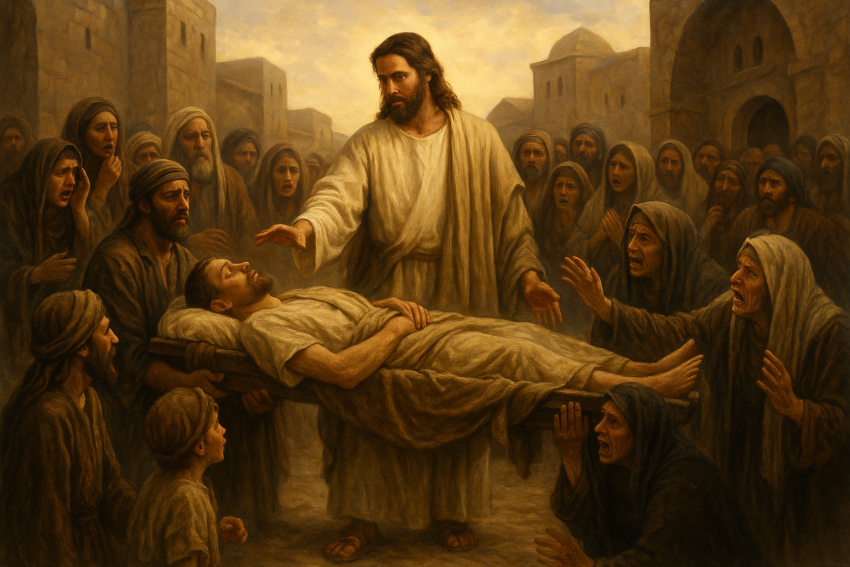
Then I heard it. Wailing. The piercing kind that tears through the air and sinks claws into your heart whether you wish it or not. Professional mourners, no doubt. Our village had plenty who made their living this way—women who could cry on cue and turn grief into performance. But even they couldn’t mask the raw agony that day. I looked up, squinting against the sun. There she was—Miriam, the widow. A woman who had already buried her husband some years before. Her face was crumpled, eyes red from weeping beyond the reach of ceremony. On the bier they carried her only son, wrapped tight, his pale feet jutting out awkwardly.
A sour taste filled my mouth. I muttered under my breath, “Life is cruel, that’s all. Better to be hard than let this world break you.” It was my motto, though I never said it so plain to others. Just kept it tucked beneath my ribs.
But something was off. A ripple moved through the crowd behind her. People parted, muttering. A name floated to my ears, and my blood heated with irritation. Jesus of Nazareth. I’d heard of him. Who hadn’t? Tales swirled from Capernaum and the lakeside towns—how he healed lepers, made lame men dance, even cast demons into squealing pigs. I’d scoffed every time. “Stories for fools who want hope cheaply,” I’d told my drinking friends. “Besides, if he’s so powerful, why not march on Tiberias and throw Herod into the sea?”
That day, though, I found myself stepping closer, stone chisel still clutched in my hand like a scepter. Maybe it was curiosity. Maybe a darker hunger, to see him fail and prove me right.
Jesus came on foot with a band of followers, dusty, unremarkable men except for the keen way their eyes watched everything. He didn’t look like a king. Didn’t look like a priest either. Just another Galilean with calloused hands. But as he neared the widow, the air itself seemed to draw tight. Miriam’s sobs hiccuped into silence, though tears still streamed. Even the professional wailers faltered, their practiced grief catching in their throats.
Then Jesus, without hesitation, stepped right into the path of the funeral procession. My stomach lurched. Who would do such a thing? Under the Law, touching the dead would make him unclean—he’d have to wash, isolate, bear the shame. Who was he to intrude on such raw sorrow? My pride rose like bile. I sneered under my breath, “Foolish rabbi, looking to show off. Does he not care for the Law at all?”
Then he did something stranger. He looked at Miriam, this crumpled woman whose world had ended twice over. His face twisted—not with pity alone, but something fiercer. Almost anger at the cruelty of it all. His voice was low but carried like a drum beat in my chest. “Do not weep.”
I wanted to spit. Easy words. Empty. How dare he tell her not to weep? What does he know of burying a son? I felt my fists tighten, not in defense of her, but to brace against how uncomfortable his words made me. They rang with an authority that unsettled me.
Then Jesus reached out and touched the bier. My breath caught. It was unthinkable, reckless—he would be ceremonially defiled. But there was no recoil in his hand, no hesitation. His eyes never left the boy.
“Young man,” he said, his voice steady as the Jordan’s flow, “I say to you, arise.”
I have tried to tell myself since that I imagined what happened next. That the sun played tricks, that the heat made my eyes dance. But I saw it clear as you see me now. The corpse stirred. A tremor ran from his shoulders to his feet. Then he sat up, blinking, gulping air like a newborn. His lips parted, and he croaked out a sound. “Mother?”
Miriam screamed—a sound that split grief from joy. She stumbled forward, clutching her boy so hard it seemed she’d never let go. The crowd erupted, some crying, some falling to their knees. Others shouted praises to God. “A great prophet has arisen among us!” they screamed. “God has visited his people!”
As for me, I stumbled back, the stone chisel slipping from my sweaty grip. My pride, my neat explanations, all the cold logic that had let me mock others’ faith—it cracked like cheap pottery. My mouth was dry, my heart a wild animal pounding to escape my chest. I felt exposed in a way I never had under Roman tax collectors or the harsh gaze of the Pharisees. Because for the first time, I knew God was not distant, tidy, or containable. He was here, overturning funeral processions, defying ritual boundaries, wrecking my illusions.
I wanted to curse Jesus for ruining my comfortable unbelief.
In the days that followed, I found no peace. I returned to my quarry, but my work felt empty. I’d pick up a block, set my chisel, then see that boy’s living face flash before me, hear Miriam’s sob of joy. I wanted to curse Jesus for ruining my comfortable unbelief. At night, I lay awake staring into the dark, wrestling with every hidden thing I’d buried—my lust, my simmering hatreds, my fear of truly depending on anyone but myself.
I sought out the synagogue rulers, hoping they’d tell me Jesus was a fraud. Instead they muttered that he was dangerous, a threat to order, possibly even a blasphemer. That only fueled the gnawing question in me: what if he was exactly what he seemed—a man sent from God, or God himself, reaching into our broken funerals to pull out life?
I wish I could say I ran straight to him, confessed all, and became a shining example of faith. That would make for a clean tale, wouldn’t it? The truth is uglier. I held back. I told myself I had to keep my business afloat, my name respected. I couldn’t risk alienating the synagogue, or the merchants who might stop hiring me if I threw in my lot with this scandalous Nazarene. I feared losing the very reputation that had always been my false refuge.
So I compromised. I listened when disciples passed through, even fed them a meal, nodded at their stories. But I kept my distance, always wrapping my deeper need in excuses. “Not yet. Maybe later. I have contracts to fulfill first. Besides, surely if he is truly from God, he will overturn Rome next, and then I’ll know.”
Years passed. The boy lived, grew strong, married. I watched him sometimes in the square, playing with his own children. Miriam aged with a peace I envied. Meanwhile, I aged with a sourness that deepened in my gut. I found my eyes drawn to younger women more than ever, my heart twisted with petty rivalries. My hands still shaped stone, but each block felt heavier, each commission less satisfying.
One spring, news came from Jerusalem. That same Jesus had been crucified by the Romans at the instigation of our own priests. I told myself it proved he was just a misguided teacher after all. Yet days later, travelers returned babbling that he had risen—truly risen—from the grave. That hundreds had seen him alive.
That crushed me in a way the resurrection in Nain hadn’t. Because if it was true, then it meant he’d not only pulled one boy from death, he had stormed death’s fortress entirely. It meant he was more than prophet. It meant I had wasted my chance to bow to him when he walked dusty roads through my own village.
I stand here now, an old man. My joints ache from years of stone lifting. My eyes are dimmer. I’ve built fine homes for others, but inside, I’ve let my own soul lie in ruins. I see that clearly. My tragic flaw was pride—an unbending self-reliance that kept me from clinging to the only One who could have truly raised me from my spiritual death.
Perhaps it was my fate. Perhaps woven into my very blood was this stubborn need to prove myself, to be my own foundation. Or perhaps it was simply my repeated choice, day after day, to build altars to my own importance. I don’t know. That’s the haunting part—whether I was ever truly free to be anything else.
Sometimes at night, I lie awake replaying that funeral day, trying to justify why I stood back. I tell myself I had responsibilities, that I was being cautious, practical. But those are thin garments for my shame. I know better. I was afraid. Afraid to be real. Afraid to let him see how needy, how twisted, how desperately hollow I was beneath my carefully carved reputation.
So I warn you, men. Because I see in your eyes the same haunted calculations I once made. You hide behind your trades, your ambitions, your families, your secret shames. You think admitting weakness will tear down everything you’ve built. Maybe it will. But better to have your false fortress demolished by grace than to die inside it, never having truly lived.
I missed my chance to walk beside him when his sandaled feet pressed the roads of Galilee. I may die still regretting that. Don’t let your story end like mine. If he comes to your funeral procession—your hidden griefs, your private moral corpse—don’t just stand back. Let him raise what’s dead. Let him break your pride. Let him make you real.
And if any part of you recoils at that? Well, that’s the very part he’s come to heal.
If you’re curious to see what sort of Messiah would stop a funeral just to give a son back to his mother—and a stonecutter a chance at new life—start by reading for yourself in Luke’s Gospel: Luke 7:11-17 (Bible Gateway). You might find your own heart rising before you even know it.
Author’s Note
I’m not going to sugarcoat it: I’ve wrestled with the same pride and anger that tore Matan apart. As a programmer, there’s this fierce pride in what I build—lines of code, software that works, systems that don’t break. When things go wrong, that pride turns into rage. Frustration so thick it blinds you. I’ve snapped at teammates, cursed bugs, and carried a weight of “I’ve got to fix this because no one else can.”
That rage? It’s a mask. It’s pride screaming to stay in control, to never be seen as weak or incompetent. But underneath, it’s lonely and exhausting. Reading about Matan’s story forced me to face that head-on—the way I hide behind my work to avoid real vulnerability, how I let my identity get wrapped up in success and control instead of truth.
This story hit me like a hammer: pride kills, not just your soul but your chance at real life. The moment Jesus interrupted that funeral wasn’t just a miracle—it was a call for me to stop running, to stop pretending. To let go of the lie that I have to carry it all myself.
If you’re like me—clutching pride, simmering with rage, afraid to be real—know this: you’re not alone. And it’s okay to let your walls fall. Because real strength isn’t about hiding your cracks. It’s about letting Jesus meet you there and raise you up.
— Thanks for sticking with this. Stay raw. Stay real.

Sources
- Luke 7:11-17 (Bible Gateway ESV)
- BibleRef Commentary on Luke 7:11
- Enduring Word Commentary on Luke 7
- GotQuestions: Why did Jesus raise the widow’s son at Nain?
- Bible Hub Parallel Commentaries on Luke 7:13
- The Gospel Coalition: Jesus and Resurrection
- Desiring God: Let Yourself Be Loved
- Blue Letter Bible Study Guide: Luke 7 (David Guzik)
- Ligonier Devotional: Jesus Raises the Widow’s Son
- Bible.org: Raising the Widow’s Son (Sermon)
- Crossway: Jesus and Our Fear of Being Known
- OpenBible.info: Bible Verses on Pride
- Psalm 34:18 – The Lord is near to the brokenhearted
- 1 Peter 5:5-7 – God opposes the proud but gives grace to the humble
- GotQuestions: What does it mean to be an authentic Christian?
Disclaimer:
The views and opinions expressed in this post are solely those of the author. The information provided is based on personal research, experience, and understanding of the subject matter at the time of writing. Readers should consult relevant experts or authorities for specific guidance related to their unique situations.