
4,318 words, 23 minutes read time.
I was born into the sun. Not the gentle sun of a morning walk or the warm glow that softens an old man’s bones, but the cruel, merciless sun of Pharaoh’s Egypt, bearing down on my neck until my skin cracked and bled. I remember it from my earliest days. My father would shake me awake before dawn, his hands rough from years of labor. We’d trudge together to the pits, where mud and straw waited for us, already hot from the ground’s own curse.
They told us to make bricks—thousands upon thousands of bricks—so that Pharaoh’s cities might rise, towering above the flat lands of Egypt like the sun itself, monuments to a power that seemed as eternal as the desert sands. Pithom and Raamses glittered in the distance, clad in bright limestone, dazzling to the eye, cruel to the heart. They were splendid only because they were built on the crushed bodies of Hebrews who could barely stand. I was one of those bodies. I still bear the scars to prove it—white ridges across my back that throb when the nights turn cold, a crooked finger that never set right after an overseer smashed it with his rod.
By midday, the sun was an iron weight pressing down on our skulls, burning the very thoughts out of our heads. It roasted the mud pits until the clay smoked under our feet, rising in ghostly wisps that clung to our skin. The sweat came first, pouring down in rivers that stung our eyes and drenched our linen tunics until they clung like wet bark. Then came the dizziness, a slow spinning that made the horizon sway. Then the hunger—always the hunger—twisting in my gut like a serpent that could never be fed enough.
We worked by rote, bodies moving long after our minds had gone hollow: dig the mud from the pits, mix it with the straw—never enough straw since Pharaoh commanded the overseers to stop providing it—and stomp it down until it wrapped our calves in clinging bands of sludge. Then shape it into bricks, slap them down on the ground to dry in the blistering sun, and start again. And again. And again. When someone slowed—an old man with knees that no longer bent properly, a boy whose shoulders were still narrow as reeds—the overseers’ whips encouraged us, curling around our backs and shoulders, slicing open skin already raw. I saw a man drop dead once, right there in the mud pit, face first into the sludge, his last breath bubbling up through the filth. They beat his corpse for slowing the line.
But the worst wounds Pharaoh inflicted were not on our bodies. They were wounds in our minds—carefully cut, deliberately tended. The Egyptians were master manipulators. They told us we were lazy, that we needed their whips to keep us honest. That without their firm hands we would sink into idleness and vanish like dust. They said we were a wretched people—dirty shepherd stock, too simple to rule ourselves, too backward to be anything but beasts of burden. Over time, those lies took root. I saw men stand taller after being whipped, as if grateful someone still thought them worth correcting. I heard fathers tell their sons to be thankful for work, because without it, Pharaoh might find another use for us—another Nile to drown in.
So when Moses first appeared, old and weathered by the desert, with skin like tanned leather and eyes that flashed with something none of us dared name, we did not know what to make of him. He carried a shepherd’s staff instead of a scepter, and he did not walk like an Egyptian. But he spoke words our hearts yearned for even if our minds scarcely dared believe them: that the God of our fathers—of Abraham, of Isaac, of Jacob—had seen our misery, had heard our groans, and remembered His covenant. Moses said God would lead us out from under Pharaoh’s hand with a mighty arm and an outstretched hand.
For the first time in my life, I felt a spark inside me—a warmth that was not the cruel sun or the fever of exhaustion. Hope. Dangerous, fragile hope. It flared up in my chest, and for a moment I could almost see myself as more than a beast making bricks.
But even then, Pharaoh twisted the knife. When he heard Moses’ words, he did not tremble or repent. He laughed—a cold, regal laugh—and said we were idle dreamers, making up tales of worship because we were lazy. He doubled our workload, ordered us to find our own straw, yet demanded the same tally of bricks each day. “You are idle! You are idle!” he thundered from his throne of polished gold, and his captains parroted his words as they rode through our camps on sleek horses. We began to whisper those words ourselves. Maybe Pharaoh was right. Maybe we were lazy, worthless without a taskmaster. Maybe Moses was just an old fool stirring up trouble.
That is what Pharaoh’s cruelty did to us—it not only broke our backs, it broke our minds, hollowed out our very sense of who we were. It taught us to wear masks that said, “I’m fine. This is fine. This is simply the way things are.” Because admitting otherwise was too dangerous. Because hoping hurt more than despair ever could.
So we learned to wear masks. Mine was pride. I stood straighter than most, forced a grin when my shoulders bled, told everyone I was fine—even when the weight crushed me. Especially then. Better to be seen as strong than to reveal the truth: that inside, I was angry, confused, grieving for a brother I never knew.
Eliav. That was his name. He was my mother’s first son, born in those dark days when Pharaoh, trembling at the swelling numbers of our people, decreed that every Hebrew boy must be thrown into the Nile. My parents told me about him in hushed tones by lamplight, their voices thin and shaking, as if even years later they feared soldiers might still be lurking outside our door, waiting to snatch another child from their arms.
Eliav never lived to see the mud pits or taste the lash of the overseer’s whip. He never felt the sun scorch his back as he mixed straw into mud, never stood trembling before an Egyptian taskmaster, never wore the bruises that marked us all as slaves. Pharaoh’s guards had come into our home, ripped him from my mother’s embrace while he was still warm from the womb, still scented with milk and life and hope. They hurled him into the Nile without so much as a backward glance, as if he were nothing more than refuse—another tiny offering to Pharaoh’s towering fear.
I grew up clinging to scraps of stories about him. In the quiet moments, I would let my imagination run, daring to hope that somehow Eliav’s story did not end beneath those murky waters. Perhaps, I told myself, someone kind—an Egyptian woman unable to bear her own child, or even a humble fisherman—had found his tiny body bobbing among the reeds and drawn him out, rescuing him from death. Maybe Eliav had been raised somewhere along the river’s banks, strong and laughing and unaware of the sorrow that once clung to his name. Perhaps he still lived, oblivious that his real family prayed for him every day, that I—the brother who came after—spent countless hours staring at the Nile’s slow current, imagining it had given instead of only taken.
But if I was honest—and honesty has never come easily to me—deep down I knew these were only tender lies I whispered to soothe my own heart. The Nile was not a cradle; it was a grave. Pharaoh’s orders were carried out with ruthless precision, and my parents’ haunted eyes told me the truth long before their words ever did. Eliav had perished. His tiny lungs had never learned to wail beyond that first startled breath. His life was stolen before it had even begun, leaving behind a hollow space in our family that I tried so hard, and so foolishly, to fill with fantasies.
Still, even knowing this, part of me clung to those hopes. Because to accept the truth—that my brother’s story ended beneath the Nile’s cold surface—was to accept the monstrous cruelty of the world we lived in. And that was a weight almost too heavy to bear, even for someone who prided himself on carrying burdens without complaint.
I came later, when Pharaoh’s slaughter had ebbed—at least the open killing of infants, though our lives were bled out slowly day by day. From the time I could understand words, I lived in the shadow of Eliav. My mother’s tears told me more about him than her stories ever could. Part of me hated that. I wanted her joy, her laughter—not the hollow smiles she forced for my sake. So I buried Eliav’s memory under my own growing mask. I told myself I was stronger because of it.
Years passed. Egypt’s chains only tightened. Then Moses returned, this time not as an Egyptian prince draped in fine linen, but as a prophet of the living God. With him came Aaron, his voice like thunder against Pharaoh’s stubbornness. They stood in the court of Egypt’s golden halls and declared, “Thus says the Lord, the God of Israel: ‘Let my people go, that they may hold a feast to Me in the wilderness.’”
Pharaoh laughed. I hear it still in my nightmares. That dark, curling sound of a man who believed himself invincible. “Who is the Lord, that I should obey His voice?” he scoffed. “I do not know the Lord, nor will I let Israel go.”
I stood among the crowd of my brothers and fathers, our hands still caked in clay, backs raw from whips. We watched Moses—our supposed deliverer—stand small before the throne of the greatest empire on earth. When Pharaoh dismissed him with a flick of his jeweled hand, a tremor went through us all. Part of me feared this would end in our utter ruin. Another part—a darker, more desperate part—almost hoped Pharaoh would defy the God of our fathers. Because I wanted to see Egypt break. I wanted them to suffer as we had.
And suffer they did.
It began with the Nile. Moses struck the water with his staff, and it turned to blood. I went down to the river’s edge to see it with my own eyes. The water that had once run cool and sweet was now thick and crimson, stinking of rot. Fish floated belly-up in droves. Egyptians screamed as they drew up pitchers of gore, clutching their mouths, retching on the banks.
The same Nile that had swallowed Eliav now choked on blood. Was it God’s poetic justice? I remember gripping a reed so hard it sliced my palm. I whispered, “Is this for you, brother? Is this your vengeance come round at last?”
But even as Egypt gagged on its pride, we Hebrews found our wells clear and pure. It was a wonder that left me both elated and strangely afraid. Why us? Why spare us? Was it truly mercy, or merely because we were useful for now? I wore that question like a stone on my heart.
Then came frogs, bursting from the riverbanks in a relentless tide. They swarmed Egyptian homes, invaded their kneading bowls, clambered into their beds. Their women shrieked; their priests tried vain spells that only seemed to anger the plague further. Yet in Goshen, where we lived, our floors remained clear. I would lie awake at night listening to the distant screams of the Egyptians and wonder if God did this simply to balance scales still stained by Hebrew blood.
Next, dust turned to gnats that crawled into Egyptian eyes and ears, set their skin crawling. Then flies, a black, buzzing curse that laid waste to everything—except us. Our livestock still grazed. Our children still ran barefoot through the streets. Egyptians fled their homes, gagging at the stench of rot. And I—I who had once trembled at their whips—felt a sharp, guilty pleasure pierce through my pity.
Hail shattered their fields, stripping branches bare, pounding servants and soldiers alike into the mud. Locusts finished what the hail left, eating every green leaf until Egypt stood as barren as my mother’s eyes after they took Eliav. Darkness followed—a suffocating, heavy black that smothered their lamps and left them groping like blind men. For three days they wailed, prisoners inside their own homes.
But in Goshen, there was light. Always light. I would step outside at dawn, look toward the Egyptian horizon, and see only pitch—while our own streets basked under a warm sun. It should have filled me with grateful awe. And it did, in part. But it also stirred something bitter. Was this mercy just for now? Or were we still marked for ruin, merely spared so we could witness Egypt’s humiliation?
Even Pharaoh tried to twist our deliverance into fresh chains. He accused us still of idleness. He said all of Egypt’s ruin was our fault—that if we had simply obeyed, if we had kept our heads down and accepted our fate, none of this would have happened. Those lies were sharp. They dug into wounds we already carried, whispering that perhaps we did deserve nothing better.
The worst was when I heard myself repeating those thoughts in my own heart. Maybe we were only ever good for making bricks. Maybe God was simply using us to show His power, no more invested in our freedom than Pharaoh was.
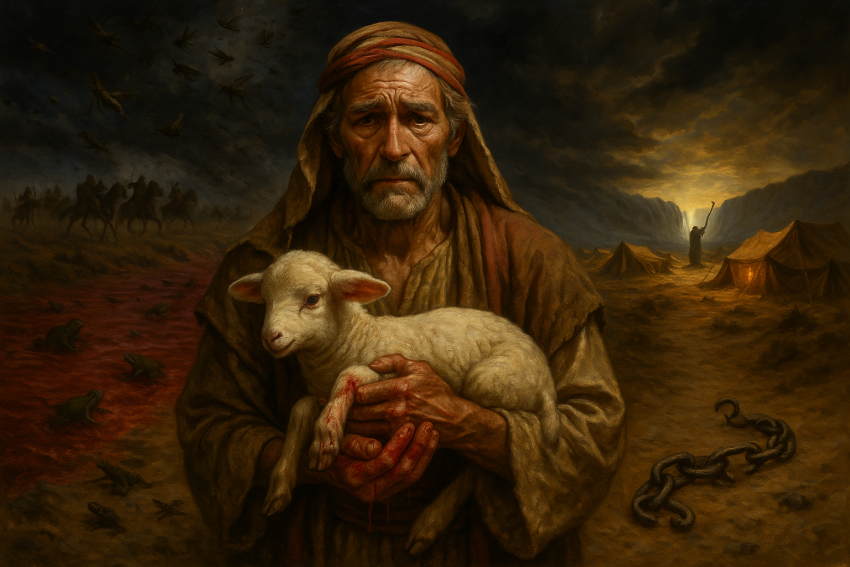
Then came the final night. Moses returned to us with words that made my knees weaken. “Slaughter a lamb,” he said, voice grave. “Paint its blood on your doorposts. Eat it with haste, staff in hand, sandals on your feet. For tonight the Lord will pass through Egypt, striking down every firstborn man and beast. But when He sees the blood, He will pass over you.”
I did as I was told. I held the little lamb tightly, feeling its warm life slipping away over my trembling wrists. Tears burned in my eyes, blurring my vision as the lamb’s breath faded into stillness. I cried—not just for the lamb, but for what this sacrifice meant. For the blood that had to be spilled, for the judgment that was coming. I knew deep down this was what God demanded, a terrible act of obedience in the face of unspeakable fear.
With shaking hands, I smeared its blood across our doorway. Then I sat inside, my heart pounding so fiercely it felt like it might burst from my chest. Outside, the air grew heavy and thick, charged with a dread that seemed to press against our walls.
That night, after the lamb’s blood was smeared and the screams echoed in the distance, I found myself wrestling with a bitter question. Later, I sat beside my father, the flicker of the oil lamp casting long shadows across his weathered face. “Father,” I said quietly, “Pharaoh’s soldiers have already taken so many of our firstborn. Why do we need to mark our doors with blood? If they’ve already killed so many, why does God demand this?”
My father looked at me, eyes steady but filled with sorrow. “Nahshon, my son,” he said slowly, “the blood on our doorposts is not for Pharaoh’s soldiers. It is a sign for the Lord. It marks us as His own, a people set apart, protected by His promise. The plagues could have destroyed us all—no one was safe. But God’s mercy is greater than we understand. He sees us, knows our hearts, and with this blood, He commands the destroyer to pass over us.”
He paused, his voice softening. “Remember, it is not just about what Egypt has done to us. It is about what God is doing for us. The blood is a covenant, a shield, a promise that even in the darkest night, His light will not abandon His people.”
I nodded, but the weight of his words pressed deep inside me. The blood was not only protection—it was a reminder. That no matter how much the world tried to destroy us, we belonged to God, who saw every tear and heard every cry. And that, even in the darkest hour, we were never truly alone.
Somewhere in the distance rose a scream—high, ragged, then abruptly cut off. Then another. And another. Egypt wailed that night, a sound that still hunts my sleep. But in Goshen, no wail rose. Not a single Hebrew child died. My own son, curled beside me, breathed steady and sweet. I pulled him close and felt tears pour down my face. Was it gratitude? Relief? Or shame that a part of me still whispered: This is the vengeance Eliav never had. This is the payment Egypt never dreamed they would owe.
Even in our deliverance, my heart was not pure. I wanted justice, yes—but I also wanted them to hurt as we had. I clung to my wounds, wore them like a mask that let me justify every dark thrill. Even now, I wonder if the same pride that hardened Pharaoh’s heart lives stubborn inside me.
All night, Egypt wailed. Mothers clawed their faces, fathers tore their robes, children screamed in terror. Death did not enter our houses—he passed by, just as promised—but outside, grief was everywhere. Pharaoh’s own son died that night, and with him, the last of Pharaoh’s illusions of power.
At dawn, Pharaoh’s summons came. “Rise, go out from among my people, both you and the children of Israel. Go, serve the Lord as you have said. Be gone, and bless me also.” The irony bit deep—he who once mocked our God now begged for His favor.
We left in haste, dough still unleavened on our kneading troughs, jewelry given by fearful Egyptians hanging heavy around our necks. After generations of bondage, we were free. Or so we thought.
Freedom tasted strange. The wilderness was wide, empty, frightening. I missed Egypt’s routines, even its predictability. Slavery was cruel, but it was familiar. Out here, we were exposed—no walls, no overseers, no daily quotas. Just us, our tents, and a God who seemed close one moment and terrifyingly distant the next.
When we reached the Red Sea, my heart sank. Ahead lay water too deep to ford; behind us, Pharaoh’s army thundered in a vengeful charge. Many around me wept, others raged. My pride refused both. I muttered instead, “I told you we should never have left. We were safer as slaves.” That’s the poison of my mask—better chains I could see than fears I could not.
But Moses lifted his staff, and the sea split like a ripped garment. Walls of water towered on either side, the seabed dry beneath our feet. We walked through as if in a dream. When the last of us stepped out, the waters crashed back, drowning Pharaoh’s mighty army in a single divine breath. The God of Eliav, the God of Moses, had fought for us. And I—Nahshon—stood alive to see it.
Yet even with Egypt’s chains shattered behind me, I carried others still. In the wilderness, my pride twisted again into a mask of certainty. When food grew scarce, I grumbled. When water ran out, I blamed Moses. I told myself I was fine—better than the others, more practical, less given to wild hope. I even sneered at the manna that fell from heaven, calling it bland, unworthy of a free people.
I suppose you could say my flaw was always pride, but not the kind that struts and boasts. Mine was quieter, disguised as strength. It told me I didn’t need help, didn’t need to show pain, didn’t need to question why Eliav died while I lived. I wore that mask so long I forgot it was a mask at all.
It’s only now, telling you this story, that I feel its edges peel away. Perhaps you know what that’s like—hiding behind “I’m fine” while inside, your soul bleeds. Maybe your burden isn’t bricks under a sun that wants to kill you, but a mortgage, a failing marriage, an addiction you swear you’ve mastered. Maybe you have ghosts like Eliav, losses you never knew but which shaped you all the same.
I wish I could tell you I learned my lesson fully. That I dropped my mask and trusted God completely. The truth is harder. Even after crossing the sea, I still struggled. When spies later went into Canaan and returned trembling, my heart trembled too. I let fear overtake faith more than once. I watched an entire generation, my generation, perish in the wilderness because we trusted our own understanding more than God’s promises. That, too, was a consequence of the mask. We’d rather die as self-sufficient men than live as humble sons.
So I stand before you now, old bones under a desert sun, and confess it plain: I was never fine. I was broken, angry, confused. I hid it behind pride, behind duty, behind a grin that said nothing touched me. But God was never fooled by my mask. He saw every wound, every hidden tear. And in His mercy, He walked with me anyway—through mud pits, across parted seas, into lonely wastelands. Even now, He waits for me to trust Him fully.
If you wear a mask like mine, take it from an old fool who spent too long pretending: it’s better to be honest. Better to admit you’re not fine. Because the God who broke Pharaoh can break chains still—chains of pride, fear, anger, lust, all of it. But He will not tear off your mask by force. That choice is yours. I pray you make it before the wilderness swallows you whole.
And yet, if I am honest, the reason I won’t see that land is tied not just to my doubts, but to the mask I wore for so long—the mask of pride and stubborn self-reliance that whispered, “I’m fine,” even when my soul screamed otherwise. It was that mask that hardened my heart and blinded me to God’s work until it was almost too late.
I clung to it like a shield, afraid to show weakness, afraid to admit fear or pain. But in doing so, I built a wall between myself and the very God who sought to carry me. That mask cost me much—perhaps even the chance to stand in the promised land myself.
Yet, I am learning that the shedding of that mask, the laying down of false strength, is where true freedom begins. IIt is my prayer that my son, Eliav—named after my older brother whom I never knew—will walk into that land unmasked—open, vulnerable, and fully known by God and by his people.
When I cross that final river, maybe I will finally be free too—free from the masks that have bound me here in the desert of my own making.
Author’s Note:
Nahshon’s masks—his stubborn self-reliance, hidden doubts, and refusal to fully trust—kept him wandering in the wilderness. Because of these, like many in his generation, he never set foot in the promised land. The desert became his final home, a place of survival but not fulfillment.
This ancient story echoes a solemn warning for us today. Jesus said, “Not everyone who says to me, ‘Lord, Lord,’ will enter the kingdom of heaven, but the one who does the will of my Father who is in heaven” (Matthew 7:21). Many who wear masks—of faith, pride, or self-righteousness—may profess belief but never truly follow God’s will with open hearts. Like Nahshon, they risk wandering, never fully receiving God’s promises.
Paul reminds us, “Therefore let anyone who thinks that he stands take heed lest he fall” (1 Corinthians 10:12). It’s a call to humility and vigilance. Our masks can blind us to our own flaws and keep us from fully trusting God’s grace. They can isolate us from others and from God’s transformative power.
So, be careful with your masks—those defenses and facades you cling to. They might protect you for a time, but they can also imprison you in a desert of loneliness, fear, and doubt. True freedom, true life, comes only when we lay down our masks, confess our brokenness, and step forward in faith.
Nahshon’s journey is a mirror for all of us. It asks: Will we keep wandering behind our masks? Or will we dare to trust fully, follow faithfully, and enter the promised land God has prepared?

Sources
- Exodus 1 (Israelites Oppressed)
- Exodus 2 (Birth of Moses)
- Commentary on Exodus 1:14 (Hard Labor & Bitter Lives)
- Bible.org on the Birth of Moses
- Why did Pharaoh order the killing of Hebrew boys?
- Desiring God: Stop Saying “I’m Fine”
- How to Take Off the Mask and Live in the Light
- Biblical Themes Related to Deception / Gaslighting
- Bible Verses about Slavery & Oppression
- Ligonier: The Heart of Slavery
- Parallel passages on God hearing the cries of the oppressed
- Bible Dictionary: Pharaoh
- Men: It’s Okay to Not Be Okay
- GotQuestions: Removing the Mask of Hypocrisy
Disclaimer:
The views and opinions expressed in this post are solely those of the author. The information provided is based on personal research, experience, and understanding of the subject matter at the time of writing. Readers should consult relevant experts or authorities for specific guidance related to their unique situations.
1 thought on “I Lied and Said I Was Fine: A Hebrew Slave’s Confession from Egypt’s Brickyards”