
2,471 words, 13 minutes read time.

Amazon Affiliate Link
There’s a special kind of person who spends countless evenings hunched over a dimly lit workbench, carefully soldering delicate circuits or piecing together rugged “go boxes” packed with radios, batteries, and every tool needed to bring communication back from the brink. They pour hard-earned dollars—sometimes thousands—into antennas, power supplies, portable towers, and handheld transceivers, all for a role they genuinely hope they never have to perform. Yet when hurricanes rip through the coast, tornadoes flatten entire neighborhoods, or wildfires rage unchecked across dry hillsides, these are exactly the people communities rely on.
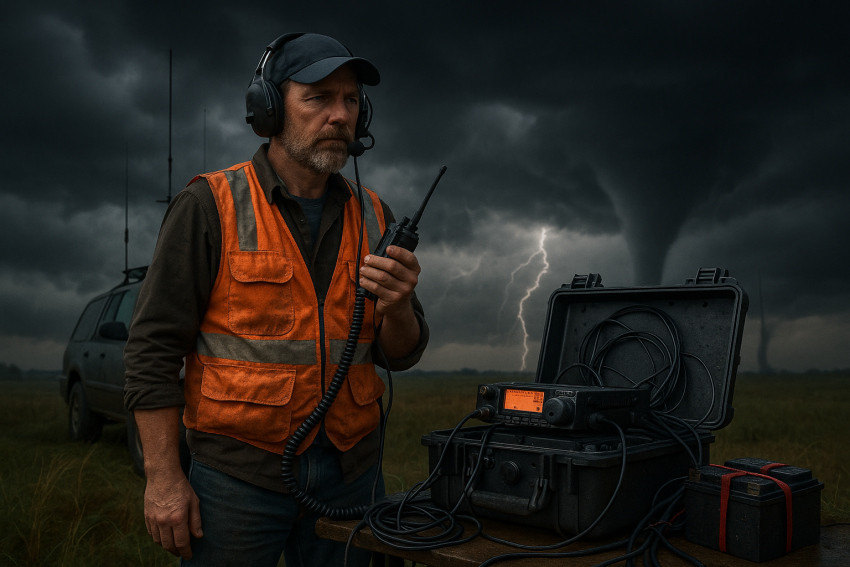
These are the amateur radio operators. The ones who stand watch when the world goes silent. They form the backbone of networks like SKYWARN, feeding live reports of hail, wind damage, and funnel clouds straight to National Weather Service meteorologists during dangerous storms. They’re the storm spotters who chase dark, rotating supercells across lonely highways, their radios buzzing with coordination nets that tie together weather officials, emergency managers, and other trained volunteers.
But what too few people see is the long road these operators walk to be ready. Before they ever key up a mic in a real disaster, they spend dozens—often hundreds—of hours studying to pass exams and earn their licenses. Many don’t stop at the entry-level Technician certificate; they press on to General and Extra, learning the intricacies of HF propagation so their signals can reach across continents if needed. Beyond licensing, many dive into thick task books—voluntary training programs developed by emergency communications groups—to prove their skills in message handling, net control, and tactical deployments.
In many places, these task books are intended to be signed off by local emergency managers or served agencies to confirm proficiency. But politics and bureaucracy can get in the way. Some agencies hesitate to formally certify volunteers, fearing liability or simply lacking time. So countless radio operators push forward anyway. They complete the training, master the checklists, and quietly stand ready—certification or not—because they know when the time comes, they’ll be the ones to bridge the communications gap.
It’s also a story of relentless preparation. These people run field exercises under blistering sun or freezing rain, testing antennas on rocky ridges, hauling go kits into remote areas just to practice. They maintain solar panels and generators, carefully cycle their batteries, and learn to program complicated radios in the dark if that’s what it takes. They log hours working digital modes like Winlink, so they can send critical emails over HF when the internet fails.
And it’s a story of community. Spend an evening at any local amateur radio club and you’ll see it: people teaching each other to tune antennas for that elusive 1.2:1 SWR, troubleshooting flaky coax, or swapping stories about bizarre late-night propagation that once carried their tiny signals thousands of miles. It’s mentorship over coffee and soldering irons, friendships forged by the shared goal of being ready to help.
Ultimately, this is a story of service. Because when the grid fails—when cell towers are bent like paperclips, power lines twist uselessly on the ground, and routers go dark—it’s these people who keep the vital lines of communication alive. They link emergency operations centers, coordinate shelter supplies, track incoming weather hazards, and pass the health and welfare messages that help families sleep at night.
So let’s step deeper into this world. Let’s explore why our modern communication systems are far more fragile than we’d like to believe, how amateur radio operators organize themselves into disciplined nets when chaos erupts, and why so many people keep investing their time, money, and sweat into this remarkable calling. If you’ve ever thought about getting involved—about becoming the calm, capable voice on the other end of the frequency when it matters most—this journey might just change your life.
Why Modern Communication Fails So Easily
Most people assume their cell phones will work forever. If not the phone, surely the internet. If not that, then certainly the local emergency broadcasts. But the reality is far more precarious.
Look back at nearly any major disaster over the past twenty years. When Hurricane Katrina roared into New Orleans, it didn’t just flood streets—it wiped out communications. Hundreds of cell towers were knocked offline. Landlines and internet cables were submerged. Even many public safety radio systems struggled under the chaos, overloaded or physically destroyed. It took weeks to restore reliable coverage.
During the 2011 Joplin tornado, one of the most violent twisters ever recorded, countless power lines were ripped apart, and cell infrastructure vanished. Local first responders had to rely on simplex (radio-to-radio, no repeater) communications, often with minimal range, while amateur operators quickly set up nets to fill the gaps.
Earthquakes pose another threat. The 2010 quake in Haiti toppled cellular infrastructure almost instantly. Internet cables snapped like dry twigs. Power was out for weeks in many areas. It was largely radio operators, some using portable HF rigs under tarps and in battered courtyards, who relayed health and welfare messages out of the country.
The problem is simple: our high-speed world depends on extremely delicate infrastructure. Towers have limited battery backups. Fiber-optic lines need power at repeaters every few miles. Even satellite-based internet requires carefully aligned dishes, ground stations, and stable power. In contrast, amateur radio can operate off a car battery, a generator, or a modest solar setup. It can communicate over local repeaters, or—if repeaters are down—directly point-to-point, or even bounce signals off the ionosphere to reach hundreds or thousands of miles.
How Amateur Radio Operators Step In
When all else fails, it’s often amateur radio that provides the last reliable link. But it doesn’t happen by accident. These are people who train, drill, and build relationships with local emergency agencies long before any storm ever appears on the horizon.
Groups like ARES (Amateur Radio Emergency Service) are organized specifically to assist during disasters. They work under memorandums of understanding with the Red Cross, hospitals, and local emergency management offices. ARES operators routinely set up temporary communications at shelters, coordinate logistics for food and medical deliveries, and pass formal messages called “radiograms” that track supplies, staffing, or urgent patient needs.
Then there’s RACES (Radio Amateur Civil Emergency Service), a formal program activated by local or state governments during declared emergencies. RACES operators are often registered and credentialed ahead of time, meaning they can be rapidly deployed into restricted zones to keep critical communications flowing.
And of course there’s SKYWARN, which many outside the hobby know best. Sponsored by the National Weather Service, SKYWARN volunteers take specialized training to identify storm features like wall clouds, hook echoes, and debris signatures. When severe weather threatens, these trained spotters position themselves carefully—sometimes chasing, more often parking on high ground with a clear view—and relay live ground truth that radar alone can’t provide. That’s the human piece of meteorology that saves lives.
The Training and Discipline Behind the Microphone
It’s easy to imagine amateur radio operators simply spinning a dial and chatting, but serious emergency communications is far more structured.
Most begin by earning their Technician license, which requires learning the basics of electrical principles, FCC rules, and practical radio operation. Many then advance to General and Extra licenses, unlocking more frequencies and building deeper knowledge—especially about high-frequency (HF) bands that can reach internationally.
But licensing is just the start. Those committed to emergency work often pursue FEMA Incident Command courses (ICS 100, 200, 700, and 800 are common baselines). They participate in local training nets, learning standardized message formats and protocols. They fill out thick ARES or AUXCOMM task books—practicing everything from traffic handling and tactical call signs to setting up field expedient antennas under stress.
Here’s where you see the dedication shine. In many counties, local emergency managers simply don’t have the bandwidth or political will to formally certify these task books. That means operators who have invested dozens of hours drilling, attending exercises, and documenting their capabilities often finish the process without an official sign-off. Still, they press on—because for them, readiness isn’t about paper. It’s about skill, muscle memory, and the confidence that when someone hands them a mic in the chaos of a flood or fire, they’ll know exactly what to do.
Real-World Moments of Triumph and Grit
During Hurricane Maria’s catastrophic strike on Puerto Rico, amateur radio operators formed lifelines. When commercial power and telecom were knocked out for nearly the entire island, hams relayed health and welfare traffic, coordinated between isolated hospitals and the Red Cross, and kept families connected to the outside world. Some operators operated out of improvised setups under tarps, carefully conserving generator fuel and running minimalist HF rigs.
After the 9/11 attacks, with Manhattan’s cell sites damaged and many landlines overwhelmed or severed, amateur radio volunteers were among the first to set up auxiliary communications for relief workers. They staffed Red Cross shelters, passed messages between logistics teams, and helped coordinate incoming volunteers and supplies.
In countless small disasters—flash floods in Oklahoma, ice storms in Maine, wildfires in California—it’s often local amateur operators who fill critical gaps. They keep emergency management linked to outlying shelters, help coordinate food and water runs, or even provide simple health-and-welfare nets so people can report in safe. For those trapped in a blackout of uncertainty, hearing that a loved one checked in over a radio circuit is worth more than gold.
The Technical Edge: Gear That Keeps Running When the Grid Falls
It doesn’t hurt that amateur radio is uniquely suited to these challenges. Unlike cell systems, a basic radio transceiver can run straight from a car battery. Many operators build portable systems—called “go boxes”—that house radios, tuners, small computers, and digital interfaces all wired together and ready to roll. Plug in a power source and toss an antenna into a tree, and they’re on the air.
Digital modes like Winlink let operators send actual emails over HF radio, completely bypassing the internet. This means emergency operations centers can maintain documented chains of communication even if fiber lines are down. Tools like APRS (Automatic Packet Reporting System) allow live position and weather reporting. Mesh networks built with inexpensive ham-grade Wi-Fi gear can even re-create local internet-like systems when the real one’s down.
All of this comes with personal cost. The average committed emergency operator might have $3,000–$5,000 invested in various radios, tuners, batteries, and antennas—not to mention countless hours learning to master them. But ask anyone who’s been through a real deployment if it was worth it, and you’ll get the same steady nod.
The Brotherhood and Sisterhood of Preparedness
For many, the best part isn’t even the radios—it’s the people. There’s a certain pride in competence, in knowing how to spin up a portable comms center on a moment’s notice. It draws like-minded individuals who enjoy challenges, problems to solve, and gear to tinker with.
Local radio clubs are a cornerstone of this community. New operators find mentors willing to spend an afternoon helping tune an antenna or troubleshoot a stubborn digital mode. Field Days—annual nationwide events where thousands of operators set up temporary stations in parks and fields—are as much about grilling hot dogs and laughing with friends as they are about logging contacts. But under that fun runs a serious thread: it’s all practice for when it counts.
Because when it does count, these same people will be hauling heavy gear into a shelter at 2 AM, stringing wire antennas in the rain, or calmly running a net that manages dozens of worried voices. That blend of skill, camaraderie, and dedication is hard to find anywhere else.
Thinking of Joining Their Ranks?
If this world intrigues you, if you find yourself wondering what it would feel like to be the calm voice on the radio when panic is all around, then maybe it’s time you explored getting your license.
Start small. Look up local amateur radio clubs. Many offer free classes or inexpensive study groups to help you pass your Technician exam. Sit in on a meeting. See who’s doing SKYWARN, who’s handling ARES traffic nets. You’ll find people eager to show you the ropes—people who’ve invested serious time mastering their craft and love nothing more than sharing it.
And if you already hold a license? Consider getting involved in emergency work. Ask your club about ARES or RACES registration. Download a task book and start working through it, even if your local officials aren’t big on paperwork. Show up for Field Day or a local public service event like a marathon or bike race—many of these use amateur operators to staff aid stations and practice traffic nets.
A Last Word—and an Invitation
At the end of the day, amateur radio in disaster response isn’t really about radios. It’s about people. It’s about neighbors helping neighbors, using a deceptively humble technology to fill the most critical gap imaginable: keeping us connected when everything else breaks. It’s about personal responsibility, quiet competence, and stepping up when the stakes are high.
So if you’re even slightly curious—about the gear, the skills, the community, or just the chance to be someone who stands steady when the world wobbles—I encourage you to take the next step. Subscribe to our newsletter to get tips on building your own emergency rig, guides to digital modes, and stories from operators who’ve been there. Or drop a comment below. Share what draws you to this world, or ask us anything that’s on your mind. We’d love to hear your story—and help you write the next chapter of it on the air.

Sources
- ARRL – Amateur Radio Emergency Communication (role of hams after infrastructure failure)
- The Vital Role of Ham Radio in Disaster Preparedness (ARES & FEMA recognition)
- ARRL – Emergency Communications Training (training courses & preparedness)
- Unleashing the Power of Amateur Radio in Times of Emergency (ARES, RACES, SATERN, SKYWARN overview)
- Use of Amateur Radio Operators to Augment Emergency … (historical deployments: hurricanes, floods, wildfires)
- How Disaster Response Relies on Amateur Radio Operators (nets & resource coordination)
- Reddit – OC Discussion: What is amateur radio as an emergency response? (hams handling vital coordination)
- Wikipedia – Amateur Radio Emergency Communications (global examples, 9/11, Katrina, tsunamis)
- Wikipedia – Amateur Radio Emergency Service (ARES) (structure, partnerships, ARES/RACES/MOUs) :
- Wikipedia – SATERN (Salvation Army’s radio network for welfare traffic)
- TPR News – Hams maintain comms links during hurricanes (real-world: Helene/Milton hurricanes)
- WIRED – Through Hurricanes Helene and Milton, Amateur Radio Triumphs (in-depth story, deployment, Winlink)
Disclaimer:
The views and opinions expressed in this post are solely those of the author. The information provided is based on personal research, experience, and understanding of the subject matter at the time of writing. Readers should consult relevant experts or authorities for specific guidance related to their unique situations.