
2,493 words, 13 minutes read time.

Amazon Affiliate Link
When most guys imagine getting into amateur radio, it’s easy to picture a bench full of soldering irons, racks of glowing transceivers, maybe even a cranky old Elmer growling about band plans and standing wave ratios. It’s a hobby that draws men in droves, partly for the challenge of mastering complicated gear, partly for the sheer thrill of contacting someone halfway across the planet using little more than wire and watts. But behind this rugged image lies a story most men overlook — one that’s every bit as technical, as daring, and as full of raw pioneer spirit as anything the classic gray-bearded hams ever accomplished.
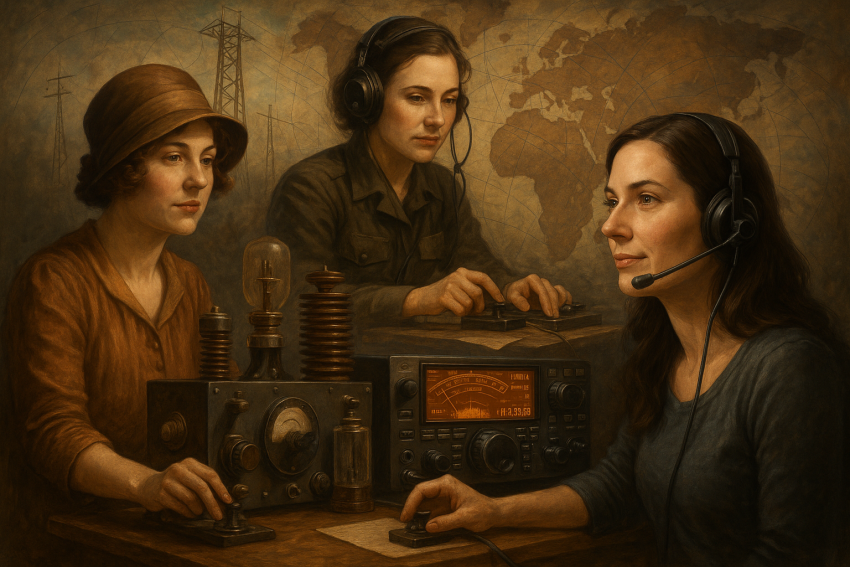
It’s the story of women. Not just women who picked up the mic once in a while, but women who built the backbone of amateur radio. Women who designed transmitters, taught code, drafted blueprints, hauled heavy field equipment, organized global nets, and — maybe most importantly — opened doors to a more welcoming, service-driven, community-focused vision of the hobby. In many ways, these legendary women set the stage for the very kind of meaningful ham experience that draws men to chase their licenses today.
This isn’t an article to guilt you into anything. Quite the opposite. By seeing how these pioneers operated, you can pick up priceless insights that’ll not only help you become a licensed operator but also make you the sort of ham who truly shapes the community. Their stories prove that amateur radio has never just been about testosterone or bragging rights over contest scores. It’s about grit, curiosity, public service, and global camaraderie — values that resonate with any man aiming to do more than simply turn knobs.
So pour yourself a cup of strong coffee, settle in, and let’s explore how these women of the mic forged a legacy that can inspire your own path on the air.
The First Voices on the Airwaves: Gladys Parkin, Mary Loomis, and Florence McKenzie
Amateur radio’s earliest years were a kind of technological Wild West. Before the Federal Radio Commission laid down clear laws, countless enthusiasts built spark transmitters in barns and kitchens, reaching out into the ether with homemade coils. Among these tinkerers were teenage boys — and teenage girls, though history books rarely mention them.
One of the earliest documented female ham operators was Gladys Kathleen Parkin. Born in California in 1900, Gladys developed an interest in radio at just nine years old, shadowing her older brother and soldering crystal sets in their workshop. By the age of fifteen, she earned a first-class commercial radio license, the highest available certification. This wasn’t just unusual for a young woman in 1916 — it was almost unheard of for anyone her age, period. Newspapers ran stories marveling at this “girl wireless operator” who could handle a Morse key faster than many grown men. She signed her call sign 6SO (later W6SO) with calm authority, operating a high-powered station that outperformed many coastal commercial setups.
Not long after, Mary Texanna Loomis emerged as a pioneering figure not only behind the key but also behind the chalkboard. In the wake of World War I, radio was still seen as a mysterious art requiring dedicated training. Mary Loomis saw a future in radio for thousands of Americans and founded the Loomis Radio College, one of the first institutions of its kind. She wrote textbooks, designed curriculum for wireless operators, and personally taught classes filled with war veterans and curious youth alike. Her no-nonsense technical style, coupled with a passion for hands-on learning, helped standardize what it meant to be a competent radio operator.
Meanwhile, half a world away in Australia, Florence Violet McKenzie was breaking new ground of her own. Often called “Mrs. Mac,” she became the first woman in Australia to earn a wireless transmitting license. But McKenzie didn’t stop there. Seeing the gathering storm clouds of WWII, she lobbied the Australian military to train women in Morse code so they could serve as signals operators, freeing men for front-line duties. Her Women’s Emergency Signalling Corps trained thousands, and according to some historians, directly influenced the Allies’ wartime communications strength.
For a man looking to dive into amateur radio today, these stories do more than show historical trivia. They highlight how a relentless drive to learn and teach — combined with the courage to ignore social expectations — can transform not just personal careers but the entire landscape of the hobby. If your goal is to earn your license, build out your shack, and maybe even pass along your knowledge one day, there’s no better set of examples to emulate.
Building Networks and Mentorship: Loretta Ensor and the Young Ladies’ Radio League
Once you scratch past the early days of scattered enthusiasts, you see how amateur radio evolved into a tightly knit network of local clubs and international nets. Much of that connectivity came through operators who saw beyond technical performance and focused on the bonds between people. Women were instrumental in making that happen.
Consider Loretta Ensor, who signed W9UA from her family farm near Olathe, Kansas. In the 1920s and ‘30s, Loretta and her brother Marshall operated what many historians call one of the Midwest’s most powerful private stations. Their antennas loomed over cornfields, and their transmissions — thanks to carefully tuned spark gaps and later vacuum tube rigs — bounced across the Atlantic. Loretta in particular became famous for calmly handling pileups of stations from Europe and South America, proving that gender meant nothing when it came to mastering propagation or pileup control.
But Loretta’s greatest contribution might have been her attitude toward new hams. She regularly welcomed school groups into her station, explained tuning and grounding in plain language, and even held informal “radio nights” where locals could watch and learn. In doing so, she helped normalize the idea that amateur radio should be open and welcoming to all curious minds, not just a private club for engineering insiders.
Around the same time, a larger movement took shape. In 1939, the Young Ladies’ Radio League (YLRL) officially formed. Its founders understood that amateur radio could be isolating, especially for operators scattered across small towns. YLRL organized nets, printed newsletters, arranged on-air contests, and even launched scholarships. These weren’t just social clubs — they were structured mentoring ecosystems long before the word “networking” became corporate jargon. For men today considering a license, looking at how YLRL fostered skill-sharing and camaraderie is a reminder that building relationships matters just as much as building antennas.
Women as Engineers and Emergency Champions: Eunice Randall and Betty Hahn Bernbaum
Some of the most compelling reasons men jump into ham radio involve rugged technical problem-solving and the ability to step up during emergencies. Ironically, many of the greatest role models in these areas wore skirts at a time when that was supposed to limit them.
Take Eunice Randall, for example. Known by her call sign W1MPP, Eunice was an electrical engineer and one of the first female radio announcers in New England. In the early 1920s, she didn’t just read news or spin phonograph records; she designed circuits, fixed shorts, climbed ladders to string wire, and rewound transformers by hand. Her employer, AM station WGI in Medford Hillside, relied on Eunice’s skill to keep them on the air. Off the commercial clock, she was active on the amateur bands, experimenting with portable setups and explaining inductance formulas to anyone who showed an interest. Modern articles like one in the Antique Wireless Association Review call her a quiet titan of early RF engineering.
Then there’s Betty Hahn Bernbaum. Her story is less about schematics and more about how technical chops can quite literally save lives. Betty learned radio as the spouse of a U.S. diplomat stationed in South America. Facing frequent earthquakes and landslides, she became the critical communications hub whenever local lines failed. In one incident after a quake in Venezuela, Betty’s steady CW hand relayed emergency supply needs to distant consulates, ultimately getting relief teams deployed faster than any bureaucratic chain could manage. The same traits that make an effective emergency net controller today — calm under pressure, precise communication, deep familiarity with gear — were precisely what Betty embodied decades ago.
For guys considering amateur radio partly because they want to be that steady voice in a disaster or because they love solving hard electrical problems, these women’s stories underline a timeless lesson: technical prowess and composure aren’t gendered. They’re earned through countless hours soldering, tuning, testing, and learning from inevitable failures. The next time your SWR meter spikes inexplicably or a local repeater nets gets scratchy under atmospheric ducting, remember there’s a century-long tradition of hams — many of them women — who faced down far tougher challenges.
Global Trailblazers and DX Adventures: VU2RBI and M. Bhanumathi
If there’s one aspect of amateur radio that captures the heart of nearly every man who earns his ticket, it’s the idea of DX — reaching distant shores, maybe even rare entities. Few things match the thrill of a new prefix breaking through static at 3 AM. Here again, women have been right at the center of pushing boundaries, both literally and culturally.
Consider Bharathi Prasad, VU2RBI, often called the “Mother of Indian DXpeditions.” A senior telecom engineer by trade, Bharathi organized some of the first serious DX operations from remote Indian territories in the 1980s and 1990s. Her efforts brought thousands of new contacts into logbooks worldwide. At a time when traveling to isolated islands like Andaman and Nicobar involved complex permits and personal risks, Bharathi’s calm leadership and technical thoroughness ensured successful activations that made rare grid chasers giddy with excitement.
She wasn’t alone. Another trailblazer, M. Bhanumathi (also known by VU2BL), led efforts to popularize ham radio in rural Indian schools, organizing field demonstrations that often involved hauling generators into dusty playgrounds. Her conviction was simple: “Amateur radio is the world’s largest wireless classroom.” That’s the kind of hands-on, service-first attitude that resonates with men who see radio not just as a personal hobby but as a tool for wider education and connection.
When you finally get your license and start spinning that VFO knob, hoping for a faint reply from a distant station, remember the likes of VU2RBI. The DX you chase stands on paths cleared by people who often had to overcome more than just poor band conditions.
Modern Leaders Keeping the Tradition Alive: Ria Jairam, Nancy Hall, and Michelle Thompson
It’s easy to romanticize ham radio’s past and assume that the real grit ended somewhere around the vacuum tube era. That couldn’t be further from the truth. Today’s women operators are still innovating at levels that demand attention from anyone serious about this hobby.
Take Ria Jairam, N2RJ. As past Director for the ARRL Hudson Division, she championed initiatives to modernize licensing resources, fought for better RF exposure education, and continues to teach classes and mentor new hams via online workshops. Ria often points out how understanding regulations and band allocations isn’t just bureaucratic — it’s a mark of a disciplined, responsible operator. Her straightforward approach to everything from tower grounding to digital modes is something any aspiring male ham can learn from.
Then there’s Nancy Hall, KC4IYD, an engineer at NASA who also chairs amateur radio outreach at major space events. Nancy helps run special event stations that bring thousands of young people into contact with hams — literally, through live QSOs with the International Space Station. Watching her explain Doppler shift to kids with the same enthusiasm as she might discuss antenna phasing diagrams should make any man reflect on the power of combining deep technical skill with a passion for teaching.
And Michelle Thompson, W5NYV, stands as another modern powerhouse. A professional cryptography and satellite communications expert, she serves on the board of AMSAT, pushing forward open-source software-defined radio platforms for satellites. Michelle’s advocacy for “transparent spacecraft” means more hobbyists can participate in space-based experiments without proprietary black boxes. Her work exemplifies the cutting-edge side of ham radio — the side that merges orbital mechanics, digital signal processing, and raw RF engineering.
If you’re the sort of guy who wants not just to pass your license test but to dive into SDR builds, satellite tracking, or regional repeater linking, paying attention to these modern leaders is more than inspiring. It’s practically a roadmap.
Why These Stories Matter to You
So what does all of this mean for you, a man browsing articles because you’re curious about getting your amateur radio license? It means the best lessons in this hobby often come from examples you might not have expected.
These women weren’t just token participants in a male-dominated field. They were, and continue to be, foundational. They built transmitters from scratch, wrote training manuals, organized global networks, and even steered satellites. They approached challenges with steady nerves and a meticulous love of detail. Their stories remind us that technical brilliance pairs best with humility and a willingness to mentor — traits that make a ham not just good on paper but respected on the airwaves.
As you prepare for your Technician or General exams, or wrestle with your first balun or coax connector, keep this history in mind. You’re stepping into a community shaped by fearless innovators who didn’t let stereotypes define them. In doing so, you’ll be better equipped to not only master your own rigs but to eventually serve as a guide to others, just as they did.
Ready to Build Your Own Legacy?
Thanks for taking the time to explore this powerful, often-overlooked side of amateur radio history. If these stories sparked something in you — maybe a resolve to finally crack open that licensing manual or a desire to fire up an old FT-897 and chase a new country — we’d love to hear about it.
Join the conversation by dropping a comment below. Share who inspired you most, or how you see yourself contributing to the future of amateur radio. And if you want more deep dives like this — rich with history, technical tips, and community insights — make sure to subscribe to our newsletter. Together, let’s keep building the kind of welcoming, innovative ham culture these legendary women would be proud of.

Sources
- Amateurs of Action: The Women of Radio
- QRZ.com Issue #31: Women of Amateur Radio
- First Female Ham Radio Operators: An Awesome Legacy
- Gladys Kathleen Parkin – Wikipedia
- Mary Texanna Loomis – Wikipedia
- Florence Violet McKenzie – Wikipedia
- Young Ladies’ Radio League (YLRL) – Wikipedia
- Eunice Randall – Wikipedia
- Women Hams Ride the Radio Wave in India
- Betty Hahn Bernbaum – Wikipedia
- AWA 2021 Conference: The Women of Early Amateur Radio (YouTube)
- The Women Operators (YL’s) of Ham Radio (YouTube)
- BRARA: The First Female Ham Radio Operators
- Famous Ham Radio Operators (YLs included)
- QCWA: Women in Amateur Radio History
Disclaimer:
The views and opinions expressed in this post are solely those of the author. The information provided is based on personal research, experience, and understanding of the subject matter at the time of writing. Readers should consult relevant experts or authorities for specific guidance related to their unique situations.