
1,968 words, 10 minutes read time.

Amazon Affiliate Link
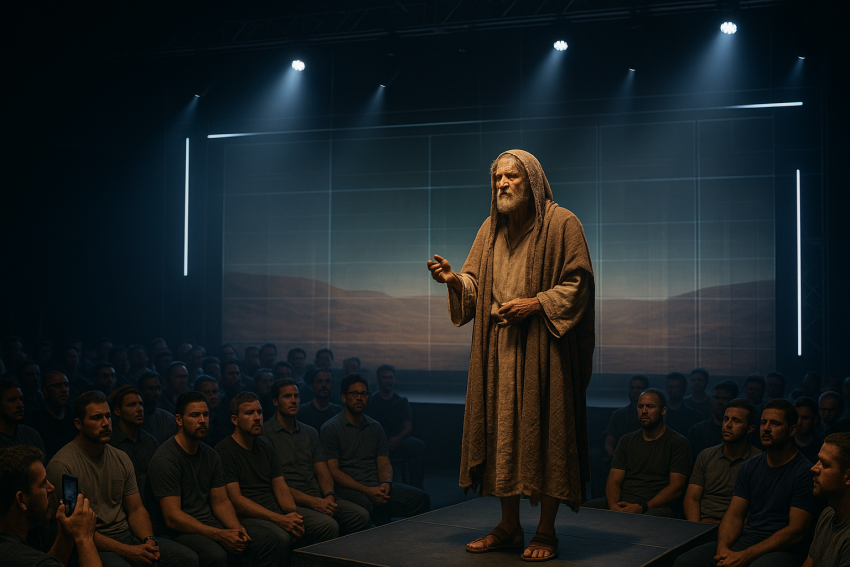
It was a Saturday morning at Stone Ridge Church, a sprawling modern mega church set on the edge of Dallas, Texas. The building rose like a glass-and-steel fortress against the hot summer sky, its parking lots stretching for acres, dotted with SUVs and pickup trucks. Inside, the main auditorium could seat over five thousand, with giant LED screens, a state-of-the-art sound system, and sleek rows of cushioned chairs.
Men from all over the city had gathered for a special event—an annual men’s conference known for big-name speakers, powerful worship bands, and coffee stations that never ran dry. But this morning’s guest was unlike any they had ever hosted.
His name was Job. Yes, that Job—the ancient man from Uz whose story of suffering and redemption had echoed through centuries. Somehow, in a way only God could orchestrate, Job had been invited to step out of the pages of Scripture and into the pulpit of this modern sanctuary.
He didn’t arrive in a tailored suit or skinny jeans. He wore a simple, earth-colored robe tied with a leather cord, sandals dusty from travels unknown. As he stood backstage, taking in the glow of LED lights, the pulsing bass of worship music, and the crowd of men sipping lattes and checking phones, Job prepared to tell his story—one that was both thousands of years old and yet painfully, beautifully relevant today.
—
The bright lights of this place still catch me off guard. Back in my day, men gathered under open skies, in tents pitched on dry ground. We didn’t have padded chairs arranged in neat rows, or air that hummed cool through hidden pipes. And these beams of light—these swirling colors—seem more like the auroras that danced above our deserts than anything made by hands. I see men sitting here, side by side, with coffee in hand and phones in pockets—things I cannot pretend to understand.
And yet, as different as your world is from mine, I see something familiar. Your shoulders are squared the same way ours were, as if bracing under loads you never speak of. Your laughter sometimes feels just a touch too quick—like men laughing so no one will look close enough to see the cracks underneath. I see you, brothers. In Uz, we wore rough robes and sandals. You wear denim and boots or suits and polished shoes. But inside, we are not so different.
I once thought a man’s worth was proven by the strength of his hand, the size of his herds, the loyalty of his household. I had all of that—wealth that spread across valleys, a name that carried weight in the city gates. My counsel was sought, my friendship prized. And I had children—seven sons and three daughters—who were the delight of my life.
Eliezer, my eldest, was my steady right hand. Nathaniel, wise beyond his years, always questioned so we would see deeper truth. Azariah brought me strange little stones and leaves, his heart full of far-off wonders. Malachi healed wounded lambs and calmed restless men with the same gentle touch. Zebulun’s laughter made our courtyard brighter. Uriel burned with fierce loyalty, always watching out for his sisters. Young Simeon clung to me, eyes wide, wanting to be a man before his time.
And my daughters—Jemimah danced through life as if music followed her everywhere. Keziah’s clever mind kept even our priests honest. And little Keren-Happuch—my songbird—would sprint to meet me at the gate, her giggles ringing like wind chimes.
But all that I took pride in was stripped from me. One day news came that raiders had taken my oxen and donkeys. Fire fell from the skies, devouring my sheep. More raiders came and stole my camels. Servants lay dead in the fields. And then, worst of all, a fierce wind struck the house where my children feasted. The walls fell, and with them, every future dream I had.
I walked through rubble where their voices once rose in laughter. I found Jemimah’s hair comb, Uriel’s staff snapped in two. I would have traded every herd, every coin, every field just to hear Keren-Happuch call out to me once more.
Then my own body failed me. Boils covered my skin. My wife, broken by grief, urged me to curse God and die. Friends came, at first sitting in silence—a gift. But soon their words cut deeper than any knife, convinced I must have sinned to deserve such suffering. I tried to wear my mask tight, to be the unshaken man they expected. But inside I was breaking. Angry. Confused. Betrayed by the God I had trusted so completely.
So I did what many of you fear to do. I spoke my anguish. I questioned God’s justice. I demanded an audience. Was I not righteous? Had I not sacrificed for sins even my children might unknowingly commit? Why this silence from heaven?
Then God answered. Out of a whirlwind, His voice thundered over me:
“Where were you when I laid the earth’s foundation? Who shut up the sea behind doors? Have you ever commanded the morning, or shown the dawn its place?”
In that moment, I saw how small my perspective was, how much I had tried to hold God to human standards of fairness and control. God did not scold me for my pain or doubt but invited me into a deeper trust—trust beyond what I could see or comprehend. It was humbling, yet freeing. I realized that faith is not about having all the answers but about trusting the One who does.
This encounter changed everything. It stripped away the last of my pride and left me with a heart ready to receive restoration—not just of my fortunes but of my spirit.
God restored my health, blessed me with a new family, and renewed my life far beyond what I had before. I held children again, and laughter returned to our halls. I lived long enough to see my children’s children to the fourth generation. But more than that, He restored my hope. My story became one not of defeat but of redemption—a testimony to the power of God’s love that never fails, even when all seems lost.
So I stand before you men, in this house of lights and steel and songs lifted by wires and speakers, to tell you this: many of you still live with that same silent battle I did. You carry pain too heavy to share. Maybe you’ve buried anger, fear, regret so deep you worry it would make you weak or less of a man to speak it. I want you to know: that silence is not peace. It is a wound needing healing.
God sees through every mask. He hears the cries behind your quiet. Even when the world stops listening, His heart remains open. He calls us not to a false strength, but to authentic life—grace for the broken, hope for the weary.
His presence is not tied to clear answers or outward displays of strength. He draws near in the silence, holding close the broken, the angry, the doubting. Even when His reasons are hidden and the path seems uncertain, He remains steady—an unshakable refuge for those who feel lost or overwhelmed.
So drop the mask, brothers. Bring your true selves before Him—wounded, weary, questioning. Because you are not alone. You are needed. And above all else, you are loved.
And if you will allow an old man to pray over you before I step down: O God, Look upon these men, each carrying burdens that no one else may see. Lift the weight of silent sorrow. Mend the hearts that have grown calloused from holding pain too long. Restore to them hope as you did to me. Grant them the courage to trust You even when they cannot see Your hand. Surround them with Your steadfast love, so they know beyond doubt: they are not alone, they are chosen, and they are dearly loved. Amen.
Author’s Note
This story isn’t just a creative retelling of an ancient account—it’s deeply personal. Lately, I’ve felt God pressing on my heart to speak more intentionally to men and the struggles we face in our modern world.
I’ve been writing from a raw perspective, because honestly, I’ve been deeply troubled watching people—especially those who call themselves Christians—post some of the most hateful, un-Christlike words online. It breaks my heart and stirs up a burden in me to return to what Jesus actually calls us to: compassion, truth, humility, and love.
I’ve also noticed—through various social media accounts, emails, and other messages—that some people aren’t exactly thrilled that I often write to a mostly male audience. That’s okay. I know it might seem narrow or exclusive, but it’s not meant to be. It’s simply where I sense God tugging at me most right now—into the hearts of men who’ve been told to stay silent, toughen up, and never admit they’re hurting.
Honestly, I’m surprised by this calling too, because I don’t consider myself the most manly of men, and I often feel unqualified to speak into these struggles. I don’t even care for football—that should say a lot. But somehow, this calling—to write openly to men about their pain, struggles, and silent battles—is exactly where God is leading me to show up.
But I want to be absolutely clear: I long for a community that’s built around love—real, grace-filled, unconditional love—toward everyone. Whether you’re a man or a woman, whether you’re straight or part of the LGBTQ+ community, whether you’re a veteran or still figuring things out, whether you’re young or old, certain of your faith or wrestling with doubts—you’re invited here. You matter. You’re seen. You’re loved. This journey hasn’t been easy for me—I’ve even faced pushback close to home, with my own brother blocking me because I advocated for kind and loving treatment of the LGBTQ+ community. But that only strengthens my resolve to build a space where all are welcome and accepted.
We live in a culture that rarely gives men permission to be real. We’re expected to keep it together, stay silent about our pain, wear masks of strength even when we’re breaking inside. But there’s a heartbreaking reality that shakes me every time I think of it: every 13 minutes, another man takes his own life—and that number is even higher in veteran and LGBTQ+ communities. It’s a staggering, devastating truth.
I believe God is calling us to have deeper conversations. To stop pretending. To remind each other that we’re not alone, that we’re needed, loved, and seen by a God who isn’t intimidated by our weakness or questions.
So if Job’s story reached into your own silent battles, know this—it’s not by accident. I pray it stirs something in you to lay down the mask, open up, and discover there’s still hope and healing waiting, even in the darkest places.
If this resonates with you, I’d love for you to subscribe to my newsletter, so we can keep walking this road together. Or join the conversation by leaving a comment below—I truly read them all. And if you ever need to talk, please know you can reach out to me directly. I mean that with all my heart.
#Every13Minutes #MensMentalHealth #YouAreNotAlone #LoveOneAnother

Sources
- Book of Job – NIV Bible
- Got Questions: Who was Job?
- Bible Study Tools: Story of Job
- Desiring God: Job – When the Righteous Suffer
- Crosswalk: Lessons from Job
- Blue Letter Bible: Overview of Job
- BibleProject: Job Video Overview
- Christianity Today: Articles on Job
- Ligonier: Study Series on Job
- OpenBible: Verses about Job
- BibleRef: Commentary on Job
- The Gospel Coalition: Job Articles
- Got Questions: Meaning of the Book of Job
- Overview Bible: Quick Facts on Job
- Oxford Biblical Studies: Job
Disclaimer:
The views and opinions expressed in this post are solely those of the author. The information provided is based on personal research, experience, and understanding of the subject matter at the time of writing. Readers should consult relevant experts or authorities for specific guidance related to their unique situations.
Hi, Bryan.
I enjoyed the story of Job very much. What touched me most, though, were your personal comments after the story.
Perhaps some of your recent posts may seem aimed at men. As a woman, that doesn’t bother me at all. I do not feel slighted or unimportant because you are trying to bring awareness and assistance to groups of people with needs different from my own. God’s words and lessons apply to all of His children, so I can take something meaningful from all of your writings. Keep going in the direction you feel God is leading you. 🙏
Mare