
1,839 words, 10 minutes read time.
Unmasking True Selves
This devotional is raw. Not polished. Not tidy. I’m not offering wisdom from a mountaintop—I’m writing from the valley. I don’t have everything figured out. In fact, most days, I feel more like a mess than a messenger. But I’ve learned something in the middle of my failures and fears: honesty opens the door to healing.
If you’re looking for a neat devotional with three cheerful points and a Pinterest-worthy quote, this probably isn’t it. But if you’ve ever sat in church surrounded by people smiling and wondered, “Am I the only one faking it?”—you’re in the right place.
Scripture
“Praise be to the God and Father of our Lord Jesus Christ, the Father of compassion and the God of all comfort, who comforts us in all our troubles, so that we can comfort those in any trouble with the comfort we ourselves receive from God.”
— 2 Corinthians 1:3–4 (NIV)
Reflection
I’ve sinned more than I want to admit. I’ve worn masks so long I forgot what my own soul looks like. I’ve raised my hands in worship while silently drowning in shame. I’ve said I was “fine” when inside I was losing faith, losing hope, losing myself.
Over the years, I thought I had a bad memory. I was told multiple times that things I thought happened never did. There are parts of my past I later learned were hidden from me, then I was gaslighted further with false stories and outright lies. It turns out I actually have a decent memory of the past, but it’s incomplete—some pieces were built on lies, making the truth hard to trust or even see clearly. Have you ever dealt with loved ones gaslighting you, telling you a fake narrative, or hiding the truth only for you to find out later?
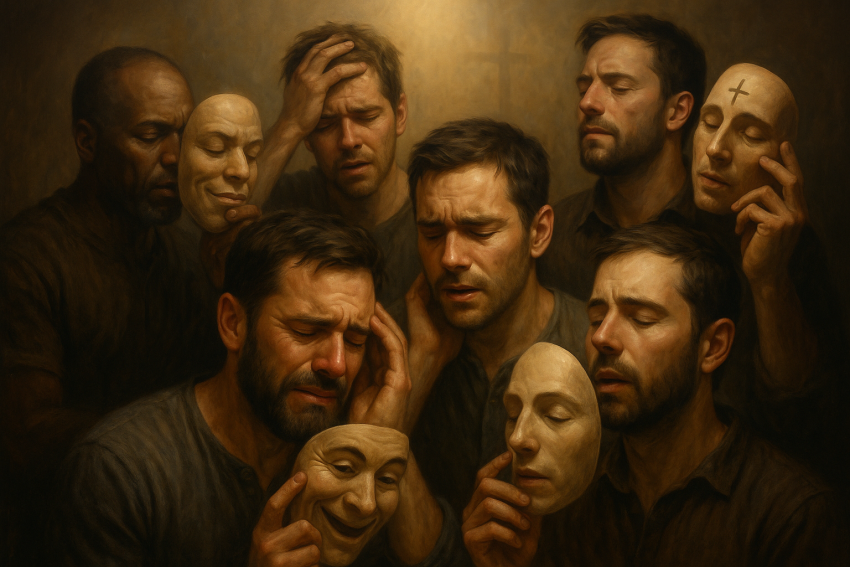
For years, I was part of a men’s group whose leader would say, “This is a no-mask zone.” It wasn’t just a slogan—it was a call to be real, to stop pretending, and to lay down the façades of strength or perfection. Honestly, men today are broken in many ways: marginalized, misunderstood, and carrying wounds from abuse, rejection, loneliness, and relentless pressure to “man up.” These burdens leave many feeling isolated and silent.
In that group, the invitation to drop the masks wasn’t just a slogan—it was a lifeline. Hearing others share their struggles, their doubts, and the times they fell down but got back up with scraped knees and raw prayers made a deep impact on me. It showed me I wasn’t alone in my brokenness. I wasn’t just a spiritual failure or a silent struggler. I was human. And I was not alone.
That moment changed how I see church. It’s not supposed to be a stage for the spiritually elite. It’s a hospital for the broken. A community of people with stories—some still messy, some still healing, and some shining with the fingerprints of God all over them. The beauty of Christian community is that God doesn’t waste anything—not our wounds, not our sins, not even our silence. But He can’t redeem what we’re still hiding.
Paul’s words in 2 Corinthians remind me of this: comfort doesn’t just come to us; it’s meant to flow through us. And we can’t pass it on unless we’ve been brave enough to speak from the places where we’ve needed it ourselves.
Application
Maybe it’s time to go first.
To be the one who says, “Here’s where I’ve struggled. Here’s where I failed. Here’s where God met me.” Because someone else is sitting silently under the same weight you once carried, and your honesty could be the very hand God uses to lift them up.
One piece of hard-earned wisdom I’ve learned from the valley is this: get completely real with God. Lay bare your failures, your sins, your doubts, and your unbelief. It’s not just about a single prayer or moment of confession, but a continual coming before Him with honesty and humility. Keep talking to Him when the weight feels heavy, when your faith falters, and when you don’t know what to believe anymore. God isn’t overwhelmed by your brokenness—He’s moved by your truth. It’s in this ongoing, raw conversation with Him that healing begins, strength is renewed, and the courage to remove your mask takes root.
Take a moment to consider the mask you’re wearing today. Is it the one that tells others, “I’ve moved on,” even though inside you’re still hurting? Or maybe it’s the familiar “I’m fine” mask you put on when you’re actually broken and barely holding on. Sometimes, we cover our exhaustion with a show of strength, pretending everything is okay when it’s not. I’ve heard it said too many times that people don’t want to hear your struggles; but in my humble opinion, that leads to everyone wearing the “I’m fine” mask. The truth is, we’re all broken. It takes real courage to admit those feelings, even to just one person. Ask God to help you find the bravery to remove that mask—not everywhere, not with everyone—but with someone you trust. Healing begins when we stop hiding and start being real.
And that’s exactly what the Devil wants—he loves to keep us isolated, silent, and feeling alone in our struggles. When we hide behind masks and refuse to be real, we give him more power. But when we dare to be honest, reach out, and let others in, we break the chains of loneliness and open the door for healing and connection.
And if you’re on the receiving end—when someone finally takes the brave step to open up—resist the urge to offer perfection or quick fixes. Instead, offer your presence. Be there fully, with patience and grace. Share your own story honestly, but don’t overshadow theirs by exaggerating your experiences or making it about how amazing you are or how spectacularly God is working in your life. That can unintentionally gaslight them or make them feel small. Sometimes the most Christlike response is simply saying, “I’ve been there,” and letting them know they’re not alone in their struggle. It’s in those moments of shared brokenness and authenticity that real healing begins.
When someone takes the brave step to open up, resist the urge to offer quick fixes or perfection. Instead, offer your full presence—with patience and grace. Share your own story honestly, but avoid overshadowing theirs with exaggerated tales of how amazing you are or how spectacularly God is working in your life. That can unintentionally gaslight them or make them feel small. Often, the most Christlike response is simply saying, “I’ve been there,” and reminding them they’re not alone. It’s in these moments of shared brokenness and authenticity that true healing begins.
If you don’t know what to say, or haven’t walked through the exact same struggles, that’s okay. Sometimes the best thing you can offer is simply to listen—to be present without judgment or advice. Your willingness to hold space for someone’s pain can be a powerful act of love. And maybe you know someone else who has faced similar struggles; you can help connect them, showing that community and support exist beyond just the two of you.
#NotAlone.”
Prayer
Father, thank You for being the God who doesn’t run from my mess. You meet me in it. You comfort me, even when I feel ashamed. Help me take off the masks I’ve used to survive. Help me be honest—with You, and with the people You’ve placed in my life. Give me the courage to share my story, and the compassion to hold space for someone else’s. May Your comfort not stop with me, but flow through me to someone who desperately needs to hear: “You’re not alone.” In Jesus’ name, amen.
Closing Thoughts
I’ve lived behind masks for too long. Smiling masks. Holy-sounding masks. Masks that said, “I’m fine,” when really, I was barely hanging on. But healing didn’t come until I started tearing those masks off—one by one—and letting others see the real me: sinful, scared, struggling… and still held by grace.
The truth is, we all need to hear each other’s stories. Not just the victories, but the stumbles. Not just the polished testimonies, but the prayers whispered in doubt. We need to hear about the dark nights when faith almost broke… and how God showed up anyway. We need to know that someone else has failed and fallen—and been met by mercy, not condemnation. That someone else begged God to show up… and He did.
When we rip the masks off and tell the truth, something sacred happens. Shame loses its grip. Loneliness cracks. And the God of all comfort steps in—not just through heaven, but through each other.
So today, I’m choosing honesty over image. I’m choosing grace over perfection. I’m choosing to say, #NotAlone, and I hope you will too.
If this hit something deep in you, I’d love to hear your story. Drop a comment—feel free to share anonymously if you prefer; all I see is an IP address, so your privacy is protected. Or send me a message to share a moment when God met you in the middle of the mess. And if you want to keep walking this road together, don’t forget to subscribe to my newsletter.
And if you’d like me to tell your story anonymously—so someone else can hear they’re not alone—or if you just need to tell your story but can’t find someone to listen or want someone to truly hear it, please reach out. I’m here to listen and can keep it completely private, or help carry your story into the light—whichever you prefer.
Let’s stop pretending. Let’s start healing.
You are not alone.
#NotAlone

Sources
- “Why Is Vulnerability So Important?” – Anxious Faith
- “Strength in Vulnerability: Embracing True Biblical Strength” – Capuchins West
- “The Freedom of Vulnerability” – The Daily Grace Co.
- “The Peace of Spiritual Vulnerability” – Serenity in Suffering
- “The Importance of Vulnerability” – Faith by Grace
- “3 Ways Vulnerability Is Powerful” – Crosswalk.com
- “The Power of Vulnerability: Finding Hope through Shared Struggles” – Vaneetha
- “Leaders, Talk About Power to Protect the Vulnerable” – TGC
- “God’s Call to the Church in Response to the #MeToo/#ChurchToo Movement” – BWIM
- “The Church’s #MeToo Reckoning” – CCCU Magazine
- “The Beautiful Veracity of Vulnerability” – Live Original
- “Freedom of Vulnerability” – The Daily Grace Co. (repeat valuable insight)
- “When You Feel Insecure or Uncertain” – Proverbs 31 Ministries
- “The Peace of Spiritual Vulnerability” – Serenity in Suffering (repeat for depth)
- “The Importance of Vulnerability” – Faith by Grace (repeat to reinforce)
- Book: *We Too: How the Church Can Respond Redemptively to the Sexual Abuse Crisis* – Mary DeMuth
Disclaimer:
The views and opinions expressed in this post are solely those of the author. The information provided is based on personal research, experience, and understanding of the subject matter at the time of writing. Readers should consult relevant experts or authorities for specific guidance related to their unique situations.