
6,167 words, 33 minutes read time
Image Source: The AI Pixel Prophet
The Sixth Seal – Cosmic Upheaval and the Wrath of the Lamb
Our unfolding exploration through the prophetic scroll of Revelation has been a journey through escalating divine judgments, each seal revealing a deeper layer of God’s plan for a world entangled in sin and rebellion. The First Seal introduced the subtle yet pervasive influence of the White Horse, symbolizing either the initial advance of the Gospel or the deceptive rise of antichrist forces. The Second Seal then unleashed the brutal realities of war and bloodshed with the fiery Red Horse, highlighting the destructive consequences of human conflict. The Third Seal brought the somber arrival of the Black Horse, depicting the crushing weight of famine and economic collapse. Following this, the terrifying Fourth Seal presented the Pale Horse, ridden by Death and accompanied by Hades, ushering in widespread mortality through war, famine, disease, and the chaos of the natural world. Our focus then shifted heavenward with the Fifth Seal, where we encountered the poignant cries of martyred souls beneath the altar, longing for divine justice and vindication for their faithful sacrifice.
Now, as the Lamb breaks the Sixth Seal, the scope of judgment expands dramatically, moving beyond earthly tribulations to cosmic upheavals of unprecedented scale. The very fabric of creation seems to groan under the weight of impending divine judgment. We will delve into the terrifying biblical description of this seal, marked by a great earthquake, the darkening of the sun and moon, the falling of stars, and the receding of the sky. We will explore the powerful symbolism of these cosmic disturbances as signals of God’s dramatic intervention and the terrifying recognition of “the wrath of the Lamb” by a terrified humanity. Furthermore, we will examine the historical context of such apocalyptic imagery and its theological implications regarding God’s absolute sovereignty, human accountability, and the foreshadowing of final judgment. Finally, we will consider the profound lessons the Sixth Seal holds for believers in our modern world, prompting reflection on global instability, encouraging steadfast faith in God’s control, and issuing a powerful call for repentance. Let us prepare to witness the heavens and the earth reel before the power of the Almighty.
Biblical Description of the Sixth Seal
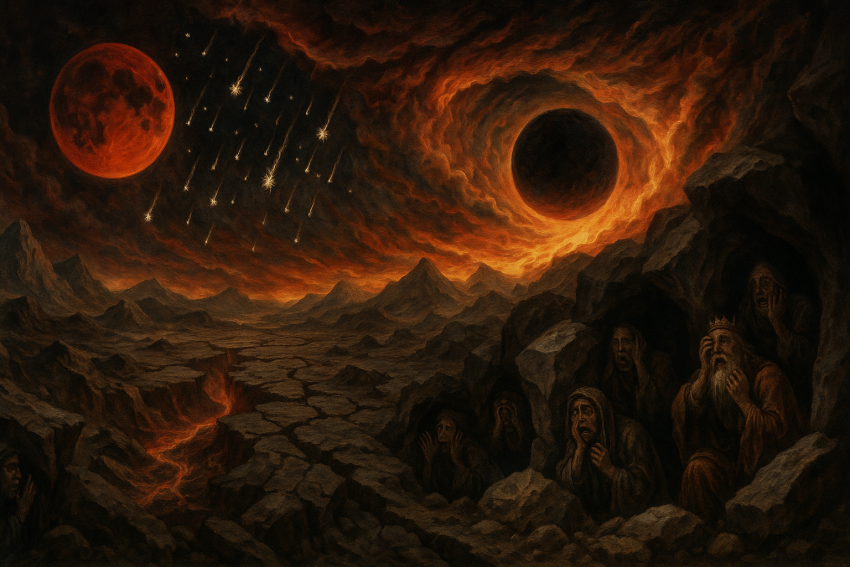
Our attention now turns to the cataclysmic events described in Revelation 6:12–17: “I looked when He opened the sixth seal, and behold, there was a great earthquake; and the sun became black as sackcloth of hair, and the moon became like blood. And the stars of heaven fell to the earth, as a fig tree drops its late figs when it is shaken by a mighty wind. Then the sky receded as a scroll when it is rolled up, and every mountain and island was moved out of its place. And the kings of the earth, the great men, the rich men, the commanders, the mighty men, every slave and every free man, hid themselves in the caves and in the rocks of the mountains, and said to the mountains and rocks, ‘Fall on us and hide us from the face of Him who sits on the throne and from the wrath of the Lamb! For the great day of His wrath has come, and who is able to stand?’” This passage paints a picture of universal upheaval and terror, as both the cosmos and humanity are shaken by divine power. Let’s dissect the key elements of this terrifying vision:
First, John witnesses a cataclysmic event of unimaginable scale: a great earthquake. This is not depicted as a localized tremor or a regional disaster, but an upheaval of such unprecedented magnitude that it shatters the very foundations of the earth. The Greek word used here, seismos megas, emphasizes its extraordinary intensity. Think of the most devastating earthquakes in human history, magnified exponentially, their destructive power rippling across the globe. This seismic event serves as a potent metaphor for a complete destabilization, not only of the physical ground beneath humanity’s feet but also of the seemingly solid structures of human society and order. Political systems, economic frameworks, social hierarchies – all that humankind has built and relied upon begins to crack and crumble under this divine shaking. As the prophet Isaiah forewarned in Isaiah 2:19, “People will flee to caves in the rocks and to holes in the ground from the fearful presence of the Lord and the splendor of his majesty, when he rises to shake the earth.” This initial act of the Sixth Seal signals a fundamental shift, a tearing away of the familiar and the ushering in of an era of profound instability.
This great earthquake signifies more than just physical destruction; it speaks to a global upheaval that impacts every facet of human existence. Consider the psychological impact of such an event – the utter terror and helplessness as the ground itself betrays all sense of security. Societies would be thrown into chaos, communication networks shattered, and the very fabric of civilization strained to its breaking point. As contemporary Bible teacher Jack Hibbs notes, “When God shakes the earth, He’s not just rearranging the furniture; He’s getting humanity’s attention.” This initial judgment is a forceful and undeniable sign that the established world order, with its inherent injustices and rebellion against God, is being radically challenged. It’s a cosmic wake-up call, a violent disruption intended to make humanity confront the precariousness of its own constructs in the face of divine power. The stability that humanity often takes for granted is revealed to be utterly dependent on the sustaining hand of God, and when that hand begins to move in judgment, all earthly security dissolves.
Furthermore, the description of this earthquake as more than a local tremor, signifying a global upheaval, underscores the universal scope of God’s impending judgment. No nation, no people, no corner of the earth will be immune to this cataclysmic shaking. It’s a leveling event, stripping away the illusions of human power and self-sufficiency on a planetary scale. As Charles Spurgeon, once said, “When God arises to judgment, the loftiness of man shall be bowed down, and the haughtiness of men shall be made low: and the Lord alone shall be exalted in that day” (Isaiah 2:17). This initial act of the Sixth Seal sets the stage for the subsequent cosmic disturbances, indicating that God’s judgment will not be limited to earthly affairs but will extend to the very heavens, signaling a profound and irreversible turning point in human history and God’s unfolding plan. The fracturing of the established world by this great earthquake is the first domino in a series of cataclysmic events that will lead to humanity’s ultimate confrontation with the wrath of the Lamb. Sources and related content
Following the unprecedented global earthquake, John witnesses further terrifying celestial phenomena: the sun became black as sackcloth of hair, and the moon became like blood. These are not mere astronomical anomalies; they are dramatic and unsettling celestial signs that fundamentally reverse the natural order of light and darkness established by God at creation (Genesis 1:14-18). The sun, the source of all earthly light and life, becoming black as sackcloth of hair – a coarse, dark material often associated with mourning, lament, and judgment – speaks of a profound loss of essential life-giving light and warmth. Symbolically, this darkening can represent God’s withdrawal of His sustaining grace and blessing from a world in rebellion, or the onset of a period of profound spiritual darkness and judgment. As the prophet Amos declared concerning a future judgment, “And on that day,” declares the Lord God, “I will make the sun go down at noon and darken the earth in broad daylight” (Amos 8:9). This cosmic darkness signifies a disruption of the very foundations of life and a chilling foreshadowing of divine wrath.
Simultaneously, the moon became like blood. This terrifying transformation of the night’s luminary is a traditional and potent harbinger of divine wrath and impending doom, evoking vivid images of judgment, violence, and bloodshed. Throughout Scripture, blood is associated with sacrifice, both for atonement and as a consequence of violence and judgment. The moon turning blood-red suggests a cosmic sign of divine anger and the spilling of life on a massive scale. The prophet Joel, in describing the “day of the Lord,” similarly states, “The sun shall be turned into darkness, and the moon into blood, before the great and awesome day of the Lord comes” (Joel 2:31). This celestial sign would have been deeply unsettling for John’s original audience, tapping into ancient understandings of celestial events as omens of divine activity. For a modern audience, it speaks of a universe thrown into terrifying disarray, a stark visual representation of God’s judgment extending beyond the earthly realm to the very cosmos itself.
Together, the darkened sun and the blood-red moon paint a picture of utter cosmic disruption, a reversal of God’s created order that underscores the severity and universality of the impending divine judgment. These are not subtle signs; they are dramatic, undeniable pronouncements from the heavens themselves, signaling that the day of the Lord’s wrath has arrived. As theologian John Calvin commented on such passages, “When the order of nature is subverted, it is a certain sign that God is departing from his ordinary course, and that he is coming forth to execute some extraordinary work.” These celestial disturbances serve as a terrifying prelude to the full unleashing of God’s judgment upon a world that has rejected His love and His sovereignty.
The Sixth Seal brings a further escalation of cosmic chaos with the declaration, “And the stars of heaven fell to the earth, as a fig tree drops its late figs when it is shaken by a mighty wind.” This is not merely a metaphorical description of falling stars, but a terrifying image of celestial bodies plummeting towards the earth with devastating force. The comparison to a fig tree being violently shaken and dropping its ripened fruit underscores the suddenness and inevitability of this event. It’s not a gentle rain of shooting stars, but a chaotic and violent bombardment, like a hailstorm of celestial debris. This imagery evokes a sense of utter cosmic disarray, where the established order of the heavens is violently disrupted, and the very foundations of creation are shaken.
This catastrophic event signifies more than just physical destruction; it represents a profound breakdown of the cosmic order established by God. The heavens, once a symbol of divine order and stability, are now in turmoil, reflecting the chaos and rebellion that have gripped the earth. As the prophet Isaiah warned, “The stars will fall from the sky, and the heavenly powers will be shaken.” (Isaiah 13:10). This celestial chaos mirrors the spiritual and moral chaos that has gripped humanity, a world that has rejected God’s rule and embraced its own destructive path. The falling stars serve as a stark reminder of the consequences of humanity’s rebellion, extending the judgment beyond the earth and into the very fabric of the cosmos.
Furthermore, this image emphasizes the severity of God’s intervention. It’s not a subtle warning or a gradual unfolding of judgment, but a dramatic and forceful display of divine power. The image of the fig tree violently shaken evokes a sense of urgency and inevitability. Just as the ripe figs are inexorably drawn to the ground, so too are these celestial bodies inexorably drawn towards the earth, carrying with them the destructive force of God’s judgment. This is not a judgment executed with a light touch, but with the swift and decisive power of a mighty wind, leaving no room for escape or resistance. The falling stars serve as a terrifying reminder that God’s judgment is not something to be taken lightly, and that those who have rejected Him will ultimately face the consequences of their rebellion.
The passage continues with the chilling image of “the sky receded as a scroll when it is rolled up.” This is not simply a darkening or obscuration of the sky, but a more profound and unsettling event. The imagery suggests a dramatic and sudden shift in the very fabric of creation, as if the heavens themselves were being peeled back like an ancient scroll, revealing a hidden and terrifying reality beyond. This is not a gradual fading but a forceful and abrupt removal, leaving behind a void where the familiar sky once stood. This cosmic unfurling symbolizes the end of the current world order, the familiar structures and systems that have governed human existence being stripped away like a discarded garment.
This imagery evokes the concept of “new heavens and a new earth” (Revelation 21:1), suggesting that the current creation, marred by sin and rebellion, is being dismantled to make way for something entirely new. As the Apostle Peter wrote, “But in accordance with his promise we are looking forward to new heavens and a new earth, where righteousness dwells.” (2 Peter 3:13). The receding sky can be seen as a visual representation of this transition, a stripping away of the old to make way for the new, a process that will culminate in the creation of a renewed and perfected universe where God’s righteous purposes will be fully realized.
This cosmic unfurling is not merely a physical event; it has profound spiritual implications. It signifies the end of an era dominated by sin, death, and rebellion, and ushers in a new age of redemption and restoration. As the prophet Isaiah prophesied, “Behold, I create new heavens and a new earth, for the former things will not be remembered or come to mind.” (Isaiah 65:17). The receding sky represents the passing away of the old order, with all its pain, suffering, and injustice, and the dawning of a new era where God’s justice and righteousness will finally prevail.
The culmination of these terrifying cosmic disturbances is the staggering pronouncement: “and every mountain and island was moved out of its place.” This paints a picture of absolute and utter devastation affecting every geographical feature of the earth. Mountains, symbols of stability and permanence throughout human history, are uprooted and cast aside. Islands, often seen as isolated refuges, are torn from their moorings and vanish. This is not a localized catastrophe but a total devastation affecting all corners of the earth, underscoring the truly universal scope of this divine judgment. No place, no matter how seemingly secure or remote, remains safe or untouched by this cosmic upheaval. The very landscape that humanity has known and inhabited is violently and irrevocably transformed. As the Psalmist declared in anticipation of such a day, “The mountains quake before him, the hills melt, and the earth heaves before him, the world and all who dwell in it.” (Nahum 1:5).
In direct response to these terrifying and unprecedented events, humanity, from the highest rulers to the lowliest slaves, experiences profound terror and seeks refuge in utter desperation. “The kings of the earth, the great men, the rich men, the commanders, the mighty men, every slave and every free man, hid themselves in the caves and in the rocks of the mountains.” Social hierarchies and earthly distinctions become utterly meaningless in the face of such overwhelming divine power. All are united in their fear and their futile attempt to escape the inescapable. Their desperate cry “to the mountains and rocks, ‘Fall on us and hide us from the face of Him who sits on the throne and from the wrath of the Lamb! For the great day of His wrath has come, and who is able to stand?’” signifies humanity’s ultimate and terrifying recognition of God’s absolute power and the stark reality of His righteous wrath. Having rejected His love, His mercy, and His sovereignty throughout their lives, they are now confronted with the terrifying consequences of their rebellion. The title “Him who sits on the throne” emphasizes God’s ultimate authority and judgment, while the phrase “the wrath of the Lamb” is particularly striking. The Lamb, Jesus Christ, who offered Himself as a sacrifice for the sins of humanity, is now revealed in His full glory as the righteous judge, and His wrath is a holy and just response to persistent unrepentance. Their desperate question, “who is able to stand?” underscores the utter helplessness of humanity before the unveiled power and justice of the Almighty. As the prophet Malachi asked, “But who can endure the day of his coming, and who can stand when he appears? For he is like a refiner’s fire and like fullers’ soap.” (Malachi 3:2). The Sixth Seal culminates in humanity’s terrifying acknowledgment of the divine judgment they have brought upon themselves.
Symbolic Interpretations
The breaking of the Sixth Seal unleashes a torrent of powerful symbolism that pierces through the literal descriptions of cosmic chaos to reveal profound and enduring truths about God’s impending judgment upon a rebellious world and the ultimate, terrified response of humanity when confronted with the unveiled power and wrath of the Almighty. This seal acts as a pivotal turning point in Revelation, moving beyond localized tribulations to a universal reckoning where the very fabric of creation reflects the severity of divine justice. The imagery employed is not meant to be taken as a mere recounting of astronomical events, but rather as a potent and unforgettable depiction of the cosmic consequences of sin and the awesome power of the Lamb in His role as both Savior and Judge. As the renowned theologian Dr. Charles Ryrie noted, “The events of the sixth seal are clearly supernatural and portend the great day of the Lord’s wrath.” This seal strips away any illusion of human control or autonomy, forcing humanity to confront the ultimate authority and terrifying holiness of the God they have often ignored or rejected. The symbols within this seal speak directly to the disruption of God’s created order and the stark reality of divine accountability.
Cosmic Disturbances: The great earthquake, darkened sun, blood-red moon, falling stars, and receding sky are not merely literal astronomical events, although they could have a literal fulfillment in the future. Symbolically, these cosmic disturbances represent God’s dramatic and undeniable intervention in creation to signal His impending judgment on a rebellious world. They signify a violent shaking and dismantling of the very foundations of the existing order, both physical and societal, announcing that the current way of things, steeped in sin and defiance, is coming to a definitive and cataclysmic end. The consistent use of such powerful celestial and terrestrial imagery throughout Old Testament prophecies concerning the “Day of the Lord” (Isaiah 13:9-11, Joel 2:30-31) underscores the profound significance of these signs as harbingers of divine wrath and the ushering in of a new era. These are not subtle hints but earth-shattering pronouncements from the Creator Himself, declaring that His patience has a limit and His justice will ultimately prevail. As the Psalmist declared, “The earth and all its inhabitants tremble; it is I who keep its pillars firm.” (Psalm 75:3). When those pillars begin to shake, it is a clear indication of divine action.
The Wrath of the Lamb: Perhaps the most striking and paradoxical element of this seal is humanity’s terrified recognition of “the wrath of the Lamb.” The title “Lamb,” consistently used throughout Revelation to describe Jesus Christ, evokes images of gentleness, sacrifice, and redemption (John 1:29, Revelation 5:6). This same Lamb, Jesus Christ, who willingly submitted to crucifixion as the ultimate sacrifice for humanity’s sin, is now revealed in His power and glory as the righteous judge. This dramatic shift underscores the multifaceted nature of Christ’s identity and role. The very one who offered salvation now wields justice against those who have persistently rejected His grace.
Their desperate cry to be hidden “from the face of Him who sits on the throne and from the wrath of the Lamb!” signifies humanity’s ultimate, albeit terrified, acknowledgment of God’s absolute power, perfect holiness, and unwavering justice. Having spurned His offer of love and mercy, they now face the terrifying and inevitable consequences of their rebellion. As the Apostle Paul warned, “For we must all appear before the judgment seat of Christ, so that each of us may receive what is due for what he has done in the body, whether good or evil.” (2 Corinthians 5:10). The juxtaposition of “the Lamb” with “wrath” highlights the profound dual nature of Christ – the compassionate Savior who bore the sins of the world and the righteous Judge who will ultimately hold all accountable. This terrifying scene underscores that God’s love does not negate His justice, and those who refuse His offer of redemption will ultimately face the full measure of His holy wrath.
Echoes in Scripture: The imagery of the Sixth Seal resonates powerfully with numerous Old Testament prophecies concerning the “Day of the Lord,” a time of divine intervention and judgment upon the earth. The parallels with Joel 2:31 (“The sun will be turned to darkness and the moon to blood before the coming of the great and dreadful day of the Lord“) are particularly striking, highlighting the consistent prophetic association of cosmic disturbances with God’s judgment. Similarly, Isaiah 13:9-10 describes a coming day of the Lord with the sun darkened, the moon not giving its light, and the stars of heaven not showing their brightness, mirroring the celestial upheaval depicted in Revelation.
Furthermore, the New Testament itself echoes these themes in descriptions of the end times. Jesus, in His Olivet Discourse recorded in Matthew 24:29, states, “Immediately after the tribulation of those days the sun will be darkened, and the moon will not give its light; the stars will fall from the sky, and the heavenly bodies will be shaken.” This direct parallel underscores the continuity of prophetic revelation regarding the signs that will precede Christ’s return and the final judgment. The consistency of this imagery across both testaments emphasizes the prophetic significance of these cosmic events, indicating that they are not random occurrences but divinely ordained signs pointing towards God’s ultimate intervention in human history. These echoes serve to confirm the authenticity and interconnectedness of biblical prophecy, reinforcing the gravity and certainty of the events described in the Sixth Seal.
Section 3: Historical Context
Understanding the historical context provides crucial insight into how John’s original, predominantly first-century audience might have interpreted these dramatic and often terrifying signs, as well as how these images might resonate throughout subsequent history: For John’s first readers, living under the shadow of the powerful Roman Empire and often facing persecution, the language of apocalyptic prophecy was not entirely foreign. Jewish apocalyptic literature, prevalent during that era (such as the writings of Enoch and 4 Ezra), frequently employed vivid and dramatic cosmic imagery to depict God’s intervention in history, often in response to oppression and injustice. These were not necessarily seen as literal, far-future events, but as powerful symbolic representations of God’s power to disrupt the existing order and bring about deliverance or judgment. Therefore, when John described a “great earthquake,” a sun becoming black as sackcloth, and a moon turning to blood, his audience would have likely understood these as potent signs signifying a profound and imminent act of divine judgment upon the forces opposing God and His people – which, in their immediate context, could certainly have included the Roman Empire. As Dr. N.T. Wright explains, apocalyptic language in the first century was often a way of speaking truth to power, using dramatic symbolism to critique earthly empires and affirm God’s ultimate sovereignty. The familiarity with this literary style would have allowed John’s readers to grasp the gravity of the situation he was describing, even if the precise timing and literal nature of these events remained somewhat veiled.
First-Century Context: In the ancient world, particularly within Jewish and Greco-Roman cultures, earthquakes and eclipses were often interpreted as significant divine signs, portents of either impending blessing or, more frequently, judgment. These events were not seen as random natural occurrences but as direct communications from the divine realm, signaling shifts in the relationship between the gods and humanity. The dramatic celestial events described in the Sixth Seal – the darkening of the sun, the blood-red moon, and the falling stars – would have carried immense weight for John’s readers. They would have immediately evoked a sense of impending doom, a cosmic disruption indicating the direct and powerful intervention of the divine in human affairs. Jewish apocalyptic literature, contemporary with Revelation, frequently employed such cosmic imagery to depict God’s judgment upon Israel’s enemies and the ushering in of a new age (e.g., Isaiah 13, Joel 2). Therefore, John’s audience, familiar with this prophetic tradition, would have likely understood these signs as signaling a cataclysmic act of divine judgment on a global scale. Furthermore, within the Roman Empire, unusual celestial phenomena were often linked to the fate of emperors and the stability of the realm. For instance, a sudden darkening of the sun might be interpreted as a sign of imperial displeasure or impending disaster for the empire. Thus, John’s vivid descriptions would have resonated deeply with their understanding of the cosmos as intertwined with divine and earthly powers.
Broader Historical Applications: While the ultimate and most literal fulfillment of the Sixth Seal likely points towards future eschatological events accompanying Christ’s return, the powerful cosmic imagery may also symbolize significant political, social, or environmental upheavals throughout history that serve as foreshadowings or localized manifestations of God’s judgment leading up to the final consummation. Periods of great societal collapse, such as the fall of the Roman Empire, marked by widespread chaos and instability, or violent revolutions that overturned established political and social orders, might be seen as historical echoes of the cosmic shaking described here. Similarly, devastating natural disasters of global impact, like widespread plagues, massive volcanic eruptions that darkened the skies, or prolonged periods of extreme climate change leading to famine and societal breakdown, could be interpreted through this prophetic lens as localized reflections of the ultimate cosmic judgment depicted in the Sixth Seal. These historical echoes, while not the full fulfillment, serve as stark reminders of the fragility of human systems and the potential for divine judgment to manifest in various forms throughout history, urging believers in every age to recognize the signs and remain faithful.
Section 4: Theological Implications
The dramatic and terrifying events of the Sixth Seal carry profound and far-reaching theological implications, shedding crucial light on the very nature of God, the responsibility of humanity, and the inevitable reality of final judgment:
God’s Sovereignty Over Creation: Absolute Authority and Divine Purpose: The cataclysmic events unleashed by the Sixth Seal powerfully and unequivocally demonstrate God’s absolute sovereignty over all of creation, encompassing both the natural and what we might perceive as the supernatural realms. The sheer scale and intensity of the earthquake, the unprecedented darkening of the sun and moon, the violent fall of the stars, and the very recession of the sky reveal that He controls the fundamental forces of nature and the vast expanse of the cosmos with effortless authority. These are not random occurrences but divinely orchestrated events brought forth to fulfill His divine purposes. As Psalm 103:19 declares, “The Lord has established his throne in heaven, and his kingdom rules over all.” The Sixth Seal vividly illustrates this truth, underscoring that there is no power in the universe, whether earthly or celestial, that can ultimately thwart His sovereign will or escape the reach of His righteous judgment. This understanding should instill both awe and reverence for the Creator, recognizing His ultimate control over all things.
Human Accountability: Confronting Divine Wrath and Recognizing Ultimate Authority: Humanity’s utterly terrified response to these cosmic events starkly highlights the inescapable reality of human accountability before a holy God. Despite centuries of rebellion, rejection of His authority, and often blatant disregard for His commands, when confronted with the undeniable and terrifying display of His power and righteous wrath, they finally recognize His absolute sovereignty. Their desperate and futile plea to the mountains and rocks to provide refuge underscores the profound reality of divine judgment and the devastating consequences of rejecting God’s grace. As Romans 1:18 states, “For the wrath of God is revealed from heaven against all ungodliness and unrighteousness of men, who by their unrighteousness suppress the truth.” The Sixth Seal unveils a moment where that long-held back wrath begins to manifest in a tangible and terrifying way, forcing humanity to confront the eternal consequences of their choices. This scene serves as a solemn warning about the ultimate accountability we all face before our Creator.
Preparation for Final Judgment: A Sobering Forewarning of Greater Tribulation: The Sixth Seal serves as a stark and terrifying forewarning of the greater tribulation and the ultimate final judgment that is yet to come. It signifies a critical turning point in God’s unfolding plan, indicating that the current period of His longsuffering and patience, while enduring, will eventually give way to the full and unmitigated expression of His righteous wrath. The cosmic chaos and human terror depicted here are but a prelude to the final reckoning before the throne of God, where every individual will ultimately be held accountable for their actions and their response to His offer of grace through Jesus Christ. As Hebrews 9:27 reminds us, “And just as it is appointed for man to die once, and after that comes judgment…” The Sixth Seal is a powerful and sobering reminder of this impending reality and underscores the urgent need for repentance and reconciliation with God before that final, inescapable judgment arrives.
Section 5: Lessons for Today
The dramatic and terrifying events unveiled by the Sixth Seal, though seemingly distant in their cosmic scale, hold profound and urgently relevant lessons for believers navigating the complexities and uncertainties of our modern world:
Reflection on Global Instability: Recognizing the Echoes of a Shaking Creation: While we may not yet have witnessed cosmic disturbances on the scale described in Revelation 6, our contemporary world is increasingly characterized by global natural disasters of unprecedented intensity, the looming threat of climate change and its far-reaching consequences, and widespread societal instability marked by political unrest, economic anxieties, and moral decay. While these events may often be analyzed through scientific and sociological lenses, they can also serve as sobering and poignant reminders of the inherent fragility of our world and the potential for significant and widespread upheaval. Perhaps these are echoes, on a smaller scale, of the cosmic shaking to come, prompting us to consider the impermanence of earthly systems and the ultimate power of the Creator. As contemporary theologian Dr. Albert Mohler often points out, the increasing intensity of global crises can serve as a wake-up call to the deeper spiritual realities at play and the ultimate destiny of this present age.
Encouragement for Believers: Anchoring Our Hope in God’s Unshakable Sovereignty: Amidst the potential for increasing chaos and uncertainty in the world around us, believers are called to anchor their hope not in the shifting sands of earthly security but in the unshakeable foundation of God’s ultimate sovereignty. The terrifying events of the Sixth Seal, while depicting a world seemingly spiraling out of control, ultimately reveal God’s absolute power and authority over all creation. This should be a source of profound comfort and assurance for believers. Even when the world around us appears to be falling apart, the Sixth Seal reminds us that God remains firmly in control of His cosmic plan. Therefore, we are called to prepare spiritually for Christ’s return, living lives that are pleasing to Him, marked by holiness and obedience, and diligently sharing the hope of the Gospel with those who are still living in spiritual darkness, unaware of the impending judgment and the offer of salvation. As Hebrews 12:28 encourages us, “Therefore let us be grateful for receiving a kingdom that cannot be shaken, and thus let us offer to God acceptable worship, with reverence and awe.”
Call for Repentance: Responding to Divine Warnings with Urgent Action: The sheer terror experienced by humanity in the face of God’s unveiled wrath in the Sixth Seal serves as a powerful and urgent call for repentance in our own lives and in the world around us today. Recognizing the potential for divine judgment, both in the smaller tremors we experience now and the ultimate cosmic shaking to come, we are implored to turn away from sin, self-reliance, and the fleeting idols of this world, and turn wholeheartedly toward God before the final day of reckoning arrives. The signs we see – whether natural disasters, societal unrest, or the moral decline of our culture – can be viewed as opportunities, granted by God’s continuing grace, to examine our hearts, confess our sins, and seek reconciliation with Him through faith in Jesus Christ. As the Apostle Peter exhorted, “Repent therefore, and turn back, that your sins may be blotted out, that times of refreshing may come from the presence of the Lord…” (Acts 3:19). The Sixth Seal is not just a prophecy of future doom, but a present-day warning urging us to seek refuge in the only One who can ultimately protect us from the coming wrath of the Lamb.
Conclusion
Our journey through the first six seals of Revelation has been a progressive and increasingly intense unveiling of God’s judgment and ultimate plan. We began by contemplating the subtle power of the First Seal’s White Horse, a symbol of conquest or deception setting the stage for the tumultuous events to follow. The Second Seal’s Red Horse then plunged us into the brutal realities of war and bloodshed, highlighting the destructive nature of a world estranged from peace. The Third Seal’s Black Horse brought the grim specter of famine and economic collapse, revealing the fragility of human provision. The Fourth Seal’s Pale Horse, ridden by Death and accompanied by Hades, unleashed widespread mortality upon the earth. Turning our gaze heavenward, the Fifth Seal revealed the poignant cries of martyred souls longing for divine justice and vindication for their faithful sacrifice.
Now, with the breaking of the Sixth Seal, we have witnessed a dramatic and terrifying escalation. The very cosmos has responded to divine judgment, marked by a great earthquake, the darkening of the sun and moon, the falling of stars, and the receding of the sky. This cataclysmic upheaval signifies God’s undeniable intervention in creation and humanity’s ultimate, terrified recognition of “the wrath of the Lamb.” We have explored the profound symbolism of these cosmic disturbances, their echoes in Scripture, their historical context, and their weighty theological implications regarding God’s absolute sovereignty, human accountability, and the stark foreshadowing of final judgment. The lessons for today urge us to reflect on global instability, anchor our hope in God’s unshakable control, and heed the urgent call for repentance.
As we stand on the precipice of the final seal, the tension and anticipation reach their peak. Join us next time for the climactic conclusion of this initial sequence of judgments in The Seventh Seal – Silence in Heaven and the Prelude to Trumpets. Prepare for a moment of profound stillness before the next, even more intense phase of God’s unfolding plan is revealed.
What are your final reflections on the awesome and terrifying events of the Sixth Seal, and how do they shape your anticipation for the ultimate resolution found in God’s complete plan? Share your thoughts in the comments below. If this exploration has deepened your understanding and prepared your heart for what is to come, please like, subscribe, and share this series with others seeking to understand the unfolding prophecies of Revelation. Your engagement encourages us as we approach the final seal in this initial cycle.

Sources
- Bible Gateway – For scripture references and different translations.
- Blue Letter Bible – Offers in-depth study tools, including Greek lexicons for understanding terms like *seismos megas*.
- Enduring Word Commentary by David Guzik – Revelation 6 – Provides commentary on the Sixth Seal and its symbolism.
- Got Questions Ministries – The Sixth Seal of Revelation – Offers a concise overview and different interpretations.
- Ligonier Ministries – Revelation 6:12-17: The Sixth Seal – Offers a theological perspective on the judgment of the Sixth Seal.
- The Gospel Coalition – The Sixth Seal – Offers insightful commentary from a Gospel-centered viewpoint.
- Desiring God by John Piper – The Wrath of the Lamb – A sermon focusing on the significance of the Lamb’s wrath.
- Bible Study Tools – Revelation Commentaries – Offers various commentaries for different perspectives on the Sixth Seal.
- Britannica – Eclipse – For understanding the historical interpretation of celestial events.
- Britannica – Earthquake – For understanding the nature and impact of earthquakes.
- Moody Publishers – Search for relevant books on Revelation and eschatology.
- Wm. B. Eerdmans Publishing Co. – Explore scholarly resources on biblical prophecy.
- Bible Hub – Greek Lexicon (seismos) – For a deeper understanding of the original Greek word for “earthquake.”
- Bible Gateway – Isaiah 2:19 – For the Old Testament parallel of cosmic shaking.
- Bible Gateway – Matthew 24:29 – For Jesus’ discourse on the end times.
Disclaimer:
The views and opinions expressed in this post are solely those of the author. The information provided is based on personal research, experience, and understanding of the subject matter at the time of writing. Readers should consult relevant experts or authorities for specific guidance related to their unique situations.