
3,653 words, 19 minutes read time.
Image Source: The AI Pixel Prophet
Second Seal: The Red Horse (Revelation 6:3–4)
Our exploration into the heart of Revelation’s prophetic vision continues, as we methodically unveil the significance of the Seven Seals. In our introductory post, we laid the groundwork, establishing the context of John’s apocalyptic encounter and the profound importance of the sealed scroll – God’s sovereign plan for judgment and redemption, revealed through the Lamb, Jesus Christ. We then turned our attention to the First Seal, where the enigmatic white horse and its crowned rider emerged, leaving us to ponder the dual possibilities of righteous conquest or insidious deception marking the initial stages of the end times.
Now, as the Lamb breaks the second seal, the tone shifts dramatically. We move from the subtle complexities of the white horse to a stark and terrifying reality: the unleashing of the fiery red horse. This is no longer a question of veiled intentions; the vision is one of overt violence, widespread war, and the brutal taking of peace from the earth. This second seal represents a significant escalation in the unfolding judgments, moving from potential spiritual or political deception to the tangible and devastating consequences of human conflict on a global scale.
In this blog post, we will delve deeply into the biblical description of this crimson harbinger, dissecting its key elements – the fiery red horse itself, the rider empowered to incite violence, and the great sword signifying widespread slaughter. We will explore the symbolic interpretations, examining how this seal represents the pervasive reality of war and conflict throughout history and its connection to God’s sovereign hand in judgment. Furthermore, we will consider the historical context, including the early church’s experience with persecution, and draw parallels to broader periods of intense warfare. By understanding the theological implications of the Second Seal, we gain a clearer perspective on the cost of sin and the escalating nature of the tribulation period, urging us to seek peace in Christ amidst a world often consumed by strife. Join us as we confront the brutal reality of the Red Horse and its enduring message for our time.
Unpacking the Crimson Vision: A Deeper Look at Revelation 6:3-4
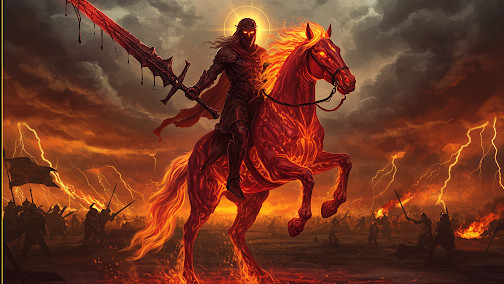
Turn your attention with me once more to the chilling words of Revelation 6:3-4: “When He opened the second seal, I heard the second living creature saying, ‘Come and see.’ Another horse, fiery red, went out. And it was granted to the one who sat on it to take peace from the earth, and that people should kill one another; and there was given to him a great sword.” This brief but potent passage unveils a terrifying escalation in God’s prophetic judgments, moving from the potential for deception to the stark reality of widespread human conflict. Let’s meticulously dissect the key components of this crimson vision, drawing upon the wisdom of theological giants to illuminate its profound meaning.
First, we are confronted with the Fiery Red Horse. The color red, as many commentators have noted, carries a universal and visceral association with blood, violence, and intense wrath. As the esteemed theologian Dr. John MacArthur has pointed out, “Red is the color of blood, and this horse symbolizes the bloodshed that will engulf the earth during this period.” This isn’t a gentle hue; it’s a screaming banner of fury unleashed upon the world. This horse, therefore, embodies the very essence of war in its most brutal and unrestrained form – not just isolated skirmishes, but a pervasive atmosphere of violence and the shedding of blood on a catastrophic scale. The “fiery” aspect further intensifies this imagery, suggesting a passionate, burning intensity to the conflict, a rage that consumes and destroys.
Next, we encounter the Rider. Unlike the rider of the white horse, whose intentions sparked considerable debate among interpreters, the purpose of this figure is explicitly and unequivocally stated: “it was granted to the one who sat on it to take peace from the earth, and that people should kill one another.” Notice the passive voice – “it was granted.” This detail, as insightful teachers like R.C. Sproul have emphasized, subtly underscores the overarching sovereignty of God, even in the unleashing of such destructive forces. While human agency is undoubtedly involved in warfare, the ultimate permission and scope are within God’s providential control. The rider’s mission is not to establish order or enforce justice in a godly way; rather, he is empowered to remove peace – the very foundation of stable human society – and to incite internecine violence, meaning people turning against their own kind, leading to widespread slaughter and societal breakdown. This isn’t just about nations warring against each other, but the disintegration of social cohesion at a fundamental level.
Finally, the rider is armed with a Great Sword. This is no mere weapon for individual combat or localized disputes. The term “great sword” (Greek: machaira megas) signifies a weapon capable of inflicting massive casualties, indicative of large-scale warfare and the organized, systematic destruction of human life. As the renowned expositor Charles Spurgeon eloquently stated, though speaking on the broader theme of divine judgment, “God’s sword is not a toy; it cuts deep and wide.” In this context, the great sword symbolizes the power and authority to wage extensive and devastating conflicts, the kind that reshape nations and leave indelible scars on humanity. It speaks to the industrialized nature of warfare that would characterize later periods of history, where the capacity for mass destruction is amplified. This isn’t just about skirmishes; it’s about the very fabric of peace being torn apart by widespread and lethal conflict.
In essence, this terrifying vision of the Second Seal paints a grim picture of a world descending into widespread and brutal warfare, a time when the very foundations of peace are removed, and humanity turns against itself with terrifying efficiency. The imagery is stark, direct, and serves as a powerful warning about the consequences of sin and the unfolding trajectory of God’s judgments in the end times.
Unpacking the Crimson Code: Deeper Symbolic Interpretations
The imagery of the Second Seal isn’t just a literal depiction of equine terror; it’s a rich tapestry of symbolism pointing directly to the pervasive reality of war and conflict engulfing the earth. That red horse isn’t merely a beast of burden; it’s a potent emblem of widespread warfare, societal breakdown, and the descent into the very abyss of chaos. Think about it: red is the color of spilled blood, of fiery rage, of the raw, untamed passions that fuel human conflict. As the insightful theologian Dr. R. Albert Mohler Jr. has often discussed, biblical colors are rarely arbitrary; they carry significant theological weight. Here, the crimson hue saturates the entire vision, underscoring the all-consuming nature of the violence to come. It’s not localized skirmishes or isolated incidents; it’s a global climate where peace is a rare and fleeting commodity, replaced by the brutal reality of nations and peoples locked in deadly embrace. This resonates powerfully with Jesus’ own prophetic words in the Olivet Discourse, recorded in Matthew 24:6-7: “You will hear of wars and rumors of wars. See that you are not alarmed, for this must take place, but the end is not yet. For nation will rise against nation, and kingdom against kingdom…” The Second Seal, in its stark depiction of a world consumed by red, seems to be a visceral manifestation of this very prophecy, highlighting the escalating nature of conflict as a precursor to the ultimate culmination of history.
Furthermore, the seemingly simple phrase, “it was granted to the one who sat on it to take peace from the earth,” carries profound theological implications regarding God’s sovereignty even amidst the chaos of human conflict. This isn’t a scenario where evil forces have somehow wrested control from a passive or powerless deity. As the steadfast teacher Alistair Begg frequently reminds us, God is never surprised and never defeated. The active permission granted to the rider underscores the ultimate authority of God over the unfolding events of history. Even the unleashing of such destructive forces, while undeniably carried out through human agency and driven by human sin, operates within the permissive will of the Almighty. This can be a difficult truth to grapple with, especially when confronted with the immense suffering caused by war. However, it points to a larger, often incomprehensible, purpose within God’s grand narrative. It reminds us that history is not simply a random series of events, but a story being written by a sovereign God who will ultimately bring about His perfect justice and redemption. This doesn’t excuse human culpability for acts of violence, but it does provide a framework for understanding that even in the darkest of times, God remains on the throne, His ultimate plan still unfolding. The Second Seal, therefore, is not just a prophecy of war; it’s a stark reminder of God’s ultimate control, even when the world seems to be tearing itself apart at the seams.
Shadows of the Past: Historical Echoes of the Second Seal
To truly grasp the weight of the Second Seal’s imagery, we need to delve deeper into the historical context of the first century, particularly life under Roman rule and the dynamics within the Jewish community, and then trace the echoes of its grim prophecy throughout the ages.
Life for the Jewish people under Roman rule was a complex tapestry woven with threads of both tolerance and oppression. While Rome generally allowed conquered peoples to maintain their local customs and religions – a pragmatic approach to maintaining order – this tolerance had its limits, especially when perceived as a challenge to Roman authority or imperial cult. For the Jewish people, their unwavering monotheism set them apart. They refused to participate in the worship of Roman gods or the emperor, a stance that, while often grudgingly accommodated, created underlying tensions. They were granted certain exemptions, such as not being forced to serve in the Roman army due to Sabbath observance and dietary laws, and they were allowed to maintain their religious practices to a degree. However, this delicate balance was constantly threatened by heavy taxation, the presence of Roman legions (often displaying idolatrous symbols), and the sometimes heavy-handed actions of Roman governors. Events like Pontius Pilate’s provocative placement of Roman standards in Jerusalem were constant reminders of Roman power and could easily ignite unrest.
Within the Jewish community itself, the Temple in Jerusalem held immense religious, political, and economic significance. Its leadership, primarily composed of the High Priest and the Sanhedrin, wielded considerable authority, acting as a liaison between the Jewish populace and the Roman authorities. During Jesus’ time, figures like Caiaphas held a powerful position, often navigating the treacherous waters of Roman demands and Jewish religious sensitivities. The Temple was not just a place of worship; it was the center of Jewish national identity and a source of considerable wealth and influence for the priestly aristocracy. However, this leadership was not universally respected. Sects like the Pharisees and Essenes often held differing theological and political views, and there was a simmering resentment among the common people towards both Roman rule and what was perceived by some as the Temple leadership’s collaboration with the occupiers. The Zealots, a more radical group, actively advocated for armed rebellion against Rome. This internal friction and the external pressure of Roman occupation created a volatile environment where peace was always precarious. The brutal suppression of Jewish uprisings by the Romans in the decades following Jesus’ crucifixion, culminating in the destruction of the Temple in 70 AD, serves as a stark historical illustration of the “peace being taken from a segment of the earth” with devastating consequences for the Jewish people.
However, the significance of the Second Seal extends far beyond the Roman Empire and the immediate context of its writing. Looking at broader historical applications, this seal resonates as a recurring representation of periods of intense warfare that have scarred human history. Think of the protracted and devastating conflicts of the Middle Ages, fueled by religious and dynastic ambitions, the seemingly endless cycle of warfare in pre-modern Europe, or the industrial-scale slaughter of the two World Wars in the 20th century. As historians like Victor Davis Hanson have analyzed, the underlying causes of war – human ambition, greed, ideological clashes, and the lust for power – remain tragically consistent across civilizations and epochs. The chaotic and bloody scenarios depicted by the fiery red horse and its sword-wielding rider find their grim counterparts in the scorched earth tactics of ancient warfare, the brutal sieges of medieval castles, and the mechanized killing fields of the modern era. These historical realities underscore the enduring relevance of the Second Seal, demonstrating that the forces of violent conflict have been a persistent and destructive presence throughout human history, echoing the prophetic vision laid out in Revelation. The promise of lasting peace, it seems, has been a consistently elusive dream for humanity.
Delving into Divine Design: Profound Theological Implications of the Second Seal
The unveiling of the Second Seal by the Lamb, Jesus Christ, is not merely a description of future earthly turmoil; it plunges us into the very heart of God’s character and His intricate plan for creation. The fact that it is Christ Himself who initiates this judgment underscores the profound truth of God’s absolute sovereignty over all things, including the unleashing of war and its devastating consequences. The towering theologian John Calvin’s view on divine sovereignty, articulated centuries ago, is well encapsulated by the statement: “Nothing takes place by chance; God governs the world with his providence.” This seal reminds us that even the most horrific expressions of human violence are ultimately within the permissive will and under the ultimate authority of the Almighty. This isn’t to say God delights in suffering, but rather that He is the ultimate conductor of history, using even the rebellious actions of humanity to serve His larger, often inscrutable, purposes. The opening of this seal by the Lamb, the one who willingly bore the wrath of God on the cross, highlights that even judgment flows through the hands of grace and redemptive history. As the insightful pastor A.W. Tozer once wrote, “God is sovereign. His will is ultimate and decisive. He is the potter, and we are the clay.” This seal compels us to acknowledge that history’s trajectory, even its darkest chapters, is not outside the scope of divine control.
Furthermore, the Second Seal offers a stark and undeniable portrayal of war as a direct and brutal manifestation of the cost of sin. Humanity’s fundamental rebellion against God and His principles of love, justice, and peace inevitably breeds conflict. As the apostle James so clearly stated, “What causes fights and quarrels among you? Don’t they come from your desires that battle within you?” (James 4:1). War, in its myriad forms, is the outward expression of our inward brokenness, our self-centeredness, and our refusal to submit to God’s righteous rule. The bloodshed depicted in this seal is not just random violence; it is the bitter fruit of a world that has rejected its Creator and chosen the path of self-destruction. The esteemed Bible teacher Chuck Swindoll often emphasizes the pervasive nature of sin and its far-reaching consequences. The Second Seal serves as a macro-level illustration of this principle, demonstrating how individual and collective sin can escalate into widespread carnage and the utter destruction of peace. It’s a sobering reminder that true and lasting peace can only be found through reconciliation with God and the transformation of human hearts by His grace.
Finally, the Second Seal acts as a somber and significant preparation for the greater tribulation that is yet to unfold in the narrative of Revelation. It signifies a clear escalation in the intensity of God’s judgments upon a world that continues to reject His authority. This seal serves as a stark warning, reminding believers that the path leading to Christ’s return will not be one of uninterrupted peace and prosperity, but rather one marked by increasing turmoil, suffering, and divine intervention. As the prophetic scholar Dr. J. Dwight Pentecost meticulously outlined, the seals represent a progression of judgments, each building upon the last. The unleashing of widespread war in the Second Seal sets the stage for the even more devastating economic hardship, famine, and death depicted in the subsequent seals. This understanding calls believers not to fear, but to unwavering faith and trust in God’s ultimate victory. Even amidst escalating global crises and the apparent triumph of evil, the promise of Christ’s return and the establishment of His eternal kingdom remains our steadfast hope and anchor. The Second Seal, therefore, is a crucial reminder that the end times will be characterized by increasing darkness before the ultimate dawn of Christ’s glorious appearing.
Echoes in Our Time: Lessons from the Red Horse for Today’s Man
The chilling imagery of the Second Seal isn’t confined to the pages of ancient scripture; it reverberates with a stark and unsettling resonance in our contemporary world. The daily news cycle is a relentless testament to the ongoing reality of current global conflicts and societal divisions. From protracted regional wars and the rise of extremist ideologies to the simmering tensions between nations and the volatile fault lines within our own societies, the headlines are often saturated with reports of violence, civil unrest, and international tensions. Peace, in many corners of the globe, remains a fragile and elusive commodity, constantly threatened and all too often brutally extinguished. The “peace being taken from the earth” isn’t just a prophetic prediction; it’s a lived reality for countless individuals and communities in our modern age. As men navigating this turbulent landscape, we cannot afford to dismiss the stark parallels between John’s vision and the world we inhabit.
For those of us who identify as believers in Jesus Christ, the Second Seal carries a powerful encouragement to actively seek and embody peace amidst this pervasive chaos. In a world constantly teetering on the brink of conflict, our calling is clear: we are to be peacemakers, reflecting the very nature of our Prince of Peace. As the Apostle Paul urged, “If it is possible, as far as it depends on you, live at peace with everyone” (Romans 12:18). This isn’t a passive hope for a better world; it’s an active engagement in promoting reconciliation, understanding, and compassion in our spheres of influence. It means being agents of calm in the midst of storms, seeking to bridge divides, and pointing others not to temporary political solutions or fleeting moments of truce, but to the ultimate source of lasting peace – a right relationship with God through Jesus Christ. As the revered pastor Billy Graham often preached, “Peace with God, peace among men, peace with oneself – this is the road to a better world.” The Second Seal reminds us that this is not merely a desirable ideal, but a crucial mission for every follower of Christ in a world desperately yearning for true and lasting tranquility.
Finally, the Second Seal serves as a sobering call for vigilance regarding the limitations of human solutions to the problem of conflict. It reminds us that treaties, diplomatic efforts, and political maneuvering, while potentially offering temporary respite, often fall short of achieving true and lasting peace when they fail to acknowledge and address the root cause of human conflict – sin and the brokenness of the human heart. As the profound thinker C.S. Lewis astutely observed, “Peace is not the absence of war but a virtue, a state of mind, a disposition for benevolence, confidence, justice.” True and enduring peace is not merely the cessation of hostilities; it is a fundamental transformation that occurs within individuals and then radiates outward. The Second Seal underscores the critical truth that genuine and lasting peace is ultimately found in a right relationship with God and the radical transformation of human hearts through the power of the Gospel. Without this foundational change, all human attempts at building lasting peace will ultimately prove fragile and ultimately fail to eradicate the underlying causes of the fiery red horse’s destructive ride.
Conclusion
So far in our exploration of Revelation’s Seven Seals, we’ve laid the groundwork by understanding the profound significance of the sealed scroll – God’s sovereign plan for judgment and redemption, revealed through the Lamb, Jesus Christ. We then confronted the enigmatic First Seal, where the white horse and its crowned rider emerged, prompting us to consider the initial stages of the end times as potentially marked by either righteous advance or subtle deception. Following that, we faced the stark and brutal reality of the Second Seal, where the fiery red horse unleashed widespread war and bloodshed, highlighting the devastating consequences of sin and God’s ultimate sovereignty even amidst global conflict.
Now, as we prepare to delve into the next stage of this unfolding prophetic drama, we turn our attention to the Third Seal. When the Lamb breaks this seal, a new and equally ominous figure appears: a rider on a black horse, wielding a pair of scales. This vision speaks not of military conflict, but of a different kind of devastation – one that strikes at the very heart of human survival: famine and economic collapse. In our next blog post, we will unpack the symbolism of this dark rider and his scales, exploring the potential societal breakdown and stark inequalities that this seal portends. Join us as we confront the chilling realities of scarcity and economic hardship revealed in Revelation’s Third Seal.
What are your reflections on the Second Seal and its relevance to our world today? Share your thoughts in the comments below. And remember to like, subscribe, and share this exploration with others seeking to understand the unfolding prophecies of Revelation.

Sources
- Bible Gateway – A comprehensive online Bible resource with various translations and study tools.
- Blue Letter Bible – Offers in-depth study tools, including lexicons, commentaries, and interlinear translations.
- Enduring Word Commentary by David Guzik – A well-respected and accessible commentary on the entire Bible, including Revelation.
- Got Questions Ministries – The Second Seal of Revelation – Provides a concise overview and different interpretations of the Second Seal.
- Ligonier Ministries – Revelation 6:3-4: The Second Seal – Offers a theological perspective on the meaning of the Second Seal.
- The Gospel Coalition – The Second Seal – Provides insightful commentary from a Gospel-centered perspective.
- Desiring God by John Piper – The Four Horsemen of the Apocalypse – A sermon that delves into the meaning of the first four seals.
- Bible Study Tools – Revelation Commentaries – Offers a range of commentaries on Revelation, allowing for comparison of different viewpoints.
- Moody Publishers – Search for books on Revelation for in-depth analysis.
- Wm. B. Eerdmans Publishing Co. – Explore scholarly works on the Book of Revelation.
- Britannica – Book of Revelation – Provides historical and literary context.
- World History Encyclopedia – Roman Empire – Offers historical background on the Roman Empire.
- Bible Hub – Revelation 6:4 Commentaries – A compilation of various commentaries on this specific verse.
Disclaimer:
The views and opinions expressed in this post are solely those of the author. The information provided is based on personal research, experience, and understanding of the subject matter at the time of writing. Readers should consult relevant experts or authorities for specific guidance related to their unique situations.