
7,660 words, 41 minutes read time.
The story of From Dust to Glory is not merely a tale of a soldier’s courage in the face of death, but a profound journey of faith, sacrifice, and divine redemption. Set in the tumultuous days of ancient Israel, it follows Aram, a battle-hardened soldier, and his comrades—Josiah, Eliab, and Nadav—who face an uncertain death in a valley that once echoed with peace but now trembles with the roar of war. Aram begins the story with a voice heavy with weariness and reflection, acknowledging the inevitable: “We all knew that few of us would leave this valley alive.”
The valley, a place of rugged beauty and quiet, becomes a stage for death. Aram introduces himself, a soldier in Israel’s army, and his comrades, each with their own quirks and strengths. Josiah, youthful and enthusiastic; Eliab, wise and gruff; and Nadav, the quiet man of prayer, all stand united as they prepare for the fight ahead. Yet even before the battle begins, a sense of doom hangs in the air. As the soldiers take their positions, Aram can’t shake the feeling that this might be the last time he stands with his brothers.
As the battle erupts, Aram’s narration paints a vivid picture of the chaos—clashing swords, the thundering of chariots, and the cries of men lost in the fury of war. Amid the madness, Aram holds on to the moments of humanity that still exist—Josiah’s enthusiasm turned to grim determination, Eliab’s steady wisdom amidst the storm, and Nadav’s quiet prayers that cut through the din of battle. But as the battle rages on, Aram begins to question everything: “Were we destined to die here, forgotten among the rocks and dust?”
The fight that follows will change everything, not only for Aram and his comrades but for the very valley they stand in. This is not just a battle for survival—it’s a battle for redemption.
Part One: The Valley Before the Battle
I remember the valley before it became a graveyard. It was not just any valley—it was my valley, the place where I had spent my childhood. Its jagged hills and winding trails had once been a place of adventure, where my friends and I chased each other through the wildflowers and played games of heroism beneath the open sky. Back then, it felt vast and eternal, a sanctuary untouched by the troubles of the world. My father would bring me here to graze our sheep, and in the evenings, we would sit beneath the stars while he told me stories of Israel’s great warriors—David, Gideon, Samson—whose courage brought glory to our people.
But now, as I stood there that fateful day, clad in armor and gripping my spear, the valley felt smaller, darker, and burdened by the weight of what was to come. It was no longer a sanctuary; it was a trap. The commanders spoke of victory, their voices filled with conviction, but my heart was heavy with doubt. How could we, so few and ill-prepared, stand against such a mighty foe? Still, we stood, not for ourselves, but for our people, for the covenant we believed bound us to our God. I glanced at my comrades—Josiah with his boyish grin, Eliab with his gruff wisdom, and Nadav, whose quiet prayers steadied us all. They, too, must have felt the weight of knowing this could be our last stand.
As I stood there, a chill ran down my spine as I glanced toward a ridge in the distance—where my father now lay buried. His grave was not far from where I stood. I had dug the earth with my own hands not many seasons ago, after his final breath left him. I remembered his stories of battle, of courage, of what it meant to stand for Israel, and yet I could not escape the bitter weight of his absence now, as I prepared to fight in this place. I wondered if he, too, had stood here once, perhaps on the same ground, carrying his own doubts. I missed him terribly in that moment, wishing his wisdom could guide me through this impossible battle.
Josiah, barely more than a boy, clutched his sword with trembling hands, his youthful energy masked by a thin veil of courage. Eliab, the eldest among us, clapped Josiah on the shoulder and muttered something that made us all laugh—a rare balm in the tension of the moment. Nadav knelt, head bowed, lips moving in silent prayer. I envied him for his unshaken faith, for I could not quiet the storm of fear and doubt within me.
As the sun climbed higher, its relentless heat bore down on us, casting long shadows across the valley floor. The signal to advance came, sharp and unyielding. My grip tightened on my spear, and with a final glance at my comrades, I stepped forward. Each step carried us closer to the jaws of destiny, the air growing heavier with each passing moment.
The cries of battle soon filled the valley—the clash of swords, the thunder of chariots, and the anguished shouts of men. Amid the chaos, a strange clarity settled over me. Every swing of my sword, every block with my shield, felt like an echo of the stories my father had told. I thought of David standing against Goliath, of Gideon’s small army prevailing against the Midianites. But this was no story, and the blood that soaked the ground was real. So were the screams of men falling around me.
My comrades fought valiantly. Josiah’s youthful determination turned to desperation as he held his ground against overwhelming odds. Eliab, ever the stalwart, barked orders that kept our faltering lines from breaking. Nadav’s prayers became a battle cry, his voice rising above the din as he called upon the God of Israel to remember us.
And I—Aram, a soldier of Israel—fought not for glory, but for survival. The valley consumed us, one by one, until it claimed even me.
Part Two: The Battle Unfolds
The chaos of the battle unfolded around me like a storm unleashed. At first, there was nothing but the heavy silence of the valley, broken only by the distant clatter of weapons being readied and the muted murmurs of soldiers praying or shouting orders. But then the signal came—a sharp blast of the horn—and the world erupted into a cacophony of noise.
The clash of swords rang through the air, the shrill screams of men mixing with the thunder of chariots charging across the ground. The earth trembled beneath the weight of hooves and wheels, and the sky seemed to darken with the smoke rising from the burning remnants of campfires. The air itself seemed thick with the scent of sweat, blood, and iron.
I fought beside Josiah, Eliab, and Nadav, each of us linked by a shared sense of purpose, though our fates seemed uncertain. The enemy—Babylonian soldiers, fierce and disciplined—advanced with the relentlessness of a flood, their eyes hard with the hunger for victory.
Josiah, whose youth had once brought so much hope, now moved with the wild energy of a man possessed. His sword swung with fierce precision as he parried blow after blow. His face was covered in sweat, his youthful features hardened by the heat of battle. I saw him strike down an enemy soldier—his sword cutting through the man’s armor with a sickening thud, the soldier’s face frozen in a look of shock before he crumpled to the ground. Josiah barely paused to wipe the blood from his blade before he lunged at another foe, his boyish grin replaced by a grim, determined look. The innocence of his youth was gone. In its place was the face of a soldier, willing to die for those he loved.
Eliab, ever the veteran, stood beside us, his eyes calm amid the chaos. His hand gripped his spear with a practiced strength, thrusting it forward into the chest of a soldier who tried to charge him. The enemy fell with a guttural scream, blood spilling onto the parched earth beneath us. Eliab hardly flinched as the life drained from the man, his gruff voice issuing commands to the others with authority. “Keep your formations! Don’t let them break through!” His words were a steadying force in the madness, but I could see the weariness in his eyes, the strain of years of battle.
Nadav, silent as always, was a presence of quiet strength. His sword was steady, his movements deliberate. But it was his prayers that gave us courage. His lips moved in constant supplication, calling on the God of Israel, even as the battle raged around him. I heard him mutter the words of our ancestors, asking for deliverance, for victory, for the strength to stand firm. His voice rose above the din of the battlefield, a soft whisper in the tempest of war. It was as though, in his prayer, he found the strength to fight. I found myself drawn to the peace that surrounded him, even as men around us died, blood soaking the earth.
I too fought, my spear finding its mark again and again. I felt the impact when my weapon pierced the flesh of an enemy soldier—his body crumpling in front of me, the shock in his eyes fading as the light left them. It was not glorious. It was not the victory I had imagined in my youth, standing on these same hills with my father. It was a brutal, vicious thing—life snuffed out with the swing of a sword, the thrust of a spear, and the desperate need to survive. The ground beneath me was slick with the blood of men, their faces—once filled with resolve—now frozen in fear or agony.
Yet, amid the bloodshed, there were moments of humanity. Josiah’s youthful enthusiasm, once a spark of hope, now burned with grim determination as he fought with a ferocity I had never seen in him before. His wide-eyed energy was gone, replaced by a look of manhood forged in the flames of battle. He fought not for glory, but for survival—for the people he loved, for the homeland that had raised him.
Eliab’s gruff wisdom offered fleeting comfort. When I stumbled in my own doubts, he was there, steadying my arm with his strong grip, his voice low and assuring. “Keep your head, Aram. Don’t let the fear take hold. We fight for the ones who will carry on. Fight for them.” His words were like a balm for my troubled spirit, but even as I fought on, I questioned the purpose of this war.
Was this what we were meant for? Was this our destiny—to die here, forgotten among the rocks and dust, our names lost in the sands of time? The valley, once a place of joy and light, was now a graveyard, its beauty swallowed by the bloodshed. We had no hope of victory. The enemy pressed on with the force of a tide, their numbers endless, their discipline unmatched. And yet, we stood, not for ourselves, but for our people—for the covenant we believed bound us to our God.
The screams of the wounded, the cries of my fallen comrades, and the clash of metal became a maddening symphony. At times, it felt as though the battle would never end. The weight of the war—its violence, its futility—began to crush me. I could see the faces of the men I had fought alongside, the men I had once considered brothers, slipping away.
As Josiah took down another opponent, his sword glinting in the sun, I caught a glimpse of Nadav, his face serene even as his sword struck down another foe. And in that moment, I understood something deeper than the rage of battle. This was not about us. It was about something greater—something beyond the bloodshed. But in that fleeting moment of clarity, I was once again swept up by the brutal tide of war.
Part Three: The Fall of Comrades
The battle was chaos—an unrelenting storm of steel and blood. The sounds of swords clashing, the thundering of chariots, and the agonized cries of men were the only things I could hear as I fought, my breath coming in ragged gasps. The heat of the sun pressed down upon us, but it was nothing compared to the fire that raged inside me, the anger and fear mixing into something dark, something that would consume me before the battle ended.
In the midst of the carnage, I found Josiah.
He was there—still fighting, his youthful face covered in dirt and sweat, his eyes burning with determination. But there was something in his gaze that was different now, something hard and knowing. The innocence had been stripped away, replaced by a grim resolve. He was no longer the boy who had once laughed beside me in the valley, the boy who had dreamed of glory. No, Josiah had become a man in those moments, tempered by war.
He was locked in a fight with one of the Babylonian soldiers—an older man, his eyes cold and merciless. Josiah swung his sword, the blade striking against the man’s shield. But the Babylonian’s counterattack was swift. His sword slashed across Josiah’s side, slicing through his armor and skin with a sickening sound. Josiah staggered back, gasping for breath, clutching his side, but the man pressed forward, a cruel smile on his lips as he prepared to strike again.
“Josiah!” I shouted, my voice hoarse with desperation, but the words barely reached him above the roar of battle.
Without thinking, I charged. I saw red—the soldier, the enemy, the one who had done this to Josiah, was all that mattered now. There was no strategy in my movement, no thought for form or technique. It was pure, brutal rage.
I shoved past another enemy soldier, my spear cutting through the air with the fury of a storm. The Babylonian turned just in time to see me coming, but he was too slow. My spear found its mark—driving through his throat with a sickening, wet crunch. He gasped for breath, blood spilling from his mouth, but I twisted the spear and pulled it out, watching as his body crumpled to the ground.
Without a second glance, I was back at Josiah’s side.
He had fallen to his knees, his hand still pressed to the wound in his side, blood flowing freely between his fingers. His face was pale, and his breath came in short, painful gasps.
“Aram…” he whispered, his voice weak. His eyes fluttered as if he were struggling to stay awake, struggling to stay alive.
I knelt beside him, feeling the weight of what was happening, the weight of his life slipping away.
“Josiah, no. Don’t leave me,” I begged, though I knew it was already too late. The blood soaked his tunic, his strength fading.
With a strained smile, Josiah reached out, his fingers brushing against my arm. “It’s alright, Aram. I did what I could. We all did.” His voice faltered, and I felt the tremor in his hand as it rested on my arm.
Tears welled up in my eyes, but I couldn’t stop them. The boy I had once fought beside in the valley, the boy who had once laughed and dreamed of adventure, was dying before me.
His hand fell away from my arm, his body sinking into the earth. I held him, feeling the warmth fade from his skin, but there was nothing I could do. He was gone.
The roar of the battle faded into a dull thrum in my ears. All I could hear was the ringing in my head, the sound of Josiah’s final words echoing in the silence that followed his death.
I stood, trembling with a mix of grief and rage. I had never known such fury, such hate. My sword felt heavier in my hand, and the blood of the enemy before me seemed like nothing more than a small measure of justice for Josiah’s life. I turned and looked into the faces of those who had killed him—those who had taken everything from me—and I vowed then that I would make them pay.
With the rage of my grief propelling me forward, I rushed back into the fray. I swung my sword with all the hatred I could muster, each blow a desperate attempt to avenge Josiah, to take back what had been stolen from us. Each enemy that fell beneath my strike was a small piece of justice for the boy who had been cut down too young.
The battle raged on, but for me, the world had narrowed down to a single, brutal reality: Josiah was dead. The boy who had looked up to me, the boy who had dreamed of a different life, was gone. And in his place, there was only the weight of grief and the fire of vengeance burning deep within me.
I hardly noticed the fall of the next friend, Eliab, until it was too late.
Eliab had always been the rock of our group, the eldest among us and the most experienced in the art of war. He had seen countless battles, had fought in the blood-soaked fields where men learned quickly that mercy had no place on the battlefield. He knew what it meant to survive. His gruff voice was always a source of steadying comfort—when we were unsure, he was the one who spoke with the certainty of someone who had lived through the worst. He had never flinched, not even when the Babylonian forces had first arrived in our land, bearing down on us like a storm.
But now, I saw him at the front lines, his back to a craggy outcrop, fighting with the fierce tenacity of a man who knew his time was running out. He swung his sword in a blur of motion, his grunts of effort mingling with the shrieks of the enemy. I saw a Babylonian soldier rush forward with a spear aimed directly at him. Eliab, with a strength born from years of battle, parried the strike with his shield, but the spear struck his side with a brutal force, the point ripping through his armor like paper.
For a moment, Eliab staggered back, his face twisting in pain, but he didn’t fall. His hand gripped the wound, and he bellowed a war cry, forcing his body to keep fighting despite the blood that poured from the gash. But as he turned to engage another soldier, the force of the strike had taken its toll. His body gave way, and he collapsed, his sword slipping from his grasp.
I didn’t see it happen—the flash of the enemy soldier’s sword, the fatal strike that cleaved Eliab’s head from his shoulders. I heard only the sickening sound of a body hitting the ground, and then I looked up to see Eliab’s eyes, wide and lifeless, staring at the sky above.
I ran to him, dropping to my knees beside the fallen soldier, but it was already too late. He was gone. My friend, my brother in arms, was dead. I reached out and touched his hand, but there was no warmth left in it. He was nothing but a cold body, lying forgotten in the dust.
It was Nadav’s prayer that brought me back from the haze of shock. The soft murmur of his voice was like a balm to my frayed spirit.
Nadav, always the quiet one, always the one who found solace in the arms of prayer, was kneeling not far from us. His lips moved in silent supplication to the God of Israel, his hands raised in a quiet plea. He was unafraid, unshaken by the bloodshed around him, the chaos of battle swirling as if it were nothing more than a passing storm. Nadav had always been the heart of our group, the one who reminded us of why we fought, of the promise of God’s protection, even in the face of certain death.
But that, too, was shattered in an instant.
A Babylonian soldier, perhaps seeing the calm in Nadav’s movements, perhaps sensing an easy target, moved in swiftly. Nadav, as always, was unarmed with anything but faith. The soldier’s sword found its mark, plunging into Nadav’s side with a sickening thud. I saw his face contort in pain, his lips still forming the words of his prayer as blood poured from his wound.
“Please,” I whispered, scrambling toward him, but he smiled, even in the agony of the moment.
“It is… alright,” Nadav breathed, his voice strained but gentle. “Do not… mourn me… Aram. God is with us.”
And then, just like that, Nadav, the man whose prayers had steadied my heart countless times, was gone. His body fell limp in my arms, his final breath leaving him as softly as the wind passing over the valley. His words hung in the air, but they didn’t comfort me. They only filled me with a bitter emptiness.
I was alone.
The valley had taken my friends, one by one. And with each death, the weight of the battle grew heavier, the screams louder, the blood more suffocating.
There was no time to mourn. There was no time for weakness. I stood, gritting my teeth, my fists clenched so tightly around my sword that my knuckles ached. And though the world around me blurred, though my heart screamed for release, I fought. I fought because there was no other choice. I fought for Josiah, for Eliab, for Nadav—men who had shared this moment with me, men who would never see the world beyond this battlefield.
And as I slaughtered the enemy, each blow a desperate prayer for vengeance, I couldn’t help but think that this was what they had wanted—to be remembered. To know that their sacrifice had not been in vain.
Part Four: Aram’s Last Stand
The battle was no longer a war—it was an execution.
The enemy’s forces pressed in from all sides, a suffocating wave of death that seemed to wash over every inch of the valley. My comrades were gone—Josiah, Eliab, Nadav—each fallen to the ground like a prayer unanswered. The cries of war had died down, replaced by the sound of my own heartbeat, pounding in my chest like a war drum.
I was alone now. The last of my brothers in arms.
The spear in my hand felt heavy, not just with the weight of steel, but with the burden of hopelessness. My shield was battered, nearly torn in half, the edges crumpled like paper from hours of deflecting blows. My armor, once gleaming in the sunlight, was now caked with the grime of battle, blood soaking into the fabric. My face, smeared with dirt and sweat, felt like the mask of a man already dead.
There was no turning back. There were no more orders to follow, no more cries of comrades urging me forward. There was only the inevitability of death, closing in like a shadow at dusk. Yet, I did not flee.
I stood, battered and broken, in the center of the valley where once we had played. The ground beneath my feet was soft with blood, the earth itself stained by the sacrifice of those who had fought before me. But it was more than the blood that held me in place—it was the fierce, unyielding call to honor the memory of those who had fallen. I could hear their voices now, faint whispers through the chaos—Josiah’s youthful enthusiasm, Eliab’s gruff wisdom, Nadav’s prayerful murmurs. They were with me still, even if only in spirit.
I looked out across the battlefield, seeing the advancing Babylonian forces. The soldiers moved with purpose, confident that victory was within their grasp. They saw me, a lone warrior—just one man in a field of dead. They would come for me, as they had come for the others.
I knew it was foolish to think I could survive, but in that moment, a strange clarity filled me. The fear that had once gnawed at me was gone, replaced by something else. Something stronger.
I would not die on my knees.
I gripped my spear tighter, the wood slick with the blood of my enemies. The Babylonian soldiers were closing in, and I could see the gleam of their weapons, hear the thud of their boots hitting the earth as they marched toward me. There were at least a dozen of them, but it didn’t matter. Numbers didn’t matter. What mattered was that I stood, that I would make them earn every inch of this land.
I raised my spear, shouting a war cry that tore from my throat like a thunderclap. The first soldier who came at me was a hulking brute, his sword raised high. He swung with all his might, but I was faster. I sidestepped the blow and drove my spear into his side, feeling the satisfying resistance as it tore through flesh and bone. He grunted, staggering back, but I didn’t give him the chance to recover. I drove the point deeper, pulling the spear back with a sickening tear of his body.
One down.
Another soldier charged at me, his sword aimed for my heart. I parried the blow with my shield, feeling the reverberation of the strike travel through my arm. The force of it pushed me back, but I recovered quickly, thrusting my spear at his throat. The sharp metal cut through his flesh, and he dropped like a sack of grain.
Two down.
But for every man I struck down, two more took their place. The Babylonian soldiers seemed to multiply, and the weight of their onslaught began to drag me down. My arms were growing heavy, the spear feeling like a burden rather than a weapon. My shield was all but useless, shattered from too many blows.
My vision blurred, the edges of the world fading into a haze of red. My breath came in ragged gasps, each inhalation a struggle as the exhaustion from hours of fighting finally took its toll. I could feel my strength slipping away, my limbs trembling as they fought to remain steady. The soldiers’ faces became indistinct, their movements nothing more than shadows rushing toward me.
But still, I stood.
I fought not just for myself, but for all of them—Josiah, Eliab, Nadav, and the countless others who had fallen before me. Each strike of my spear, each swing of my shield, was a prayer—a final act of defiance against a fate that seemed determined to claim me.
And then, as the last of my strength drained from my body, I felt it. The sharp sting of a blade slicing through my side. The pain was immediate and overwhelming, a hot fire that spread through my body like a storm. I staggered, my grip loosening on the spear as I fell to my knees.
I looked up, seeing the soldiers standing over me, their faces devoid of pity or mercy. The world around me began to darken, the sounds of battle growing distant as my vision blurred. I knew this was it—the moment I would fall, like the others, forgotten among the dust.
But even as my sword fell from my hand, I found peace.
I had done what I could. I had fought for them, for my people, and for God. And though death had come for me, I knew my sacrifice had not been in vain.
As I closed my eyes, the last thing I heard was a whisper—a prayer that carried on the wind, across the valley, through the blood and death.
A prayer that would not go unanswered.
Part 5: The Aftermath: The Valley of Dry Bones
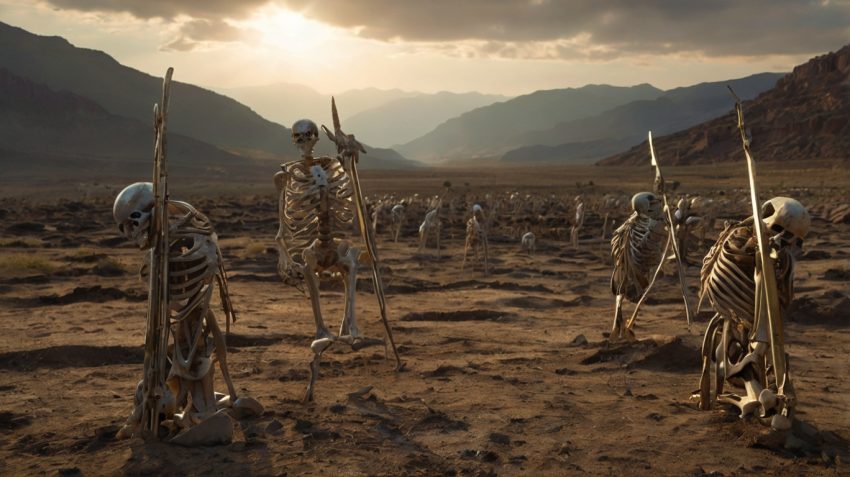
The battle was over, and the silence that followed was almost as deafening as the clash of steel and the cries of men. The valley, once a place of childhood memories, now lay shrouded in death. There was no victory, no triumph—only the aftermath of Israel’s fall. The bodies of the fallen, soldiers from both sides, lay scattered across the land like broken pieces of a shattered dream, but there were no sounds of Israelite voices, no cries of defiance. The soldiers of Israel were either dead, or in the chaos of the final moments, had fled, abandoning their posts, leaving only their bloodied, lifeless forms behind.
I, too, lay among the dead—my body still and cold, no longer a soldier but simply another casualty in a land that had become a graveyard. But even in death, my mind, though distant and fading, remained keen. The valley seemed to breathe with the weight of so many lost lives, yet there was no honor here. No one left to mourn or remember the sacrifices made. The soil beneath me was thick with blood, the ground churned by the trampling of men in their final moments.
Above all, the only movement was from the victorious Babylonian soldiers, who surged through the field like vultures to a carcass. They moved with grim purpose, stripping the dead of what little remained—armor, weapons, shields—all plundered from bodies that once fought for a cause. They did not care whose bones they scavenged; the fallen were all the same to them now—broken, discarded, and forgotten.
The cries of the looters echoed in the distance as they tore into the remains of the fallen Israelites. Their hands moved quickly, pulling at chainmail, wrenching spears from lifeless hands, and tearing away cloaks. They were ruthless in their search, showing no mercy, no respect for the dead who had once fought against them with all their strength. I could see one soldier pry a gold ring from the lifeless finger of a fallen comrade, his face twisted with greed, while another scavenged through pockets that once held the hopes and dreams of a warrior. They made no distinction between friend and foe—they were all just bodies to be stripped of anything useful, anything that could be turned into gold or used in future battles.
Among the heaps of the fallen, I could still see the faces of my friends—Josiah, Eliab, and Nadav—locked in their final moments of struggle, their features twisted in pain or defiance. But no amount of blood could bring them back, and no amount of plunder could fill the void left by their sacrifice. Josiah, who had fought with youthful bravado, now lay silent, his body cold and lifeless. Eliab, with his steadfast wisdom, had fallen to the same fate, his grip on his sword now forever useless. Nadav, whose prayers had once risen above the din of battle, now lay still, his lips sealed, the sound of his voice lost forever.
The Babylonians, having looted the fallen, moved to the next body, indifferent to the lives they had taken or the destruction they had wrought. Their eyes gleamed with satisfaction at their spoils, but there was no victory in this—only the emptiness of a battlefield strewn with the remnants of a war that had no true winner. The soldiers’ footsteps crunched over the bones of the slain as they worked their way across the valley, leaving behind the desecrated remains of those who had once fought for their homes, for their families, for their faith.
As the last rays of the sun dipped below the horizon, casting long shadows over the valley, I could almost feel the weight of time settling upon me. This land, once filled with life, had become a tomb—a vast graveyard where the bones of the fallen lay in their final resting place, forgotten by the living. There would be no visits to this place, no mourning, no one to honor those who had given their lives in the name of their God, their people, and their country. In the days and weeks that followed, the winds would blow across this valley, scattering dust and memories. The bones would remain, weathered by time, a silent testament to the lost hopes of Israel.
The valley had become a resting place for the dead—a place where the living could no longer tread without the weight of their loss bearing down on them. And yet, the valley itself seemed untouched by the passage of time. No one came to bury the dead, no mourners stood to cry out for the fallen, and no prayers were offered over the bodies of the men who had once fought here. It was as if the world had forgotten this place, as if the very earth had swallowed it whole.
I lay among the ruins of my brothers, my comrades, knowing that no one would come to speak our names, no one would come to remember our sacrifice. We were lost, our stories unwritten, our lives forgotten in the wind. This valley, our final resting place, had become a tomb not just for our bodies, but for the memory of who we had been and what we had fought for. The Babylonians would leave when their plunder was done, and soon, this place would fall into oblivion, its history reduced to the bones that would one day decay and return to dust.
But even in death, there was something stirring beneath the surface—a quiet promise that lingered in the stillness of the valley. The bones of the fallen may be forgotten by men, but not by God. And though no one would come to visit us, there would be One who would remember. Even in the desolation of this valley, hope had not been entirely buried.
Part 6: The Awakening of the Valley
The valley, once a place of fierce battle, had become a forgotten resting place for the dead. The bodies of the fallen soldiers—both Israeli and Babylonian—lay scattered, their remains slowly consumed by time and the earth. Days turned to weeks, weeks to months. The bones, long bereft of their rightful owners, were picked at by scavengers—wild dogs, vultures, and other creatures that roamed the desolate land.
The silence of the valley was profound, broken only by the rustling of the wind and the occasional cry of a bird circling above. The bodies of the fallen had long since been stripped of their armor and their weapons, leaving only the bare bones to tell the story of what had once been. Some were half-buried in the dirt, others picked clean by the scavengers. Those who had once fought side by side now rested in a shattered state, forgotten and ignored by all except for the forces of nature that claimed them.
Seasons passed, and the valley remained a graveyard—a place where the glory of Israel had died. No one came to bury the dead. No one came to mourn their loss. The blood of soldiers had long seeped into the earth, leaving behind a quiet testament to the futility of war. Only the dead knew what had truly happened here.
But on one particular day, as the valley lay still beneath a pale sky, something extraordinary began to unfold.
From the depths of the valley, beneath the fallen bones and dust, there came a stirring—a tremor that shook the earth itself. The dead, long forgotten and abandoned, were about to be awakened. In the distance, a figure appeared. He was like none of us. His appearance was that of a man, but his presence was unearthly—an emissary from a realm beyond understanding. This man, who appeared before us, was a stranger, his words carrying a weight none of us could have comprehended.
As he spoke, I could hear the voice of God in the wind, echoing through the valley like thunder. I did not know who this man was, but I felt his words seep into my very soul. This was not just a mere prophet. This was the messenger of God Himself.
“Son of man, can these bones live?” The voice of the God rang out, carrying an authority that transcended time and space. His words were simple, but there was an undeniable power behind them.
I, along with my comrades—once soldiers, now mere bones—could hear this conversation, though we could not move. The voice of God was unmistakable, and we felt His presence stirring in the air around us. We could not understand all that was being said, but we felt it.
“O Lord God,” the prophet responded, his voice trembling as if overwhelmed by the enormity of what he had been asked. “You know.”
Then the voice of God echoed through the valley with a command that resonated in our very bones: “Prophesy over these bones, and say to them, ‘O dry bones, hear the word of the Lord! Thus says the Lord God to these bones: Surely I will cause breath to enter into you, and you shall live. I will put sinews on you and bring flesh upon you, cover you with skin, and put breath in you; and you shall live. Then you shall know that I am the Lord.'”
We, the bones, lay in the valley, still and silent. The world around us had forgotten us, and we, too, had forgotten the world. Time had passed without care, as scavengers picked at our remains, and the elements slowly turned us to dust. Yet in that moment, we felt something stir—something powerful, something beyond our understanding.
The man spoke again, and the ground itself trembled. The bones that had once belonged to warriors of Israel began to stir. At first, it was subtle—a slight shifting of the bones, a rustling of the dried earth. But soon, the tremors grew stronger, and the bones began to move on their own, as though drawn by an invisible force. Sinews and tendons, once dry and brittle, began to knit themselves together. Flesh grew over bone, and skin covered the bodies of the soldiers. The once-decayed remains were restored to life.
We could hear the cracking of bones as they reconnected, the rush of breath filling our lungs. My comrades—Josiah, Eliab, Nadav—began to rise, their bodies fully restored as if the battle had never taken place. We, the dead, stood once again, our lives renewed.
As we stood and looked around, a strange and bitter realization washed over me. For so long, I had thought that this valley was where I would lie forever. But here we were, alive again, a stark contrast to my father. He, too, had died in this very valley, but there would be no awakening for him. His bones, unlike ours, had been left untouched, buried under the earth in the quiet soil near the foot of the hills. No divine intervention had come to him—he had been swallowed by the earth and forgotten by time. His story was lost to the winds, while we now stood in God’s presence, renewed. The memory of my father, his burial site not far from where I now stood, struck me like a sudden blow. How could I, his son, who had fallen as a soldier, be the one to be resurrected? What had my father missed, and why were we to be called back?
I did not know the answers to these questions, but I knew this: God had given us a second chance, a new purpose. We stood as an army, but not as we had been before. The valley that had claimed our lives was now the place of our rebirth. The prophecy had come true, and God’s words had given us life once more.
The man, whose voice had echoed through the valley with such power, raised his arms to the heavens once more. We, the resurrected soldiers of Israel, stood as a great army, our purpose now clear. The valley that had once known only death now sang of life.
Part 7: A New Purpose
We stood in the valley, our feet planted firmly upon the ground, feeling the weight of the change that had come upon us. The air was thick with the presence of God. The battle, the bloodshed, the hate—it was all gone, swept away like dust in the wind. The ground that had once been soaked in the blood of brothers now beneath our feet, no longer held the bitterness of war. There was no more victory or defeat, no more Babylonian or Israelite—there were only those who had been called back to life by the will of God.
We had been restored, not for the glory of men, but for the glory of God. The purpose of our resurrection was clear now—our lives had been given back to us for His service. We were no longer soldiers in a battle for land or power; we were soldiers in the service of the One who had breathed life back into us. The God of Israel had spoken over us, and we had heard His call to rise. This was not a mere return from death. This was a transformation, a renewal that reached deeper than the flesh and bone that had been restored. We were not the same men who had fallen in that battle.
The battlefield, now silenced, had become sacred ground. We looked around, and where there had once been the stench of death, there was now an overwhelming sense of peace. My comrades—Josiah, Eliab, Nadav—stood beside me, and though the battle was no more, our bond had deepened. We were no longer merely men of war; we were witnesses to something greater than ourselves, something beyond the reach of human understanding.
I thought of my father, buried not far from where I now stood. He had lived and died in the valley, a man of faith, who had known no resurrection. But now, in this moment, I understood something that had eluded me in my grief. My father’s life had been a testament to God’s faithfulness, even in death. And though he was not part of this miraculous revival, I knew that in God’s timing, all things are restored.
But there was something else that weighed heavily on my heart. My wife, my children—what had happened to them? In the madness of the battle, I had no time to think of them. I had no way of knowing whether they had survived or fallen in the wake of our defeat. Had they fled? Were they even alive? The thought gnawed at me, a question I would never have the answer to. I had fallen here, in this valley, and when I had closed my eyes, it was with no certainty of their fate. I had always hoped that my family would be protected, but in the chaos of war, no one was safe.
As I stood in this valley now, restored to life, I realized I would never know if they were out there, waiting for my return, or if they, too, had perished in the storm that had consumed us all. The uncertainty of their fate was a shadow that lingered over me. Would they remember me? Would they know I had given my life for my people, for the covenant with God?
But, as I stood among the resurrected, the past seemed distant, less important. The God who had brought us back to life—who had given us new breath—had shown me that there was hope, even in uncertainty. In this life or the next, God’s plan was greater than my understanding. I had to trust that my family, like the bones that had come to life, were in His hands, and that His will for them, too, was part of His divine purpose.
We were no longer just soldiers, no longer just men bound by war and bloodshed. We had been restored with a new purpose, one that transcended all that we had known. The focus was no longer on what we had lost, but on what we had gained. We were to serve God, to spread His message, and to live as witnesses of His power to restore not just our bodies, but our souls.
The valley, once a place of death, now held the promise of life. Our mission was no longer one of vengeance or survival. We stood in the midst of the restoration, and it was clear that the purpose of our lives was to carry that hope to others. The battle was no longer important. What mattered now was the future, and the hope that we, as His people, would be instruments of His will in a broken world.
And so, as we stood in the valley of dry bones, we knew that our mission was clear. We had been given a new purpose: to live for God and to share His message of redemption with all who would listen. The past—our families, the war, the destruction—no longer held us captive. We had been resurrected for something far greater than what we had known.
The God who had breathed life into us would continue to breathe life into the world. And with that promise, we could face whatever lay ahead.
