
606 words, 3 minutes read time.

The story of David and Goliath is iconic, often presented as an underdog’s triumph. Yet, beneath the surface lies a profound message about faith, deliverance, and ultimate victory. Let’s explore this biblical narrative through a deeper lens inspired by a remarkable interpretation from Biblical Frameworks.
Beyond the Pebbles: The Cosmic Battle
David and Goliath isn’t an isolated tale of courage; it’s woven into the Bible’s grand narrative, beginning in Genesis 3. Here, God declared enmity between the seed of the woman and the seed of the serpent—a prophecy of an enduring cosmic battle. The serpent’s defeat was foretold: “He will crush your head, and you will strike his heel.”
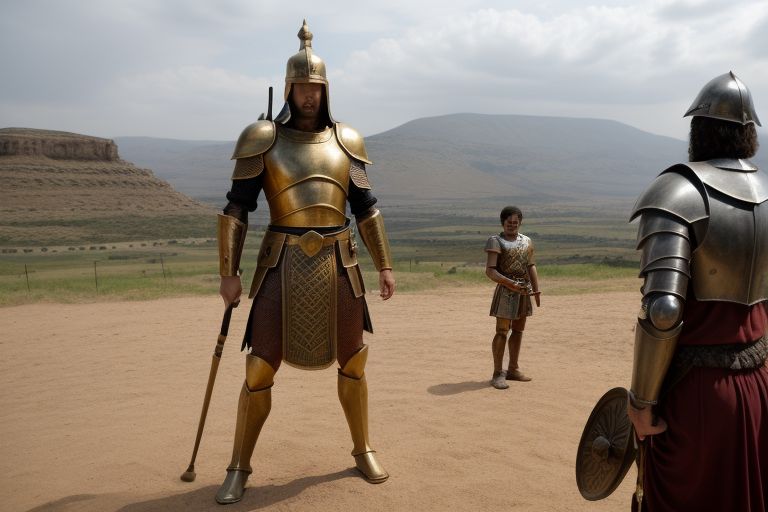
Fast forward to David’s time. Goliath, the nine-foot-tall Philistine warrior, clad in scaled bronze armor, embodies the serpent’s image. His taunts to Israel mirror Satan’s own tactics: mocking, intimidating, and demanding submission. When Goliath calls for a champion to face him, the Israelites cower, powerless and paralyzed. This is more than a physical battle; it’s a confrontation between good and evil.
David’s Role as the Anointed One
David’s arrival on the battlefield is no accident. At this point, he is the Lord’s anointed, a precursor to the Messiah. While others, including King Saul, shy away from Goliath’s challenge, David steps forward, not in human strength but in divine confidence. He refuses Saul’s armor and opts for five smooth stones—a simple yet profound decision reflecting his trust in God rather than human innovation.
David’s faith is central. He declares to Goliath: “You come against me with sword and spear, but I come against you in the name of the Lord Almighty.” His boldness isn’t rooted in self-belief but in God’s sovereignty, a reminder that victories are won not by might but by His power.
The Crushing of the Serpent’s Head
The turning point comes when David strikes Goliath with a single stone, crushing his head—a direct echo of the Genesis prophecy. This act foreshadows Christ’s ultimate victory over sin and death. Just as David defeats Goliath on behalf of Israel, Jesus conquers the powers of evil on behalf of humanity.
Here’s where the story challenges popular interpretations. Often, we’re told to see ourselves as David, called to face our giants. But this perspective falls short. As Biblical Frameworks explains, we’re more like the Israelites—fearful, unable to save ourselves, and in desperate need of a champion. David points us to Jesus, the greater champion who went alone into the battle against sin and crushed the serpent’s head through His death and resurrection.
The Real Message: Christ’s Victory, Our Deliverance
This reframing transforms David and Goliath from a motivational tale into a gospel proclamation. It’s not about slaying personal giants but celebrating Christ’s victory over sin, fear, and bondage. As the Apostle Paul writes, “Thanks be to God! He gives us the victory through our Lord Jesus Christ” (1 Corinthians 15:57).
This perspective invites us to rest in what’s already been accomplished. Just as Israel shared in David’s victory, we share in Christ’s triumph. It’s a call to trust, worship, and find hope in the ultimate deliverance He provides.
A Story of Worship, Not Self-Empowerment
David and Goliath isn’t about us finding inner strength but about God’s faithfulness to deliver. It shifts the focus from human effort to divine grace. Nancy Guthrie aptly observes, “Through David, God shows how He works through weakness to overcome the seemingly invincible”
The message is clear: we have a champion. Christ has gone ahead, faced the enemy, and secured eternal victory. Like the Israelites, we can now stand free, no longer slaves to fear or sin.
