
As we approach the celebration of Christmas, it’s easy to get caught up in the busyness of the season—gifts, decorations, and gatherings. But at the heart of it all lies a profound story that has been foretold for centuries: the birth of Jesus Christ, the Savior of the world. God, in His infinite wisdom, revealed this great event long before it unfolded, through the voices of prophets who spoke His words to Israel. These prophecies, scattered across the Old Testament, not only set the stage for the coming Messiah but also reveal the faithfulness of God to keep His promises. Today, we will explore some of these prophecies, how they were fulfilled in the birth of Jesus, and the mystery of the Star of Bethlehem that announced His arrival to the world.
Prophecies of the Savior’s Birth
The Old Testament is filled with rich prophecies that pointed toward the coming of a Savior. These predictions were not vague or ambiguous; rather, they were specific in terms of the Messiah’s nature, birthplace, and purpose. They were a roadmap, carefully crafted by God, to prepare His people for the most important event in history—the birth of Jesus Christ.
- Isaiah 9:6: “For to us a child is born, to us a son is given…”
Isaiah’s prophecy is one of the most well-known and beloved scriptures that speaks directly to the birth of the Messiah. This passage, written approximately 700 years before the birth of Jesus, beautifully describes the coming Savior’s divine and human nature. He would be a child, born to us, yet also God Himself, as indicated by the titles given to Him: “Wonderful Counselor, Mighty God, Everlasting Father, Prince of Peace.” These titles highlight the Savior’s eternal reign, His wisdom, and His power. Jesus, fully God and fully man, would bring peace to a broken world, and His reign would be unending. - Micah 5:2: “But you, Bethlehem Ephrathah, though you are small among the clans of Judah, out of you will come for me one who will be ruler over Israel…”
In this prophecy, the location of the Messiah’s birth is revealed. Bethlehem, though small and humble, would be the birthplace of the great King. The significance of this prophecy cannot be overstated. Bethlehem, known as the “City of David,” was the hometown of King David. The Messiah, therefore, had to be a descendant of David, fulfilling God’s covenant promise to establish a king from David’s line who would reign forever (2 Samuel 7:12-16). This prophecy was fulfilled in the most humble of circumstances: Jesus was born in a stable in Bethlehem, just as Micah had foretold. - Jeremiah 23:5-6: “The days are coming, declares the Lord, when I will raise up for David a righteous Branch…”
Jeremiah’s prophecy speaks to the Messiah as a descendant of King David, emphasizing His role as a righteous and just ruler. The Messiah would be a King who would bring justice and righteousness to Israel, restoring the people of God. This prophecy highlights the dual nature of Jesus’ mission: He came to restore both the physical and spiritual kingdom of Israel, offering salvation and justice to all people.
The Star of Bethlehem: A Sign of the Savior
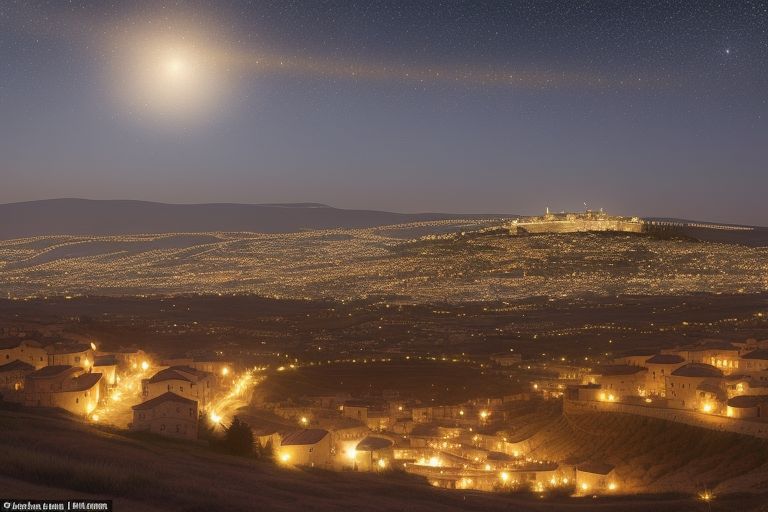
Among the many elements surrounding Jesus’ birth, one of the most intriguing is the appearance of the Star of Bethlehem. This celestial event guided the wise men, or Magi, to the birthplace of Jesus, marking the moment the Savior entered the world. But what exactly was this star, and how does it fit into the story of Jesus’ birth?
- Prophecy Fulfilled in the Heavens
The prophecy in Numbers 24:17 foretold that a star would rise out of Jacob, a direct reference to the Messiah’s coming. Balaam, a prophet who was not an Israelite, spoke of a future king who would rise in Israel, and this star would mark His arrival. “I see him, but not now; I behold him, but not near. A star will come out of Jacob…” (Numbers 24:17). The Star of Bethlehem was more than just a physical phenomenon; it was a divine sign, visible in the heavens, proclaiming the birth of Jesus, the King. - Modern-Day Theories on the Star
In recent years, astronomers and historians have examined the possibility that the Star of Bethlehem was an actual astronomical event, rather than a purely supernatural occurrence. Some have speculated that it could have been a conjunction of planets, such as the one between Jupiter and Saturn in 7 B.C., which would have created an unusually bright point of light in the sky. Another theory points to the “Great Conjunction” of Jupiter and Venus in 2 B.C., when these two planets appeared extraordinarily close together, forming a brilliant star-like object visible for miles. These astronomical occurrences would have been highly significant to the Magi, who were astrologers and would have seen the alignment as a signal of a royal birth.Other theories suggest that the Star of Bethlehem could have been a comet or a nova, which would explain its brilliance and appearance. While we may never know the exact nature of the star, what is clear is that it was a sign from God, guiding the wise men to Jesus. The star was not just a natural phenomenon but a divine marker of the Savior’s arrival. - The Symbolism of the Star
The Star of Bethlehem was more than just a cosmic event—it was a symbol of God’s guidance and a proclamation of Jesus’ kingship. The Magi, who traveled from afar, followed the star, indicating that Jesus’ birth was not just for the Jewish people, but for the entire world. The star’s appearance emphasized the universal significance of Jesus’ birth and His role as the Savior of all nations.
God’s Faithfulness in Fulfilling His Promises
The birth of Jesus was not an accident or a random event; it was the culmination of God’s promises, fulfilled through the course of centuries. The prophecies, as we’ve seen, were specific and clear, showing that God had a divine plan for the salvation of humanity. The timing of Jesus’ birth, the place of His birth, and the very event itself were all part of a greater story that began with God’s promise to send a Savior.
As we reflect on these prophecies and the fulfillment of God’s promises, we are reminded of His faithfulness. The same God who fulfilled these promises is still at work in our lives today. Just as He kept His Word through the birth of Jesus, we can trust that He will fulfill His promises to us. Whether we’re waiting for answers to our prayers or seeking guidance in difficult times, we can be assured that God’s timing is perfect, and He is faithful to His Word.
Reflection and Application
As we celebrate the birth of Jesus, let us take a moment to reflect on God’s faithfulness in fulfilling His promises. Jesus’ birth was anticipated for centuries, and it came to fruition in the perfect way at the perfect time. God’s plan for salvation was not random; it was meticulously woven through history, and Jesus’ arrival was the culmination of that plan.
We too can trust in God’s promises. Just as He promised the Savior, and just as He fulfilled those promises with precision, He continues to be at work in our lives today. Whether we face difficulties, doubts, or uncertainties, we can rest in the knowledge that God is faithful. His promises are sure, and His plan for our lives is perfect.

What a thoughtful reflection on a beautiful symbol of Christ’s birth!