
1,560 words, 8 minutes read time.
Image Source: The AI Pixel Prophet
I never imagined the day I would owe my life to a Samaritan. Even now, as I sit by the window of this small inn recovering, the thought feels surreal. You see, I was raised to believe that Samaritans were lesser men—outsiders, outcasts. My family and community treated them like enemies. We were taught that no good could come from them. But that belief crumbled when I found myself lying half-dead on the road to Jericho, beaten, robbed, and left for dead.
But let me start at the beginning.
My name is Malachi. I’m a merchant from Jericho, a trader of olive oil and fine goods. I built my business from the ground up, inheriting my father’s trade and growing it far beyond his dreams. You could say I was proud of what I’d accomplished. No, you should say it. I was proud—proud to a fault.
My father used to say, “The world is divided, son. There are people who belong, and there are people who don’t. Stick with your own.” He was a practical man, but also a cautious one. He believed in keeping to ourselves, in holding fast to our community and tradition. He taught me that Samaritans were among those who didn’t belong, that they were a people to be avoided. I never questioned this. It was the way of things.
Samaritans lived apart from us. They worshiped differently, believed differently. To us Jews, they were impure—unclean. I never bothered to know more than that. Why would I? They kept to their side of the land, and we kept to ours.
As I grew older, I became successful. I spent more time building my business, expanding my reach, trading with merchants across towns. My focus shifted from the simple lessons my father taught me to the complexities of commerce and trade. The world was bigger than I had once imagined, and yet I still held onto certain views about Samaritans without thinking twice. They were them, and I was us. That was all I needed to know. I never had reason to challenge those beliefs—until that day on the road.
It started like any other journey. I was headed from Jerusalem back to Jericho with a good profit in my satchel. The road between those two cities is as dangerous as they come, but I had traveled it more times than I could count. I prided myself on my ability to navigate those treacherous roads. Bandits were always a risk, but I told myself I was careful, cautious, smart enough to avoid trouble.
But I was wrong.
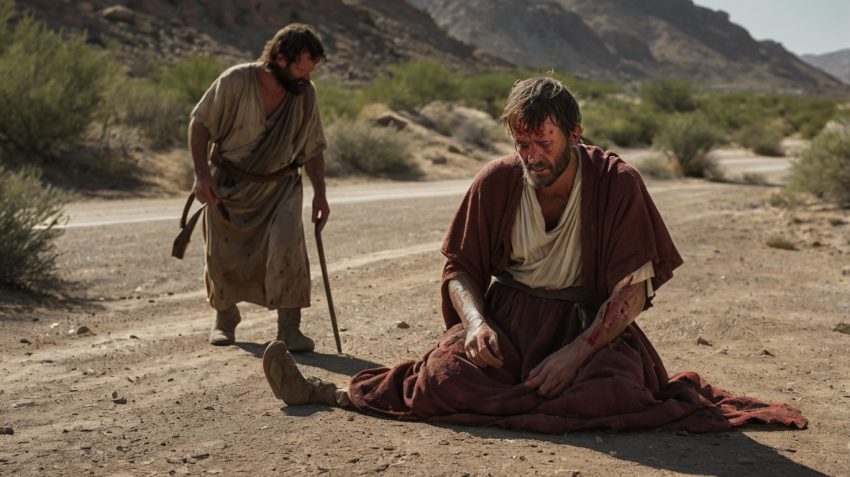
I had only been on the road for an hour when they came at me—three of them, quick and silent. Before I knew it, I was on the ground, their fists and boots crashing into my body. I fought back, or at least I tried to, but there were too many. One blow to the head and I was out cold.
When I came to, I was a broken man. Literally. My ribs ached, my skin was torn, and blood crusted over my face. They had taken everything—my money, my clothes, even my sandals. I lay there on that dusty road, barely able to move, staring up at the unfeeling sky.
I didn’t feel angry at first—just disbelief. How had I let this happen? I was always so sure of myself, always so in control. Yet here I was, stripped of everything. For the first time in my life, I felt truly powerless.
My first thought was survival. Surely, someone would come. Surely, a fellow Jew, a neighbor, or a passerby would help me. But as the hours dragged on, hope began to slip through my fingers like sand.
The first man I saw in the distance was a priest. I could tell by his robes, a man of God. My heart leapt. Surely he would stop. Surely he would help. But as he got closer, he slowed only for a moment, glancing at my broken body with a mix of fear and disgust. He crossed to the other side of the road, pretending not to see me, and hurried away.
I was too weak to shout after him, but my soul screamed inside me. Was I not his brother? Was I not worth saving?
Then came a Levite—a religious leader. I tried to catch his eye, hoping for even a sliver of compassion. But like the priest, he kept his distance. His pace quickened as if helping me would somehow tarnish him. The dust from his feet settled on my wounds, and the despair in my heart grew darker.
You can’t imagine what it feels like to be abandoned like that, lying there knowing that your own people would rather pass by than get their hands dirty helping you. I don’t know how long I lay there, drifting in and out of consciousness, wondering if this road would be my grave.
That’s when I heard the hooves. At first, I barely opened my eyes. What was the point? Another stranger to pass me by, no doubt. But this time, I felt a hand on my shoulder. A soft, steady voice spoke words I didn’t expect to hear: “Hold on, friend.”
I opened my eyes fully and saw his face. A Samaritan.
I won’t lie—my first thought wasn’t gratitude. It was shock. A Samaritan? We Jews don’t associate with them. In fact, we despise them. I had been taught that they were unclean, enemies of our people.
The lessons of my childhood flooded back, warning me not to trust him, reminding me that Samaritans were different. I’d been taught that they didn’t belong in our world, that we were righteous, and they were not. And yet, here he was, kneeling beside me, his eyes filled with something I hadn’t seen all day—compassion.
He didn’t hesitate. He poured oil and wine on my wounds, cleansing and bandaging them with care. I couldn’t understand why he was doing it. Why would he, a Samaritan, help me—a Jew who had likely looked down on him at one point or another?
But he didn’t ask for thanks. He didn’t ask for anything. He lifted me onto his donkey and walked beside me, mile after painful mile, until we reached an inn. I could barely stay awake, my body and mind drained, but I remember him speaking to the innkeeper, paying for my stay and saying, “Take care of him. When I return, I’ll cover any extra expenses.”
It’s been days since then. My wounds are healing, but the deeper injury—that to my pride—has only just begun to mend.
How foolish I’ve been.
Looking back now, I see how blind I was, how my pride and arrogance kept me from understanding the world as it truly is. My whole life, I believed I could stand alone, that my success was my own, that people who needed help were weak. I’ve been a man who passed by those in need, just like the priest, just like the Levite. I would see beggars on the street, people struggling in the marketplace, and I’d turn away. I told myself it wasn’t my problem, that they should figure things out for themselves.
I never imagined the day would come when I’d need someone else to save me—let alone a Samaritan.
And now I can’t stop thinking about it. About the moment he stopped, when others didn’t. I’ve asked myself a hundred times why he did it. Why did he stop for me? We’d been taught to hate each other, to distrust each other. And yet, in my darkest moment, he was the one who showed me mercy.
A Samaritan, a man I was raised to despise, showed me what it means to love your neighbor. And it’s not about words or religion or nationality. It’s about action. He had no reason to stop for me—no obligation. Yet, in my darkest moment, he was the one who saved me. Not because he had to, but because it was the right thing to do.
This experience has turned everything upside down for me. What I once thought was strength—this self-reliance, this pride in my own abilities—has been revealed as a weakness. I was so blinded by my need to be in control, to be independent, that I forgot something crucial. We all need each other.
I’ve been thinking about my father lately, about the lessons he taught me. I wonder now if he ever questioned them, or if he, too, would have passed me by on that road. I don’t say that out of bitterness, but out of sorrow. How many opportunities to show love have I missed because I was too concerned with who was worthy and who was not? Too concerned with preserving my pride, my position?
Now, I see. It was my pride, my self-reliance that had blinded me. And in that dusty, broken place on the road to Jericho, I learned a lesson I will carry for the rest of my life: compassion knows no borders, no boundaries.
The stranger who saved me taught me more about mercy than I ever understood before. I owe him my life, but more than that, I owe him my heart’s transformation.
The End
