
1,494 words, 8 minutes read time.
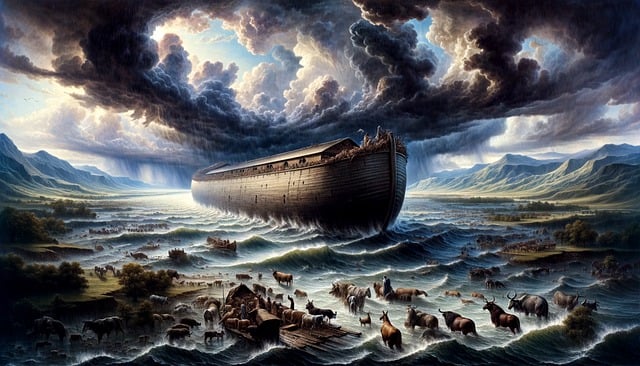
The sky had been weeping for weeks, as if the heavens themselves were mourning. What started as a steady rain had become a relentless deluge, pounding the earth until rivers overflowed and hills vanished beneath the rising water. People at first scoffed, dismissing it as just another storm. But soon, they could no longer ignore the ominous clouds overhead—heavy not just with rain, but with something darker, more foreboding.
Noah stood at the entrance of the ark, his weathered face turned skyward as the torrents fell. The ground, once firm beneath his feet, had turned to muck. For years, he had labored on this colossal vessel—300 cubits long, 50 cubits wide, and 30 cubits high—amid the ridicule of his neighbors. They had laughed at him, pointing out the absurdity of a ship far from any sea. “Madman!” they called him. Yet now, as the floodwaters began to rise, their laughter had turned to cries of desperation. But it was too late.
“Father,” Shem’s voice broke through the endless patter of rain. Noah turned to see his eldest son standing beside him, worry etched across his face. “The animals are restless.”
Noah glanced back at the ark, already creaking under the weight of the life it sheltered. Lions growled in their pens, sheep huddled together, and birds flapped frantically against their cages, their instincts attuned to the looming catastrophe. Noah knew the feeling. It wasn’t just the animals that were uneasy; it was as though the very earth trembled beneath the storm.
“They sense what’s coming,” Noah said softly, placing a hand on Shem’s shoulder.
“And what is coming?” Shem asked, though the answer was already written in his eyes.
“The end,” Noah replied.
But what Noah did not yet know—what no one knew—was that this flood was more than just rain.
Far beyond the clouds, in the vastness of space, a meteor hurtled toward earth, unseen and unnoticed. Some later speculated that it was this cosmic event, this fiery rock from the heavens, that had triggered the flood. Whether it was divine will or a natural disaster, no one could be certain. But the effects were undeniable. The meteor, when it struck the ocean with a force beyond imagination, unleashed a cataclysm. The impact sent tidal waves racing across the seas and the skies themselves churned with violent, unrelenting storms.
The rain, then, wasn’t just the wrath of the heavens—it was the earth itself reacting to this celestial strike. As the water levels rose, people ran in every direction, seeking refuge on higher ground. But there was no ground high enough to escape what was coming.
Inside the ark, Noah’s family felt the tremors of the impact, though they did not know the cause. The great ship rocked violently as waves battered its sides, but the ark held strong, its massive beams and gopher wood reinforced with divine precision. Shem, Ham, and Japheth moved quickly to secure the animals, while their wives whispered prayers for the world they had left behind.
“Do you think this is the end of everything?” Japheth, the youngest, asked as he sat beside the doves, whispering reassurances to the birds.
“The Creator has given us a chance,” Noah answered, though the weight of the unknown pressed heavily on his soul.
The flood raged for forty days, the rain falling without end. The sky was a constant shade of grey, the waters rising until even the tallest mountains were submerged. The people outside, the ones who had mocked Noah, were now long gone, their voices silenced by the overwhelming tide. All that remained was the ark, a solitary vessel adrift on a sea with no shore.
Inside, the mood was tense. The family moved through their days in a haze of chores and prayer, caring for the animals and maintaining the ark. But each night, Noah sat alone, staring into the darkness, his thoughts consumed by the enormity of it all. Was this truly the end of the world? What had been lost? What kind of future awaited them when the waters receded?
Then, one morning, the rain stopped. The sky, which had been a curtain of endless grey, cleared to reveal a pale sun. It wasn’t the vibrant, warm sun they remembered, but it was light, and with it came a sense of hope. The floodwaters still stretched endlessly in all directions, but Noah felt something shift—a promise that the worst was over.
He sent out a raven, watching it disappear into the horizon. Days later, he sent out a dove. The first time, it returned with nothing. But on the second journey, the dove came back, an olive branch clutched in its beak.
Noah’s heart swelled. Land. There was still land.
Weeks later, the ark struck something solid—Mount Ararat, rising above the waters like a beacon of hope. As the floodwaters slowly receded, Noah and his family prepared to disembark. The doors of the ark opened, and the first breath of fresh air in months filled their lungs. The earth smelled damp and new, the landscape transformed into a wild, untamed world.
They stepped onto the ground cautiously, leading the animals into this new world. The air was still, the silence profound. Trees bent from the weight of the rain, and valleys lay submerged beneath pools of water that would take time to drain. But life would return. It had to.
Noah stood for a long time, watching the animals scatter into the wilderness, his family following to explore the strange, quiet land. The world was different now, but it was alive with possibility.
As the sun set behind the mountains, casting a golden glow across the landscape, Noah whispered a quiet prayer. The flood had washed away the old, but in its place was a new beginning. He didn’t know what challenges lay ahead, but he felt a deep sense of peace. This was their second chance.
And as the stars began to twinkle in the sky, Noah thought of the meteor—the fire from the heavens that had perhaps played a role in this great cleansing. Whether divine or natural, it didn’t matter. What mattered was that they had survived, and with them, the promise of a new world.
Tomorrow, they would start again.
