
12,735 words, 67 minutes read time.
Every man walking this earth lives with a tension he can’t quite name.
On one side, there’s a voice that says burn it down—the rage that rises when you watch someone get away with evil, when the liar gets promoted, when the abuser walks free, when the cheater prospers while honest men starve. It’s the voice that wants accounts settled, ledgers balanced, receipts pulled, and debts collected with interest. It’s the voice that built courthouses and carved “an eye for an eye” into stone tablets because some part of the human soul knows that wrong unpunished is a cancer that metastasizes until whole civilizations rot from within.
On the other side, there’s a different voice—quieter, but no less insistent. It’s the one that whispers let it go when you’re lying awake at 2 AM rehearsing an argument from three years ago. It’s the one that says give him another chance when every logical neuron in your brain is screaming that fool has burned through his last nine lives. It’s the voice that makes you pull back the fist, swallow the comeback, delete the scorched-earth email you spent an hour crafting. It’s the voice that sounds suspiciously like weakness until you watch it disarm a decades-long feud with six words: “I was wrong. Will you forgive me?”
Most men spend their entire lives trying to kill one of these voices.
The “justice” guys build their whole identity around being the hard men who do what needs to be done. They’re the ones who never forget a slight, never give an inch, never let anyone off the hook because “principles matter” and “people need to learn.” They quote Clint Eastwood movies like Scripture and mistake brutality for strength. They die alone, surrounded by scorched earth and a perfect record of being technically right.
The “mercy” guys go the opposite direction. They’re so terrified of being their angry fathers that they become doormats with theology degrees. Everything is “grace” and “letting go” and “not judging.” They watch their kids get devoured by the culture, their wives lose respect, their friends take advantage, and they smile through it all because “that’s what Jesus would do.” They don’t realize that Jesus also braided a whip and flipped tables when the situation called for it.
Both types are half-men. Dangerous in different ways, but equally crippled.
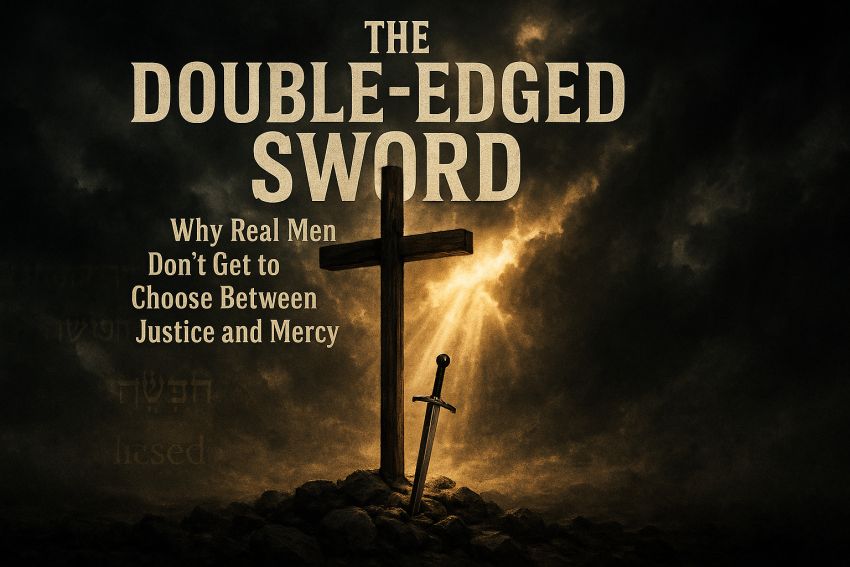
Because here’s what the Bible actually says, and it’s going to wreck your comfortable categories: God doesn’t choose between justice and mercy. He doesn’t toggle back and forth depending on His mood. He doesn’t have “justice days” and “mercy days.” He is simultaneously, perfectly, completely both. All the time. Without contradiction. And if we’re going to bear His image—if we’re going to be the kind of men who can hold a family together, lead in a crisis, and sleep at night—we don’t get to pick one and ghost the other. We get both barrels, every day, for the rest of our lives.
This isn’t a personality preference. It’s not a matter of temperament or background or what Myers-Briggs letter salad you got assigned. This is bedrock-level, throne-of-God, foundation-of-reality truth. Psalm 89:14 doesn’t stutter: “Righteousness and justice are the foundation of Your throne; steadfast love and faithfulness go before You.” Micah 6:8 doesn’t give you options: “He has shown you, O man, what is good. And what does the LORD require of you but to do justice, to love mercy, and to walk humbly with your God?”
Do justice. Love mercy. Both. Non-negotiable.
The problem is we live in a culture that has completely lost the script on both.
On one side, you’ve got the outrage machine running 24/7, where justice has been weaponized into cancel culture, where every mistake is unforgivable, every offense is prosecuted in the court of social media, and mercy is just another word for being complicit with evil. People don’t want restoration; they want blood. They don’t want repentance; they want public executions. The mob doesn’t rest until careers are destroyed, families are ruined, and some poor fool’s worst moment is the first thing that shows up when you Google their name for the next forty years.
On the other side, you’ve got the therapy-culture types who have turned mercy into a narcotic we use to numb ourselves to reality. Everything is excused, nothing is your fault, accountability is “toxic,” and boundaries are “unloving.” Wrong is just “hurt people hurting people.” Sin is just “trauma response.” Adultery is just “finding your truth.” We’ve got grown men walking around who’ve never been told “no,” never faced a real consequence, never had to own the wreckage they leave in their wake because somebody always swoops in with the emotional bubble wrap and tells them they’re valid.
Both sides are a counterfeit. Both will destroy you.
Real justice without mercy becomes cruelty. It turns into the Pharisee thanking God he’s not like other men, into the older brother standing outside the party fuming about fairness, into Jonah sitting under a withered plant hoping God nukes Nineveh even after they repented. It becomes a prison of your own making where you’re the warden and the inmate, keeping meticulous records of everyone else’s failures while your own soul fossilizes into bitterness.
Real mercy without justice becomes sentimentality. It turns into the parent who never disciplines and wonders why their kids are monsters, into the leader who never confronts and watches the whole organization corrode, into the friend who enables addiction because “love means accepting people where they are.” It becomes a betrayal of everyone you claim to love, because mercy that costs you nothing and demands nothing isn’t mercy—it’s cowardice dressed up in spiritual language.
But when you get them both firing at the same time, something happens that this world can’t manufacture and can’t understand. You become dangerous in the best possible way. You become a man who can speak truth that cuts to the bone while bleeding for the person you’re cutting. You become a man who can enforce consequences without cruelty and extend forgiveness without compromise. You become a man who looks like the God who drowned the ancient world in a flood and then set a rainbow in the sky as a promise to never do it again. You become a man who looks like the God who rained fire on Sodom and then sent His Son to die for Sodomites. You become a man who looks like Jesus—who told the woman caught in adultery “neither do I condemn you” and in the same breath said “go and sin no more.”
That’s the man this broken world is dying for.
Not the guy who’s all wrath and no compassion, crushing everyone in his path and calling it “holding the line.” Not the guy who’s all therapy-speak and no spine, letting chaos reign and calling it “grace.” But the man who has stared his own sin in the face long enough to know he deserves the flames, and who has tasted mercy deep enough to know it cost Someone everything, and who now walks through this world with one hand holding a sword and the other hand reaching for the broken.
That’s what this is about.
The pages that follow aren’t theory. This is the operating manual for how to be that kind of man—the kind who doesn’t split the difference between justice and mercy but wields both like the double-edged sword they’re meant to be. We’re going to walk through Scripture and see what it looks like when God brings the hammer down (spoiler: it’s terrifying). We’re going to see what it looks like when God extends mercy that makes absolutely no earthly sense (spoiler: it’s scandalous). And then we’re going to look at what this means for your marriage, your kids, your work, your anger, and your soul.
Because the same Bible that promises “God will bring every deed into judgment, with every secret thing, whether good or evil” (Ecclesiastes 12:14) also says that same God “delights in mercy” (Micah 7:18). He doesn’t choose. He doesn’t compromise. He doesn’t water down one to make room for the other.
He marries them at the cross. And then He looks dead at us and says, “Now you do the same.”
Most men want to live in a world where justice is a sniper rifle aimed at everyone else and mercy is a blanket thrown over their own sins. Scripture smashes that fantasy to pieces. God’s throne is not perched on some wobbly scale trying to stay balanced; it is planted on bedrock that is simultaneously mishpat and hesed (justice and steadfast love). The same hands that shattered Egypt’s army in the Red Sea are the hands that caught Hagar’s tears in the wilderness. The same voice that thundered from Sinai is the voice that whispered to Elijah in a cave, “I’ve still got seven thousand who haven’t bowed the knee.”
If we’re going to follow this God, we don’t get to pick one attribute and ignore the other. We don’t get to customize a Jesus who matches our politics or our temperament or our trauma. We get the whole package—the Lion and the Lamb, the Judge and the Savior, the One who will return with a sword coming out of His mouth and His robe dipped in blood, whose name is “Faithful and True,” and who makes war in righteousness and whose eyes are like flames of fire that see everything and whose voice is like rushing waters that drown out every excuse.
That’s the Jesus we’re following. And if we’re going to look anything like Him, we’re going to have to learn to hold justice and mercy in the same scarred hands.
So here’s the question that will define your manhood, your legacy, and your eternity:
When you have the power to crush someone who deserves it, will you have the strength to show mercy?
And when mercy would be easier, when letting it slide would keep the peace, will you have the guts to fight for what’s right?
The men who can answer “yes” to both are the ones who change the world.
Let’s figure out how to become them.
The Foundation That Will Not Crack
Psalm 89:14 is not poetry for greeting cards: “Righteousness and justice are the foundation of Your throne; steadfast love and faithfulness go before You.” Read that again. Not the decoration of His throne. Not the mood lighting around His throne. The foundation. The load-bearing structure. The thing that holds the entire weight of God’s sovereign rule over the universe. And what is it made of? Righteousness and justice on one side, steadfast love and faithfulness on the other.
Mishpat and hesed.
These aren’t two separate pillars holding up opposite corners, creating tension that God has to manage like some cosmic balancing act. They’re fused. Integrated. Welded together like rebar inside concrete—you can’t pull one out without destroying the whole structure. This isn’t God trying to be fair by giving equal time to His “angry side” and His “nice side.” This is the revelation that in God, these attributes don’t conflict—they require each other. His justice is loving. His love is just. And both are perfect, all the time, simultaneously.
Most men’s brains short-circuit right here because we’ve been trained to think in terms of trade-offs. You can have quality or speed, not both. You can be liked or respected, pick one. You can be the tough dad or the fun dad, choose your lane. So when we see God’s character described this way, we assume He’s really good at code-switching—thundering judgment on Monday, Wednesday, Friday, and dispensing grace on Tuesday, Thursday, Saturday, with Sundays off for worship.
But that’s not what the text says. It says both are the foundation—meaning they’re always operational, always active, always fully engaged. When God judged Sodom, it was a loving act of justice that protected the innocent and declared the worth of the victims. When God saved Rahab the prostitute, it was a merciful act of justice that honored her faith and kept His covenant promises. You can’t separate them. The moment you try, you end up with a false god who looks nothing like the One who revealed Himself in Scripture.
The prophet Isaiah sees this fusion point when he describes the coming Messiah. Isaiah 9:7 says His government will rest on justice and righteousness—He’s coming as the ultimate Judge, the King who will rule the nations with an iron scepter, the One who will finally make every wrong thing right. But keep reading and you get to Isaiah 53, where the same Messiah is “bruised for our iniquities,” “pierced for our transgressions,” and “by His stripes we are healed.” The Judge becomes the defendant. The King becomes the sacrifice. Justice and mercy don’t meet at a negotiating table to hammer out a compromise—they meet at the cross.
And here’s what makes the cross so staggering: it satisfies both completely. Justice doesn’t get shortchanged. Every sin that was ever committed—every lie, every betrayal, every act of violence, every lustful thought, every moment of rebellion—gets the full weight of God’s holy wrath poured out. The books balance. The debt gets paid. The ledger clears. Romans 3:25-26 is explicit about this: God put Jesus forward as a propitiation “to show God’s righteousness” so “that He might be just and the justifier of the one who has faith in Jesus.” God doesn’t sweep sin under the rug. He doesn’t grade on a curve. He doesn’t look the other way. He absorbs the blow Himself.
But mercy doesn’t get diluted either. Every sinner who deserves the flames—every adulterer, every thief, every murderer, every blasphemer, every one of us—gets the full offer of complete forgiveness. Not probation. Not community service. Not “we’ll keep an eye on you.” Full adoption as sons and daughters, full inheritance rights, full access to the throne, new name, new identity, new heart. The prodigal gets the robe, the ring, the sandals, and the fatted calf while he still smells like pig slop. The thief on the cross gets paradise the same day he gets crucified. The woman caught in adultery gets “neither do I condemn you” from the only One qualified to throw the first stone.
The cross is the place where the steel of justice and the blood of mercy are welded together forever. And every man who wants to follow Jesus has to walk straight through that intersection and let it reshape how he sees everything.
Which brings us to Micah 6:8, the closest thing Scripture gives us to a one-sentence mission statement for manhood: “He has shown you, O man, what is good. And what does the LORD require of you but to do justice, to love mercy, and to walk humbly with your God?”
Three verbs. Three non-negotiables. Not suggestions. Not ideals for when you’ve got margin in your schedule. Requirements. This is what God says it looks like to be a man who actually walks with Him.
Do justice. Not “appreciate” justice. Not “think about” justice. Not “have an opinion on” justice. Do it. Execute it. Fight for it. Bleed for it if necessary. This is active, costly, relentless pursuit of making wrong things right. It means you stand up when everyone else sits down. It means you speak the truth when lying would be easier. It means you protect the weak even when the powerful notice. It means you don’t let evil slide just because confronting it would make your life complicated. Justice in the hands of a godly man isn’t a weapon for settling personal scores—it’s a tool for protecting the vulnerable and exposing the darkness. But make no mistake: doing justice will cost you. It cost Jeremiah a cistern. It cost John the Baptist his head. It cost Jesus a cross. And it will cost you something too—maybe a promotion, maybe a friendship, maybe your reputation in certain circles. Do it anyway.
Love mercy. Not tolerate it. Not dispense it like a miser handing out coins to beggars. Not offer it through gritted teeth while secretly hoping people get what they deserve. Love it. Chase it. Delight in it. This is the command that separates the Pharisees from the disciples. The Pharisees knew justice—they had 613 laws and a whole legal system to enforce them. What they didn’t have was love for mercy. They wanted the adulterous woman stoned. Jesus wanted her restored. They wanted the tax collectors excluded. Jesus wanted them at the table. They wanted the Sabbath-breaker punished. Jesus wanted him healed. Loving mercy means your default posture toward broken people is run toward them, not run away. It means when someone who wronged you comes back broken and repentant, your first instinct isn’t “I knew this would happen” but “kill the fatted calf.” It means you give the benefit of the doubt. You absorb the hit. You pay the cost of reconciliation even when you weren’t the one who broke it. And here’s the thing: you can’t fake this. You can grit your teeth and force yourself to do mercy, but you can’t fake loving it. That only comes when you’ve been so wrecked by how much mercy you’ve received that extending it to others feels less like an obligation and more like worship.
Walk humbly. This is the kill switch on the whole operation. Because the moment you forget you’re the chief of sinners, the moment you start thinking you’ve arrived, the moment you look at someone else’s train wreck and thank God you’re not like them—that’s the moment you’ll start swinging justice and mercy like a drunk with a chainsaw. Humility is what keeps justice from becoming cruelty and mercy from becoming enabling. It’s the constant, gut-level awareness that every breath you take is a gift, every sin you didn’t commit today is because of grace, and the only reason you’re not in chains or in flames is because Someone bled in your place. Walking humbly means you bring that awareness into every confrontation, every conversation, every decision. It means you can speak hard truth without arrogance and extend radical mercy without superiority. It means you’re dangerous to the enemy and safe to the broken, because you know exactly who you are and Whose you are.
Three verbs. Do justice. Love mercy. Walk humbly. Miss one and the whole thing collapses. Overemphasize one and you become a caricature—all wrath and no compassion, or all sentiment and no spine, or all performance and no power.
But get all three running at the same time, and you become the kind of man who looks like the God whose throne rests on justice and mercy fused together.
That’s not optional. That’s the foundation. And foundations don’t crack.
When Justice Comes Like a Flood (Literally)
Genesis 6 says the earth was filled with hamas. That’s the Hebrew word for violent brutality—not just individual acts of violence, but systemic, pervasive, culture-wide brutality that had metastasized into the fabric of civilization. It’s the same word that shows up in the prophets when they describe oppression, bloodshed, and the strong devouring the weak. You want to know what hamas looks like? Turn on the news. Read the inner-city police reports. Watch what happens when men with power decide might makes right and there’s no one strong enough to stop them. Genesis 6:5 gives us the diagnosis: “The LORD saw that the wickedness of man was great in the earth, and that every intention of the thoughts of his heart was only evil continually.”
Read that slowly. Every intention. Not “most.” Not “a troubling percentage.” Every. And not just their actions—their thoughts. The engine was corrupted. The source code was compromised. Humanity had rotted from the inside out, and the rot had gone terminal.
So what did God do? He didn’t form a committee to study the issue. He didn’t launch a ten-year rehabilitation program with metrics and quarterly reviews. He didn’t send motivational speakers to help humanity find its best self. He opened the windows of heaven and the fountains of the deep and washed the planet clean. For forty days and forty nights, water poured from above and exploded from below until every mountain was covered, every valley was drowned, every living thing that breathed air was dead. The judgment was global, comprehensive, and absolute.
And when it was over, eight people walked off an ark into a world that smelled like death and second chances. Everywhere Noah looked—corpses. Every tree, every hillside, every shoreline—evidence of what happens when the patience of God reaches its limit. The world had been given 120 years of warning while Noah built that ark and preached righteousness, and they spent those 120 years mocking him. Right up until the day the sky cracked open and the ground split apart, and then it was too late.
That’s justice: thorough, terrifying, and final. It doesn’t negotiate. It doesn’t compromise. It doesn’t get distracted or bribed or talked out of its verdict. When God’s patience runs out, the hammer falls, and it falls hard.
But here’s what most people miss: even in judgment, there’s mercy. God didn’t have to warn anyone. He didn’t have to give 120 years. He didn’t have to tell Noah to build an ark big enough for anyone who wanted to come. That door was open right up until God Himself shut it. Mercy and justice, running on parallel tracks all the way to the flood.
Centuries later, the same pattern repeats. The outcry from Sodom and Gomorrah rose to heaven like smoke from a slaughterhouse. Genesis 18 gives us one of the most fascinating scenes in Scripture: God Himself—along with two angels—walks down to see if the report is accurate. Think about that. The omniscient God who knows every sparrow that falls, every hair on your head, every thought before you think it—He investigates. Not because He needs more information, but because He’s establishing a pattern: justice is never careless, never hasty, never arbitrary. God doesn’t nuke first and ask questions later. He examines. He weighs. He listens to the outcry of the victims and measures it against the evidence.
And then comes one of the most gut-wrenching negotiations in the Bible. Abraham, knowing his nephew Lot is down there, starts bargaining: “Will You sweep away the righteous with the wicked? Suppose there are fifty righteous within the city. Will You then sweep away the place and not spare it for the fifty righteous who are in it? Far be it from You to do such a thing, to put the righteous to death with the wicked, so that the righteous fare as the wicked! Far be that from You! Shall not the Judge of all the earth do what is just?”
And God agrees. Fifty righteous, and He’ll spare the whole city. Then Abraham haggles Him down—forty-five, forty, thirty, twenty, ten. At every level, God says yes. Find me ten righteous people in a city of thousands, and I’ll spare them all.
Ten righteous men couldn’t be found.
So fire and sulfur rained from heaven until five cities were ash, smoke, and a pillar of salt where Lot’s wife used to be. She’d been told to run and not look back, but she couldn’t let go of the life she was leaving. She turned for one last look at her burning city, and she became a monument to the cost of loving the world more than God’s mercy. Abraham stood on a hillside the next morning and watched the smoke rise “like the smoke of a furnace,” and he knew the answer to his question: Yes, the Judge of all the earth does do what is just. Every time. Without fail. Justice keeps receipts, and when the bill comes due, it gets paid in full.
But if you want to see the clearest picture of God’s justice, you don’t look at the flood. You don’t look at Sodom. You look at a hill outside Jerusalem on the darkest day in history.
Romans 3:25–26 says God put Jesus forward as a propitiation—a wrath-absorbing, fury-drinking, justice-satisfying sacrifice—through His blood, “to show God’s righteousness, because in His divine forbearance He had passed over former sins. It was to show His righteousness at the present time, so that He might be just and the justifier of the one who has faith in Jesus.”
Read that again. God had a problem. For centuries, He’d been passing over sins—forgiving people, showing patience, extending mercy to people who deserved the flood, who deserved the fire. And every time He showed mercy, a question lingered in the universe: What about justice? Do these sins just… disappear? Does God not care about holiness? Is He righteous, or is He just soft?
The cross answers that question in the most brutal, beautiful way imaginable. All the fury that drowned the ancient world, all the fire that turned cities into craters, all the wrath that every sinner in history has earned and deserved—it was distilled into one cup, and that cup was pressed to the lips of the Son.
And He drank it. All of it.
The sky turned black at noon, as if creation itself couldn’t bear to watch. The earth convulsed. Rocks split. Tombs opened. And in the temple, the veil that separated the Holy of Holies from the rest of the world—the veil that said “you can’t approach a holy God and live”—ripped from top to bottom. Not from bottom to top, like human hands would tear it, but from top to bottom, like God Himself was ripping open access to His presence and saying, “The price has been paid. The door is open. Come.”
On that cross, the Father was treating the Son as pure, undiluted justice demanded. Every sin that would ever be forgiven had to be punished. Every grace that would ever be extended had to be purchased. Every mercy that would ever be shown had to have its cost absorbed by someone. And Jesus took it all—the full weight of God’s righteous wrath against every lie, every murder, every betrayal, every lustful thought, every act of rebellion from every sinner who would ever believe.
Paul says this was “to demonstrate God’s righteousness”—to put it on display for the entire universe to see that God is not playing games with sin. He’s not winking at evil. He’s not grading on a curve. Justice is being fully, completely, horrifically satisfied. The gavel fell. The sentence was executed. The wrath was poured out.
But it fell on the Lamb.
So now, God can be “just and the justifier of the one who has faith in Jesus.” He doesn’t have to choose between justice and mercy. He doesn’t have to compromise His holiness to save sinners. He doesn’t have to ignore sin to extend grace. Justice got everything it demanded at the cross. And mercy gets to throw open the doors to everyone who runs to that cross and says, “I deserve that. He took it for me. I’m Yours.”
The flood, the fire, and the cross—they’re all the same story. Justice is real. It’s thorough. It’s terrifying. And it’s coming for every sin ever committed.
The only question is: will it find you hidden in the ark, pulled out of Sodom by angels, or covered by the blood of the Lamb?
Because it’s coming. And when it does, there will be no more warnings, no more delays, no more chances to run.
Choose today.
When Mercy Makes No Earthly Sense
Yet the same God who torched cities also chases adulterers.
Let that sink in. The God who rained fire on Sodom, who drowned the ancient world, who doesn’t wink at sin or grade on a curve—that same God tells the prophet Hosea to go marry a prostitute. Not a former prostitute who’s turned her life around. Not a woman with a rough past who’s now walking the straight and narrow. A woman who will cheat on him. Repeatedly. Publicly. Humiliatingly.
Her name is Gomer, and she doesn’t just have a wandering eye—she has a wandering everything. Hosea marries her, loves her, builds a life with her, has children with her. And she sleeps with half the county. She takes the security and provision Hosea gives her and uses it to fund her affairs. She credits her lovers for the blessings her husband provided. And when she finally hits rock bottom—used up, discarded, sold into slavery because she’s got nothing left to trade—God tells Hosea to go buy her back.
Not divorce her. Not expose her. Not write her off as a cautionary tale. Buy her back. Pay the price to redeem a woman who shredded his reputation, broke his heart, and made a mockery of his covenant.
Why? Because that’s the story of Israel. That’s the story of every one of us. We’re Gomer. We take the breath God gives us and use it to curse Him. We take the gifts He provides and credit the idols. We run to every broken cistern and empty promise while the Fountain of Living Water stands there with open arms, saying, “Come back. I’ll take you back. I’ll pay the price. I’ll restore what’s broken.”
Hosea 11 is God essentially ripping His heart open on the page for everyone to see: “How can I give you up, O Ephraim? How can I hand you over, O Israel? How can I make you like Admah? How can I treat you like Zeboiim?” (Those last two are cities that burned with Sodom—God’s saying, “How can I do to you what justice demands?”) “My heart recoils within Me; all My compassion is kindled. I will not execute My fierce anger; I will not again destroy Ephraim; for I am God and not man, the Holy One in your midst, and I will not come in wrath.”
This is mercy that makes no earthly sense. It’s not strategic. It’s not deserved. It’s not based on Gomer cleaning up her act or Israel finally getting it together. It’s based entirely on the character of the One giving it. “I am God and not man.” A human husband would’ve burned the house down. A human father would’ve walked away. But God is not human. His mercy doesn’t run out. His love doesn’t have a breaking point. And that mercy—the kind that makes absolutely no logical sense—is the only mercy strong enough to save men like us.
Then there’s the story Jesus told about the son who looked his father in the eye and said, “I wish you were dead.”
That’s what “give me my inheritance” meant in that culture. Inheritance came when the father died. So when the younger son demanded his share while his father was still alive, he was essentially saying, “You’re dead to me. I want what’s mine, and I want you gone.” And the father—against all cultural norms, against all common sense—gave it to him. Liquidated assets, divided the estate, handed his son a fortune, and watched him walk away.
The son took that money and burned through it like gasoline—prostitutes, parties, reckless living. He didn’t just make bad investments; he scorched his inheritance on the most degrading, God-mocking pleasures he could find. And when it was gone, when the friends evaporated and the money dried up and a famine hit and he ended up feeding pigs (an unclean animal for a Jewish boy—the lowest you could sink), he finally came to his senses.
But even then, his plan was transactional: “I’ll go back, apologize, and ask to be a hired servant. At least I’ll eat.” He’s rehearsing his speech the whole way home, every step a reminder of how badly he’d destroyed everything.
And that’s when the story goes off the rails.
The father saw him “while he was still a long way off.” Which means the father had been watching. Waiting. Scanning the horizon every day for a silhouette he’d recognize. And when he finally sees his son—broken, filthy, reeking of pig slop and failure—he doesn’t wait for the apology. He doesn’t cross his arms and say, “Let’s hear it.” He doesn’t make the son crawl or beg or prove he’s really changed this time.
He runs.
Old men in first-century Jewish culture did not run. It was humiliating. It was beneath their dignity. You walked slowly, with gravitas, because that’s what patriarchs did. But this father hiked up his robe and sprinted like a teenager, and when he reached his son—while the boy still stank, while he was still covered in shame—the father threw his arms around him and kissed him. The son starts his rehearsed speech: “Father, I have sinned against heaven and before you. I am no longer worthy to be called your son—” and the father cuts him off.
He’s not interested in the speech. He’s already forgiven. He’s already forgotten. He starts shouting orders: “Bring quickly the best robe, and put it on him, and put a ring on his hand, and shoes on his feet. And bring the fattened calf and kill it, and let us eat and celebrate. For this my son was dead, and is alive again; he was lost, and is found.”
The best robe—the one reserved for the most honored guest. The ring—a signet ring, a symbol of authority and family identity. Shoes—because servants went barefoot, but sons wore shoes. And the fattened calf—the one you’d been saving for the most important celebration imaginable. All of it lavished on a son who deserved nothing but a spot in the servant quarters.
The older brother loses his mind. He’s been faithful, dutiful, working the fields, doing everything right. And when he hears the music and finds out why they’re celebrating, he refuses to go in. He stands outside fuming about fairness: “I’ve served you all these years, and you never even gave me a goat to celebrate with my friends! But when this son of yours comes back after blowing your money on prostitutes, you kill the fattened calf?”
And the father’s answer is the heartbeat of the gospel: “Son, you are always with me, and all that is mine is yours. But we had to celebrate and be glad, because this brother of yours was dead and is alive again; he was lost and is found.”
Mercy is scandalous. It always has been. It offends our sense of fairness. It feels like injustice to people who’ve kept the rules. It looks like weakness to people who’ve never needed it. But to the broken, the bankrupt, the prodigal reeking of pig slop—it’s the only thing that can bring them home.
And then there’s the thief on the cross, and if you want to see mercy in its most concentrated form, here it is.
This man has spent his entire life taking what wasn’t his—robbing, cursing, destroying. He’s not a victim of circumstance. He’s not misunderstood. He’s a criminal being executed for crimes he actually committed. He says so himself: “We are receiving the due reward of our deeds.” Justice is being served. The sentence is being carried out. He’s getting exactly what he earned.
But then he looks at the man on the middle cross, and something breaks open. Maybe it’s the way Jesus prayed for the soldiers driving the nails: “Father, forgive them, for they know not what they do.” Maybe it’s the inscription above His head: “This is the King of the Jews.” Maybe it’s the strange peace radiating from a man who should be screaming. Whatever it was, the thief sees something in Jesus that the crowds missed, something the religious leaders couldn’t see, something even the other thief—mocking Jesus right beside him—was blind to.
He sees innocence. He sees holiness. He sees a King.
So while he’s gasping for air, while his hands and feet are screaming in agony, while death is closing in, he turns to the other thief and rebukes him: “Do you not fear God, since you are under the same sentence of condemnation? And we indeed justly, for we are receiving the due reward of our deeds; but this man has done nothing wrong.”
And then, with maybe minutes left to live, he turns to Jesus and says, “Jesus, remember me when You come into Your kingdom.”
No time for baptism. No chance for restitution. No twelve-step program, no accountability group, no opportunity to prove he’s really changed. Just a plea from a dying criminal to a dying King: Remember me.
And Jesus—beaten, bloodied, suffocating on a Roman cross, carrying the weight of the world’s sin on His shoulders—turns to this thief and says, “Truly, I say to you, today you will be with Me in paradise.”
Today. Not after you’ve done penance. Not after you’ve cleaned up your act. Not after you’ve proven yourself. Today. The same day you’re dying for your crimes, you’ll be with Me in paradise. Full forgiveness. Full restoration. Full access to the kingdom. All of it given freely to a man who had nothing to offer but a prayer and a plea.
That’s mercy: undeserved, unearned, and unstoppable. It doesn’t wait for you to get your life together. It doesn’t require a certain level of moral improvement before it kicks in. It meets you at your lowest point, when you’ve got nothing left to give, and it says, “Come home. You’re Mine. I’ve got you.”
And if that kind of mercy doesn’t wreck you, you haven’t understood what you’ve been saved from.
The Cost of Mercy
Here’s what most men miss when they talk about mercy: it’s never cheap. Ever.
We live in a culture that has weaponized the word “mercy” to mean overlooking sin, avoiding confrontation, and enabling dysfunction in the name of “not judging.” That’s not mercy. That’s cowardice wrapped in spiritual language. Real mercy—the kind that actually restores broken people and changes lives—costs the one who gives it. Every single time.
Look at Hosea again. When God told him to go buy back his adulterous wife from the slave market, it wasn’t just a financial transaction. Hosea had to walk through town, past the neighbors who knew exactly what Gomer had done, past the men she’d slept with, past the gossips who’d been whispering about him for years. He had to stand in a public marketplace and bid on his own wife like she was livestock. He had to hand over fifteen shekels of silver and some barley—payment for a woman who’d shattered his reputation, humiliated his family, and made a mockery of their marriage covenant.
And then he had to take her home. Back into his house. Back into his life. Back into the daily reality of rebuilding trust with a woman who’d betrayed him in every way possible. The whole community watched. The whole community talked. And Hosea absorbed it all—the shame, the whispers, the questions about his judgment and his manhood—because that’s what God told him to do. Because that’s the cost of mercy when you’re dealing with real betrayal.
It would’ve been cheaper to divorce her. Easier to walk away. Safer to protect his reputation and start over with someone who hadn’t dragged his name through the mud. But mercy doesn’t take the easy road. Mercy pays the price for someone else’s redemption, and it pays it in full.
The father in Jesus’s parable paid a different kind of price. When his younger son demanded his inheritance early, the father had to liquidate assets—probably sell land that had been in the family for generations—to give the boy his share. That’s half the estate, gone. Turned into cash that the father knew would be wasted, because that’s what foolish sons do with unearned money. But he gave it anyway, because love doesn’t force people to stay.
Then he waited. And while he waited, he endured the questions. “Where’s your son?” “What happened to the south forty you sold off?” “Heard your boy’s living it up in the far country. Must be nice.” Every conversation was a reminder of the cost. Every glance from the villagers carried judgment. The whole community knew his son had essentially told him to drop dead, and they watched to see how the father would respond.
And when the son finally came crawling back—broke, broken, reeking of failure—the father ran to him. In that culture, that act alone was scandalous. Wealthy patriarchs didn’t run. They didn’t hike up their robes and sprint through the village like undignified teenagers. But this father did, because he wanted to reach his son before the community did. He wanted to cover his shame before the villagers could mock him. He threw his own dignity on the altar to protect a son who didn’t deserve it.
Then came the robe, the ring, the shoes, the fattened calf—the calf they’d been saving for a major celebration, now slaughtered for a son who’d squandered everything. And the party. The father threw a party that the whole village could hear, making it impossible for anyone to miss the point: My son is home, and I’m celebrating. He absorbed the financial cost, the social cost, the reputational cost, all of it, because that’s what restoration requires.
But if you want to see the ultimate cost of mercy, you don’t look at Hosea or the father in the parable. You look at the cross.
Jesus didn’t just feel bad for sinners. He didn’t just wish us well from a safe distance. He didn’t send a card or offer thoughts and prayers. He came down, took on flesh, lived a perfect life we couldn’t live, and then offered Himself as a substitute for the death we deserved. Isaiah 53 doesn’t sugarcoat it: “He was pierced for our transgressions; He was crushed for our iniquities; upon Him was the chastisement that brought us peace, and with His wounds we are healed.”
Pierced. Crushed. Chastised. Wounded. Every verb is violent, physical, brutal. This wasn’t a legal fiction where God just declared us righteous and moved on. This was blood and sweat and torn flesh. This was the Son of God suffocating on a Roman cross, carrying the full weight of divine wrath against every sin ever committed. The same hands that shaped galaxies were nailed to wood. The same voice that spoke creation into existence cried out, “My God, My God, why have You forsaken Me?” The same heart that beats with perfect love was crushed under the weight of our guilt.
That’s what it cost to show us mercy. Every drop of blood. Every moment of agony. Every second of separation from the Father. Jesus didn’t just pay a portion and ask us to cover the rest. He paid it all—the full price of redemption, the total cost of our forgiveness, the complete debt we owed to a holy God.
And here’s the thing: real mercy still costs that much. Maybe not in blood, but in something. When you show mercy to someone who’s wronged you, you’re absorbing the hit. You’re choosing not to retaliate, not to settle the score, not to make them pay for what they did. You’re taking the loss. You’re covering the cost. You’re bleeding so they can heal.
That’s why soft men can’t give real mercy. They’ll call it “mercy” when they avoid confrontation, enable dysfunction, and refuse to speak hard truth because conflict makes them uncomfortable. But that’s not mercy—that’s weakness. Real mercy requires strength. It requires the ability to look someone in the eye, name the sin clearly, hold them accountable, and then pay the price for their restoration. Soft men can’t do that because they can’t handle the tension. They’d rather keep the peace than pursue righteousness. They’d rather be liked than be loving. And in the process, they destroy the very people they claim to care about.
Proud men can’t give mercy either, but for the opposite reason. They’re so focused on being right, on maintaining their reputation, on making sure everyone knows they’re the victim, that they can’t absorb a hit without broadcasting it. They’ll forgive, but they’ll make sure you know how generous they’re being. They’ll show mercy, but they’ll hold it over your head for the next twenty years. They’ll reconcile, but they’ll never let you forget what it cost them. That’s not mercy—that’s keeping score with a spiritual veneer.
Only broken men can give real mercy. Only men who have stared justice in the face, seen what they actually deserve, and lived to tell about it because someone else absorbed the blow—only those men can look another guilty man in the eye and say, “Go and sin no more,” without either crushing him or excusing him.
Because broken men know what it’s like to be crushed. They’ve felt the weight of their own sin, the horror of standing before a holy God with blood on their hands and lies on their lips. They know they deserve the flames. They know justice should’ve ended them. And they know the only reason they’re still standing is because Jesus took the hit.
So when another broken man shows up—guilty, ashamed, desperate—the broken man doesn’t lecture him from a position of moral superiority. He doesn’t excuse the sin or pretend it doesn’t matter. He looks him in the eye, man to man, sinner to sinner, and says, “I know what you did. I know what it cost. And I’m paying it. Not because you deserve it, but because someone paid it for me. Now go and sin no more.”
That’s the mercy that changes lives. Not cheap grace that costs nothing and demands nothing. Not prideful forgiveness that keeps receipts and holds grudges. But costly, bleeding, cross-shaped mercy that pays the full price and sets the prisoner free.
It will cost you. It will cost your pride, your reputation, your sense of fairness. It might cost you money, time, emotional energy you don’t think you have. But if you’ve been to the cross, if you’ve seen what your mercy cost Jesus, you’ll pay it.
Because real men don’t withhold mercy to protect themselves. They spend it to redeem others.
And in doing so, they look a little more like the God who bled on a tree so we could come home.
What This Looks Like in a Man’s Real Life
This isn’t theory. Justice and mercy don’t live in theology textbooks—they live in your kitchen at 11 PM when you’re fighting about money again, in your kid’s bedroom when you find the stash you hoped you’d never find, in the conference room when you have to decide whether to protect yourself or protect the guy who screwed up. This is where the rubber meets the road, where your theology gets tested by reality, where you find out whether you actually believe this stuff or you’re just playing dress-up with biblical language.
In Your Marriage
Justice means you keep covenant when it’s hard. When the romance has evaporated and you’re staring at the same face across the breakfast table wondering where the woman you married went. When she’s let herself go and you’re watching younger, fitter women at the gym and feeling the pull. When the bedroom’s gone cold and every other guy you know is either having an affair or trading in for a newer model, and the temptation to do the same whispers that you “deserve better.”
Justice says: you made a vow before God and witnesses. You said “for better or worse, in sickness and health, till death do us part.” You didn’t say “till I get bored” or “until someone hotter comes along” or “as long as my needs are being met.” You planted a flag and said “this woman, this covenant, this promise—I’m keeping it even if it kills me.” That’s justice. Doing what you said you’d do. Honoring the covenant even when feelings have fled and everything in you wants an exit ramp.
But justice alone will turn your marriage into a grim death march where you’re technically faithful but emotionally checked out, keeping score of every failure, nursing resentment like a prized vintage. That’s where mercy comes in.
Mercy means when she blows it—and she will—you absorb the hit. When she says the cutting thing designed to wound you in the one place she knows you’re vulnerable, you don’t fire back with both barrels. When she makes the financial decision you explicitly said not to make, you don’t spend the next six months throwing it in her face. When she fails you, disappoints you, reveals she’s just as broken as you are, you speak the truth in love and you fight for restoration instead of retaliation.
You don’t excuse it. You don’t pretend it didn’t hurt. You don’t become a doormat who absorbs abuse in the name of “biblical manhood.” But you also don’t weaponize her failures. You don’t keep a mental ledger of every wrong so you can pull it out during the next argument. You deal with it, you speak truth, you hold the line on what’s acceptable—and then you fight to rebuild what’s broken instead of burning it down because it’s easier.
In Your Parenting
Justice means you enforce boundaries. You don’t let rebellion go unchecked because you’re tired or you don’t want to be the bad guy or you’re afraid they won’t like you. When your son talks to his mother with disrespect, you don’t ignore it—you shut it down immediately and make it clear that in this house, we honor women, especially that one. When your daughter breaks curfew for the third time, there are consequences that actually matter, not empty threats you never follow through on.
You teach them that actions have consequences because the world will teach them that lesson a lot more brutally than you will. Better they learn it at home under your roof where you can control the stakes than out in the real world where the stakes are prison, addiction, or a ruined life. You don’t parent out of fear of their disapproval. You parent out of love for their future selves—the adults they’re becoming who will either bless you for holding the line or resent you for being spineless.
But here’s where most men fail: they think being the “justice dad” means being the hammer that only knows how to come down hard. They enforce rules but they don’t pursue hearts. They win the battle for compliance but lose the war for relationship. And when their kids inevitably blow it—when they come home drunk, when you find out they’ve been lying for months, when they make the choice you begged them not to make—these dads say “I told you so” and close the door.
That’s where mercy comes in. When your prodigal comes home broken, smelling like the consequences of their rebellion, you don’t stand at the door with your arms crossed and a speech prepared. You run. You embrace them while they still stink. You don’t say “I told you so”—you kill the fatted calf and start the music. You make it clear that this house is always open, that your love isn’t conditional on their performance, that no pit is so deep you won’t climb down to pull them out.
And here’s the tension: you do this without excusing the sin, without pretending it didn’t matter, without becoming the enabler who funds the next round of destruction. Mercy doesn’t mean you hand them cash and car keys the next morning. It means you love them fiercely while holding the line firmly. You celebrate their return while not financing their next departure. You’re the father in Luke 15, not the friend who helps them book the next trip to the far country.
In Your Work
Justice means you don’t steal time. You don’t show up late, leave early, and spend three hours a day scrolling social media while you’re on the clock. You don’t cut corners on the project because “good enough” gets you to Friday faster. You don’t sabotage your coworkers, spread gossip in the break room, or climb over other men’s backs to get the promotion. You do the work you were hired to do with excellence, integrity, and the fear of God, because Colossians 3:23 says, “Whatever you do, work heartily, as for the Lord and not for men.”
You’re not just earning a paycheck—you’re representing the kingdom. The way you work, the way you treat people, the way you handle pressure and deadlines and difficult personalities—it’s all a testimony. And justice says you don’t get to represent King Jesus Monday through Friday and then work like you serve the devil.
But then mercy shows up in the form of the new guy who screws up the presentation that could’ve been your ticket up. He panics, freezes in front of the client, butchers the numbers you spent weeks preparing, and torpedoes the deal. You’ve got two choices: throw him under the bus to protect your reputation, or take the heat with him.
Mercy says you take the heat. You go into the debrief meeting and say, “We dropped the ball. Here’s what we’re going to do to fix it.” Not “He dropped the ball.” We. You absorb part of the failure that wasn’t technically yours because that’s what mercy does—it bleeds to protect someone else. And then, in private, you coach him. You help him figure out what went wrong and how to do better next time. You give him the shot you wish someone had given you when you were the new guy.
Does this mean you let incompetence slide? No. Does it mean you enable chronic failure? No. But it does mean your first instinct isn’t self-protection—it’s restoration. You fight to make him better instead of fighting to make him gone.
In Your Anger
Justice means you hate evil. Not with the performative outrage of social media mobs, but with the righteous anger that sees injustice and can’t stay silent. You call sin sin. You don’t wink at corruption because it’s convenient or profitable. You don’t let racism slide because confronting it would be awkward. You don’t ignore abuse because the abuser is your boss or your buddy or someone who could make your life difficult.
There’s a place for anger. Jesus had it when He braided a whip and cleared the temple. It’s not sinful to be furious at child trafficking, at the exploitation of the poor, at systems designed to crush the vulnerable. Anger at evil is a sign you’re still alive, still moral, still made in the image of a God who hates wickedness.
But here’s where most men derail: they nurse the anger. They keep the grudge. They rehearse the offense over and over until it metastasizes from righteous anger into bitter poison. They replay the argument from three years ago, adding new comebacks they wish they’d said. They build entire mental case files on everyone who’s ever wronged them, complete with footnotes and exhibits. They go to sleep angry and wake up angrier, and somewhere along the way, the anger stops being about justice and starts being about feeding the beast inside them that wants blood.
That’s where mercy has to step in. Mercy says you don’t keep the ledger. You don’t rehearse the offense until it owns you. You deal with it—you confront if confrontation is needed, you speak truth if truth needs speaking, you involve authorities if authorities need involving—and then you release it. You hand it to God and you let Him carry the weight of judgment because that’s His job, not yours.
Ephesians 4:26 says, “Be angry and do not sin; do not let the sun go down on your anger.” There’s a place for anger, but there’s also an expiration date. When anger turns into bitterness, when it takes up permanent residence in your soul, when it shapes how you see the world and interact with people—it’s no longer righteous. It’s poison. And mercy is the antidote.
In Your Soul
Justice means you stop making excuses. You stop blaming your father for how he raised you, your ex for how she wounded you, your boss for how he overlooked you, the culture for how it failed you. You own it—every swing you took, every cruel word you spoke, every lustful glance, every time you chose comfort over obedience, pleasure over purity, yourself over God.
You stop with the “I’m not as bad as” comparisons. You stop with the “everyone does it” rationalizations. You stop with the “I had a hard childhood” explanations. You stand before a holy God and you say, “I am the man who did those things. No excuses. No spin. Just guilt.”
That’s terrifying. It should be. Because justice looks at that confession and says, “Then you deserve the fire.” And you do. Every last one of us does.
But that’s where mercy meets you. Not mercy that says, “It’s okay, you’re not that bad.” Mercy that says, “You’re worse than you think, and I paid it anyway.” You run to the throne that Psalm 89 says is built on both justice and mercy, and you throw yourself on the One who was pierced for your transgressions, crushed for your iniquities, who took the chastisement that brought you peace.
You don’t clean yourself up first. You don’t get your act together and then approach. You come broken, guilty, covered in the stench of your rebellion, and you find that the Father’s already running toward you. The robe’s already being pulled out. The ring’s already being polished. The calf’s already being slaughtered.
Justice and mercy meet at the cross. And when you live there—when you let the reality of both reshape how you see yourself and how you see others—everything changes. Your marriage, your parenting, your work, your anger, your soul—it all gets reoriented around the God who is simultaneously the Just Judge and the Merciful Savior.
And you become a little more like Him every day.
The Ultimate Test of Manhood
The ultimate test of a man’s character is simple and brutal: can you show mercy when you have the power not to?
Not when you’re cornered and have no choice. Not when showing mercy is the strategic move that protects your reputation. Not when you’re weak and mercy is just another word for surrender. But when you have the power, the justification, and the opportunity to crush someone who deserves it—can you stay your hand?
That’s the test that separates boys from men, Saul from David, the older brother from the father.
Look at Saul. He’s the first king of Israel, hand-picked by God, anointed by the prophet, standing head and shoulders above everyone else. He’s got everything—power, position, the favor of the nation. And then a shepherd boy kills a giant, and the women start singing, “Saul has struck down his thousands, and David his ten thousands.” That’s all it takes. One song. One perceived threat to his status. And Saul spends the rest of his life reaching for a spear.
He tries to pin David to the wall. Twice. When that doesn’t work, he chases David through the wilderness with three thousand of his best troops, hunting him like an animal. He slaughters eighty-five priests at Nob because they gave David bread. He consults a witch at Endor because he’s so consumed with eliminating his rival that he violates the very laws he’s supposed to uphold. Every time Saul has a choice between mercy and the spear, he reaches for the spear. Every. Single. Time.
Why? Because Saul’s entire identity is built on power, position, and the approval of others. When those things are threatened, he’s got nothing left. He can’t absorb a hit. He can’t let an offense slide. He can’t show mercy because mercy requires you to be secure enough in who you are that you don’t need to defend yourself at all costs.
Now look at David. He’s running for his life, living in caves, hiding in enemy territory, leading a ragtag band of debtors and malcontents. He’s got every reason to hate Saul—the king is trying to kill him for no reason other than insane jealousy. David’s done nothing wrong. He’s been loyal, faithful, successful in every mission. And his reward is a decade of being hunted like a criminal.
Then, in 1 Samuel 24, David gets his shot. Saul walks into a cave to relieve himself—alone, vulnerable, completely unaware that David and his men are hiding in the shadows in the back. David’s men whisper, “This is it. This is the day the LORD has delivered your enemy into your hand. Do whatever you want to him.”
David creeps forward. He’s got a knife. Saul’s back is turned. One thrust and it’s over. The nightmare ends. Justice is served. The throne is his. Every man with him is telling him to do it.
And David cuts off the corner of Saul’s robe.
That’s it. Not his throat. Not even a wound to prove he could have killed him. Just a piece of fabric. And even then, David’s conscience bothers him because Saul is still the LORD’s anointed. When Saul leaves the cave, David follows him out and calls after him: “My father, see the corner of your robe in my hand! I could have killed you, but I spared your life. See and know that there is no wrong or treason in my hands. I have not sinned against you, though you hunt my life to take it.”
Saul weeps. He admits David is more righteous than him. He acknowledges David will be king. And then, because Saul hasn’t actually changed, he goes right back to hunting David a few chapters later.
Which brings us to 1 Samuel 26. David sneaks into Saul’s camp at night and finds the king asleep, his spear stuck in the ground beside his head. Abishai, one of David’s mighty men, whispers, “God has given your enemy into your hand this day. Now please let me pin him to the earth with one stroke of the spear, and I will not strike him twice.”
One stroke. Clean. Justified. Deserved. And for the second time, David says no. He takes Saul’s spear and water jug to prove he was there, and he walks away. Again. When he’s at a safe distance, he calls out to Saul’s commander: “Why have you not kept watch over your lord the king? Someone came to destroy the king your lord. You deserve to die. Look, here is the king’s spear.”
Two opportunities. Two clear shots. Two moments when every human instinct, every logical calculation, every piece of conventional wisdom said end this. And twice, David showed mercy to a man who didn’t deserve it, wouldn’t appreciate it, and wouldn’t reciprocate it.
Why? Because David’s identity wasn’t built on what he could take or who he could destroy. It was built on being a man after God’s own heart. And God’s heart is the place where justice and mercy meet without contradiction.
That’s why 1 Samuel 13:14 records God’s assessment: “The LORD has sought out a man after His own heart.” Not a man after His own strength. Not a man after His own strategy. A man after His own heart. A man who could wield power without being corrupted by it. A man who could have justified revenge and chose costly mercy instead.
This is the test every man faces, usually multiple times in his life. You’ve got the email thread that proves your coworker lied about you. You’ve got the evidence that would destroy your ex-wife’s custody case. You’ve got the information that would torpedo your competitor’s deal. You’ve got the power to annihilate someone who hurt you, and the world would call it justice.
Can you stay your hand?
Most men can’t. They’ll dress it up in noble language—”I’m just setting the record straight” or “People need to know the truth” or “I’m protecting others from this person”—but underneath, it’s just Saul reaching for the spear again. It’s the older brother refusing to go into the party. It’s the servant who was forgiven ten thousand talents and then choked his fellow servant over a hundred denarii.
Because here’s what power reveals: it doesn’t change who you are. It exposes who you’ve always been. Powerless men dream about what they’ll do when they finally have the upper hand. Powerful men show you what’s actually in their hearts when no one can stop them.
And the test isn’t whether you have good reasons to unleash. You probably do. The test is whether you have the strength—and make no mistake, it takes far more strength—to absorb the hit, stay your hand, and trust that vengeance belongs to the LORD.
Every time you come back to the cross, you see the ultimate example. Jesus had all power. Legions of angels were one word away. He could have called down fire, stopped His own heartbeat and restarted it at will, walked off that cross any time He chose. Peter tried to defend Him with a sword, and Jesus told him to put it away: “Do you think I cannot appeal to My Father, and He will at once send Me more than twelve legions of angels?”
Twelve legions. That’s 72,000 angels. In 2 Kings 19, one angel killed 185,000 Assyrian soldiers in a single night. Jesus had access to 72,000 of them. He could have wiped out Rome, Jerusalem, and everyone who ever lifted a hand against Him. He had the power. He had the justification. He had the right.
And He spread His arms wide and absorbed the blow meant for you.
The soldiers mocked Him: “He saved others; He cannot save Himself.” They were wrong. He could have saved Himself. That’s the whole point. He had the power not to show mercy. And He showed it anyway.
That’s the test. Not when you’re weak. When you’re strong. Not when you have no options. When you have all of them.
Can you cut the corner of the robe instead of going for the throat?
Can you take the spear and walk away instead of driving it home?
Can you absorb the blow when you have the power to return it tenfold?
That’s when the world finds out whether you’re a man after God’s own heart, or just another Saul reaching for the spear.
The Final Reckoning
One day the books will be opened. Every idle word, every lustful thought, every time we used our strength to crush instead of protect—it will all be read aloud in a voice that makes mountains melt. Justice will have its perfect day.
Revelation 20 doesn’t stutter: “And I saw the dead, great and small, standing before the throne, and books were opened. Then another book was opened, which is the book of life. And the dead were judged by what was written in the books, according to what they had done.” Every deed. Every secret thing. Every moment you thought no one was watching. It’s all there, recorded in perfect detail, waiting for the day when the Judge of all the earth stands up and the courtroom goes silent.
This isn’t a metaphor. This isn’t poetry. This is the unavoidable reality that every human being will face. The man who climbed over bodies to build his empire—he’ll stand there. The father who abandoned his kids—he’ll stand there. The husband who betrayed his covenant—he’ll stand there. The guy who spent forty years nursing grudges and destroying reputations—he’ll stand there. And so will you. So will I.
There will be no spin, no excuses, no lawyers to plea bargain it down to a lesser charge. Justice will finally get its perfect day, and every account will be settled. The books will be balanced. The scales will be calibrated with absolute precision. And the sentence will be read.
But here’s the staggering, universe-shaking reality that we’ve been driving toward through every page of this: if you are hidden in Christ, if you have run to the cross and thrown yourself on the Lamb who was slain before the foundation of the world, Mercy Himself will step forward.
He’ll lift nail-scarred hands—hands that still bear the evidence of what your redemption cost—and He’ll silence the courtroom with five words that will echo through eternity: “I already paid that debt.”
Not “Let’s overlook this.” Not “We’ll give him another chance.” Not “He wasn’t that bad.” But “I paid it.” Past tense. Finished. Complete. The debt that should have destroyed you was transferred to His account, and He paid it in full on a Roman cross two thousand years ago. Romans 8:1 makes it explicit: “There is therefore now no condemnation for those who are in Christ Jesus.” Not less condemnation. Not conditional condemnation. No condemnation.
That’s the gospel. That’s the place where the steel of justice and the blood of mercy are welded together forever. Justice got everything it demanded—every sin punished, every law satisfied, every requirement met. And mercy got everything it desired—every sinner forgiven, every prodigal welcomed home, every broken fool made whole.
But until that day—until the books are opened and the verdicts are read and Mercy steps forward with those scarred hands—we live in the tension. We live in the already-but-not-yet. We live as men who have been shown both the terror of justice and the scandal of mercy, and now we’re commanded to go do the same.
That’s what this whole thing has been about. Not abstract theology. Not interesting Bible trivia. But the operating manual for how to be a man who looks like the God whose throne rests on righteousness and justice, steadfast love and faithfulness.
You’ve seen what justice looks like when it comes like a flood—thorough, terrifying, final. You’ve seen what mercy looks like when it makes no earthly sense—chasing adulterers, running toward prodigals, giving paradise to thieves. You’ve seen what it costs—public humiliation for Hosea, half an estate for the father, every drop of blood for Jesus. You’ve seen what it looks like in your real life—your marriage, your kids, your work, your anger, your soul. And you’ve seen the ultimate test: can you show mercy when you have the power not to?
Now the question is: what are you going to do with it?
Because you can’t read this and stay neutral. You can’t see the cross and walk away unchanged. You’re either going to become the kind of man who wields justice and mercy like the double-edged sword they’re meant to be, or you’re going to default back to the broken patterns that got you here—all wrath and no compassion, or all sentiment and no spine, or all performance and no power.
So here’s what it looks like to actually live this:
Fight for the fatherless, the widow, the immigrant, the unborn. Do justice. Don’t just have opinions about injustice—bleed to stop it. Use your strength, your resources, your voice, your influence to protect people who can’t protect themselves. That’s not optional. That’s not for “social justice Christians.” That’s Micah 6:8, James 1:27, and Isaiah 1:17. If you’re not fighting for the vulnerable, you’re not following Jesus. Period.
Speak hard truth without apology. Don’t soften the edges to make people comfortable. Don’t trade clarity for likability. Call sin sin. Name evil. Hold the line on what Scripture actually says, not what the culture wishes it said. But—and this is crucial—speak that truth drenched in the awareness that you’re the chief of sinners who’s only standing because someone bled for you. Truth without humility is just cruelty with a Bible verse attached.
And when some broken fool crosses you—when they lie about you, betray you, humiliate you, cost you something that matters—remember the measure you use will be measured back to you. Matthew 6:14-15 is terrifying: “For if you forgive others their trespasses, your heavenly Father will also forgive you, but if you do not forgive others their trespasses, neither will your Father forgive your trespasses.” You want mercy? Give it. You want grace? Extend it. You want your ledger cleared? Stop keeping one for everyone else.
Make damn sure the measure you’re using is the measure that hung bleeding on a Roman cross—the measure that absorbed every hit, paid every debt, and opened the door for every broken sinner who would run to it.
That’s the only way a man becomes unbreakable. Not because you’re invincible, but because you’ve already been broken at the cross and put back together by the only hands qualified to do it.
That’s the only way a man becomes safe. Not harmless—dangerous men who have chosen to be gentle. Men who could destroy but have learned to build. Men who have the power to crush and the strength to show mercy instead.
That’s the only way a man becomes like Jesus. And in the end, that’s the only thing that will matter when the fire falls and the books are opened and the King walks in wearing scars for a crown.
So choose today whose son you’re going to be: the older brother standing outside fuming about fairness, keeping score of every injustice, nursing the grudge until it metastasizes into bitterness that will poison everything you touch? Or the prodigal inside dancing with the Father’s arms around you, covered in the robe you didn’t earn, wearing the ring you didn’t deserve, eating the feast that cost someone else everything?
Justice is coming. Make no mistake about that. The books will be opened. The verdicts will be read. Every secret thing will be brought to light.
But mercy is here. Right now. Today. This moment. The Father is scanning the horizon, watching for the silhouette He’ll recognize, ready to run the second you turn toward home.
The cross stands between you and the judgment you deserve. The question is whether you’ll run to it or run from it.
Run to it, brother. Throw yourself on the Lamb. Let the blood that satisfied justice cover you. Let the mercy that makes no earthly sense remake you.
And then go live like a man who’s been to the cross and come back different.
Fight for justice. Bleed for mercy. Walk in humility.
That’s what God requires. That’s what the world is dying to see. That’s what separates men after God’s own heart from men who are just playing religious games.
The gavel is coming. But if you’re hidden in Christ, it fell two thousand years ago on someone else.
Live like you believe it.
Call to Action
If this study encouraged you, don’t just scroll on. Subscribe for more bible studies, share a comment about what God is teaching you, or reach out and tell me what you’re reflecting on today. Let’s grow in faith together.

Sources
- Psalm 89:14 Commentaries – Bible Hub
- Matthew Henry Commentary on Psalm 89
- David Guzik Commentary on Psalm 89 – Enduring Word
- Micah 6:8 Commentaries – Bible Hub
- What Micah 6:8 Really Means – The Gospel Coalition
- Justice and the Justifier (Romans 3:25-26) – Desiring God
- The Justice and Mercy of God – John Bunyan
- Justice, Mercy, and the Character of God – Ligonier Ministries
- Charles Spurgeon Treasury of David – Psalm 89
- The Justice and Mercy of God – Grace to You (John MacArthur)
- Strong’s Hebrew 4941 – Mishpat (Justice)
- Strong’s Hebrew 2617 – Chesed (Mercy/Lovingkindness)
- Commentary on Micah 6:1-8 – Working Preacher
Disclaimer:
The views and opinions expressed in this post are solely those of the author. The information provided is based on personal research, experience, and understanding of the subject matter at the time of writing. Readers should consult relevant experts or authorities for specific guidance related to their unique situations.
… liked this!