
1,000 words, 5 minutes read time.
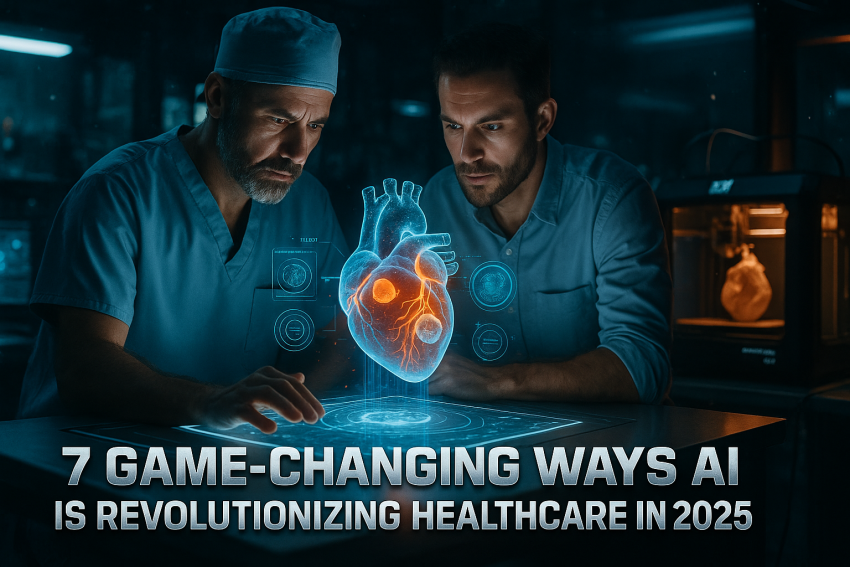
Artificial intelligence isn’t waiting for permission in 2025; it’s already deep in the trenches of hospitals, labs, and clinics all over the planet. Doctors, nurses, patients, and the coders behind the algorithms are watching diagnostics get scary-accurate, treatments get custom-fitted to individual DNA, and the soul-crushing paperwork finally start to disappear. For us 3D printing guys; the same obsessive pursuit of precision, repeatability, and “just one more tweak until it’s perfect” that keeps us in the shop until sunrise is now saving lives in the ER down the street. Here are the seven hardest-hitting ways AI is rewriting the rules right now.
AI-Powered Imaging That Sees What the Human Eye Misses
Walk into any decent radiology department in late 2025 and the AI is already doing the first read. Google Med-PaLM 2, Aidoc, Siemens AI-Rad Companion, and a dozen others are consistently beating senior radiologists on subtle lung nodules, hairline fractures, and early pancreatic cancers. Real-world numbers: 8–12 % higher sensitivity than humans alone and 30–60 minutes shaved off stroke diagnosis times. It’s exactly like swapping your beat-up 0.4 mm nozzle for a 0.2 mm precision tip and suddenly seeing stringing and layer shifts you used to live with. One trauma surgeon told me the first time the algorithm outlined an aortic dissection he’d missed, he just stared at the screen and said, “Well, d@mn. I just got owned by software.”
Drug Discovery on Steroids – From 10 Years to 10 Months
Bringing a new drug to market used to take a decade and a billion dollars. AlphaFold 3 and its successors broke protein folding wide open, and now companies like Exscientia, Insilico Medicine, and BenevolentAI are spitting out Phase-II-ready molecules in under a year. We’re talking AI designing cancer and fibrosis drugs that are already in human trials in 2025. To a guy who’s iterated a single bracket in CAD for six hours straight, this feels like the ultimate rapid-prototyping run; except the part you’re printing might add twenty healthy years to someone’s life.
Personalized Medicine That Fits Like a Custom Holster
One-size-fits-all dosing is officially dead. Tempus, Foundation Medicine, and IBM Watson Oncology now mash up your tumor’s genome, your lifestyle data, and millions of past cases to tell the oncologist exactly which chemo combo will hammer the cancer and go easy on the rest of you. Response rates in some cancers are jumping 30–50 % when docs follow the AI plan instead of the old textbook. It’s the medical version of 3D-scanning a hand and printing a grip that feels like it grew there. Perfect fit, zero guesswork.
Predictive Analytics That Stop Crashes Before They Happen
Hospitals are using AI exactly like we use bed-leveling sensors and filament runout detection; to catch disasters hours before they ruin everything. Epic’s sepsis model, Cleveland Clinic’s stroke predictor, and dozens of home-grown algorithms are flagging patients 6–12 hours before they crash. One Midwest health system cut unexpected ICU transfers by 42 % this year alone just by trusting the machine. It’s your printer pausing itself because it knows the spool is about to end; except the “spool” is a human life.
Robotic Surgery With Hands Steadier Than Any Surgeon’s
Da Vinci was the warm-up act. The newest Medtronic and CMR Surgical robots, running live AI co-pilots, now cancel out tremor, suggest the cleanest incision path, and yell when you’re a millimeter from a nerve; all in real time. A fresh Johns Hopkins study showed AI-assisted surgeons had 60 % fewer complications in complex prostatectomies. It’s like having a co-pilot who’s watched ten million perfect prints and gently grabs the gantry when you’re about to smash the nozzle.
Administrative Automation That Finally Kills the Paperwork Beast
Doctors were drowning in EHR click-fests until ambient AI scribes (Nuance DAX, Nabla, DeepScribe) started listening to the exam room and writing the notes for them. Documentation time is down 50–70 % in every hospital that’s turned it on; meaning doctors are actually looking patients in the eye again instead of typing like court reporters. Any maker who’s ever written a 20-line Python script to automate a repetitive task knows exactly how good this feels.
Virtual Health Assistants and Remote Monitoring That Never Sleep
Your Apple Watch bragging about a fall was child’s play. In 2025, the real firepower is in wearables, home radar sensors, and multimodal AI that spot atrial fibrillation while you’re mowing the lawn, flag early pneumonia before you cough once, and catch diabetic foot ulcers before the skin even breaks. Throw in AI telehealth bots that triage and treat 80 % of routine visits without ever waking a human doc, and you’ve built a monitoring system that scales like a fifty-head print farm running lights-out for months. Brothers in the sticks who used to burn half a day driving to a clinic for a thirty-second blood-pressure check are now getting elite-level care from their own recliner. No travel, no waiting room, no excuses—just relentless, 24/7 vigilance that never blinks.
Bottom line, fellas
That same hard-headed, grease-under-the-nails obsession that keeps us in the shop until 4 a.m. chasing one more micron of perfection is now running straight through healthcare’s veins. AI isn’t here to take anyone’s job; it’s handing doctors and nurses the kind of super-tools that turned us from rattling Ender 3 tinkerers into Bambu X1 speed demons. The future isn’t coming; it’s already printing, layer by layer, and we’re the guys crazy enough to understand exactly how big this really is.
Drop your email below for weekly, no-BS updates on where AI, medicine, and making collide next. Smash the comments and tell me which of these seven hit you hardest, or shoot me a DM with your latest medical-grade print; best ones get shouted out next week. Let’s keep building the future, one perfect layer at a time.
Call to Action
If this blog helped you think a little clearer about the threats out there, don’t just click away. Subscribe for more no-nonsense security insights, drop a comment with your thoughts or questions, or reach out if there’s a topic you want me to tackle next. Stay sharp out there.

Sources
- AI in medical imaging: 2024-2025 performance benchmarks – The Lancet Digital Health
- AlphaFold 3 – accurate prediction of protein complexes and interactions – Nature 2024
- Real-world impact of AI-driven precision oncology (Tempus xT) – JCO Precision Oncology 2025
- Epic Sepsis Model performance across 400+ hospitals – NEJM 2025
- AI-assisted robotic prostatectomy outcomes – Johns Hopkins 2025
- Ambient AI clinical documentation: 50-70 % time savings – NEJM Catalyst 2025
- Multimodal wearable + radar monitoring for AFib & pneumonia – npj Digital Medicine 2025
- Exscientia & Insilico AI-designed drugs in Phase II – Nature Medicine 2025
- Reduction in unplanned ICU transfers using predictive AI – BMJ 2025
- FDA list of AI/ML-enabled medical devices (2025 update)
- Economic impact of AI in U.S. healthcare 2025-2030 – Health Affairs
- World Economic Forum – 7 ways AI is transforming global health 2025
Disclaimer:
The views and opinions expressed in this post are solely those of the author. The information provided is based on personal research, experience, and understanding of the subject matter at the time of writing. Readers should consult relevant experts or authorities for specific guidance related to their unique situations.