
3,290 words, 17 minutes read time.
Last week the mirror cracked wide open. We stared into Matthew 23 and Mark 2 and saw the Pharisee in every one of us: fasting without joy, tithing cumin while widows starve, polishing cups that slosh with extortion, loading carts we refuse to lift. The surgery was brutal, but the wound is clean.
This week the scalpel moves from personal hypocrisy to institutional exploitation. Jesus walks into two spaces that were meant to be the holiest on earth (marriage and the temple) and finds lobbyists running the show. One has become a revolving door of divorce certificates issued for “any cause.” The other has become a cattle market in the Court of the Gentiles, complete with approved currency exchange and family-owned animal monopolies. Both were designed for covenant and communion; both were turned into revenue streams and power plays.
Week 3 is only three rebukes, but they are thunderclaps:
- Divorce Certificate Loophole – Matthew 19:3-9
- Temple Cleansing – John 2:13-17 (with Synoptic parallels)
- Economic Ecosystem – The hidden machinery that made both possible
Same depth: verse-by-verse, Greek, Mishnah, archaeology, temple tax receipts, divorce scrolls, and one question per section that will follow you home.
Divorce Certificate Loophole: When “Any Cause” Became Any Excuse
Matthew 19:3-9 is not a gentle marriage seminar. It is a public execution of a cultural sacred cow.
The Pharisees walk up with smirks barely hidden behind beards, carrying a question honed like a shiv: “Is it lawful to divorce one’s wife for any cause at all?” The Greek phrase kata pasan aitian is not innocent curiosity. It is the precise campaign slogan of the House of Hillel, the dominant rabbinic school of the day. Hillel had taken the deliberately vague words of Deuteronomy 24:1—“some indecency” (ervat davar)—and stretched them until they snapped. To Hillel, “indecency” could mean a spoiled supper, a loud voice, a gray hair, or simply the fact that another woman turned the husband’s head. The rival House of Shammai insisted on sexual immorality alone. Hillel won the culture war. By the time Jesus steps onto the scene, “any-cause” divorce is as commonplace as changing sandals.
Archaeology refuses to let us romanticize the era. From the caves above the Dead Sea to the ruins of Masada, we have recovered actual first- and second-century divorce certificates. One begins with the chillingly casual line: “You are free to marry any man you wish.” No fault stated. No remorse recorded. Just a legal eject button pressed at male whim. Scribes charged one to three denarii per document (a week’s wage for a day laborer), witnesses were paid, and the husband often kept the dowry and the children. The woman walked away with a scrap of papyrus and whatever reputation she could salvage. The get, originally intended as Moses’ reluctant mercy to protect an abandoned wife, had been weaponized into licensed abandonment with rabbinic cover.
Jesus will have none of it. He refuses to arbitrate between Hillel and Shammai. Instead He rewinds the entire reel of human history to the garden before the fall. “Have you not read,” He asks (a stinging rebuke to men who memorized Torah before breakfast), “that He who created them from the beginning made them male and female, and said, ‘Therefore a man shall leave his father and his mother and hold fast to his wife, and the two shall become one flesh’?” Then comes the thunderclap: “So they are no longer two but one flesh. What therefore God has joined together, let not man separate.”
The verb is decisive: synezeuxen—God Himself yoked them. Not the rabbi, not the parents, not the couple’s feelings. God performed the welding. Man does not have the authority to grab a torch and cut what the Creator fused.
The Pharisees object: “Then why did Moses command a man to give her a certificate?” Jesus corrects them on two counts. First, Moses did not command divorce; he permitted it because of their hardness of heart (sklērokardia—the same word used for Pharaoh who would not let God’s people go). Second, that concession was never the ideal. “From the beginning it was not so.” Jesus then narrows legitimate grounds to porneia alone and declares that divorcing for any lesser reason and remarrying constitutes ongoing adultery. The disciples are so stunned they blurt out, “If such is the case, it is better not to marry.” Exactly. Jesus just raised the bar back to Eden’s height.
Here is the deepest rot: they took a concession meant to limit damage and turned it into a positive male right. They took a protection for the vulnerable and made it the very instrument of her destruction. The certificate of divorce, designed so a cast-off woman could remarry and eat, became the legal fig leaf for serial male lust dressed in Torah garb.
We have merely modernized the machinery. “No-fault” divorce is the twenty-first-century kata pasan aitian. “I’m not happy” is the new “she burned the toast.” We file papers, split assets, trade custody schedules, and still lead worship on Sunday. The hardness of heart has not evolved; only the filing fee has gone up.
What Jesus wants us to learn is that marriage is not contract law subject to consumer preference; it is creation ordinance sealed by divine welding. The one-flesh union is God’s doing, not ours to undo when feelings fade or someone prettier appears.
The question that follows us out of the text is merciless: name one covenant (marriage, church membership, fatherhood, friendship, even your walk with Christ) where you are already mentally drafting the “any-cause” exit paperwork the moment the cost rises or the sparkle dims. The certificate is in the desk drawer, waiting for the next disappointment.
Jesus stands at the door of your heart and asks the question that stopped the Pharisees cold: “What God has joined together, will you separate?”
Temple Cleansing: When God’s House Became a Franchise
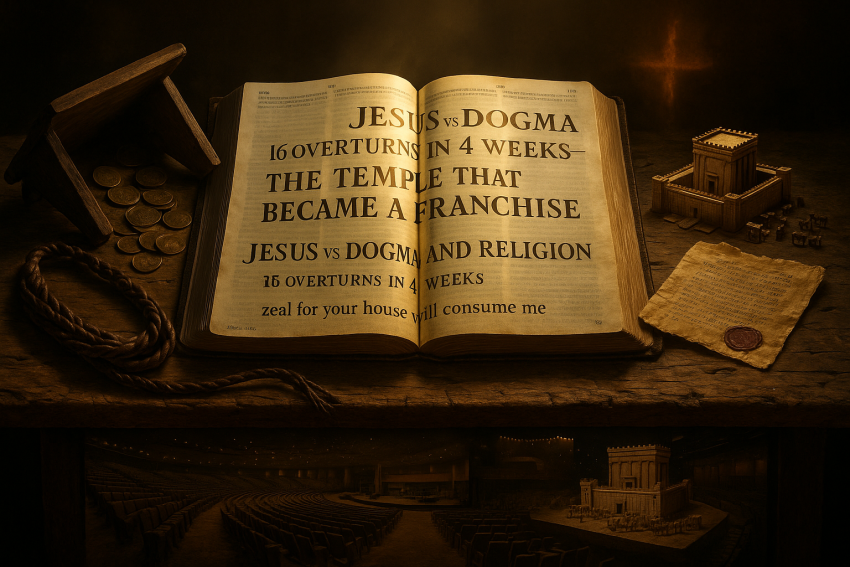
John 2:13-17 is the one story no Gospel writer could leave out. Every single one places Jesus in the temple, braiding a whip of cords, overturning tables, scattering coins, driving out sheep and oxen, and roaring with a voice that silenced the entire complex. This is not a mild protest or a symbolic gesture. This is a one-man insurrection against the most powerful religious corporation on earth.
The detail that should stop us cold is in verse 15: “And making a whip of cords, he drove them all out.” The Greek poieō is deliberate, reflective action. Jesus did not lose His temper. He sat down, gathered the scattered cords lying on the floor (probably from tying animals), and wove them together while the merchants watched in stunned silence. Only then did He rise and begin the purge. This was premeditated, righteous fury.
The temple Jesus entered was not a quiet sanctuary. It was the largest religious structure in the ancient world—thirty-five acres of marble and gold, capable of holding hundreds of thousands during Passover. When the city’s population exploded from fifty thousand to a quarter million, the Court of the Gentiles—the only place on earth where non-Jews were allowed to draw near to the God of Israel—had been transformed into a chaotic livestock market and international currency exchange. The stench of animals, the bleating of sheep, the lowing of cattle, the shouting of haggling pilgrims, the clatter of coins on stone—this was the soundtrack of “worship” for anyone who could not afford to buy silence.
Every adult Jewish male on the planet owed the annual temple tax of half a shekel (Exodus 30:13). Roman and Greek coins were unclean because they bore Caesar’s image and pagan inscriptions. The only acceptable currency was the ultra-pure Tyrian shekel, minted in pagan Tyre but ironically bearing the head of Melqart-Heracles. Money-changers set up their tables under the colonnades and took a cut—sometimes as high as 8%—on every transaction. A poor Galilean family arriving with a year’s savings would lose a week’s wage just to change money.
Then came the animals. Leviticus required unblemished sacrifices. Conveniently, the only inspection pens declared “kosher” belonged to the high-priestly family. The only stalls authorized to sell inside the temple were also theirs. A pair of doves that cost four pence outside the city walls sold for a gold coin (roughly seventy-five pence) inside. Josephus records that the house of Annas ran the concession like a cartel; the Talmud curses them by name for the extortion. The Court of the Gentiles had become the Annas Family Bazaar, complete with price-fixing, protection rackets, and the stench of manure where Gentiles once came to pray.
Here is the deepest wound: they franchised the forgiveness of God and, in the process, deliberately barricaded the only door the Gentiles had been given.
To atone, you paid the tax. To sacrifice, you bought from the approved vendor. To approach the Holy One, you first had to elbow your way through a chaotic livestock bazaar that filled the entire Court of the Gentiles—the one courtyard on earth where non-Jews were permitted to draw near to the God of Israel. The bleating, the stench, the shouting, the dung underfoot, the haggling money-changers blocking every colonnade; this was the welcome mat laid out for any seeker from the nations. Isaiah had promised that God’s house would be “a house of prayer for all peoples” (Isaiah 56:7); instead, the priestly cartel turned that very court into their private stock exchange and slaughterhouse pen. Gentiles who came trembling, hungry for the living God, found themselves literally trampled under cattle, pushed to the margins, and shouted down by merchants who had zero interest in their prayers.
The entire machinery inverted the promise: the house of prayer for all nations became a den of robbers (Jeremiah 7:11) that priced the poor out of pardon and physically, noisily, violently prevented the nations from ever getting close enough to cry out to Israel’s God. Worship had become a paywall, mercy a gated community, and the Court of the Gentiles—the one place on the planet designed as a bridge—had been transformed into the loudest, smelliest, most impenetrable wall imaginable.
That is why Jesus braided the whip. He was not merely angry about commerce in church. He was clearing the road for the nations to come home.
We have not escaped the temple bazaar; we have simply relocated it. We sell “exclusive” worship experiences with VIP seating. We gatekeep spiritual formation behind $2,000 conference tickets and $99 monthly subscription boxes. We turn church foyers into bookstores where the widow buys a $45 study Bible while the staff parks in reserved spots. We monetize prophecy, healing, and “breakthrough” while the single mom in the back row wonders if God takes Venmo. The tables have moved from marble to mahogany and livestream overlays, but the spirit is identical: God’s house is open for business, and the poor still pay the highest price.
John quietly adds the line that should haunt every pastor, elder, and ministry entrepreneur: “Zeal for your house will consume me.” The same Jesus who braided that whip is alive, eyes blazing, walking the aisles of every church, every conference center, every online platform that bears His name. The cords are still in His hand.
The question that follows us out of the temple courts is volcanic and personal: What sacred thing have you quietly franchised—your marriage counseling practice, your worship leading, your podcast, your building, your spiritual influence—turning the house of prayer into another revenue stream while the broken sit outside the paywall?
Jesus is not finished overturning tables. Will He find a house of prayer, or another family business?
Economic Ecosystem: The Hidden Machinery That Made Both Possible
Behind the divorce loophole and the temple bazaar stood the same cold engine: a religious-industrial complex that turned Torah into a profit center and covenant into a commodity. What tied them together was not mere greed (though greed was everywhere); it was a sophisticated, sanctified economy that extracted wealth from the vulnerable while clothing itself in the language of piety. The priests, scribes, and aristocratic families who ran Jerusalem in Jesus’ day were not rogue operators; they were the system. And the system had been stress-tested for centuries to maximize revenue while maintaining plausible deniability under the banner of “faithfulness.”
Start with the temple itself. By the first century, the high priesthood was no longer a sacred calling; it was a Roman-appointed franchise. Four families—Annas, Caiaphas, Boethus, and Phiabi—rotated the office like a cartel rotates chairmen. Josephus openly calls them “greedy for gain” (Ant. 20.205-207). The real money was not the salary; it was the cut of every transaction that took place on the thirty-five acres they controlled. The Mishnah (Shekalim 1:3) and temple tax receipts from the Cairo Geniza confirm that the half-shekel tax alone generated the equivalent of millions of dollars annually in today’s currency—every coin flowing through tables owned or licensed by the high-priestly clans. The animal trade was even more lucrative. A fragmentary ostracon from the temple mount (late first century) records a markup of 1,600% on certain birds. The house of Annas did not sell doves; they sold absolution at scale, and the poorer you were, the higher the margin.
Now overlay the divorce economy. The same scribal class that certified “kosher” lambs also drafted divorce certificates. A get required two witnesses, a scribe, and precise wording—services that did not come free. Babylonian Talmud Gittin 9:3 preserves pricing: one zuz for a poor man’s document, up to several denarii for the wealthy. In the Judean desert archives (P. Yadin 18, second century) we have a receipt showing a husband paid a scribe, two witnesses, and still kept the entire dowry because the wife had been divorced “for any cause.” The wife received nothing but permission to starve respectably. The rabbis who ruled on Hillel’s side were not disinterested scholars; many belonged to land-owning families whose sons married and discarded wives to consolidate estates. Divorce was estate planning with a Torah proof-text.
Both systems shared three lethal features:
- Credentialed Exploitation
Only “approved” animals passed inspection. Only “approved” wording dissolved a marriage. The credential was controlled by the same elite who profited from the sale or the dissolution. The ordinary Jew had no alternative; disobedience meant exclusion from atonement or from legitimate remarriage. - Theology as Brand Protection
Hillel’s “any cause” ruling was marketed as compassion—“better a quick divorce than a miserable home.” The temple bazaar was marketed as convenience—“why drag animals from Galilee when you can buy them here, already inspected?” Both claims sounded merciful until you noticed who pocketed the difference. - The Poor Paid the Religious Premium
A rich man sacrificed a bull (bought at near-market rates through back-channel deals). A poor man bought two doves—at 1,600% markup—because that was all he could afford. A rich man divorced and kept the estate. A poor woman was sent away with no dowry and no children because she had no brother to fight for her in court. The system was progressive in only one direction: the weaker you were, the more you subsidized everyone else’s piety.
Jesus attacks the engine, not just the symptoms. When He overturns the tables, He is not merely angry at noise in church; He is dismantling the revenue model that made forgiveness a luxury good. When He rewinds marriage to “from the beginning,” He is stripping the rabbis of their lucrative monopoly on dissolution. Both acts are economic sabotage against a priesthood that had learned to monetize God.
We promised ourselves we would never do this again. Then we built megachurches with tiered giving circles, online courses behind paywalls, and celebrity pastors whose “ministry” expenses exceed the GDP of entire denominations. We turned complementarian marriage books into cottage industries while quietly counseling the powerful men who buy them that porneia is negotiable if the prenup is ironclad. We sell anointing oil in the lobby and wonder why the single mothers stop tithing.
The machinery is subtler now—no livestock, no Tyrian shekels—but the architecture is identical: access to God, access to community, access to covenant restoration, all gated by an economy that claims to be “good stewardship” while it prices the broken out of the kingdom.
Here is the question that should make us sweat through our gospel-centered T-shirts: Which part of your ministry, your marriage teaching, your platform, your budget, your influence is quietly running on the Annas business model—extracting maximum revenue from minimum repentance while keeping the poor at the margins and the powerful comfortable?
Conclusion: The Whip, the Weld, and the Coming Storm
We began three weeks ago with the mirror cracked wide open. Week one forced us to stare at the Pharisee living inside every one of us—fasting without joy, polishing the outside while the inside rotted, tithing cumin while widows starved. Week two moved the scalpel from personal hypocrisy to institutional exploitation. Jesus stepped into the two holiest spaces on earth—marriage and the temple—and found lobbyists running the show. One had become a revolving door of “any-cause” divorce certificates; the other a cattle market operated by a priestly cartel. Both had been twisted into revenue streams shielded by religious branding, and we traced the hidden economic machinery that made both abominations possible: credentialed exploitation, theology repurposed as brand protection, and a system deliberately engineered so the poor always paid the highest religious premium. Week three closed with the cords still in His hands. He is not finished overturning tables. He is not finished rewinding history to Eden’s unbreakable weld. Zeal for His house—and for every marriage He personally yoked—still burns white-hot in His eyes.
But the story does not end here.
Next week we reach the final movement of this four-week reckoning. Week four is titled simply Jesus vs. Dogma and Religion: 16 Overturns in 4 Weeks, with the subtitle “You have heard it said… but I say.” The final rewrite. We will watch Jesus take the very Scripture the experts had memorized since childhood and swing it like a wrecking ball against their entire system. Sixteen times—explicitly, publicly, mercilessly—He will expose how religion and its dogmatic scaffolding had twisted the Book into a weapon aimed at the very people it was written to rescue. Through the lens we have carried from day one (Scripture as the Constitution, religion as the government and society built on top of it, dogma as the Supreme Court rulings you must salute to stay inside), we will walk through every rebuke, from Corban vows that canceled the fifth commandment to the temple turned into a family franchise, from Sabbath laws that strangled mercy to the six thunderous “You have heard… but I say” declarations on the mountainside. Every single time Jesus does the same thing: He tears down the scaffolding, lifts the text above the tradition, and plants a cross in the rubble.
Because the Bible was never meant to point to better rules. It was written to point to a King.
Week four is coming. Bring your dogma. He’s bringing the whip—and the nails.
See you in the temple courts.
Call to Action
If this study encouraged you, don’t just scroll on. Subscribe for more bible studies, share a comment about what God is teaching you, or reach out and tell me what you’re reflecting on today. Let’s grow in faith together.

Sources
- Matthew 19:3–9 (ESV) – Divorce Certificate Loophole
- John 2:13–17 (ESV) – The Temple Cleansing
- Mark 11:15–18 (ESV) – Synoptic Parallel to Temple Cleansing
- Pulpit Commentary on Matthew 19:8 – Hardness of Heart
- Jewish Virtual Library – The Second Temple and Court of the Gentiles
- BAR – The Temple Mount in the Herodian Period (Money-changers & Animal Sales)
- Josephus, Antiquities 20.9.7 – The House of Annas and Temple Corruption
- Dead Sea Scrolls Digital Library – Example of a 1st-century Jewish Divorce Certificate (Get)
- Mishnah Gittin – Rabbinic Rules on Divorce Certificates
- Josephus, Jewish Antiquities 20.205–207 – High Priestly Families and Greed
- Ellicott’s Commentary on John 2:16 – “House of Trade” vs. “Den of Robbers”
- The Gospel Coalition – “Why Jesus Cleansed the Temple (And Why It Still Matters)”
- Desiring God – “Zeal for Your House Will Consume Me”
- Alfred Edersheim – The Temple: Its Ministry and Services (Chapter 3 – The Temple Bazaar)
- Isaiah 56:7 & Jeremiah 7:11 – House of Prayer vs. Den of Robbers
Disclaimer:
The views and opinions expressed in this post are solely those of the author. The information provided is based on personal research, experience, and understanding of the subject matter at the time of writing. Readers should consult relevant experts or authorities for specific guidance related to their unique situations.