
3,482 words, 18 minutes read time.
Last week we watched Jesus dismantle four traditions that rewrote Scripture’s plain commands—Corban vows that starved parents, hand-washing rituals that excluded neighbors, Sabbath rules that withheld healing, and grain-plucking bans that criminalized hunger. The pattern was clear: human fences built to protect the law had become cages that imprisoned the very people God sent it to serve. Jesus performed open-heart surgery, restoring the law’s telos: human need always trumps ritual.
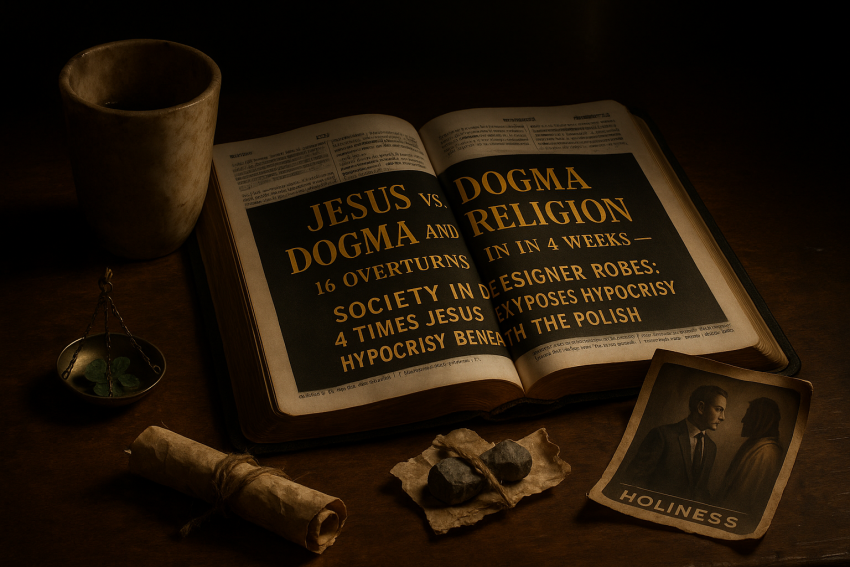
This week we shift from overwriting to outward masking. The Pharisees’ robes are pristine, their prayers public, their tithes exact—but beneath the designer fabric is a rotting core. In four confrontations Jesus peels back the polish to reveal greed, neglect, and control masquerading as piety. My framework remains the same: Scripture is the Constitution, religion the society that grows around it, dogma the amendments we elevate to equal authority. I work from the ESV, with Greek lexical tools (BDAG, Strong’s) and historical-grammatical method—Christ-centered, practically aimed at men who bear weight in homes, workplaces, and congregations.
Fasting Debate: When Mourning Replaces Joy
We open Week 2 in Mark 2:18-22, a scene charged with unspoken accusation. John the Baptist’s disciples and the Pharisees are fasting—nēsteuontes, a public discipline of mourning and repentance. Jesus’ disciples, meanwhile, are feasting. The question comes sharp: “Why do John’s disciples and the disciples of the Pharisees fast, but your disciples do not fast?” (verse 18). The Greek dia ti is not casual curiosity; it is a legal challenge—a demand for justification under covenant norms.
The cultural backdrop is critical. Fasting was not commanded in the Torah except on the Day of Atonement (Leviticus 16:29-31), but by the first century it had become a Pharisaic badge of piety. Zechariah 8:19 lists four national fasts commemorating Jerusalem’s fall; the tradition expanded these into twice-weekly fasts (Monday and Thursday, per Didache 8:1 and t. Ta’anit 2:9). Public fasting was theater: disheveled hair, unwashed faces, ashes on the head—visible proof of covenant zeal. Archaeological evidence from Masada and Qumran shows fasting calendars etched into community life. The Pharisees weren’t wrong to mourn Israel’s exile; they were wrong to make mourning the permanent posture while the Bridegroom stood in their midst.
Israel was fasting in mourning and missing the point. They wept for a kingdom they believed was still lost, a glory still delayed. Their twice-weekly fasts were a perpetual funeral for a Messiah who hadn’t come. But Jesus steps into the middle of their dirge and declares: “The Bridegroom is here. The wedding has started. Stop the funeral.” They were fasting in the wrong key—old wineskin: “God has abandoned us.” New wine: “God has arrived in person.” That’s why His question in verse 19 devastates: “Can the wedding guests fast while the bridegroom is with them?” It’s not just a rebuke—it’s a revelation. The exile is over. The banquet has begun. The kingdom isn’t delayed—it’s dancing in their midst. And they missed it, not because they didn’t know the Scriptures, but because they knew them without recognizing the Bridegroom.
Jesus answers with three rapid-fire images, each dismantling the old system:
- The Bridegroom (verses 19-20): Mē dynantai hoi huioi tou nymphōnos… nēsteuein?—“Can the wedding guests fast while the bridegroom is with them?” The huioi tou nymphōnos are the groom’s intimate companions, bound to celebrate. Fasting at a wedding was unthinkable—m. Ta’anit 4:7 forbids it. Jesus identifies Himself as the eschatological Bridegroom (Isaiah 62:5; Hosea 2:19), inaugurating the messianic banquet. The days of mourning are over; joy has arrived.
- The Patch (verse 21): No one sews unshrunk cloth on an old garment—rhakos agnaphos (raw, unfulled cloth) will tear away when washed, worsening the rip. The old covenant’s mourning garment cannot contain the new wine of kingdom joy.
- The Wineskins (verse 22): New wine (oinos neos) bursts old skins (askous palaious). The Greek pimplēsin (to fill) echoes the Spirit’s outpouring (Acts 2:4). The old system of perpetual penance is incompatible with the new covenant’s exuberance.
What Jesus wants us to learn is a paradigm shift from penitential posture to celebratory presence. For Jews, this obliterates the Pharisaic calendar that turned every week into Lent. For Gentiles—Mark’s audience—it models a faith where joy is not a reward for discipline but the atmosphere of the kingdom. The Bridegroom’s presence demands feasting, not fasting—until He is “taken away” (aparthe apo autōn, verse 20), a veiled passion prediction. After the ascension, the disciples did fast (Acts 13:2-3; 14:23)—but never in mourning, only in mission. Their fasting was occasional, Spirit-led, and forward-looking, not a return to the old garment of sorrow. For us, the diagnostic is brutal: identify one religious practice you perform in a spirit of mourning or scarcity—a fast you keep to prove devotion, a budget you pinch to appear disciplined, a schedule you overload to signal sacrifice. Ask: Is the Bridegroom at this table? If your faith feels like perpetual Lent, you’re still wearing the old garment. The new wine is here. Drink.
Tithing Herbs: When Precision Neglects Justice
We move to Matthew 23:23-24, the third of Jesus’ seven woes against the scribes and Pharisees. The air is thick with judgment; Jesus has already called them whitewashed tombs and children of hell. Now He zeroes in on their micro-tithing: “Woe to you, scribes and Pharisees, hypocrites! For you tithe mint and dill and cumin, and have neglected the weightier matters of the law: justice and mercy and faithfulness” (verse 23). The Greek apodekatoute is present tense—they are actively counting out one-tenth of every garden herb.
The practice had no direct Torah command. Deuteronomy 14:22-23 mandates tithing grain, wine, oil, and firstborn livestock—agricultural staples. But by the first century, Pharisaic halakhah extended this to every edible plant, even kitchen spices. Mishnah Ma’aserot 1:1 lists mint (hēdyosmon), dill (anēthon), and cumin (kyminon) as titheable; m. Demai 2:1 requires tithing even doubtful produce. Archaeological finds from the Burnt House in Jerusalem reveal tiny clay jars labeled for tithe portions—evidence of a system obsessed with decimal precision. The Pharisees weren’t stealing; they were scrupulous to a fault.
Here is the deeper wound: they tithed the garden to avoid tithing to support their neighbor. The Torah’s tithe was never about the percentage—it was about people. Deuteronomy 14:28-29 commands a triennial tithe for the Levite, the sojourner, the fatherless, and the widow—the tithe was bread on their table, not coins in the treasury. By obsessing over cumin seeds, the Pharisees weaponized obedience to dodge the messy, costly, relational demands of justice, mercy, and faithfulness. A sprig of mint fits neatly in a jar; a widow does not. A pinch of dill can be weighed; an orphan cannot. The tithe had become a substitute for love, a way to say “I gave at the temple” while the vulnerable starved at the gate.
We do the same with taxes and government programs. We write the check, pat ourselves on the back for “caring for the poor,” then walk past the single mom in our pew who can’t pay rent. The system lets us outsource mercy—a bureaucratic camel we swallow while straining out the gnat of personal involvement. Programs can feed bodies but enslave dignity when they replace the hands-on, face-to-face justice God demands. Jesus isn’t against systems; He’s against systems that let us tithe herbs while the neighbor bleeds.
Jesus does not condemn the tithing—He says, “These you ought to have done”—but exposes the deadly inversion. The Greek ta barytera tou nomou (“the weightier matters of the law”) echoes Hosea 6:6 and Micah 6:8: mishpat (justice), hesed (mercy), pistis (faithfulness). These are not add-ons; they are the torso of the Torah. Tithing herbs while widows lose homes, orphans go hungry, and foreigners are scorned is straining out a gnat while swallowing a camel (diylizontes ton kōnōpa, tēn de kamēlon katapinontes, verse 24). The image is grotesque: a man meticulously filtering wine for a tiny insect (Leviticus 11:23) while gulping down a carcass. Precision without proportion is perversion. The camel is not the tithe; the camel is the neighbor crushed under the cart of your piety.
What Jesus wants us to learn is proportional obedience: the whole tithe includes justice, mercy, and faithfulness, not just the measurable 10%. For Jews, this guts the Pharisaic ledger that equated covenant fidelity with ledger entries. For Gentiles—Matthew’s audience—it models a faith where love is the fulfillment of the law (Romans 13:10). The kingdom is not a spreadsheet; it’s a table where the orphan eats first. For us, the diagnostic is surgical: identify one area where you are scrupulously precise—budgeted giving, church attendance, Bible-reading streak, screen-time limits—while neglecting a weightier matter. Do you tithe your income but ignore the single mom in your small group? Track your quiet time but tune out your spouse’s cry for help? The gnat is not the discipline; the camel is the person you filter out. Jesus says: do both—tithe the mint, but don’t leave justice undone. Your tithe is not complete until the widow’s table is full.
Clean Cup: When Outside Shines, Inside Festers
We stay in the furnace of Matthew 23, now at verses 25-26—the fifth woe. Jesus’ voice is white-hot: “Woe to you, scribes and Pharisees, hypocrites! For you clean the outside of the cup and the plate, but inside they are full of greed and self-indulgence. Blind Pharisee! First clean the inside of the cup and the plate, that the outside also may be clean.” The Greek harpage is not mild “greed”—it is robbery, plunder, extortion (BDAG: “violent seizure of property”). Akrasia is unrestrained appetite, the same word Paul uses for gluttony and sexual excess (1 Corinthians 7:5). The cup is not just dirty; it is stolen goods sloshing inside a polished shell.
The image is domestic and devastating. First-century homes displayed gleaming stoneware—archaeological digs in the Herodian quarter of Jerusalem uncover alabaster cups polished to a sheen, symbols of status and purity. But Jesus flips the table: the vessel can sparkle while the contents rot. The Pharisees scrubbed the exterior with ritual washings (baptizontai, v. 25) but never touched the heart. Their “clean” hands had just signed foreclosure papers on widows’ houses (v. 14). Their “pure” lips had just devoured the poor under the guise of long prayers. Outside: Instagram holiness. Inside: financial predation.
Here is the deeper rot: they polished their image to hide their plunder. The same men who tithed cumin seeds were devouring widows’ estates through legal loopholes—corban again, or “devoted to God” trusts that stripped inheritance while they collected fees as trustees. Josephus (Antiquities 20.9.1) records high priests sending thugs to seize tithes from threshing floors; the cup was clean because the blood was on the inside.
We do the same with social media and personal branding—the modern alabaster cup. We curate the feed: Bible verse overlays, gym check-ins, mission trip selfies—while inside the cup is rage-scrolling, porn, or quiet resentment toward the spouse we just posted about. We build platforms on “transparency” but monetize outrage. We lead men’s groups on integrity while hiding the affair. And then there’s the Meme Pastor: a profile plastered with “Holiness” graphics, fire emojis, and viral soundbites—all shine, no substance. The algorithm rewards the polish; Jesus demands the scrub on the inside.
But the wound cuts deeper still: the cup is not just dirty—it is the very instrument of the robbery. The Pharisees used piety as the tool of predation. Their public prayers were cover for extortion (v. 14). Their tithing jars were alibis for theft. The cup is not neutral; it is weaponized holiness. The outside is not merely false—it is strategic deception. They did not sin in spite of their religion; they sinned through it.
What Jesus wants us to learn is integrity from the inside out. For Jews, this guts the Pharisaic façade that equated external purity with covenant standing. For Gentiles—Matthew’s audience—it models a faith where character is the cup, not the filter. The Greek prōton katharison (“first clean”) is a command of sequence and substance—the inside determines the outside, never the reverse.
For us, the diagnostic is merciless: name one public image you polish—your marriage posts, your leadership title, your giving receipts, your Meme Pastor feed—while a private vice festers. Do you preach generosity but hoard inheritance from aging parents? Teach sexual purity but consume lust in secret? The cup is not clean until the greed is gone. Jesus says: scrub the inside first. Only then will the outside stop lying.
But go further: is your piety the very tool of your sin? Do you use your small group to network while ignoring the broken man beside you? Do you leverage your “ministry” to avoid your family? The cup is not just dirty—it is the weapon. Jesus does not want a better filter; He wants a new heart. The only way the outside becomes clean is when the inside is emptied of plunder and filled with Him.
Heavy Burdens: When Leaders Load, Never Lift
We end Week 2 at the opening salvo of Matthew 23:2-4, where Jesus sets the stage for the entire indictment: “The scribes and the Pharisees sit on Moses’ seat, so do and observe whatever they tell you, but not the works they do. For they preach, but do not practice. They tie up heavy burdens, hard to bear, and lay them on people’s shoulders, but they themselves are not willing to move them with their finger.” The Greek phortia dysbasta kta is brutal—burdens impossible to lift. Basta zō means “to carry”; dys- negates it. These are not guidelines; they are crushing loads.
“Moses’ seat” was literal—stone chairs in synagogues where teachers sat to expound Torah. The Pharisees had inherited authority but abandoned the heart. By Jesus’ day, the oral law had ballooned to 1,500+ Sabbath regulations alone (m. Shabbat 7:2–24:5): you could not carry a needle, spit on dirt (it made mud = plowing), or rescue a sheep unless you left one leg in the pit. The Mishnah records debates over whether a tailor could carry his needle home on Friday dusk—precision that paralyzed. The average Jew was buried under rules he could never keep, while the Pharisees walked free because they wrote the exceptions.
Here is the deeper rot: they used authority to control, not to carry. The burden was not the law—it was law without love. They loaded the cart with 613 commandments plus thousands of fences, then stood back and watched men stagger. The Greek kinēsai autōn tō daktylō (“move with their finger”) is contemptuous—not even a pinky to help. They were spiritual slave-drivers, cracking the whip of “holiness” while the people bled under the weight.
We do the same in church covenants and leadership culture—and the rot spreads to society and government. We draft 27-page membership agreements, mandate serving rotas, enforce dress codes, and gatekeep communion—then call it “discipleship.” We load young couples with “biblical manhood” seminars but won’t babysit so they can attend. We demand tithing from the unemployed but won’t open the benevolence fund. The burden is the point—it keeps people small, dependent, and under our thumb.
But look wider: government piles on the same cart. We pass 1,000-page tax codes no citizen can read, then jail the single dad who misses a form. We mandate licenses for hair braiders while bureaucrats collect six-figure salaries. We criminalize feeding the homeless without a permit, then pat ourselves on the back for “public safety.” The state becomes the new Pharisee—sitting in the seat of power, writing rules it never lifts, crushing the vulnerable under regulatory weight while exempting the connected.
And the rot is personal. We’ve all seen the man on three divorces—serial covenant-breaker—posting on the church Facebook page: “God hates pride flags. Repent or burn.” 🔥🏳️🌈 He loads the LGBTQ+ community with a burden he refuses to carry himself: lifelong fidelity. He demands from strangers what he never delivered to his own spouses. The finger that types the condemnation has signed three divorce decrees. This is not leadership; it is projection with a Bible filter.
Jesus demands more from leaders—and judges them harder. Luke 12:48: “Everyone to whom much was given, of him much will be required.” James 3:1: “Not many of you should become teachers, my brothers, for you know that we who teach will be judged with greater strictness.” The Pharisees sat in Moses’ seat—higher platform, heavier reckoning. They will receive the greater condemnation (Matthew 23:14). Power is not privilege; it is stewardship under fire.
What Jesus wants us to learn is leadership that lifts, not loads. For Jews, this guts the Pharisaic hierarchy that turned Moses’ seat into a throne. For Gentiles—Matthew’s audience—it models a faith where authority serves, never subjugates. The Greek phortia echoes Galatians 6:2—bear one another’s burdens—but the Pharisees inverted it.
For us, the diagnostic is brutal: name one rule you enforce—church, home, ballot box, or social media—but refuse to help carry. Do you require your kids to memorize Scripture but won’t sit with them when they fail? Demand your team hit KPIs but won’t cover a shift when a child is sick? Vote for policies that bury the poor in red tape but never volunteer at the food bank? Post against “sexual sin” while your own marriage certificate is a revolving door? The burden is not the standard; the burden is the refusal to lift. Jesus says: if you sit in any seat of power, get under the cart. The kingdom—and any just society—is not built by breaking backs; it is built by broken leaders who carry. The higher the seat, the heavier the judgment if you load and never lift.
Conclusion
Researching this week gutted me—and I’m not alone. Like so many others, I dove in ready to nail the Pharisees to the wall, only to stare into their polished stoneware and see my own face staring back—the Pharisee I’ve been all along. I’ve always heard that Scripture is a double-edged sword (Hebrews 4:12), and Paul warned it cuts both ways—now I know it firsthand. I thought I was writing about them; turns out I was writing about me. The mirror didn’t flatter any of us. It exposed the same rot: the polished posts, the precise rules, the burdens I load while refusing to lift. I am the Pharisee in designer robes.
Week 2 has been a mirror held to the face of designer-robed religion—polish on the outside, plunder within. We began with the Fasting Debate (Mark 2:18-22): Pharisees mourned a kingdom they thought was lost while the Bridegroom danced in their midst; Jesus shattered the old wineskin of perpetual Lent, demanding joy in His presence. We moved to Tithing Herbs (Matthew 23:23-24): they counted cumin seeds to avoid feeding widows, weaponizing precision to dodge justice; we do the same when we outsource mercy to taxes and programs that enslave dignity.
Then came Clean Cup (Matthew 23:25-26): gleaming stoneware hiding harpage and akrasia—extortion and excess; the Meme Pastor curates “Holiness” graphics while rage-scrolling porn, using piety as the very tool of predation. Finally, Heavy Burdens (Matthew 23:2-4): leaders in Moses’ seat loaded impossible carts—1,500 Sabbath rules, 27-page covenants, 1,000-page tax codes—then refused to lift a finger; the thrice-divorced man condemns the LGBTQ+ community on church social media, demanding fidelity he never gave.
Across all four, the pattern is lethal inversion:
- Joy becomes mourning.
- Justice becomes ledger entries.
- Purity becomes predation.
- Authority becomes abuse.
Jesus does not abolish discipline; He restores its direction—from outward performance to inward transformation, from control to carrying. The cup must be scrubbed inside first. The cart must be shouldered by the leader, not the led. The higher the seat, the heavier the judgment (Luke 12:48; James 3:1).
For us, the audit is ruthless: name one polished practice—fast, tithe, post, or policy—where you load but never lift. The kingdom is not a stage for Meme Pastors; it is a table where the broken eat first. Jesus is still flipping carts, scrubbing cups, and shouldering burdens. Get under the load, or get out of the seat.
Call to Action
If this study encouraged you, don’t just scroll on. Subscribe for more bible studies, share a comment about what God is teaching you, or reach out and tell me what you’re reflecting on today. Let’s grow in faith together.

Sources
Disclaimer:
The views and opinions expressed in this post are solely those of the author. The information provided is based on personal research, experience, and understanding of the subject matter at the time of writing. Readers should consult relevant experts or authorities for specific guidance related to their unique situations.