
1,474 words, 8 minutes read time.
I still remember that day like it was yesterday, though decades have passed and my hands bear the marks of work I once thought defined me. I was just a boy then—Nathaniel—walking along the dusty shores of Galilee, following a man whose words stirred something deep inside me—words that promised more than I thought I deserved. I didn’t know it then, but I was about to witness something that would crack open the hard shell of pride I carried, even at twelve.
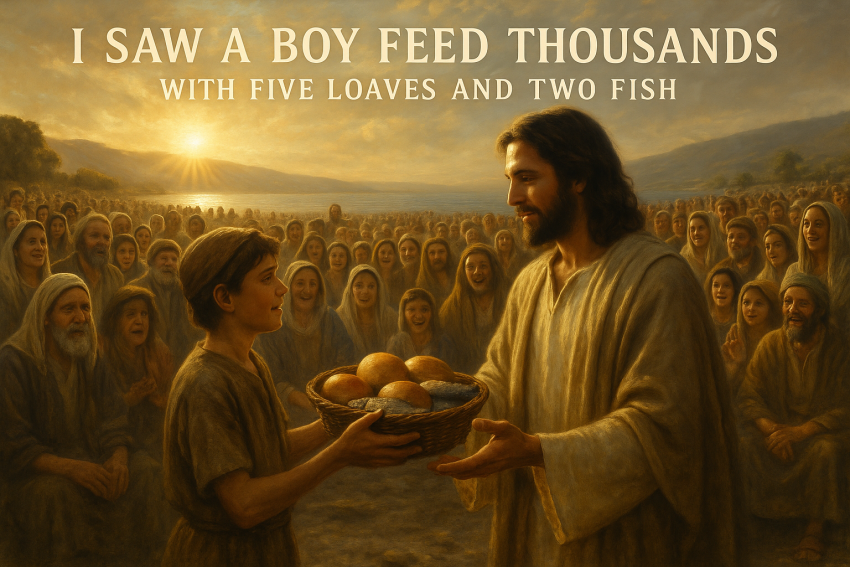
The crowd was massive, pressing around Jesus with a hunger that went beyond food. Men, women, and children jostled one another, their faces grim, their stomachs empty. And I—well, I had always thought I needed to prove myself, to measure up. My father’s stern voice haunted me, reminding me that my worth came from work, strength, and achievement. And there I was, powerless, clutching five loaves of bread and two small fish I had brought from home, thinking they were hardly enough to feed anyone—let alone thousands.
The disciples were tense. I overheard them muttering, complaining about the impossible task before them. They were clever, educated in the Torah, experienced in life, yet they couldn’t see past the sheer impossibility of feeding such a crowd. And me? I had nothing to lose. I didn’t know what would happen, but I couldn’t hide—not from Him, not anymore.
Jesus looked at me. His eyes were patient, quiet, piercing in a way that made me feel like He could see straight into my heart—the pride I clung to, the fear I masked, the loneliness I tried to cover with clever words and obedience that was more for show than love. “Bring them here to me,” He said, and somehow, despite the chaos, His voice cut through.
I stepped forward, clutching my basket as if it held the weight of the world. The disciples whispered among themselves, probably thinking a boy had no place here. I felt small, ridiculous. But Jesus took the loaves and fish from my hands. He looked to heaven and gave thanks. And then—He broke them. Pieces fell into the hands of the disciples, who distributed them to the crowd.
And something happened that defies logic. The bread multiplied. The fish multiplied. Every single person—thousands of them—ate until they were full. And when it was over, there were even leftovers. Twelve baskets full. From five loaves and two fish. I didn’t understand it then, and I don’t fully understand it now. But I remember the tightness in my chest, as if God had squeezed the part of me that thought I had to earn His favor by being strong, by hiding weakness, by pretending I was enough.
Men struggle with pride. They think control, strength, and self-reliance are the measures of their worth. I know this well. I spent years trying to prove I could carry everything on my own, trying to hide my fear, my mistakes, my shame. That day, watching a boy’s small offering become enough for thousands, I realized pride isn’t strength—it’s blindness.
I remember Simon the fisherman, grumbling under his breath because he couldn’t understand what he had just seen. He had wrestled with the sea his whole life, trusted only in nets and brawn. And yet, he too had to reckon with the reality that God could provide in ways he could never force or control. I see that same stubbornness in men today—the ones who think success is measured by what they own, the battles they’ve won, the control they exert. And I tell them the same truth I was slowly learning: you cannot make your own miracle. You can only offer what you have and let God do the rest.
The boy didn’t boast. He didn’t announce that he had bread and fish. He simply offered what he had. And in that simple act, the kingdom of God revealed itself. I watched men eat until their bellies were full, children laughing with crumbs on their lips, women quietly marveling at what they had just seen. I, too, marveled—not because I understood the mechanics, not because it made sense, but because it revealed a truth I was only beginning to grasp: humility and obedience can change the world. Even if you are small, even if your offering seems insignificant, God can use it.
I wish I could say that moment fixed me—that I left the crowd with a pure heart, unshakable faith, and freedom from the chains of pride and fear. I didn’t. I walked home that evening, tired, my stomach empty because I hadn’t eaten, my mind racing with thoughts about how I had to measure up, how I still had to earn approval, how I still feared vulnerability. But there was a seed planted, one I didn’t recognize fully until decades later. The memory of that boy, and of Jesus, would surface in the quiet moments of my life when pride whispered too loudly.
Even now, I wrestle with my flaws. I still want to control, to be self-reliant, to hide the parts of me that are messy and broken. But the memory of that day reminds me that God’s provision doesn’t care about your size, your status, your skill, or your pride. It cares about your willingness to give, your willingness to be real, your willingness to let go and trust.
Men, we struggle to admit weakness, to say, I need help. I cannot do this on my own. We hide behind anger, behind pride, behind the illusion that our worth is tied to achievement or status. That boy taught me that courage is not in strength. Courage is in honesty, in vulnerability, in offering what little we have, knowing God can do more than we imagine.
That day, Nathaniel saw more than a miracle. I saw what it meant to surrender pride, to trust beyond understanding, to be small in the right way. I saw a glimpse of how God values the heart, not the size of the offering, not the skill, not the power. I saw how God takes what we think is insignificant and multiplies it beyond imagination.
So, to the men listening tonight, I say this: you don’t have to have it all together. You don’t have to carry the weight of the world on your shoulders. You don’t have to pretend your life is more perfect than it is. Being real—the way that boy was real—is what God honors. Offering your five loaves and two fish, however small you think it is, is more than enough. It can feed the world in ways you cannot see.
I walk with scars of a life lived too much in pride and too little in trust. I have chased status, wrestled with anger, hidden weakness behind smiles and clever words. And yet, I can look back at that boy, at those loaves and fish, at the crowd that was satisfied, and I know: God is faithful. He can take what is small and multiply it beyond comprehension. He can take our weakness and make it strength. He can take our fear and make it courage.
And so I testify: don’t be afraid to be small. Don’t be afraid to be overlooked. Don’t be afraid to give what little you have, even when it seems meaningless. You may just witness a miracle—just like I did that day on the shore of Galilee, when a boy with five loaves and two fish changed the world without ever seeking glory.
Call to Action
If this story struck a chord, don’t just scroll on. Join the brotherhood—men learning to build, not borrow, their strength. Subscribe for more stories like this, drop a comment about where you’re growing, or reach out and tell me what you’re working toward. Let’s grow together.

Sources
- John 6:1-15 – Jesus Feeds the 5000
- Mark 6:30-44 – The Feeding of the 5000
- Matthew 14:13-21 – Feeding of the 5000
- Luke 9:10-17 – Feeding of the 5000
- Matthew Henry Commentary – Jesus Feeds the 5000
- Desiring God – Five Loaves and Two Fish
- Blue Letter Bible – Commentary on Matthew 14
- Bible Hub – John 6 Commentary
- Got Questions – Why Jesus Fed the 5000
- Christianity.com – Feeding of the 5000 Explained
- Catholic Online – Miracle Stories and Teachings
- Ligonier Ministries – The Boy with Five Loaves and Two Fish
- Bible Odyssey – Historical Context of Feeding the 5000
- Christianity Today – Understanding the Feeding of the 5000
- Bible Study Tools – Fish in Biblical Symbolism
Disclaimer:
The views and opinions expressed in this post are solely those of the author. The information provided is based on personal research, experience, and understanding of the subject matter at the time of writing. Readers should consult relevant experts or authorities for specific guidance related to their unique situations.