
2,635 words, 14 minutes read time.
I remember the road as if it were burning beneath my feet, the sun slanting low over the hills of Judea, the dust rising in clouds that clung to my cloak and my sweat. I was breathing hard, not from the climb, though it was steep, but from the weight I carried in my chest — authority, purpose, righteousness. I had letters from the high priest in my hand, written in ink that smelled faintly of cedar and ink, declaring my mission: to root out those who called themselves followers of “the Way.” I was a man with a name, a standing, a duty to perform, and I was proud of it. I had trained for this, studied for this, and I had never questioned that I was on the right side.
Yet, as I walked that long, twisting road toward Damascus, I sensed something I could not name — not fear exactly, but a tightening in my chest, a shadow at the edges of my certainty. I had always been careful not to let weakness show, not even to myself. Strength was survival. Pride was my shield. I had learned early that a man could not bend, could not stumble, could not show doubt, lest the world devour him. And yet, here, on this sun-blasted path, I felt a tremor in my bones, a whisper that I was not as untouchable as I believed.
I was not alone. My companions walked behind me, their sandals kicking up dust, their eyes on the road ahead or the letters we carried. They did not speak much, which suited me fine — I did not want to hear dissent, not when I was performing righteousness on the world’s stage. I carried the law in my mind like a sword and my letters like a shield. Those who had strayed from the true path would know the weight of my hand. I had delivered judgments before, and I was proud of it. I had looked into the eyes of men and women who quivered at my word and felt a grim satisfaction. It had been necessary. It had been just.
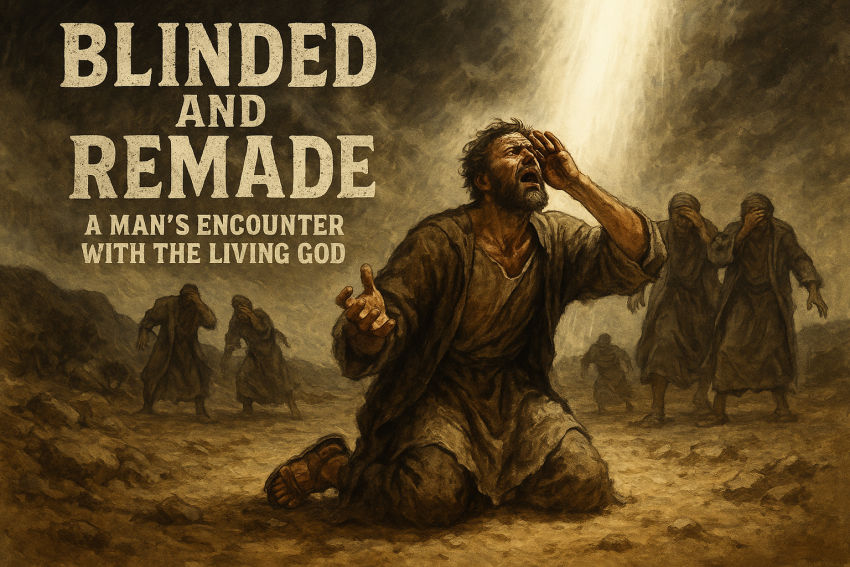
And yet, even as I thought these thoughts, the sun brightened, and I was aware — not in sight but in soul — that something was coming, something immense, sudden, undeniable. I did not see it at first, only felt it as a pressure in the air, a vibration under my feet, a strange silence that pressed on my ears. Then the light struck. It was not sunlight, though it burned brighter than the noon sun. It was white and living, like the eyes of God had opened in the sky and poured their fury and mercy all at once. The ground seemed to vanish beneath me. My companions cried out; I remember a shout, maybe my own, maybe theirs, I cannot say, and then I fell.
I fell, and the dust was in my mouth, in my eyes, in the folds of my mind. I tried to rise, but the strength I had always counted on was gone. I realized in that moment, in a burst of truth I could not deny, that my pride, my ambition, my self-reliance — all of it — had been a lie. I was small. I was nothing. And yet, the light was not just destruction; it was a presence. A voice, a sound that was not sound, but cut through my very bones: “Saul, Saul, why do you persecute me?”
I could not answer. I wanted to. I tried to argue, to explain, to justify. I thought of the law, of the letters, of the righteous fury I carried for the blasphemers and the heretics. I wanted to tell the voice that I was acting for justice, for the glory of God, for the preservation of truth. But no words came. I felt my tongue stiffen, my throat close. And in that silence, a terror unlike any I had known rose in me — the realization that I had been fighting the wrong fight, that the enemy I had hated was standing before me, not in shadow or disguise, but in the living, unstoppable presence of God Himself.
I fell to my knees in the dust. My companions fell too, scrambling, frightened, blind, and shouting. I could hear their panic, the clatter of sandals, the gasp of men realizing that the world as they knew it had shifted. And I was at the center, the man who had always thought himself untouchable, now humbled beyond measure. My sight left me, as if the light had burned my eyes. Darkness surrounded me, yet the voice persisted, patient, commanding, piercing. “Rise and go into the city, and you will be told what you must do.”
I remember the walk into Damascus, led by hands that were not my own, guided by companions who could see my body but not my soul. I walked blind, unable to read the letters I had carried, unable to see the road, unable to see the world I had thought I controlled. I had been a man of status, of fearsome authority, of law, of command. Now I was a man stripped bare, a man rendered dependent on others, a man who could no longer boast of his own power. I tasted the bitterness of humility, the raw edge of fear, the trembling fragility of a life I had once assumed I mastered.
I spent days in the house of Judas on Straight Street, lying in silence, wrestling with the truth that had struck me. I could not hide from it. I could not fight it. I could not speak it. My thoughts turned inward, dark and sharp. Had I been righteous in my zeal, or had I been blind? Had I been following God, or had I been following my own ambition, my own pride? I saw the faces of those I had persecuted, the fear I had wrought, the blood I had not spilled but whose lives I had crushed beneath the weight of my authority. And I hated myself, yet I wanted to justify it, wanted to explain, wanted to cling to the remnants of my false identity.
Then He sent a man, Ananias, into that room. A servant, humble and trembling, yet firm with faith. He spoke words I could not understand at first, words that seemed too simple to reach the depth of my torment: “Brother Saul, the Lord has sent me, so that you may regain your sight and be filled with the Holy Spirit.” I wanted to argue. I wanted to tell him I did not need him, I did not need any man, I did not need anyone to tell me how to walk. But my pride was gone, melted away in the light that had struck me down. I could only lie there, silent, and let his hands rest on me, and in that touch, feel the weight of mercy and the truth of my weakness.
Sight returned slowly, but with it, a new vision. Not merely of the streets of Damascus, the houses, the marketplaces, the people going about their lives, but of the world I had been blind to — the world of grace, of love, of a power that does not require arrogance to wield. I had sought authority, and I found submission. I had sought righteousness, and I found humility. I had sought to crush the Way, and I found that I had been called to it.
Those first days were the hardest. I was no longer Saul of Tarsus, the zealous Pharisee, the man whose letters struck fear into the hearts of the Way. I was a man broken, a man dependent, a man naked before God and man alike. I walked the streets, not as judge but as penitent, not as master but as servant, not as warrior but as one called to be remade. My hands that had held swords now trembled as they lifted in prayer. My tongue that had spoken threats now whispered truth. My heart that had clung to pride now clung to mercy.
I reflected often in those early days, pacing the quiet rooms, listening to the low murmur of Damascus at night. I thought of the men I had followed and feared, the rabbis who had taught me, the elders who had praised me. I thought of my family, my teachers, my friends — and realized that all the accolades, all the power, all the law I had mastered, meant nothing in the face of God’s touch. I could hide my weakness no longer; I could deny my ambition no longer; I could justify my violence no longer. All of it had been a mask, and the mask had been burned away.
And yet, in the midst of my fear, I found courage. Real courage, born not of self-reliance, but of surrender. Real strength, born not of control, but of obedience. I began to preach in Damascus, slowly at first, testing my voice, trembling at the reaction of those who had once cowered at my name. They stared at me, some with fear, some with suspicion, some with awe. But I did not falter. I had been broken, yes, but in the breaking I had been remade. I had been stripped of false identity, and in its place, God had planted a purpose far greater than I had ever imagined.
I write this not to boast, for I have no cause to boast in the flesh. I write this to men like you, who measure worth by strength, by control, by status, by the ability to hide your fears and lusts and anger. I write this to men who feel invincible, who carry pride like armor, who deny the vulnerability that makes them human. I know you. I was you. I walked the road of certainty, carrying my righteousness like a sword, seeing my mission as justice, blind to the mercy I had never understood. And God struck me down, and I saw myself as I was — small, flawed, broken.
Do not fear the light that comes to burn away your pretense. Do not resist the shaking that strips you of your pride. Do not cling to the identity you have built on work, on control, on fear of weakness. For it is in the breaking that real strength is born. It is in the surrender that you are made whole. It is in the humility that a man finds courage greater than his ambition, love deeper than his fury, and life beyond the vanity of status.
I am Paul now, called by another name, but still the same man who walked that road. Only now, I am not the man I thought I was. I am a man who has been confronted by the living God, humbled, broken, remade. And I tell you this: if you are willing to meet the light, to fall to your knees, to let go of the mask, to admit your weakness and your anger and your pride, you too may find yourself remade. Not as a man who controls, not as a man who dominates, not as a man whose identity is in what he can accomplish or what he can hide, but as a man whose worth is found in being known by God, and whose strength flows from surrender rather than self-reliance.
The road is still before me. The road will always be before me. I stumble, I fail, I struggle with anger, with lust, with fear of being seen as less than I am. But I walk now with eyes open — not to conquer, not to dominate, not to boast — but to witness, to serve, to live the transformation that God has wrought. And you, man, you who reads these words, must ask yourself: what road are you on? What pride blinds you, what ambition deceives you, what mask do you cling to? What if God struck your world and burned it away, leaving you naked before Him? Would you fall? Would you rise? Would you be remade?
I tell you the truth: it is terrifying. It is painful. It is humbling. It is glorious. And it is the only way to become a man who is not ruled by fear, pride, or control, but ruled by the hand of the living God, who breaks and makes, who humbles and exalts, who calls even the proudest, the most self-reliant, the fiercest among men, and says: follow Me, and you will be remade.
Author’s Note:
Men, I’m going to be real with you: God doesn’t hand out His work to perfect people. He doesn’t call the polished, the ready, or the ones who think they’ve got life figured out. He calls the broken, the bruised, the unqualified — the ones who can’t do it on their own. He called Saul, a man full of pride and fire, and broke him to make him powerful in ways he could never have imagined. And He still does the same thing today.
Look at Jason DeFord — Jelly Roll. That man has been through hell and back. Addiction, arrests, mistakes that would crush most men’s spirits — he’s been swamped by life, buried under chaos, and beaten down by his own choices. And yet, he didn’t stay there. He didn’t wait to be perfect or ready. He surrendered. He let God in. And he’s living proof that God can take the messiest, most messed-up life and make it meaningful.
His song “I Am Not OK” hits me like a hammer. Because I get it. There are days I am not OK — swamped by work, responsibilities, commitments, expectations. I feel the weight of it all and the pull to just keep going, to grit my teeth, to hide my weakness. Making time for the simple things — to breathe, to pray, to connect — feels impossible. And yet, that song reminds me that God sees me in the moments I’m falling apart. He sees you too. You don’t have to have it all together. You don’t have to fake it. You just have to be willing to be used.
This story, and the one you just read, is for men who are tired of pretending, men who are strong on the outside but feel weak inside, men who hide their anger, their fear, their shame. God doesn’t need perfect men. He needs real men — men willing to be broken so they can be remade. He meets you on the road that breaks you, and if you let Him, He’ll use that brokenness to build something stronger than pride, stronger than fear, stronger than anything you’ve ever tried to hold onto on your own.
Call to Action
If this story struck a chord, don’t just scroll on. Join the brotherhood—men learning to build, not borrow, their strength. Subscribe for more stories like this, Drop a comment about where you’re growing, or Reach out tand tell me what you’re working toward. Let’s grow together.

Sources
Acts 9:1-9 (Saul’s journey to Damascus)
Acts 9:10-19 (Ananias & Saul’s transformation)
Acts 22:6-11 (Paul’s own retelling of the road-experience)
Acts 26:12-20 (Paul’s address before Agrippa, recounting his call)
Enduring Word Bible Commentary – Acts 9
Working Preacher – Commentary on Acts 9:1-19a
GotQuestions – What happened on the road to Damascus?
God Centered Life – 5 Lessons from Saul’s Conversion
Matthew Henry’s Commentary – Acts 9
Scripture Analysis – Paul’s Road to Damascus Transformation Explained
Church on the Move – “Going Deeper: Acts 9”
Disclaimer:
The views and opinions expressed in this post are solely those of the author. The information provided is based on personal research, experience, and understanding of the subject matter at the time of writing. Readers should consult relevant experts or authorities for specific guidance related to their unique situations.