
1,703 words, 9 minutes read time.
My name is Eliab, son of Zebulun, a merchant of Jerusalem in the days when David was our king. I stand before you, brothers, in this house of worship, to tell a tale not of my triumphs but of my shame—a story of a man who saw glory and turned away, clutching his pride like a shield. You men, you who wrestle with the weight of your own strength, who hide your cracks beneath titles and toil, listen close. This is about the day I saw King David dance before the Lord, a day that should’ve changed me but instead set me on a path to ruin. It’s about joy that lasts, the kind I glimpsed but refused, and the price I paid for it. I tell you this not as a saint, but as a fool who thought he could outrun his own heart.
It was a day of fire and dust in Jerusalem, the air thick with the scent of sacrifice and the hum of a thousand voices. The Ark of the Covenant, God’s holy presence, was coming home. For years, it had been lost to us, carted off by Philistines, then tucked away in Kirjath-jearim after Uzzah’s death—a grim reminder of God’s holiness, struck down for touching what was sacred (2 Samuel 6:6–7). But now, David, our shepherd-king, had brought it back, and the city was alive with celebration. I stood among the crowd, my robes pressed and my purse heavy with silver from a good week’s trade. I was a man of standing, known in the markets, my name spoken with respect. But beneath it all, I carried a gnawing envy, a pride that measured my worth against others and always found them wanting.
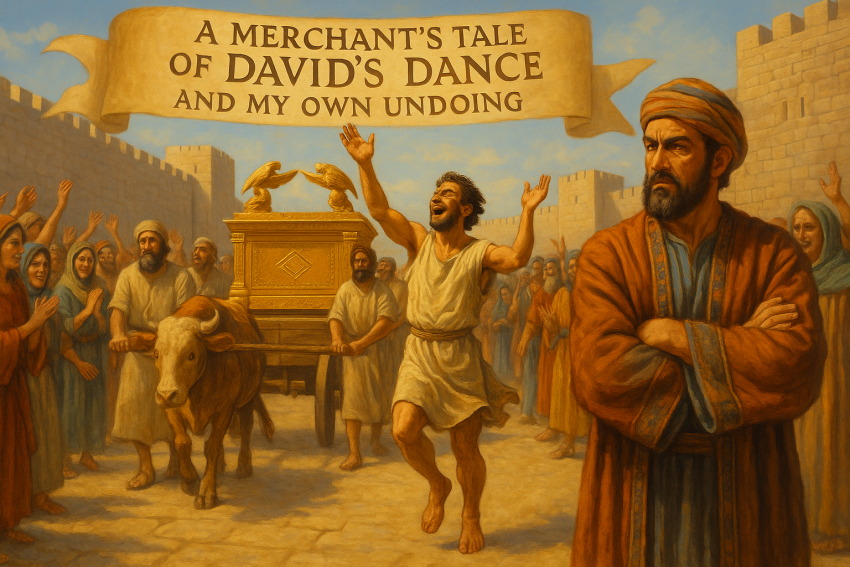
The procession began with a roar—trumpets blaring, rams’ horns echoing off the stone walls, and the rhythmic thump of timbrels. Oxen lowed as they pulled the cart bearing the Ark, draped in fine cloth, its golden cherubim glinting in the sun. Men and women lined the streets, their faces alight with awe, some weeping, others shouting praises to Yahweh. I stood near the city gate, my arms crossed, watching it all unfold. Then I saw him—David, the king, not clad in royal robes but in a simple linen ephod, barely covering his frame. He was dancing, spinning, leaping before the Ark with a wildness that made my stomach turn. His movements were unmeasured, his joy unrestrained, his body swaying to the music of lyres and the pulse of the crowd. This was no dignified march. This was a man undone, a king acting like a fool (2 Samuel 6:14).
I felt heat rise in my chest. Who was this David, stripping himself of decorum, prancing like a child? A king should be stately, composed, a figure of strength. I had heard the stories—David the giant-slayer, David the warrior, David the poet whose psalms stirred the soul. But this? This was madness. I glanced around, expecting others to share my disgust. Some did. I saw narrowed eyes, heard muttered complaints about propriety. But others—many others—were caught up in it, their hands raised, their voices joining the chorus of “Blessed be the Lord!” I felt a pang, sharp and unfamiliar, like a blade slipping between my ribs. Was it envy? Shame? I pushed it down, telling myself I was above such displays. A man like me, a merchant who’d built his name through cunning and control, didn’t need to grovel before God or man.
Let me tell you something about myself, brothers, because you might see yourself in me. I was proud, not the loud kind that boasts in the marketplace, but the quiet kind that festers in the heart. I measured my worth by my wealth, my status, the way men nodded when I passed. I hid my weaknesses like a thief hides stolen gold. My wife, Miriam, once said I was a fortress, but she meant it as a lament, not a compliment. I didn’t let her in, didn’t let anyone in. Vulnerability was a luxury I couldn’t afford. And yet, watching David dance, I felt exposed, as if his abandon was a mirror held up to my soul. I hated him for it. I told myself he was reckless, that a king should never lower himself so. But deep down, I knew I was the one hiding, clinging to my pride like a drowning man clings to a sinking ship.
The procession moved closer, the Ark now passing within arm’s reach. The priests walked solemnly, their faces etched with reverence, while David danced on, sweat gleaming on his brow, his eyes fixed not on the crowd but on something—or Someone—beyond us. I overheard two men beside me, their voices cutting through the din. One, a grizzled shepherd named Amos, said, “Look at him, giving all for the Lord. That’s a heart God loves.” The other, a scribe called Nathan, scoffed. “A king should act like one, not a drunken fool. What will the nations say?” I nodded to myself, siding with Nathan. Propriety mattered. Status mattered. But Amos’s words lingered, gnawing at me. A heart God loves. What did that even mean? I’d spent my life offering sacrifices, keeping the Law, but my heart? That was locked away, safe from scrutiny.
Then I saw her—Michal, David’s wife, standing at a window above the street. Her face was a mask of scorn, her lips curled as she watched her husband dance (2 Samuel 6:16). I felt a kinship with her, a shared indignation. She, too, saw the foolishness of it all. Later, I heard she confronted David, her words dripping with contempt: “How the king of Israel has distinguished himself today, disrobing in the sight of the slave girls of his servants as any vulgar fellow would!” (2 Samuel 6:20). David’s reply was sharp, unapologetic: “It was before the Lord… I will become even more undignified than this, and I will be humiliated in my own eyes” (2 Samuel 6:21–22). Those words, when I heard them, struck me like a blow. He wasn’t dancing for the crowd, for Michal, or for himself. He was dancing for God, and he didn’t care who saw his weakness.
That moment should’ve broken me, brothers. I felt the Spirit of God stirring, whispering that my pride was a chain, my self-reliance a trap. I saw David’s joy, a joy that didn’t depend on status or strength but on surrender. It was real, raw, the kind of joy that lasts because it’s rooted in the One who never fails. But I turned away. I chose my pride. I told myself I was right to stand apart, to keep my dignity intact. I justified it, saying a man must hold his head high, must never let others see him weak. But inside, I was afraid—afraid of what it would cost to let go, to be vulnerable, to be real. I walked away from that procession, my heart heavier than my purse, and I didn’t join the celebration. I went back to my shop, my ledgers, my carefully controlled life.
Years passed, and that choice haunted me. My pride grew like a weed, choking out everything else. I pushed away Miriam, my wife, with harsh words and cold silences. I drove away friends who dared to challenge me. My business thrived, but my soul withered. I became a man of wealth but not of worth. I heard later that Michal, too, paid a price for her scorn—she bore no children, a curse in our culture, a mark of shame (2 Samuel 6:23). I wondered if she, like me, regretted her hardness, her refusal to see what David saw. I heard David’s psalms sung in the temple, words of joy and repentance, of a man who sinned greatly but never hid from God. I envied that, too, but I wouldn’t admit it, not then. I told myself I was fine, that my life was enough, that I didn’t need the kind of joy David had.
Now, here I am, an old man speaking to you across time, my voice carried by grace to this place. I’m not here to tell you I found redemption, though I pray for it still. I’m here to tell you I chose wrong. My pride, my fear of vulnerability, my need to be seen as strong—it led to my undoing. I lost my family, my peace, my chance at the joy David knew. I justified my choices, told myself I was protecting my name, my status, but all I did was build a prison. You men, you know this struggle. You know what it’s like to hide your doubts, your fears, your sins behind a mask of strength. You know the anger that flares when someone gets too close, the lust for control that drowns out love, the pride that whispers you don’t need anyone—not even God. But I tell you, brothers, that’s a lie. The joy that lasts, the kind David had, comes from being real, from laying it all bare before the Lord.
Look at David. He wasn’t perfect. He fell—oh, how he fell—with Bathsheba, with Uriah, with his own sons (2 Samuel 11–12). But he never stopped running to God, never stopped baring his soul, even when it hurt. That’s what I saw that day in Jerusalem, and it’s what I ran from. Don’t make my mistake. Don’t let pride or fear keep you from the God who sees you and loves you anyway. Be real, brothers. Let go of the masks. Dance before the Lord, not for the crowd, but for Him. The joy you find there—it’s the kind that lasts, the kind that carries you through the fire. I learned that too late, but you don’t have to. Choose now. Choose Him.

Sources
- 2 Samuel 6:12–23 (NIV) – Bible Gateway
- David Guzik Commentary on 2 Samuel 6 – Blue Letter Bible
- Matthew Henry Commentary on 2 Samuel 6 – Bible Study Tools
- ESV Global Study Bible Notes on 2 Samuel 6
- What does the Bible say about David dancing? – GotQuestions.org
- David’s Dance Before the Lord – Ensign Magazine
- David Danced Before the Lord – Biblical Archaeology Society
- The Ark of the Covenant – Jewish Virtual Library
- Ark of the Covenant – Encyclopaedia Britannica
- The Holy Ark – Chabad.org
- Dancing with Joy – Desiring God
- Why Did David Dance Before the Lord? – Crossway
- David Danced, Michal Despised – The Gospel Coalition
- 2 Samuel 6:14 Commentaries – Bible Hub
- 2 Samuel 6 – Treasury of Scripture Knowledge
Disclaimer:
The views and opinions expressed in this post are solely those of the author. The information provided is based on personal research, experience, and understanding of the subject matter at the time of writing. Readers should consult relevant experts or authorities for specific guidance related to their unique situations.