
4,642 words, 25 minutes read time.
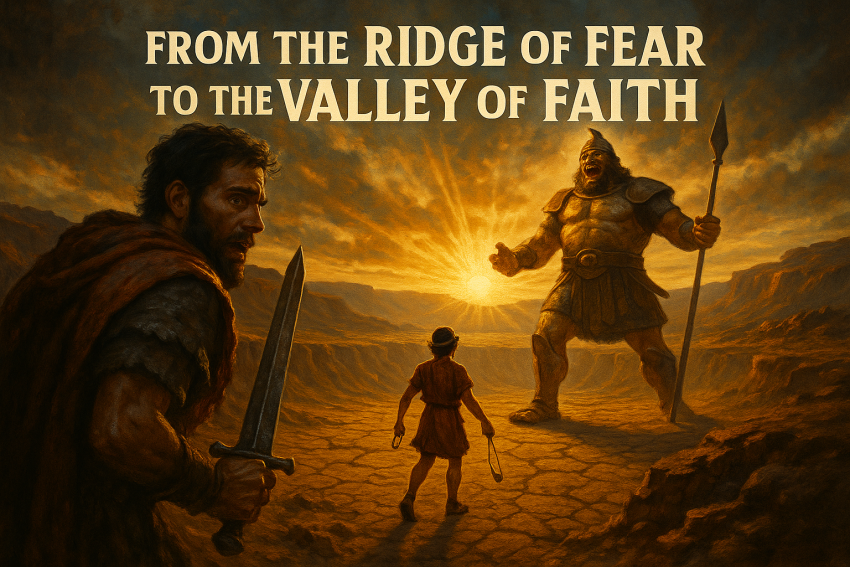
My name is Malchu ben Zerah—a name you won’t find in any scroll or song. Son of no one important. A soldier in the service of King Saul, and one of the many men who stood frozen on the slopes of the Valley of Elah the day a shepherd boy killed a giant.
I wasn’t born into greatness. My father, Zerah, was a potter in Gibeah—hands always gray with clay, eyes always tired from squinting into the fire. He taught me early that a man had to make himself hard to survive. When he died, my mother remarried a man who spent more time boasting than working, and I swore I’d never be like him—soft words, empty hands. I wanted to be strong. I wanted people to remember my name.
So I joined Saul’s army when I was barely old enough to hold a spear. Back then, the king still smiled. He stood tall, taller than any man in Israel, and when he walked through the camp, his shadow made you feel like God Himself was near. We thought no one could stand against us. And for a time, it felt true.
I fought in the raids against the Ammonites, where the stench of burning flesh and iron filled the air. I was there when Saul led us against the Philistines at Michmash—the day we cheered as Jonathan, the king’s own son, climbed the cliffs and struck down their outpost. I remember the sound of steel on bone, the rush of blood in my ears, the madness that takes you when you fight to prove something—to prove you’re not weak, not like the men who stay behind.
That’s what drove me. Not duty. Not honor. Just a hunger to be more. To be seen.
You tell yourself you’re fighting for your people, for your king, maybe even for God. But if I’m being honest—and I didn’t used to be—I fought for me. For the feeling that came when another man’s fear met my blade. For the respect that came when the captains spoke my name.
The older soldiers used to say faith gives a man courage. I thought courage came from willpower. From clenching your jaw, gripping your weapon tighter, refusing to give in. I laughed at the priests when they spoke of trusting Yahweh to deliver us. I trusted only what I could see—my sword, my strength, my control.
And then one morning, I saw what all my strength was worth.
The valley stretched before us, its floor carved by the dry streambed that cut between the armies of Israel and Philistia. For forty days, their champion came down into that valley—Goliath of Gath, a man built like a fortress. His voice shook the ground. His armor gleamed like a bronze sunrise. Every time he roared his challenge, we stood there, gripping our spears, pretending we were brave.
And I—I who prided myself on my strength—stood among them. Silent. Paralyzed.
If you’ve ever told yourself you were strong enough to face anything, that you just had to push harder, grit your teeth, or power through—then you already know me. You know the kind of man I was.
I believed in muscle, discipline, and control. I trusted willpower more than God. And that day, when a boy named David walked into a valley with nothing but a sling, I learned what real strength looked like.
The sun in that valley burned like judgment, a white-hot eye staring down on our shame. The air itself felt angry, pressing against your skin until your armor stuck to your back. We’d been camped there for weeks, the men of Israel lined on one ridge, the Philistines on the other, with a wound of dry earth yawning between us. The stream that once cut through the Valley of Elah had long since bled out—just a cracked bed of stone and dust now, littered with the bones of jackals. Every step crunched like breaking pottery.
At first, the camp was full of talk. Boasting. Plans. Men slapping each other on the back, polishing their shields, daring one another to face the giant. But that was in the early days—back when courage was still cheap and no one had yet seen Goliath up close. By the end of the first week, the laughter died. The songs stopped. Even the priests’ prayers sounded thinner. We started moving slower, talking quieter, pretending to sharpen our blades when there was nothing left to sharpen but our fear.
The Philistines across the ravine were loud—always loud. Their fires burned bright at night, the smoke thick with roasting meat and arrogance. You could hear their laughter echo through the valley as they mocked us, calling us cowards, dogs, servants of a weak king. And maybe they were right.
Their champion, Goliath of Gath, was no mere man. He was a fortress in flesh—taller than any of us by two heads, shoulders broad as a cart. His armor wasn’t the dull iron we carried; it was bronze that caught the sun like fire. The man shimmered, like a god of war stepping out of a furnace. The shaft of his spear was thick as a weaver’s beam, the iron tip heavy enough that two men together would have struggled to lift it.
Every morning, when the sun first broke the ridges, he came striding into the valley. And every evening, before the light slipped away, he returned to do it again—forty days of it, relentless as the sun itself. His voice rolled up the hills like thunder, and with every roar, I swear the earth trembled. He mocked our king, mocked our God, dared us to send one man to face him. “Come!” he’d shout, laughing. “Send a warrior! If he kills me, we’ll serve you. But if I kill him—” He’d grin then, slow and cruel. “You’ll bow to us, and your children will bear our yoke.”
The first time he said it, we spat in the dirt and called him a blasphemer. By the tenth time, most of us couldn’t even look up.
You could feel the fear thick in the camp, the kind that seeps into your bones. Men stopped making eye contact, afraid that if their gaze met the captain’s, they’d be chosen to fight. Saul’s tent stood high on the ridge, but even from a distance, you could sense it—the weight of a man who’d lost something unseen. The king who once burned with the Spirit now paced like a shadow, restless, haunted. Some nights I’d hear him muttering to himself. Other nights, he’d stand outside his tent staring toward the Philistine camp, his armor shining but his shoulders sagging. He looked like a man trying to convince himself he was still chosen.
And we followed his lead. Pretending we still believed.
I remember sitting by the fire one night, watching the flames twist. My friend Eliab was beside me, his hands trembling even though he swore he wasn’t afraid. He said the giant’s laughter echoed in his dreams. I didn’t tell him it did in mine too. I just told him to grow a spine, that we were soldiers of the Living God. But even as I said it, I felt hollow.
That’s the thing about pride—it doesn’t vanish when courage does. It just hides behind excuses. I told myself we were waiting for the right moment, for a divine sign, for Saul to give the command. But deep down, I knew the truth. I wasn’t waiting for a sign from God. I was waiting for someone else to take the risk first.
So we stood there, every man a wall of armor and fear, staring down into that dead valley where one man’s faith—or one man’s will—would soon be tested.
I can still hear his voice. Booming. Mocking. Relentless.
“Send me a man to fight me!” he’d shout, his laughter rolling across the valley like thunder. “If he kills me, we’ll serve you. But if I kill him—” He’d pause then, grinning wide enough for us to see the gold between his teeth. “Then you, Israel, will serve us!”
Every time he said it, the words hit harder. It wasn’t just a challenge anymore. It was a declaration.
See, Goliath wasn’t just mocking us. He was mocking our God. Every word he spoke wasn’t only against Saul’s army—it was against the name of Yahweh Himself. He stood there, towering over the dry streambed, and cursed the very covenant that made us who we were.
We were supposed to be the chosen people, the army of the Living God. But standing on that ridge, armor clanking, hands slick with sweat, we didn’t feel chosen. We felt exposed. Forgotten. Powerless.
That’s what fear does—it rewrites your theology. It makes you forget what you know.
When Goliath mocked God, something inside us should have burned. We should’ve risen up, even if it meant dying. But instead, his words sank into us like a slow poison. We started to believe them. Started to wonder if maybe Yahweh really had abandoned Saul… and us with him.
I remember looking around one morning as Goliath bellowed his challenge. The sun was still climbing, and the heat shimmered off the valley floor. Men were staring at the ground, pretending to tie their sandals or clean their weapons—anything to avoid looking down that slope. You could feel the shame pressing on us like a weight.
The Philistines shouted insults from across the ravine, their laughter sharp as knives. They called us cowards, said our God was deaf, said our king was mad. And maybe the worst part was… none of us could argue. Saul hadn’t moved from his tent in days. The prophets were silent. The priests’ prayers sounded desperate, like men bargaining with a God who’d already turned His face away.
And Goliath—he knew it. You could see it in his eyes. Every insult was aimed straight at our fear, every word chipping away at our faith. He wasn’t just trying to kill a man; he was trying to break a people. To prove that the Living God of Israel was no different than the idols of stone and wood that the Philistines bowed to.
And in our silence, we gave him what he wanted.
That’s what haunts me most, even now. Not that I was afraid to fight him—but that I was afraid to believe. I’d seen what faith could do. I’d heard the stories of the Red Sea, of Jericho, of Gideon and his three hundred men. But those were other men’s stories, other generations. Somewhere along the line, I stopped believing they still applied to me.
So when Goliath mocked God, I told myself it didn’t matter. That words couldn’t hurt the Almighty. That all we needed was a better plan, a stronger man, a sharper sword. But deep down, I knew better. The fear wasn’t about dying—it was about being wrong.
Because if God really was with us… then why did He feel so far away?
I was one of Saul’s chosen men. Not the generals, not the captain of the guard, but among the ranks he trusted enough to stand on the front lines and call me brave. My armor wasn’t the best, but it was polished. I’d earned it over years of raids and battles, campaigns where I’d seen the sharp edge of death and survived. I’d killed before. I took pride in it. I told myself each life I ended was a measure of my courage, proof that I was more than just a boy with dreams in a cruel world. I thought killing made me brave. I thought standing tall made me righteous. But truth? The raw, ugly truth was I was terrified. Every man in that camp was.
We tried not to talk about it. Pride makes silence easier than honesty. Men clung to each other in small knots of bravado—telling stories of past battles, joking about the Philistines, even mocking Goliath when no one dared answer his calls. But behind the laughter, we were hollow. Every glance toward the ravine was a dagger twisting in our guts. You could see it in the eyes of the seasoned soldiers, the captains who had marched through fire and blood. They clenched their fists, gritted their teeth, and muttered prayers that felt like bargaining: “God, deliver us,” we said, while hoping we could deliver ourselves first.
On the fortieth day, everything changed.
That morning, I remember the chill in the air, the valley’s dust lifting in little spirals as the sun hit the stone. And then I saw him. A boy. A kid, really—young, lean, barely old enough to shave. His skin was sun-worn from tending sheep, not marching with armies. His eyes were steady, scanning the camp, and there was no fear in them, none at all. He carried bread and cheese in a small bag slung over his shoulder. He didn’t move like a soldier. He didn’t march. He didn’t stomp. He walked like he belonged there—like he was a guest at a festival, not a witness to forty days of death threats and terror.
I remember thinking, Who sent him? Why here? Why now?
He approached our line, his small feet crunching over the stone, his voice calm but clear as he introduced himself: “My name is David, the son of Jesse. I’ve come to bring food to my brothers.”
I laughed at first, and I wasn’t alone. Some of the older soldiers snorted, exchanging knowing looks. A boy? A shepherd? To face Goliath? One man standing thirty feet tall, armored in bronze, laughing at our very God? The idea was ridiculous.
And yet… I couldn’t take my eyes off him. Something in the way he carried himself—his gaze steady, unyielding—cut through the fear that had wrapped around our camp like a thick, choking fog. He didn’t look up to the generals. He didn’t shrink from the captains. He didn’t flinch at Goliath’s voice booming across the valley.
He just… stood.
Even now, I can see it. That boy, small and unarmed in our eyes, holding nothing but a staff, a bag of stones, and a faith we had all forgotten. He walked into a battlefield where men had been paralyzed by fear for forty days, and somehow he radiated courage. Not the kind that comes from a sword or armor, but a quiet, terrifying kind—the kind that made you feel your own bravery was just an illusion.
It was the first time I realized how fragile we really were. Forty days of fear, forty days of pretending, and in a single morning, a boy walked into the camp carrying nothing but bread, cheese, and his own conviction. He had come to deliver food to his brothers, but what he brought was something else entirely. Something none of us had carried in years: courage anchored in faith, not muscle or discipline.
David didn’t wait for permission. He started asking questions no one wanted to answer, questions that cut through the fog of our fear like a sword: “Why are you all just standing here? Who is this uncircumcised Philistine that he should defy the armies of the living God?”
I nearly spat out my water. The audacity of it stunned me. This kid, barely grown, spoke as though the name of his God was more protective than the armor on our backs. His words had weight. Not the weight of arrogance, but the weight of conviction.
His brothers scolded him. Told him to shut up. Told him to go home. Told him he was arrogant, foolish. I wanted to agree. I wanted to nod, to turn away and bury my pride in silence. But something about the way David stood, calm and unafraid, refused to let me look away. His voice didn’t shout, didn’t demand; it declared. And that declaration left a hollow in my chest I couldn’t ignore.
He went to King Saul. I followed, pretending to guard the tent, but the truth is I was pulled forward by curiosity. I had to see this.
“I’ll fight him,” David said.
Saul blinked like he’d never understood words before. “You? You’re just a boy.”
David didn’t flinch. He spoke with the quiet authority of a man who had faced lions and bears, who had faced death countless times tending sheep. “Your servant kept his father’s sheep. When a lion or a bear came, I went after it. The Lord who delivered me from their paw will deliver me from this Philistine.”
That word—deliver—hit me like a spear. Years of training, years of trying to carve courage out of my own sinew and willpower, and here was this boy, claiming a power I had ignored, a strength I had tried to manufacture.
Saul, desperate for a miracle, offered him his armor. The boy strapped it on. It hung off him like a tent, clumsy and foreign. He shook his head and took it off. “I can’t go in these. I’m not used to them.”
And then he walked out to the stream, stooped to pick five smooth stones from the water, and stepped toward the valley.
For the first time in forty days, the camp went utterly silent. Every man gripped his sword hilt so tight the knuckles ached. Every soldier’s chest felt tight, every heartbeat loud.
Across the valley, Goliath’s laugh tore through the air, harsh and mocking, like metal scraping stone. “Am I a dog,” he shouted, “that you come to me with sticks?”
I felt the words like blows. Each syllable from that giant’s mouth wasn’t just meant to frighten a boy—it was meant to break us all. Every man in the camp knew the story. We grew up on it, hearing it whispered around fires when fathers told tales to sons, when priests reminded the people of the line of Israel, and when mothers warned daughters of the consequences of turning away from God. Orpah, Ruth, Naomi. Names that carried faith and betrayal, loyalty and abandonment. And here it was, brought to life in bronze and muscle and hatred.
This wasn’t just a boy versus a man. This was history, breathing and stomping across the valley, a living testament to choices that had shaped generations. Orpah, who had walked away from Naomi and returned to Moab, had chosen her own path, turning her back on the God of Israel. According to the old stories, her descendants had become enemies of Israel, raised in defiance of our covenant and traditions. Goliath—the towering monster before us—was said to be one of them, a distant kin of the family that David himself descended from. Generations apart, yet blood still linked them in ways that carried meaning across the centuries.
It was strange to think of it that way, yet we all knew the story: Ruth, faithful and loyal, had clung to Naomi, embraced the God of Israel, and in time had become the great-grandmother of David, the boy now stepping toward this giant. And on the other side, Orpah’s line had hardened in opposition, producing warriors like Goliath to challenge God’s people. The irony wasn’t lost on any of us: David, the faithful descendant, standing against a man who shared the same distant bloodline, yet represented everything twisted and defiant.
That lineage, distant yet undeniable, added weight to the fear that already gripped us. This was more than a battle of flesh and bronze—it was a confrontation of history, of choices, of faith and rebellion stretching back decades, maybe centuries. And here we were, men who prided ourselves on courage and steel, frozen in the shadow of a giant who carried both personal menace and the echo of generations gone astray.
Goliath wasn’t only mocking David—he was mocking us. He was mocking our God. Every soldier in Saul’s army could feel it. His words weren’t empty. They carried the weight of generations that had turned from faith and suffered the consequences. Standing there, hearing the echoes of history in that roar, we felt the shame of our fathers, the fear of our own inadequacy, and the question pressing down on us all: if God’s hand had delivered Israel before, why were we paralyzed now?
I could see it in the men around me. Some tried to laugh, some spat into the dust, some muttered prayers they didn’t believe. Every glance at Goliath’s shadow, every step he took, reminded us of our mortality and our weakness. And yet, even knowing all of this, even understanding the lineage and the history, our fear didn’t turn to anger or resolve—it turned inward. It whispered that we were not enough. That all our training, all our discipline, all our swords and shields, would not matter.
Some of the soldiers whispered prayers, others spat to hide their fear. I gripped my sword so tight my knuckles ached, trying to convince myself that knowing the history made me stronger. It didn’t. It made the fear sharper.
Then David stepped forward. Small, unarmored, completely unafraid. He lifted his sling, his voice cutting across the valley like a blade. “You come at me with sword and spear and javelin,” he called, “but I come at you in the name of the Lord of Hosts—the God of Israel who will strike you down today!”
It wasn’t a shout. It wasn’t a boast. It was a declaration, calm and unyielding, like he already knew the outcome. Even across the distance, I felt it pierce through the fear that had paralyzed us for forty days. It wasn’t courage born of muscle or armor. It was faith—faith that made the rest of us, trained soldiers of Israel, look like children playing at war.
And then he moved. Fast. Faster than any man I’ve ever seen move toward danger. The sling whipped around his head, once, twice, three times. And then crack! The stone struck true. Goliath’s roar turned into a gasp, and the giant fell face first into the dirt.
For a moment, no one moved. Time itself seemed to hold its breath.
David ran forward, took the giant’s sword, and cut off his head. Just like that, forty days of fear ended. The Philistines broke and ran. We chased them for miles, shouting victory.
But I didn’t shout. Not really. Something inside me broke too, but not the way I expected.
That night, while others sang and laughed around their fires, I sat staring at my hands. Steady only when gripping something—my sword, my pride, my illusions of control. Without them, I was shaking. And I hated it.
I thought about what I’d seen: a boy with no armor, no training, no brute willpower to prove himself—just faith. And it had been enough.
I hated that truth. It stripped me bare. All my effort, all my strength, all my reputation meant nothing compared to a shepherd’s trust in God.
So I did what proud men do: I buried it. I told myself David had been lucky. That Goliath had slipped. That the sun had blinded him. Anything to avoid the real explanation: God had done what no human strength could.
I returned to training, fighting, climbing the ranks. I wanted Saul’s approval. I wanted to be seen. And when the people began singing songs about David—“Saul has slain his thousands, and David his tens of thousands”—the fire of envy, pride, and bitterness burned in my chest. I told myself I was justified. I had served longer, I had bled more. I deserved recognition.
Pride always finds a reason.
Years passed. I watched David rise, watched Saul’s jealousy twist into madness. Brothers turned against brothers. And through it all, I pretended I was fine. But at night, I’d dream of that stone flying through the air, see Goliath fall again, hear David’s voice saying, “The Lord who delivered me…”
I’d wake sweating. Because I knew: I’d been trying to deliver myself for years, and I had failed.
Sometimes, I prayed, half-heartedly: “God, make me stronger. Make me better. Make me more like David.” But in truth, I wanted the hero’s glory, not the shepherd’s faith.
I learned, the hard way, that victories earned through strength alone feel hollow. Every battle won left me emptier. Every promotion brought heavier loneliness. I learned to wear faith like armor—polished, heavy, for show. Inside, I was hollow.
Years later, after Saul’s fall and David’s rise, I found myself stationed near Hebron. A young soldier asked me one night what it was like to see David fight Goliath.
I told him the truth—or as much as I could:
“It was the day I learned what real strength looks like,” I said.
He asked if I wasn’t afraid. I wanted to lie. But I didn’t.
“I was terrified,” I said. “Not of Goliath. I was afraid of what faith would demand if I let it in.”
Faith doesn’t come naturally to men like me. We’re builders, fighters, fixers. We like to conquer problems, not surrender them. But faith isn’t passive. It’s standing in the open, unarmed, trusting that God will do what you cannot. That’s what David did. And that’s what I failed to do.
You can’t out-muscle fear. You can’t outthink temptation. You can’t outwork shame. You can only out-faith it.
Faith doesn’t look like willpower—it looks like trust when everything says you shouldn’t.
I’ve seen the strongest men break under their own strength. The proudest fall to the smallest sins. And I’ve seen boys, barely men, walk through impossible battles with peace because they trusted someone greater.
Faith doesn’t make you soft. It makes you real. It strips away the lies you tell yourself to feel in control.
If I could go back to that valley, I’d like to say I’d step forward beside David. But I probably wouldn’t have. Pride doesn’t die easy.
Maybe God let me live so I could learn that real victory isn’t in killing giants—it’s in surrendering to the One who slays them for you.
I tell my story now, not to boast, but to warn another man standing on his own hillside, gripping his sword, convinced he can handle life alone.
Listen. I’ve been there. I’ve tried to fight my giants with grit, control, and pride. None of it works. Faith does.
It’s the only thing that ever did.
And if you doubt that, go read about a boy named David, and remember: a grown soldier watched him win—and learned that sometimes, the bravest thing a man can do is drop his armor.

Sources
- 1 Samuel 17 – David and Goliath
- 1 Samuel 16 – David Anointed by Samuel
- Psalm 27:1 – The Lord Is My Light and Salvation
- Proverbs 3:5–6 – Trust in the Lord, Not Your Own Understanding
- Ephesians 6:10–18 – The Armor of God
- 2 Corinthians 12:9–10 – Strength in Weakness
- Hebrews 11:1 – Faith Is the Substance of Things Hoped For
- Hebrews 11:32–34 – By Faith They Subdued Kingdoms
- James 2:17–18 – Faith Without Works Is Dead
- GotQuestions.org – What Should We Learn from David and Goliath?
- BibleProject – Understanding the Story of David and Goliath
- Desiring God – What the Story of David and Goliath Is Really About
- Crossway – What It Really Means to Trust God
- Ligonier Ministries – David and Goliath
- BibleRef Commentary – 1 Samuel 17
Disclaimer:
The views and opinions expressed in this post are solely those of the author. The information provided is based on personal research, experience, and understanding of the subject matter at the time of writing. Readers should consult relevant experts or authorities for specific guidance related to their unique situations.