
HERE
I remember that day as though the sun itself had paused just to watch us. I was younger then, though already a father, and the weight of responsibility pressed down on me in ways I did my best to hide. Men are supposed to carry burdens silently, I thought, to be unshakable, strong, and in control. But inside, I was a broken man, trying to stitch together pride, anger, fear, and shame into a semblance of strength. I didn’t know it at the time, but the lesson of that morning would change the way I viewed God, faith, and even myself forever.
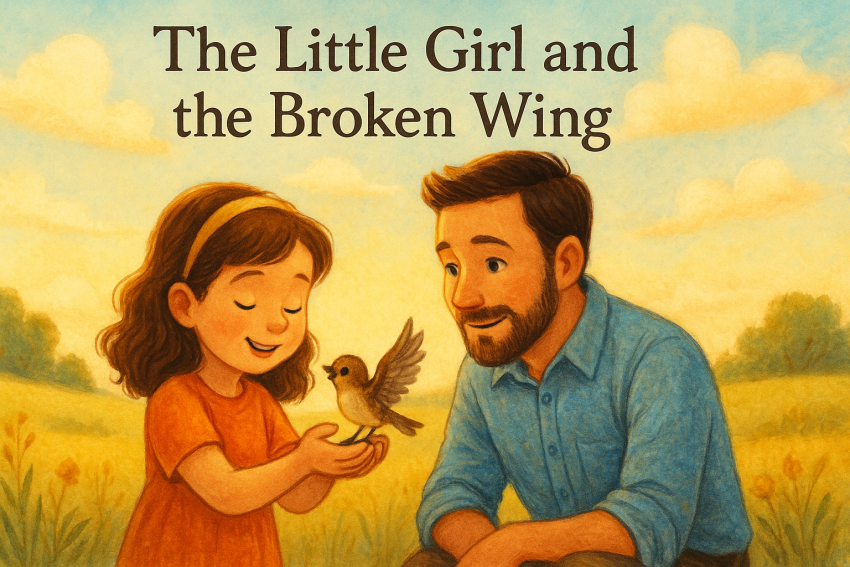
It began when my daughter came running toward me, her small feet kicking up clouds of dust as she barreled through the field where I was working. In her tiny hands, she held something delicate and trembling, a little bundle wrapped in feathers. I squinted in the morning sun and saw it was a bird, a small one, with one wing bent at an awkward angle, feathers sticking out at strange angles. Its eyes were wide, panicked, and it chirped softly, a sound that somehow made my heart tighten.
“Daddy! Daddy! Look!” she shouted, her voice full of excitement and urgency. “It’s hurt! It’s hurt, and we have to help it!”
I glanced at the bird and shook my head. I had seen enough of life to know that some things are beyond repair. Men in the village had taught me that the world was hard and cruel, and that wishing or praying often changed nothing. I felt a surge of weariness. I was already exhausted from the work of the day, from the burdens of providing, from the silent battles no one knew about. In my mind, I whispered the words of resignation I had memorized from years of hard living: “Some things can’t be fixed. Sometimes the best you can do is let go.”
But my daughter wasn’t listening to reason. She looked at me with those wide, earnest eyes, the kind that pierce through pretense, and said, “But Daddy, Jesus said not even a sparrow falls to the ground without our Father knowing. If God sees this little bird, then He can heal it too.”
I wanted to laugh, and part of me did. How naive she was, to believe that God would notice a single sparrow, let alone heal it. I thought I had seen enough to know that life doesn’t hand out miracles like candy, and I wanted to shield her from disappointment before it came. “Sweetheart,” I said, trying to sound firm, “sometimes things are broken, and they stay that way. The bird is hurt too badly. It won’t fly again. It’s better to let it go.”
Her little face scrunched up in that way children do when they cannot comprehend defeat, and she planted her tiny hands on her hips. “But Daddy, we have to try! God can fix broken things, even things people say are impossible!”
I sighed, feeling the weight of both pride and shame. Pride, because I wanted to appear wise and strong, the kind of man who always knew what to do. Shame, because deep down I had forgotten what it meant to trust God, to hope, to pray, to believe that life could be more than my own efforts and failures.
In the end, I didn’t stop her. She carefully carried the bird into our small home, a simple house that smelled of wood smoke and soil, and made a little nest for it in a shoebox lined with soft cloth. She tended to it every morning and evening, feeding it, giving it water, and whispering prayers over it with a faith that made me ashamed. “Jesus,” she said one evening, “please help my bird. Please make its wing strong again. Please let it fly.”
Her words were simple, pure, and full of trust. And each time she prayed, I felt a stirring deep in my chest, a quiet voice reminding me of verses I had once known but ignored—Matthew 10:29–31, the sparrows in God’s hand, Isaiah 40:31, mounting up with wings like eagles, Psalm 147:3, He heals the brokenhearted. I had read them in books, heard them in sermons, but I had never let them touch me, never let them speak to the broken places inside my own heart.
Days passed, and I watched as the bird slowly began to recover. At first, it was only small movements, tiny twitches of the wing that suggested hope rather than reality. I told myself it was coincidence, or perhaps that the bird was simply surviving. But my daughter’s eyes sparkled each time she noticed a small improvement. “Daddy! Look! It’s moving its wing!” she would exclaim.
I tried not to get my hopes up, tried to remain the skeptical father who knew better than to expect miracles. And yet, each day, I felt my own hardened heart soften a little. I began to see that faith was not just for children or the naive—it was for those who had forgotten how to hope.
One evening, as I returned from a particularly grueling day in the fields, I found her kneeling beside the bird, murmuring prayers and softly singing songs she had learned in Sunday school. She looked up at me with a quiet boldness and said, “Daddy, I know you don’t believe, but I do. Jesus said if we have faith the size of a mustard seed, we can move mountains. Maybe He can move wings too.”
Her words cut through my stubborn pride like a sharp blade, and I realized how far I had strayed from believing. I had thought strength meant carrying everything alone, hiding my anger, my fear, my shame, and my failures. I had thought a real man must never show vulnerability. But my little girl was teaching me that faith and hope are stronger than pride and fear, that God’s power is made perfect in weakness, just as Paul wrote in 2 Corinthians 12:9.
I remember watching her pray that night, her tiny hands folded, her voice steady, her heart open. And I realized that the bird was not just a bird. It was a symbol of what God could do in our lives, in hearts that had been broken by pride, by anger, by loss, by guilt. I began to wonder if perhaps God could heal me too, if He could restore the broken places I had hidden so carefully from the world and even from myself.
Slowly, over the course of a week, the bird’s wing began to strengthen. First it flapped weakly, then with more purpose. Each day, I watched with growing amazement as my daughter encouraged it, her faith unwavering even when I doubted. And then, one morning, the little bird climbed to the edge of the box, lifted its wings, and took off into the bright blue sky. Its flight was not perfect at first, but it soared with a freedom that made my chest ache with joy.
I stood there, humbled, heart pounding, tears threatening to fall. I realized that my daughter’s faith had not only restored a bird—it had restored something in me. It reminded me that God is not limited by human perception of what is possible. It reminded me that healing is not just physical but emotional, spiritual, and even relational. And it reminded me that even a small, vulnerable heart, like that of a child, can demonstrate a trust in God that adults often forget.
In the weeks and months that followed, I found myself thinking more about the brokenness in my own life. The anger I had harbored, the pride that had kept me silent, the fear of failure, the hidden lusts and shameful thoughts I had buried deep—all of it felt exposed in light of the lesson my daughter had taught me. I realized that these wounds, like the bird’s wing, were not beyond repair if I allowed God to touch them.
Men often carry their pain in silence. We work harder, drink more, or distract ourselves with accomplishments to hide the fact that we are hurting. We think that showing weakness is the same as failure. But the sparrow reminded me that God’s care extends even to the smallest, seemingly insignificant creatures—and if He cares for them, surely He cares for men who are trying to live rightly, even if we stumble.
I began to pray more openly, to ask God to heal what was broken in me. I spoke honestly with my wife about my struggles. I sought counsel from my pastor and fellow believers. And slowly, very slowly, I began to feel a restoration that was both tender and profound. The pride that demanded perfection began to soften. The fear that had controlled me loosened its grip. My anger became something I could recognize and surrender, instead of a weapon I wielded in secrecy.
Through it all, my daughter’s faith remained a guiding light. She never stopped believing in the bird, and she never stopped believing in God’s goodness. And as I walked beside her, witnessing both the bird’s flight and her unwavering trust, I realized that faith, hope, and love are not reserved for children—they are tools given to every man, every woman, every soul who dares to surrender to God.
And then, we began a little tradition that has lasted for years. Every spring, when the winds were gentle and the skies were wide and blue, my daughter and I would go out to the fields, hand in hand, and look for that bird. She would scan the horizon, her eyes wide and hopeful, whispering, “Maybe we’ll see our bird today.” And I would watch her, amazed at the persistence of faith and the way a child’s heart could remind a grown man of the truths he had long forgotten.
Sometimes we would spot a small silhouette winging its way across the clouds. She would clap her hands and shout, “There it is, Daddy! It’s flying again!” And in that moment, I felt the same awe I had felt the very first morning the bird took flight. Not just awe at the bird itself, but awe at God’s faithfulness, at the way He restores what seems broken, and at the way He works in ways that defy human logic but honor love and hope.
Those moments became more than watching a bird—they became our lessons in life. We learned to watch for God’s work, to trust when outcomes seemed uncertain, to rejoice when healing came, and to never underestimate the power of a heart that believes. I saw in her eyes what I had often buried in shame: the hope that God can redeem, restore, and heal, not just birds, but people, hearts, and even men like me who thought they had to carry everything alone.
Year after year, as we stood together scanning the skies, I felt my own soul take flight alongside that little bird. The brokenness I had hidden—the anger, the pride, the fear, the shame—began to lift, and in its place, God’s grace filled me in ways I had never imagined possible. I began to pray more openly, confess more freely, and live more honestly. And every time we caught sight of a bird soaring high above the fields, I was reminded that faith, even small, can carry life to heights we cannot reach alone.
I tell every man I meet, every father, every brother, that strength is not in pretending to be unbroken. Strength is in acknowledging weakness, trusting God to heal, and holding on to hope. If God can restore a bird’s broken wing, He can restore hearts, marriages, and lives. And if we teach our children to trust Him, we often find our own faith restored in ways far greater than we imagined.
So now, every spring, my daughter and I stand side by side, looking up at the sky, watching for that little bird, and remembering the lesson it taught us: that nothing is too broken for God, that faith can move mountains, and that healing comes in its own perfect time. And in the gentle sway of the wind and the sweep of the blue horizon, I see God’s promise alive, vibrant, and free.
We wait together, hand in hand, eyes lifted, hearts open—trusting that God is still at work, still restoring, still healing, still teaching a broken man and his child that faith, love, and hope can lift us to the skies.
And in that shared silence, filled with awe and expectation, I finally understand that life is not about carrying all the burdens alone, but about watching, waiting, and believing alongside those who remind us how to trust. That little girl, and that little bird, changed me forever.

Sources
- Matthew 18:3 – Unless you become like little children
- Matthew 10:29–31 – God cares for the sparrows
- Isaiah 40:31 – They shall mount up with wings like eagles
- 2 Corinthians 12:9 – My power is made perfect in weakness
- Psalm 147:3 – He heals the brokenhearted
- Luke 12:6–7 – Not one sparrow is forgotten by God
- Mark 5:34 – Your faith has made you well
- Matthew 17:20 – Faith like a mustard seed
- Romans 8:28 – All things work together for good
- GotQuestions: Does Faith Heal?
- Bible Hub Commentary on Matthew 18:3
- Bible Hub Commentary on Psalm 147:3
- Desiring God: My Grace Is Sufficient for You
- David Guzik Commentary on 2 Corinthians 12:9
- OpenBible: Verses about God’s Care
Disclaimer:
The views and opinions expressed in this post are solely those of the author. The information provided is based on personal research, experience, and understanding of the subject matter at the time of writing. Readers should consult relevant experts or authorities for specific guidance related to their unique situations.
This is beautiful, Bryan!!