
3,761 words, 20 minutes read time.
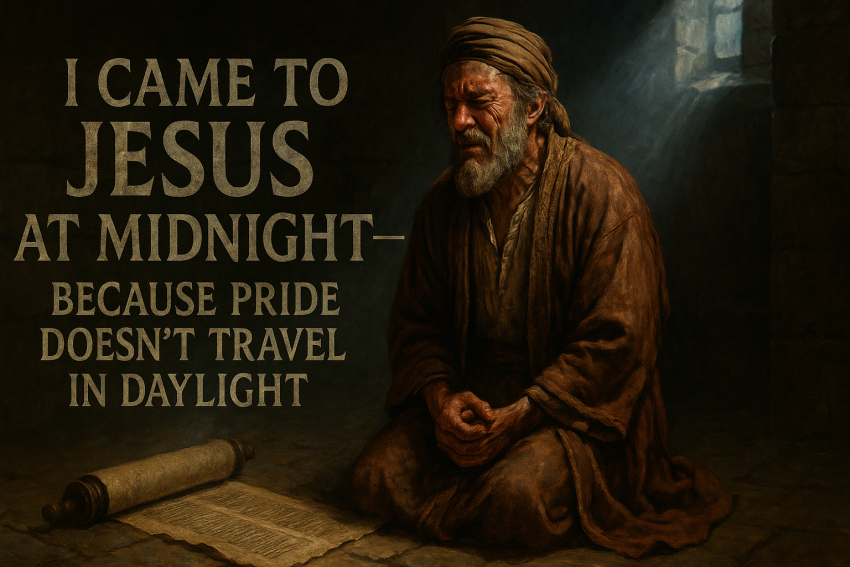
Let me start with something you won’t hear from many men in robes or pulpits: I was terrified. Not of Rome. Not of Herod. Not even of death. I was terrified of being found out — that beneath the tassels and titles, the scrolls and sermons, the respect and reputation… I was empty. Hollow. A polished tomb with nothing but dust inside.
My name is Nicodemus. Yes, that Nicodemus. The Pharisee. The ruler. The teacher of Israel. The man who came to Jesus at night. You’ve heard the story sanitized — turned into a quiet theological chat over tea and incense. Let me tell you what really happened. No stained-glass filters. No Sunday school polish. Just a man — maybe like you — who had everything the world said mattered… and none of what actually did.
You’re here tonight because someone told you this was “safe.” That it was “encouraging.” That it wouldn’t get too personal. I’m sorry to disappoint you. This isn’t safe. And if you’re a man who’s spent your life building a name, protecting an image, controlling outcomes, performing for approval — then this might feel like sandpaper on your soul. Good. It should.
Because eternal life doesn’t come to performers. It comes to paupers. To the ones who finally stop pretending they’ve got it together and admit they’re spiritually bankrupt. And brother — if you’re sitting there with your arms crossed, nodding politely while your heart screams in silence — I was you. And Jesus didn’t come for the put-together. He came for the falling apart.
I was born into privilege. My father was a respected scribe. My grandfather taught Torah to priests. By thirty, I sat on the Sanhedrin — seventy-one men who governed Jewish religious and civil life under Roman occupation. I wasn’t just a teacher; I was the teacher. Young rabbis memorized my commentaries. Synagogues invited me to settle disputes. Mothers whispered to their sons, “Study hard — maybe one day you’ll be like Nicodemus.”
And I ate it up.
Not because I loved power — though I did. Not because I craved influence — though I guarded it fiercely. But because I thought if I could just know enough, teach enough, obey enough, lead enough — I’d finally feel clean inside. Whole. Approved. Not just by men, but by God Himself.
Spoiler: it didn’t work.
By fifty, I could quote every law, trace every genealogy, debate every interpretation from Hillel to Shammai. I fasted twice a week. Tithed down to the mint and cumin. Washed my hands so thoroughly before meals that my skin cracked in winter. I was, by every measurable standard, righteous.
And I was miserable.
I lay awake at night replaying conversations, wondering if I’d said the wrong thing, missed a nuance, failed to cite the right rabbi. I avoided mirrors not out of vanity, but because the eyes staring back felt like strangers — hollow, haunted, hungry for something no scroll could satisfy. I was a man who taught others how to live… and didn’t know how to breathe.
That’s why I went to Him.
Not because I wanted to. Because I had to.
It was after Passover. Jerusalem still smelled of roasted lamb and sweat and smoke. I waited until midnight, when even the beggars slept. Wrapped myself in a plain cloak — no fringes, no insignia. Took back alleys. Avoided torchlight. If anyone saw me heading toward that Rabbi’s rented room in the lower city, my career — maybe my life — would be over.
I knocked. He opened the door like He’d been expecting me.
“Rabbi,” I said, bowing slightly — not too much, not too little. Always calculating. “We know you are a teacher come from God, for no one can do these signs that you do unless God is with him.”
Polite. Respectful. Safe. I’d rehearsed it all the way there. Acknowledge His miracles. Praise His connection to God. Keep it academic. Theological. Distant.
He didn’t blink.
“Truly, truly, I say to you, unless one is born again he cannot see the kingdom of God.”
Just like that. No greeting. No small talk. No “Thank you for coming, honored teacher.” He looked past my title, past my reputation, past my careful words — straight into the rotting core of me — and said: You must start over. From scratch. Like a baby.
I laughed. Not out loud. Inside. A dry, brittle chuckle of disbelief. Surely He misunderstood. Surely He didn’t realize who I was.
“How can a man be born when he is old?” I asked, keeping my voice calm, professorial. “Can he enter a second time into his mother’s womb and be born?”
I meant it as a gentle correction. A nudge back toward reason. Back toward the kind of conversation I excelled at — logic, metaphor, layered meanings. I was giving Him an out. A chance to rephrase, to soften, to theologize.
He didn’t take it.
“Truly, truly, I say to you, unless one is born of water and the Spirit, he cannot enter the kingdom of God. That which is born of the flesh is flesh, and that which is born of the Spirit is spirit.”
Then He looked at me — really looked at me — and dropped the hammer:
“Are you the teacher of Israel and yet you do not understand these things?”
Ouch.
Not “Nicodemus, beloved seeker.” Not “Honored scholar, let me explain.” Just: You. The teacher. And you don’t get it?
It was the most humbling moment of my life. Worse than losing debates. Worse than public mistakes. Worse than failing my own standards. This wasn’t about knowledge. It was about birth. About dependence. About becoming like a child — helpless, trusting, receiving everything as a gift.
And I hated it.
Because children don’t sit on the Sanhedrin.
Children don’t lecture in the temple courts.
Children don’t command respect or build legacies.
Children cry. They ask for help. They admit they don’t know. They receive food they didn’t earn, clothes they didn’t make, love they didn’t deserve.
And I? I was a 50-year-old man who hadn’t cried since my father’s funeral. Who hadn’t asked for help since boyhood. Who measured his worth in citations and followers and flawless performances.
So when He said, “Whoever believes in Him should not perish but have eternal life” — I almost walked out.
Almost.
Because something in me — some buried, starved, suffocating part — recognized truth when it heard it. Even if it shattered everything I’d built my life on.
You want to know what eternal life is? He told me that night. Not in parables. Not in mysteries. In one sentence you’ve probably heard so many times it’s lost its weight:
“For God so loved the world, that he gave his only Son, that whoever believes in him should not perish but have eternal life.”
Not “whoever obeys perfectly.”
Not “whoever teaches brilliantly.”
Not “whoever leads flawlessly.”
Not “whoever gives generously.”
Not “whoever prays fervently.”
Whoever believes.
That’s it.
No résumé required. No moral record to submit. No spiritual achievements to list. Just… believe. Trust. Receive.
And I — the man who could parse Hebrew verbs in my sleep, who could trace lineage from Abraham to Zerubbabel without notes, who could debate purity laws for hours without blinking — couldn’t do it.
Not then.
Because believing meant admitting I was wrong. All of it. Every sermon. Every ruling. Every fast. Every prayer. Every drop of sweat I’d poured into earning God’s favor — worthless. Dust. Ashes.
Believing meant crawling. Not standing. Not teaching. Not leading. Crawling to the foot of a cross I didn’t yet understand, and whispering, “I can’t save myself. Save me.”
And pride doesn’t crawl.
So I left. Not angry. Not argumentative. Just… undone. I walked back through those dark streets feeling like a ghost — visible to others, real to no one, least of all myself.
For three years, I wrestled. I attended His teachings — always in the back, hood pulled low. I argued quietly with fellow Pharisees, defending Him with half-truths: “Does our law judge a man without first giving him a hearing?” (John 7:51). Cowardly words. Carefully chosen. Enough to ease my conscience, not enough to cost me my seat.
I watched as He healed on the Sabbath, forgave sinners, dined with tax collectors, embraced lepers. Each miracle screamed what I refused to say aloud: This is the Messiah. The Son of God. The One Moses wrote about. And each time, I chose silence. Chose safety. Chose my reputation over His glory.
The night they arrested Him, I stayed home. Locked my doors. Pretended I hadn’t heard the commotion. Told myself it wasn’t my place to interfere. That I was preserving my influence for a better time. Lies. All lies. I was preserving my skin. My status. My illusion of control.
When they crucified Him, I watched from a distance — hidden behind a pillar near Golgotha. I saw the blood. Heard the gasps. Smelled the vinegar and sweat and death. And when He cried, “It is finished,” something inside me broke. Not dramatically. Not with tears or shouts. Just… a quiet, irreversible crack — like the sound of a bone snapping under too much weight.
I knew then. Knew beyond doubt. Beyond theology. Beyond debate.
He was who He said He was.
And I had done nothing.
Nothing to defend Him.
Nothing to proclaim Him.
Nothing to honor Him.
Just watched. From the shadows. Like I’d come to Him.
Three days later, when Mary Magdalene ran through the streets screaming, “He’s alive!” — I didn’t believe her. Not because I thought she was lying. Because I thought she was mad. Hope does that to people. Makes them see what isn’t there. Hear what wasn’t said. Believe what can’t be true.
But then Joseph of Arimathea — another secret follower, another coward like me — came to my house. Pale. Shaking. Eyes wild with something between terror and joy.
“They took the stone away,” he whispered. “The tomb is empty. The grave clothes are folded. He’s gone.”
I didn’t speak. Couldn’t. Just followed him to the tomb. Saw it for myself. The massive stone — rolled aside not by human hands, but by an angel (Matthew 28:2). The linen wrappings — lying there, undisturbed, as if a body had simply… evaporated. The head cloth — folded neatly, like a man who’d risen, dressed, and left in peace.
And I wept.
Not the dignified tears of a scholar mourning a great teacher. Ugly, heaving, shoulder-shaking sobs that scared the servants and embarrassed Joseph. I wept for the years wasted. For the pride that kept me silent. For the fear that chained me to shadows. For the Savior I’d studied… but never surrendered to.
That’s why I brought the myrrh and aloes.
Seventy-five pounds of it. More than anyone had ever used for burial. Extravagant. Wasteful. Foolish. Exactly what a broken man would do.
I carried it through the streets of Jerusalem in broad daylight. No hood. No alleyways. No apologies. Let them stare. Let them whisper. Let them revoke my seat on the Sanhedrin. I didn’t care anymore.
Because I was finally doing something real.
Something honest.
Something that cost me.
I helped Joseph wrap His body — cold, pierced, lifeless — in fresh linens soaked with spices. I touched the wounds in His hands. Kissed His forehead. Whispered apologies into His hair. And as the scent of myrrh filled my nostrils — bitter, medicinal, ancient — I realized: this was the smell of my regret. Of my failure. Of my too-late love.
I came to Him at night… but I buried Him in daylight.
And somewhere between the tomb and my home — between the spices and the silence — something shifted. Not because I deserved it. Not because I’d earned it. But because He’d promised it:
“Whoever believes in Him… has eternal life.”
Past tense. Present reality. Not “will have if you behave.” Not “might get if you try harder.” Has. Now. Today.
I believed.
Not with my mind — I’d done that for years.
Not with my lips — I’d quoted Scripture since childhood.
But with my gut. My bones. My broken, bleeding, finally-honest heart.
And just like that — after decades of striving, performing, hiding, calculating — I was born again.
Not improved.
Not reformed.
Not promoted.
Born.
From above.
By the Spirit.
Through faith.
And everything changed.
Not overnight. Not dramatically. But deeply. Irrevocably. I stopped lecturing people on how to please God — because I finally understood I never could. I started telling them about the God who pleases Himself by saving failures like me. I stopped measuring my worth in followers and fame — because I’d finally met the One whose opinion actually mattered. I stopped hiding my doubts, my fears, my questions — because I’d finally learned that eternal life isn’t for the perfect. It’s for the desperate.
Some of you are like I was. Successful on the outside. Dead on the inside. You’ve built empires — of business, of family, of ministry, of morality — and stand atop them like kings… while your souls starve in the basement. You measure your value in productivity, in performance, in praise. You’re terrified someone will find out how empty you feel. How fake you are. How far you’ve drifted from whatever fire once burned in you.
Jesus still says to you what He said to me:
“You must be born again.”
Not “try harder.”
Not “do better.”
Not “clean up your act.”
Be born. Again.
It’s not about knowledge — I had shelves full of it.
It’s not about position — I sat on the highest court in the land.
It’s not about morality — I out-obeyed most Pharisees.
It’s about surrender.
About crawling.
About crying.
About confessing, “I can’t fix this. I can’t earn this. I can’t control this. Save me.”
And here’s the scandalous, beautiful, liberating truth: He will.
Not because you’re ready.
Not because you’re worthy.
Not because you’ve suffered enough or studied enough or served enough.
Because He loves you.
“God so loved the world…”
Not the perfect world.
Not the religious world.
Not the moral world.
The world.
Messy. Broken. Sin-sick. Stinking-of-death world.
And He gave His Son — not to condemn it, but to save it. Not to grade it, but to grace it. Not to demand perfection from it, but to offer resurrection to it.
Whoever believes.
That’s you.
That’s me.
That’s the guy next to you who looks like he’s got it all together — but is dying inside.
Eternal life isn’t a reward for good behavior. It’s a gift for desperate receivers. It’s not the finish line for spiritual athletes. It’s the starting block for spiritual infants. It’s not something you achieve — it’s something you receive. Like breath. Like sunlight. Like a mother’s milk.
You don’t earn it.
You suckle it.
You gasp for it.
You cling to it.
And when you do — when you finally stop performing and start believing — you pass from death to life. Not someday. Not after you die. Now.
I know. I lived it.
I was Israel’s top teacher… and I didn’t know how to live until I became a newborn babe at the foot of the cross.
Don’t make my mistake.
Don’t wait until it’s too late to be real.
Don’t waste years polishing your tomb while your soul rots.
Don’t let pride keep you in the shadows when He’s calling you into light.
Come as you are.
Believe as you are.
Live as you are — reborn, remade, resurrected by grace.
Because “whoever believes in Him…” — yes, even you — “…has eternal life.”
And brother?
That changes everything.
— Nicodemus (formerly of the Sanhedrin, currently of the Kingdom)
Author’s Note:
This isn’t polished. It’s personal. And it’s for you — the man reading this in silence, maybe doubting, maybe angry, maybe just tired of pretending you’ve got this under control.
—
Fifteen years ago, I was mad as hell.
Not at my job. Not at my wife. Not at the world.
At God.
I’d been using smokeless tobacco for over twenty years — every day, multiple times a day. It wasn’t just a habit. It was a ritual. A crutch. A comfort. A silent companion through stress, boredom, anger, celebration — you name it, I popped a pinch for it. I even managed to use tobacco in basic training; I was really good a hiding it.
I knew it was killing me. Knew it was gross. Knew my breath stank, my teeth were yellowing, my gums were receding. Knew the cancer stats. Didn’t care. Or rather — couldn’t stop. And then, outta nowhere, this quiet, stubborn, relentless nudge in my spirit: “Give it up.”
Not a shout. Not a vision. Not a sermon. Just… a whisper that wouldn’t leave me alone. Like a pebble in my shoe during a long march — small, but impossible to ignore.
I fought it. Hard.
Told myself it was legal. Told myself I wasn’t hurting anyone. Told myself I had bigger sins to worry about. Told myself God had better things to do than police my dip can.
But the nudge didn’t back off.
So one Sunday, during a church service — the conviction hit me like a freight train. Jaw clenched. Eyes burning. Heart hammering like I was seconds from throwing a punch; I prayed as I walked out of the church, “You want me to quit? Then YOU take it. Not me. I’ve tried. I’ve failed. I’m done! If this matters to You then You rip it outta me. ‘Cause I can’t. And I won’t pretend I can.” I threw the can I had in the trash as I left the scantuanty.
That prayer wasn’t pretty; Didn’t say “Amen.” Didn’t feel holy. Felt pissed. Betrayed. Like God was asking too much. Like He didn’t understand what this thing meant to me — how it steadied me, numbed me, got me through.
And then?
He took it.
Just like that.
No withdrawal. No cravings. No headaches. No mood swings. No replacement habit. Nothing. Zip. Nada. Clean break. Cold turkey — except I didn’t even feel the cold.
One day I was a guy who couldn’t go three hours.
The next? I didn’t want it.
Didn’t miss it.
Didn’t dream about it.
Didn’t bargain with myself.
Fifteen years. Zero symptoms. Zero relapses. Zero credit to me.
None.
That wasn’t willpower. That wasn’t discipline. That wasn’t me finally “getting serious for God.”
That was Him.
Hearing a bitter, angry, addicted man say, “You want this? Come get it,” — and showing up like a surgeon with a scalpel and zero hesitation. That was my fight. My surrender. My miracle. Yours won’t look like mine.
But the God who showed up for me? He’s standing at your door right now.
Let me be plain — and personal. This isn’t about me. I’ll never know if you read this. I’ll never know your name, your sin, your shame, or the rot you’re hiding behind that strong face you show the world. This is between you — yes, you, the one scrolling at 2 a.m., jaw clenched, eyes hollow, heart like concrete — and Jesus. Nobody else. Not your pastor. Not your wife. Not your small group. Not your accountability partner. Just you. And Him. Standing in the dark. Again. Like Nicodemus. Like every proud, busted, too-smart-for-his-own-good man who finally ran out of places to hide.
It doesn’t matter what you’ve done. Gay? Trans? Murderer? Addict? Cheater? Liar? Porn-sick coward who can’t look his kids in the eye? Doesn’t matter. Not because sin’s no big deal — it’s deadly as hell — but because His blood’s bigger than your mess. You think your sin’s the exception? You think He flinches when He sees your browser history, your bank statements, your texts, your temper, your secret life? Nah. He saw it all before He drove the nails. He knew your name when He gasped on the cross. “Whoever believes” — that’s not a loophole. That’s an open door. Wide enough for the worst of us. Deep enough for the most broken. Strong enough to hold even you.
And listen — this ain’t a quick fix. You won’t wake up tomorrow suddenly pure, patient, peaceful, perfect. That’s not how resurrection works. The stone rolls away fast. The stench? It lingers. The healing? It takes time. The rewiring? It hurts. You’ll still want what you shouldn’t. You’ll still rage when you should rest. You’ll still lie when you should confess. That’s not failure. That’s flesh. And He didn’t save you to perform. He saved you to be remade. Slowly. Painfully. Beautifully. In His time. Not yours. You don’t control the pace. You just surrender the process. Let Him dig in. Let Him break what needs breaking. Let Him replace that cold-ass stone in your chest with something that bleeds, feels, loves, weeps, hopes — something alive.
So stop waiting. Stop pretending you’ve gotta get clean before you come to Him. You don’t. Bring Him the filth. Bring Him the fury. Bring Him the failure. Bring Him the parts of you you’re ashamed to name out loud. He ain’t scared of it. He’s been waiting for you to quit managing your image and start admitting you’re dead inside. Roll away the damn stone. Let the smell out. Let the light hit what’s rotting. Let Him call you by name — not the name on your business card, not the title people use, but the one He whispered when He formed you in the dark: Mine.
You think you’re too far gone? Too hard? Too dirty? Too late?
He specializes in graves.
Now’s the time. Right here. No audience. No witnesses. Just you. And Him.
Say it.
“Jesus… I’m dead. I can’t fix this. Take my stone heart. Give me Yours. I’m Yours.”
Then shut up. And let Him work.
I’ll never know if you did.
But He will.
And that’s all that matters.

Sources
- John 3:1-21 (ESV) – Jesus and Nicodemus
- John 7:50-52 – Nicodemus Defends Jesus Before the Sanhedrin
- John 19:39-40 – Nicodemus Helps Bury Jesus
- Desiring God – “What Does ‘Born Again’ Mean?”
- The Gospel Coalition – “Why Nicodemus Came to Jesus at Night”
- Bible Hub Commentaries – John 3:1-21
- Christianity Today – “The Secret Faith of Nicodemus”
- Ephesians 2:8-9 – Saved by Grace Through Faith
- Ligonier Ministries – “Jesus and Nicodemus”
- Biblical Archaeology Society – The Pharisees in Jesus’ Time
- Crossway – “What Does It Mean to Be Born Again?”
- Authentic Manhood – “When Success Feels Empty”
- Matthew 18:3 – Become Like Children
- 9Marks – “What Is the New Birth?”
- Ray Stedman – “Born Anew” (John 3 Exposition)
Disclaimer:
The views and opinions expressed in this post are solely those of the author. The information provided is based on personal research, experience, and understanding of the subject matter at the time of writing. Readers should consult relevant experts or authorities for specific guidance related to their unique situations.