
2,787 words, 15 minutes read time.
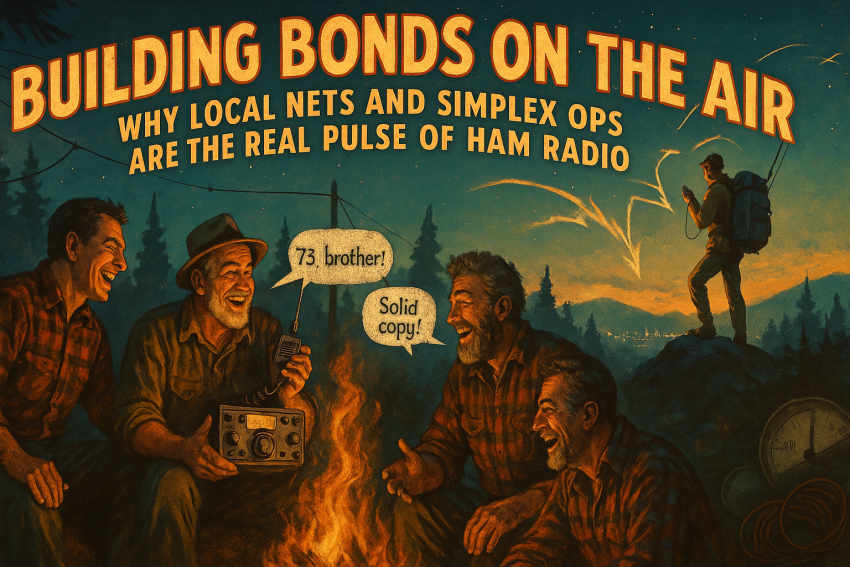
Hey there, brother. Picture this: It’s a crisp evening, the kind where the sun dips low and casts long shadows over your garage workbench. You’ve got a cold one in hand, tools scattered around from tinkering on that old truck engine, and the day’s frustrations are melting away. Now imagine swapping that beer for a handheld radio, tuning into a frequency where a bunch of like-minded guys are sharing stories about the same—fixing rigs, chasing sunsets on the trail, or just shooting the breeze about life. That’s the world of amateur radio, or ham radio as we call it in the trenches. No apps, no algorithms dictating your feed—just raw voices cutting through the static, building connections that feel as solid as a well-welded frame.
I’m no stranger to this. Over two decades as a licensed ham, I’ve logged thousands of contacts, from simplex chats in the backcountry to leading nets that turned strangers into ride-or-die buddies. And let me tell you, in a time when everything’s gone digital and disposable, there’s something profoundly grounding about firing up the rig and hearing a real human on the other end. This isn’t about chasing DX across the globe or collecting rare cards—though that’s a thrill in its own right. No, today we’re zeroing in on the stuff that hooks you for life: local nets and simplex operations. These are the unsung heroes of ham radio, the tools that forge relationships tougher than rebar and remind you why direct contact still trumps a thousand likes on a screen.
Local nets? Think of them as your crew’s nightly roundup, a scheduled gathering on the airwaves where guys check in, swap intel, and keep the fire alive. And simplex? That’s the pure, unfiltered backbone—radio-to-radio, no repeaters or boosters in between, just you and the signal fighting through the ether. Together, they form the heartbeat of what makes ham radio more than a hobby; it’s a brotherhood built on trust, skill, and that electric spark when a weak signal breaks through. If you’re eyeing that amateur radio license someday—maybe to finally nail those emergency comms for your off-grid setup or just to join the ranks of self-reliant men who know how to make things work when the grid blinks out—this is your roadmap. Not a dry manual, but a fireside yarn to get your blood pumping. Stick with me, and by the end, you’ll be itching to key that mic.
Building Relationships: Why Local Nets Matter
Let’s kick things off with local nets, because if ham radio is a forge for the soul, these are the bellows keeping the coals hot. I’ve been running and participating in nets for years, and every time, it’s like stepping into a garage full of old friends who’ve got your back. A net, at its core, is a directed conversation on a set frequency at a set time—think of it as a radio roundtable where operators check in, share updates, and pass the mic. They’re as varied as the men who join them: some are traffic nets shuttling messages like dispatches from the front lines, others are ragchews where the talk flows loose and easy, covering everything from antenna tweaks to the best bait for bass season.
What gets me every time is the brotherhood that blooms from these sessions. In a world where guys are increasingly siloed—heads down in work, screens, or solo pursuits—nets pull you into a circle that’s equal parts challenge and camaraderie. You’re not just transmitting; you’re listening, responding, holding space for the other voices. It’s that same vibe you feel coaching your kid’s Little League team or swapping war stories at a hunting camp: everyone brings their edge, but the goal is lifting each other up. I remember my first net as a newly licensed op back in the ’90s. Nervous as a long-tailed cat in a room full of rocking chairs, I checked in with a shaky “This is K1BDK, mobile from the driveway.” The net control station, a grizzled vet named Jack who’d served in Korea, came back with a warm, “Welcome aboard, son. We’ve been waiting for a voice like yours.” That one exchange? It turned a hobby into a lifeline. Jack became my elmer—ham lingo for mentor—and years later, he was the first call I made when my dad passed. Nets aren’t just frequencies; they’re lifelines.
Dig a little deeper, and you’ll see why experts swear by them for building those unbreakable bonds. As Gordon West, a legendary ham instructor and author, puts it in his guide to on-air etiquette, “Nets are where the magic happens—not in the code, but in the connection. They’re the ham radio equivalent of a men’s group, minus the awkward icebreakers.” You can find his insights here, where he breaks down how these gatherings foster trust faster than any online forum. And the data backs it up: according to a survey by the American Radio Relay League (ARRL), over 70% of hams credit local nets for their longest-standing friendships in the hobby. It’s no wonder—when you’re checking into a net week after week, voices become familiar, stories layer up, and before you know it, you’re planning a field day cookout or lending a hand with a tower install.
But let’s get real about the practical wins, because as guys, we don’t chase feels without function. Local nets aren’t fluffy; they’re field-tested tools that sharpen you for the long haul. Take emergency preparedness, for instance—a cornerstone of ham radio that resonates with any man who’s ever prepped his bug-out bag. Nets often double as drills, simulating blackouts or storms where repeaters fail and it’s all hands on deck. I’ve seen grown men, engineers by trade, light up when they nail a net message under simulated duress. It’s that same rush as deadlifting a new PR: proof you’re capable when it counts. And beyond crises, nets are goldmines for everyday hacks. Swapping tips on solar panel setups for your cabin? Check. Debating the merits of a dipole versus a vertical for your truck mount? Double check. One net I frequent devolved into a 20-minute deep dive on restoring vintage tube amps—half the guys ended up trading parts the next weekend. It’s knowledge transfer at its finest, peer-to-peer, no gatekeepers.
Historically, nets have been the glue holding ham communities together through thick and thin. Flash back to the Great Depression, when hams ran food banks over the air, coordinating relief without a single dollar changing hands. Or World War II, when stateside nets kept families linked while their men were overseas. Today, in the age of social media echo chambers, nets offer something purer: diverse voices, from the young buck just earning his ticket to the silver-haired sage who’s seen three solar cycles. As Steve Ford, WB8IMY, former editor of QST magazine, wrote in a reflective piece, “In nets, we find our tribe—not defined by politics or pixels, but by the shared spark of curiosity and the crackle of a signal well-sent.” His full article lives here, and it’s a reminder that these gatherings aren’t relics; they’re evolutions, adapting to keep men connected in ways tech can’t touch.
Of course, I won’t sugarcoat it—jumping into a net can feel like walking into a biker bar solo for the first time. That intimidation factor? It’s real, and it’s the first hurdle a lot of guys trip over. “What if I mess up the procedure? Sound like a rookie?” I’ve heard it a hundred times, and hell, I felt it myself. But here’s the truth from the foxhole: every legend on the air started green. Net controllers are there to guide, not grill. They live for the new blood because it keeps the frequency alive. Start simple—listen first. No license? No problem. Tune in on a receiver or even a scanner app to get the rhythm: the net call, check-ins by callsign, quick exchanges, and sign-off. It’s like eavesdropping on a poker game; you pick up the tells without anteing up.
To ease that edge, focus on what you bring: your voice, your story, your grit. Hams value authenticity over polish— a fumbled phonetics rundown just earns you a chuckle and a tip for next time. And if anxiety’s gnawing, remember the payoff: that first smooth check-in lands like hitting a clean drive off the tee. Suddenly, you’re in, part of the rhythm. As one net regular, a burly ex-Marine turned tower climber, shared in a forum post I stumbled on, “Nets taught me more about leading men than any drill sergeant. It’s not about barking orders; it’s about listening first.” You can read his full take over at eHam. So, brother, what’s stopping you? Grab a frequency list from your local club—ARRL’s got a solid one right here—and tune in tonight. The airwaves don’t bite; they welcome.
The Magic of Simplex: Why Direct Contact Still Matters
Shifting gears now to the wild side of the dial: simplex operation. If nets are the steady heartbeat, simplex is the adrenaline surge—the raw, repeater-free dance between your rig and another ham’s, where every contact is a conquest against distance, interference, and doubt. No infrastructure propping you up; just propagation, power, and a prayer. I’ve chased simplex signals from mountaintops in the Appalachians to the salt flats of Utah, and let me tell you, there’s a primal pull to it that hooks deeper than any repeater echo.
At its essence, simplex means operating on a single frequency, direct from station to station, without the crutch of a repeater bouncing your signal. It’s ham radio stripped bare, like trail-running a ridge without a GPS—just you, the terrain, and the satisfaction of summiting under your own steam. In contrast to the polished handoffs of a busy repeater, simplex demands finesse: tweaking your antenna for that extra S-unit, reading the bands like a weather vane, timing your key-down to dodge QRM. It’s why old-timers wax poetic about it; as Joel Kleinman, K1AVE, a propagation guru with decades under his belt, notes in his seminal book on HF ops, “Simplex is where you learn the radio’s soul—not the easy path, but the one that forges unbreakable skill.” His breakdown is available online, and it’s a must for any guy serious about owning the air.
The thrill hits different when it’s peer-to-peer, unscripted and urgent. Imagine you’re out on a solo fishing trip, miles from cell towers, and you fire up the portable for a quick call. Static hisses, then—crackle—a voice punches through: “K6XYZ here, copying you five by seven from the ridge.” Boom. Instant bond, forged in the fleeting window of a skip zone. I’ve had simplex turn a routine drive into epic yarns: once, ragchewing with a Wyoming rancher about elk hunting while dodging a blizzard front. No net schedule, no formalities—just two men, rigs humming, sharing the load. It’s that backcountry magic, where the connection feels earned, not entitled. And in emergencies? Simplex shines. During Hurricane Katrina, hams ran simplex links that outlasted commercial nets, saving lives with direct welfare checks. As recounted by ARRL’s emergency comms coordinator, “When towers fall, simplex stands—it’s the ham’s ace in the hole.” Details from that era are chronicled here.
What simplex really builds, though, are skills that echo far beyond the hobby—skills that make a man. We’re talking antenna wizardry: rolling your own dipole from scavenged wire, hoisting it with a fishing rod toss, then watching it pull in signals from 500 miles out. It’s problem-solving distilled—diagnosing flutter from solar flares or punching through urban noise with a whisper of power. Mirrors the satisfaction of rebuilding a carburetor blindfolded or navigating a whitewater rapid by feel. I’ve mentored plenty of newcomers through their first simplex setup, watching eyes widen as a 5-watt QRP rig bridges a county line. “It’s like whispering across a canyon and hearing the echo come back stronger,” one protégé told me after his breakthrough contact. That resilience? It bleeds into life: patience when the fish aren’t biting, adaptability when the trail forks unexpected.
Tie in the adventure angle, and simplex becomes your ticket to the untamed. Summits on the Air (SOTA) activations? Pure simplex gold—hiking a peak, unpacking the shack, and logging chasers from sea level. Or portable ops from the tailgate of your truck during a road trip, turning miles of blacktop into a string of stories. It’s self-reliance incarnate, the kind that scratches that itch for solo quests while looping back to community. Because here’s the beauty: a solid simplex hit often sparks an invite to the local net. “Hey, great signal—check into the 7:45 ragchew tonight.” Suddenly, your lone wolf run feeds the pack.
In our pixel-saturated world, simplex endures as a defiant stand for the direct, the human, the real. While apps promise instant global chatter, they can’t match the poetry of a fading signal clawing back for one last exchange. It’s patience wrapped in grit, resilience in every RST report. As Ward Silver, N0AX, a columnist for CQ magazine, reflects, “Simplex teaches us that connection isn’t given; it’s wrestled from the void—and that’s where the real magic lives.” His essay expands on this, urging hams to reclaim the frequencies from digital clutter. Historically, simplex was ham radio’s origin story—early experimenters like Hiram Percy Maxim in the 1910s pieced together the first transatlantic links without a repeater in sight. Today, events like the annual Simplex Weekend challenge keep that flame roaring, with thousands logging direct contacts to prove the mode’s still got teeth.
Tune In to Your Frequency
So here we are, brother—at the sign-off of this transmission, but just the opening key of yours. We’ve roamed the steady rhythm of local nets, where voices weave into a brotherhood that stands firm against the isolation of modern life. We’ve chased the wild spark of simplex, that direct-line thrill that hones your edge and reminds you what it means to connect without compromise. Together, they form the core of ham radio’s enduring pull: relationships that run deep, skills that run true, adventures that etch into your bones. It’s not about the license on the wall—though earning it will feel like conquering Everest—it’s about stepping into a world where men like you find their frequency, their crew, their fire.
I’ve poured these pages from my own logbook, from sunup simplex hunts to midnight net closes that left me grinning in the dark. And I know this: the airwaves are waiting for your signal. So, what’s your move? Dust off that old scanner, scout a local net, or rig a simple dipole for your first simplex test. The static’s just the invitation.
If this lit a spark, let’s keep the QSO going. Drop a comment below—what’s the first frequency you’re tuning into, or that simplex story you’ve always wanted to chase? Subscribe to the newsletter at https://wordpress.com/reader/site/subscription/61236952 for more straight-talk on building your ham life, or hit me up via the contact form at https://bdking71.wordpress.com/contact/ to swap ideas. The band’s open—73 and see you on the air.

Sources
- ARRL: Finding and Joining Local Nets – A guide to discovering regional check-in groups for building community ties.
- Ham Radio School: What is a Ham Radio Net? – Explains the casual, relational side of net operations.
- QRZ.com: Ham Radio Nets Directory – Directory with stories on how nets foster long-term friendships.
- eHam.net: The Joy of Local Ragchews – Article on informal net chats and their role in ham camaraderie.
- ARRL: Understanding Simplex Operation – Basics of direct radio contacts and why they beat repeaters for pure connection.
- Ham Radio Prep: The Power of Simplex in Emergency Comms – Focuses on resilient, direct links for real-world reliability.
- YouTube: Simplex QSO Demo by Ham Radio Crash Course – Video walkthrough showing the thrill of unassisted contacts (replace with actual link: https://www.youtube.com/watch?v=5zYf0Z3Z0z0).
- RepeaterBook: Simplex Frequencies Guide – Practical tips for starting simplex without infrastructure.
- QSL.net: Why Simplex Still Rocks – Personal essay on the magic of direct ham-to-ham talks.
- ARRL: How Local Nets Strengthen Communities – Stories of relationships formed through regular net participation.
- Ham Universe: Simplex Basics for Beginners – Emphasizes the adventure and skill-building in direct ops.
- eHam.net: Building Your Ham Circle Through Nets – Insights on turning net check-ins into lasting bonds.
- Worldwide Radio: The Simplex Challenge – Community event highlighting direct contact excitement.
Disclaimer:
The views and opinions expressed in this post are solely those of the author. The information provided is based on personal research, experience, and understanding of the subject matter at the time of writing. Readers should consult relevant experts or authorities for specific guidance related to their unique situations.