
2,479 words, 13 minutes read time.
It was just after a summer thunderstorm, the kind that hits fast and hard. I was standing outside, the air still warm but carrying that fresh post-rain scent, and then I saw it—a full rainbow stretching across the sky like some kind of banner. It was beautiful, but more than that, it felt loaded. Like a message hanging there, silent but powerful.
We all know the story of Noah’s Ark. The animals, the flood, the floating zoo—it’s taught to kids in Sunday school and painted in nurseries. But the rainbow? That’s the part grown men tend to brush past, assuming it’s the soft, sentimental ending to a harsh survival tale. We’re wrong.
This symbol in the sky wasn’t meant to be sweet. It was meant to be solemn. God wasn’t just saying, “Never again.” He was hanging up His war bow. That’s right. His weapon. The rainbow is a symbol of divine disarmament—and if you’re a man trying to understand God, judgment, wrath, or grace, this is where it gets real.
God’s War Bow: What the Hebrew Really Says
Genesis 9:13 says, “I have set My bow in the cloud, and it shall be a sign of the covenant between Me and the earth.” Most of us read “bow” and think of a serene rainbow—a beautiful, curved arc of color after a storm. But the original Hebrew word used here is qeshet (קֶשֶׁת)—and that changes everything.
Qeshet does not refer to decoration or optical phenomena. It refers to a literal, physical weapon. A bow of war. This word is used over 75 times in the Old Testament, and in every other instance, it describes a bow used in battle, either for hunting or launching arrows in warfare. Genesis 27:3 speaks of a hunter’s bow (qeshet). In 1 Samuel 18:4, Jonathan gives David his armor and qeshet. In Psalm 18:34, David says, “He trains my hands for battle so that my arms can bend a bow (qeshet) of bronze.” Not once is the word used poetically to mean a rainbow—except in Genesis 9, where the form and placement give it new significance.
Let that sink in for a moment: the word for the rainbow is a weapon. And not a metaphorical one. This wasn’t God putting up stained glass in the sky. This was God declaring, “I am holstering My divine weapon.”
In the world of the ancient Near East, this imagery would’ve been crystal clear. It was common practice for victorious warriors to hang up their weapons as a sign of conquest, peace, or retirement from battle. A suspended bow signaled that the fighting had ended. The gesture was as meaningful as it was visible. To hang a bow, especially in a position of rest, symbolized that the weapon would not be used.
So when God hangs His qeshet in the sky, He is doing something every ancient warrior would have understood intuitively—He’s ending the campaign. Not because He lacks the right to judge, but because He has chosen mercy over destruction. This is not the retreat of weakness; this is the restraint of unimaginable strength. The kind of strength that can destroy but chooses not to.
This act of disarmament is paired with a covenant—a binding, divine promise. In Genesis 9:11, God declares, “Never again will there be a flood to destroy the earth.” It’s a unilateral agreement. God doesn’t require anything from Noah in return. There’s no performance clause, no righteous behavior demanded to maintain the covenant. God simply says: “I will remember.” (Genesis 9:15)
But note this: the restraint is God’s. Not man’s. The covenant isn’t dependent on our goodness. It’s grounded in His decision to hold back judgment.
This is crucial to understand if you’re a man who thinks in terms of consequences, strength, and justice. This isn’t sentimental softness. This is battlefield treaty language. God doesn’t erase His capacity for wrath—He suspends it. And He sets a visible marker in the sky to remind both heaven and earth: the war is paused, and grace reigns.
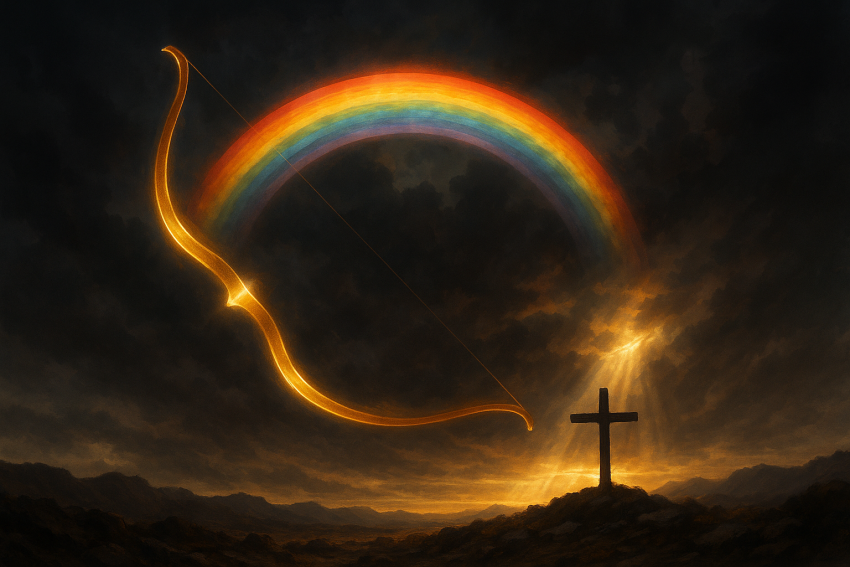
And the symbol? It’s not a dove. It’s not a crown. It’s a weapon turned upward.
That’s the gravity of the moment. That’s the kind of God we’re dealing with. One who makes peace not by hiding His power, but by declaring that He will use it only within the terms of a covenant that He, Himself, will uphold—even at unimaginable cost.
A Skyward Truce: The Bow Aimed at Heaven
Ever really studied the direction of a rainbow? Most people see the arc and think beauty, weather, or luck. But look again. The bow doesn’t point downward toward the earth or outward at humanity. It points upward—toward the heavens. That’s not just artistic flair. It’s divine intent.
The shape matters.
In ancient warfare, the orientation of a warrior’s bow communicated purpose. A bow held level was ready for combat. A bow lowered pointed to surrender. But a bow hung up or arched away from one’s enemy was a sign of peace. Now take that imagery and apply it here: God hangs His bow in the clouds—curved away from the earth, away from His image-bearers—and it bends back toward heaven.
The ancient rabbis, meticulous in their reading of the Torah, noticed this detail. Early Jewish commentaries such as Genesis Rabbah interpret the rainbow as a divine peace gesture, not simply an atmospheric sign. The bow’s position was understood to symbolize God’s restraint and mercy. He wasn’t abandoning His justice. He was choosing to bind it by a covenant of compassion.
But Christian theologians would take it a step further.
The early Church Fathers, including Justin Martyr and Irenaeus, saw the rainbow’s upward arc as profoundly Christological. They read Genesis 9 through the lens of Calvary. To them, the bow not only symbolized divine forbearance—it foreshadowed a future sacrifice. If the weapon pointed anywhere, it pointed at God Himself. And that’s exactly where the arrow of justice would land.
God was saying, in effect, “If this covenant is broken, the consequences fall on Me.”
Centuries later, at a place called Golgotha, they did.
Isaiah 53:5 puts it bluntly: “But He was pierced for our transgressions, He was crushed for our iniquities; the punishment that brought us peace was on Him, and by His wounds we are healed.” The arrow that should’ve struck humanity found its mark in the Son of God. The curved bow of Genesis was drawn taut across history and loosed at the cross.
This isn’t poetic metaphor. It’s substitutionary atonement. It’s theological bedrock. The justice of God wasn’t erased—it was executed. But the target wasn’t you or me. It was Christ.
Let that sit with you.
The rainbow isn’t a symbol of sentiment—it’s a prophetic silhouette of sacrifice. It stands between the flood and the cross, between wrath and redemption. Its very shape bends toward God’s own self-offering. The warrior’s bow was hung not in defeat but in determination: to bear the cost of the covenant Himself.
And that cost was brutal.
The sin of the world didn’t just float away. It was punished. Fully. The bow was pulled back, and the arrow of divine justice flew—piercing not the guilty, but the only innocent One who could take our place.
Noah saw the first sign. We see the fulfillment. The rainbow in the sky pointed toward a hill outside Jerusalem where blood ran down a wooden cross, and God made good on His promise to take the hit.
So next time you look up and see that arc of color, remember what it really is: a warrior’s weapon, turned upward. A holy vow in visible form. A reminder that your peace with God was bought, not bargained for. The wrath has already fallen. The war is over—for those who stand under the covenant sealed in Christ’s blood.
That’s not a myth. That’s the Gospel.
A Warrior’s Covenant for Today’s Men
We live in a culture that hates judgment but longs for justice. We want peace, but we carry private wars in our heads and hearts. Anger. Lust. Pride. Shame. We try to fight these battles on our own—through discipline, distraction, or numbing out—but nothing sticks. And deep down, we know it’s because the war isn’t just internal. It’s spiritual.
The rainbow tells us that God made peace possible. Not by ignoring our failures, but by absorbing the consequences Himself. That’s not weakness. That’s divine masculinity. That’s the heart of a warrior who protects by bearing the blow.
Romans 5:9 says, “Since we have now been justified by His blood, how much more shall we be saved from God’s wrath through Him!” That’s not Hallmark theology. That’s trench-level truth. You don’t have to live your life dodging God’s arrows. They’ve already landed—in Christ.
This is why grace isn’t soft. It’s steel wrapped in mercy. The rainbow doesn’t eliminate judgment; it reveals where judgment has already fallen. It reminds us of what it cost. And if you’ve ever stood in the middle of a wrecked relationship, a shattered habit, or a broken dream, you know exactly how heavy that cost feels. But God doesn’t just acknowledge your wounds—He steps into them. He turns the place of judgment into a place of redemption.
Men live by signs. We look for markers—some evidence that we’re heading the right direction. The rainbow is that kind of sign. It tells you that there’s a covenant bigger than your sin. A covenant secured not by your strength, but by God’s own blood.
A New Identity Under the Covenant
The problem with most of us isn’t that we don’t believe in God. It’s that we don’t believe He could really love us. We nod our heads at grace like it’s some abstract idea, but then spend every day trying to earn what’s already been given. We confuse performance with worth, effort with identity.
The rainbow confronts that head-on. It declares that God isn’t waiting for you to shape up. He’s already staked His love on you before you could even lift a finger.
Titus 3:5 says, “He saved us, not because of righteous things we had done, but because of His mercy.” That mercy isn’t conditional. It’s covenantal. And covenantal love doesn’t wear off.
Think about Noah. He wasn’t a perfect man. He messed up badly after the flood. But God didn’t revoke the bow. He didn’t withdraw the promise. That’s the kind of Father you’ve been offered.
So when shame whispers in your ear, when you feel disqualified from God’s goodness, look up. The bow is still there. The covenant is still in place. You haven’t fallen out of reach—you’ve fallen into grace.
The Rainbow as a Weapon of Peace
It sounds like a contradiction, but it’s not. The rainbow is a weapon transformed. It’s the shape of war turned into the shape of a promise. In Jesus, God takes the tools of judgment and reforges them as instruments of reconciliation.
Colossians 1:20 says, “and through Him to reconcile to Himself all things, whether things on earth or things in heaven, by making peace through His blood, shed on the cross.” That’s not abstract theology—that’s a battle won. The rainbow marks the ceasefire. The cross seals it.
Every man reading this knows what it’s like to be at war inside himself. But the war doesn’t have to define you. You can live under peace. You can stand under the bow and know it won’t be drawn against you.
It’s time to stop fearing God’s judgment and start walking in His mercy. Not because you earned it—but because He promised it.
Next Time You See a Rainbow
The next time you catch a rainbow, don’t just glance and move on. Stop. Really look. Don’t see it as just light bending through raindrops or a pretty arc hanging in the sky. See it for what it truly is: a symbol saturated with meaning—power restrained, wrath redirected, grace unleashed.
That vibrant bow spanning the horizon isn’t just nature’s art. It’s a warrior’s bow, once drawn tight in righteous fury, now unstrung in mercy. The weapon God wielded to judge sin is now hung high, silent but unyielding, reminding us that His wrath was poured out—once and for all—so it wouldn’t have to fall on you or me.
From the first pages of Genesis, where God set that bow in the clouds, to the ultimate fulfillment in the Gospels, where the Son bore the full weight of justice, this arc of color is the Gospel in living form. It’s a vivid narrative told in light and water, a covenant made visible for every generation.
It reaches into your life right now. It speaks louder than your fears, your shame, your doubts. It says you don’t have to earn God’s favor. You don’t have to carry the crushing burden of guilt or try to prove yourself worthy of love. God’s love came first, demonstrated on a cross stained with blood and sealed by an empty tomb.
That rainbow is proof beyond proof—a tangible reminder that God keeps His promises. That His grace is real and relentless. That you are held by a covenant forged not in fleeting human promises, but in divine sacrifice.
So stand tall, brother. Let that bow in the sky remind you of the peace you don’t have to fight for alone. The mercy that’s already been won. The new identity waiting for you to step into.
Because if God disarmed His wrath and hung that bow in the clouds, then you can stand firm, too.
Let’s Talk
If this devotional hit home—or even stirred up questions—I’d love to hear from you. Leave a comment, subscribe to the newsletter, or shoot me a message. Let’s keep the conversation going.
You don’t have to walk this road alone. The covenant is still in the sky. And the cross still speaks louder than the storm.

Sources
- Genesis 9:13 with Commentaries – Sefaria
- Strong’s Concordance: Qeshet – BibleHub
- Why a Rainbow? – Chabad.org
- What is the Rainbow Covenant? – GotQuestions.org
- Rainbow in Judaism – Jewish Virtual Library
- Matthew Henry Commentary on Genesis 9 – Bible Study Tools
- Charles Spurgeon: “The Rainbow – A Covenant Sign”
- Did Jesus Take God’s Wrath? – GotQuestions.org
- The Gospel Coalition: Bow in the Clouds
- John Piper: The Glory of God’s Grace – Desiring God
- BibleProject: The Covenant Theme in Scripture
- God’s Bow in the Sky – Rabbinical Assembly
- The Rainbow: God’s Sign – Ligonier Ministries
- Isaiah 53:5 – BibleGateway
- Romans 5:9 – BibleGateway
Disclaimer:
The views and opinions expressed in this post are solely those of the author. The information provided is based on personal research, experience, and understanding of the subject matter at the time of writing. Readers should consult relevant experts or authorities for specific guidance related to their unique situations.